


Choosing the best Battery Powered Pruning Saw starts with the trees you actually maintain. A small saw may handle dead branches and routine garden trimming, while thicker limbs demand greater cutting capacity. Check the manufacturer’s stated cut size, but treat it as a guide, not a promise. Hard, green, or awkwardly positioned wood can slow a saw more than a neat product specification suggests.
Battery life matters when several trees need attention. Compare the battery’s voltage and amp-hour rating, then check whether the pack works with tools you already own. A spare battery can help, though it adds cost and weight. Feel the saw’s balance, handle shape, and trigger access if you can; a tool that feels manageable in a shop may tire your wrist after repeated cuts. That matters.
Safety features deserve close attention. Look for a chain brake or guard, a secure grip, and clear instructions for tensioning and lubrication. Wear suitable eye and hand protection, and keep other people clear of the cutting area. Maintenance is part of ownership, too: chains need proper tension, and cutting parts eventually wear. A low purchase price may not tell the whole story.
No single model fits every garden. Compare weight, cutting performance, battery compatibility, maintenance needs, and warranty terms against your typical jobs. Reviews can reveal recurring issues, but user experiences vary. The right choice is the saw you can control comfortably and maintain reliably—not simply the one with the biggest battery or boldest claims.
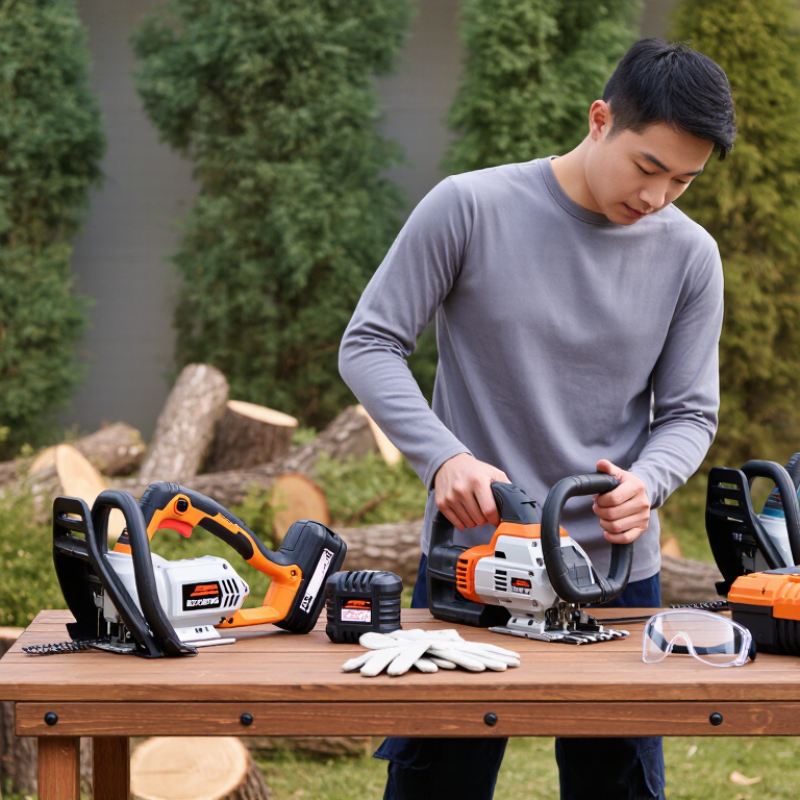
A compact handheld chain saw suits close, controlled cuts on shrubs and small branches. Its short bar is easy to guide around crowded limbs, and the tool is usually lighter than a pole model. Check the cutting capacity in the manual rather than guessing from the saw’s appearance. A thicker branch can pinch the bar or strain the motor. Keep a firm grip, and let the chain reach speed before cutting.
A battery-powered pole saw is designed for branches overhead or beyond comfortable arm’s reach. It reduces the need to climb, but the extended shaft can feel unwieldy, especially near the tip. A branch may shift as it separates. Stand clear of its fall path, and do not cut above your ability to control the tool. Reach is useful. It is not always safer.
A reciprocating pruning saw uses a back-and-forth blade instead of a chain. It can be handy for occasional cuts in tight spaces, though its motion may feel less smooth on larger limbs. Blade choice affects how cleanly it cuts. Consider branch size, working height, tool weight, and battery runtime together. The trade-off is easy to underestimate: a longer reach or faster cut may bring more weight and fatigue. There is no perfect type; the best fit depends on the trees and tasks you actually have.

Assess the branches before comparing saws. A few pencil-thin shoots need a different tool from a dense, wrist-thick limb. Check the saw’s stated cutting capacity, but treat it as a limit, not a daily target. A blade working near its maximum may cut slowly, especially through hard or dry wood. For occasional small cuts, a compact model can be easier to guide between crowded branches. For thicker limbs, look for enough capacity and a comfortable grip that keeps the saw steady. Small limbs are different.
Tips: Measure a representative branch, not just the largest one. Note whether the wood is fresh, dry, or awkwardly angled. Keep cuts within the tool’s rated capacity.
Think about the actual pruning tasks, too. Removing several light branches overhead can make weight and balance more important than maximum cutting size. Trimming a few heavier limbs may call for a longer bar and a battery that lasts through repeated cuts. If branches are tangled, a smaller saw may offer better control in tight spaces. A larger saw is not automatically better. It can feel tiring after repeated overhead work, and that detail is easy to overlook when comparing specifications.
A battery-powered pruning saw should match the branches you actually cut, not just the largest diameter printed on its package. For clean cuts on fresh, narrow limbs, compare cutting speed and how smoothly the chain moves under pressure. Dense or thicker wood can slow a small saw and drain its battery faster. A useful field check is to cut several similar branches, around wrist thickness, and note the time, effort, and cut quality. Look for a steady cut without forcing the tool. Slow down. A rough or pinched cut may reflect technique, blade condition, or wood type—not only motor power.
Battery life depends on more than the amp-hour number. Compare capacity alongside voltage, and check whether the maker states runtime under a clear test condition. A higher-capacity battery may add weight, which matters during overhead work. Charging deserves the same attention: compare the listed recharge time, charger output, and whether a spare battery can keep up with your usual pruning session. If you work in short bursts, a longer charge may be manageable; for a full day, it can become frustrating. These comparisons are not perfect, since branch hardness and cutting habits vary. Still, matching real tasks beats relying on one impressive specification.
Energy values are calculated from nominal voltage × battery capacity. Charging times are ideal estimates for a 2 A charger, calculated as capacity ÷ 2 A; actual charging can take longer. More watt-hours can support more cutting before recharging, but cutting speed and the number of cuts also depend on the saw, blade, wood type, and branch diameter.
Weight affects control, especially when trimming at shoulder height or reaching between branches. Compare the saw’s weight with its battery installed, not just the bare tool. A compact model may feel easier to guide, but a very short handle can make awkward cuts harder. Hold it in a natural working position if you can. A lighter saw is not automatically the safer choice; balance matters too.
Check for a trigger lockout, hand guard, and chain brake, then read the manual to understand how each feature works. These features reduce some risks, but they do not replace protective eyewear, gloves, and secure footing. Look for tool-free chain tensioning and clear oil-level markings. After use, disconnect the battery before cleaning, remove packed sawdust around the bar, and check chain tension as directed. Maintenance is easy to overlook when a cut takes only seconds.
Tips: Choose a saw you can steady without straining. Keep the chain sharp, and inspect it before each session. A dull chain can make cutting slower and less controlled. If a feature feels confusing, pause and check the manual before operating the saw.
Set a firm price range before comparing battery-powered pruning saws. Include the battery and charger in your calculation; some kits include both, while others do not. If you already own compatible batteries, a tool-only option may cost less. Check replacement battery prices too. A low upfront price can become less appealing later.
Match the saw to the branches you actually trim. For a few thin limbs near a patio, a compact model may be easier to control and store. Larger, denser branches call for more cutting capacity, but a heavier saw can tire your wrist quickly. Check the stated cutting capacity and leave some margin. Dry wood can be tougher than a product chart suggests. Real yards are messy. Consider battery runtime, and remember that cold weather or frequent cuts may reduce how long a charge lasts. It is tempting to buy extra power “just in case.” I would pause and weigh that against the added cost and weight. Look for clear safety instructions, a hand guard, and a chain brake, then choose a model you can hold comfortably with eye protection and gloves.
| Yard Need | Typical Saw and Battery | Suitable Branch Size | Typical Kit Budget (USD) | Best For | What to Check Before Buying |
|---|---|---|---|---|---|
| Occasional light pruning | Compact 4–6 in. bar; commonly a 18/20V-class battery system | About 1–3 in. diameter | $70–$160 | Small gardens, shrubs, and a few seasonal cuts on thin branches | Check that the kit includes a battery and charger, and compare the saw’s weight with the battery installed. |
| Regular home-yard maintenance | Mid-size 6–8 in. bar; commonly a 18/20V-class system | About 2–5 in. diameter | $120–$280 | Routine pruning of fruit trees and established garden trees | Look for a chain brake or hand guard, a trigger lock, tool-free chain adjustment if available, and readily available replacement chains. |
| Frequent pruning and thicker limbs | 8–10 in. bar; higher-capacity 18/20V-class or 36/40V-class system | About 3–7 in. diameter, depending on wood and saw capacity | $200–$450 | Larger yards with repeated cuts and occasional thicker branches | Compare battery capacity in amp-hours (Ah), replacement-battery cost, tool weight, and the manufacturer’s stated cutting capacity. |
| Long work sessions | A saw compatible with a battery platform for which you already own spare batteries | Choose the bar length to suit the branch sizes you actually cut | Varies; a bare tool may cost less than a complete kit | Users who need to rotate batteries rather than pause to recharge | Confirm battery compatibility. Voltage alone does not guarantee that batteries from different product lines will fit. |
| Lowest purchase cost | Entry-level compact saw, often sold with a smaller battery | Best kept to thin branches within the stated cutting capacity | About $40–$100 for a bare tool; kits generally cost more | Infrequent, light-duty pruning when a compatible battery is already available | Compare the complete cost, including battery and charger, and check warranty coverage and availability of replacement chains. |
Buying note: Prices are broad US retail estimates and vary by seller, included battery, and seasonal discounts. Branch-size ranges are practical guidelines, not guaranteed cutting capacities; follow the saw manufacturer’s instructions. Wear eye, hearing, hand, and leg protection, and use a stable working position.


For those larger-sized parts, or smaller quantity runs, we have 2 independent powder coat booths and ovens. The quality, durability and affordability of today’s powder coating finishes make this the process of choice for world-class companies.
Powder coating advantages over other forms of coating are many. Materials used in the Powder coating process can be metals and non-metals that come in a multitude of thicknesses, textures, colors, etc. Another of Powder coating’s biggest advantages over conventional coatings is its ability to create finishes in many different textures. Powder Coating Booths allow us the ability to apply these advantages to large products.
Tri-State Fabricators runs a full-service conveyor line for painting. Wet painting can provide protection or decoration to many different part styles. From start to finish, every project is easier to undergo random and point-based inspection by our skilled painting team.
Advantages to our Wet Paint Line are these lines start with product prep and ends with a thorough inspection of a high quality finished product. Our ability to complete large and small projects with a superior finish and doing so in a timely and economical fashion. This passes along the savings in production to our customers. When powder coating ins not an option, our Wet Paint Line gets the job done right the first time.
When the parts get big and heavy we roll-out our custom paint racks and oversize booth. By utilizing our partnerships with all the major paint brands, we can match virtually any color with wet paint.
The advantages of having access to a Wet Paint Booth are many. Large projects of many different shapes can be loaded into the booth. The Wet Paint Booth offers an environment that is much more controlled than a typical parts painting operation.
Not only are they used because of their controlled environment, but they’re are also advantageous when it comes to applying paint to parts that are needed in industries that require specialty coatings such as medical, aerospace, etc.
Our military forces have some very high standards when it comes to the finish of their vehicles and equipment. From the first pre-treatment step to final coat, it takes a great deal of knowledge and experience to protect the men and women of our armed forces. They deserve only the best, and Tri-State Fabricators provides it.
All of our processes are closely monitored by our staff and management teams. Both of which are highly trained in the processes of metal fabrication and finishing. Tri-State Fabricators’ goal is to always fully satisfy each and every customer, including the military. We will always put a 110% into what we do.
Abrasive media blasting is an excellent way to remove old paint, rust, and increase the paint/powder adhesion. Glass beads produce a much smoother and brighter finish than angular abrasives; leaving the part clean yet without any dimensional change. Chemically inert and environmentally friendly, we can recycle our beads approximately 30 times; making them a more preferred method of metal cleaning or surface finishing.
Advantages to Glass Bead Blasting are many. Glass bead blast media is used when a project is needing rough surfaces need to become smooth for applications of coatings such as paint. It is typically used to clean paint and rust from a product surface without deforming the surface it is being used on. Overall, compared to many other blasting media, Glass Bead Blasting is a very economical choice and those savings are always passed on to our customers.
Tri-State Fabricators utilize a zinc phosphate wash to clean and etch the material to ensure the best paint adhesion possible. The unique design of our 3-stage wash system does the work like a 5-stage. From Cleaning and rinsing to conversion coating and post-treatment, Our Part Washing process is a complete service and works throughout the fabrication service and the finishing service.
Along with the previously mentioned benefits, Curing is a vital chemical reaction that leaves the product finish hard and relatively safe from mild abrasion and aggressive corrosion. This process can be done in more than one way; ambient air-dry or in curing ovens at temps that exceed 240°.
From fixing paint mistakes (someone else’s of course) to simply cleaning our paint line hooks, our burn-off oven is put to good use. After a quick burn-off, a little clean up, and a fresh coat of paint, your parts will look better than new.
Why does our Burn-Off Oven work so well? Because super heating the air around parts turns the materials into ashes. From paint and powder coatings to rubber and machining oils, high temps do the job without degrading the integrity of the part.
Masking is a vital part of producing high quality products. We have die-cut masking patterns to protect machined surfaces as well as a wide range of plugs and caps to protect threaded holes and bolts. We provide permanent and temporary masking.
Masking allows the selected sections of a product to be protected from a fabrication or finishing service. This can be with both chemicals when etching and tapes, paints when only finishing just a section of the product. Masking is great in aiding the customization process of a project.
Screen printing is a photographic process that transfers artwork onto a porous nylon screen which allows colored ink to flow through the screen and be deposited on an aluminum or plastic component. We can generally have just about any design created onto a screen for your parts.
Some of the advantages of Screen Printing are, brand recognition for your business displaying on your products, assembly instructions, product warnings/hazards, etc. Tri-State Fabricators produces Screen Printing of the highest quality so you know it’s durable.
Metal Finishing is the art of treating the exterior portion of product, often metal but can also be made of other materials, so that the surface is clean and free of any debris. Then the process of applying coats or either paint of powder coat takes place. This coating process improves the quality of the product in both appearance and resistance to wear and corrosion.
Tri-State Fabricators, Inc., understands that a project typically isn’t complete until a high-quality finish has been added to your product. This is why our painting and powder coating teams continuously inspect the products throughout the Metal Finishing process.

