


How to Choose the Best Automotive Motor Tester?

Choosing the right Automotive Motor Tester begins with the faults you need to find. A small repair shop may need reliable checks for starter motors, alternators, and charging circuits. A specialist workshop may also need waveform analysis, load testing, and detailed data capture. The best choice is not always the model with the largest screen. It is the tester that answers your everyday diagnostic questions accurately, safely, and without slowing down the work. A useful principle, paraphrased from automotive technology author and educator James D. Halderman’s diagnostic approach, is: “Measure the system before replacing a part.” That habit matters.

Look closely at voltage range, current capacity, test modes, lead quality, and compatibility with the vehicles you service. A clear display helps when readings must be checked beside a noisy engine bay. Durable leads matter when tools are used daily, not just during demonstrations. Consider whether the tester stores results or connects to workshop software. Check the manual, calibration guidance, warranty, and available support before buying. Small details count.

Still, a tester cannot replace sound judgment. A low reading may come from a weak battery, a poor connection, or a failing motor. The tool shows evidence; the technician must interpret it. This guide will compare essential features, explain common trade-offs, and help match a tester to real workshop needs. Some specifications look impressive on paper. Their value depends on the jobs you actually perform.
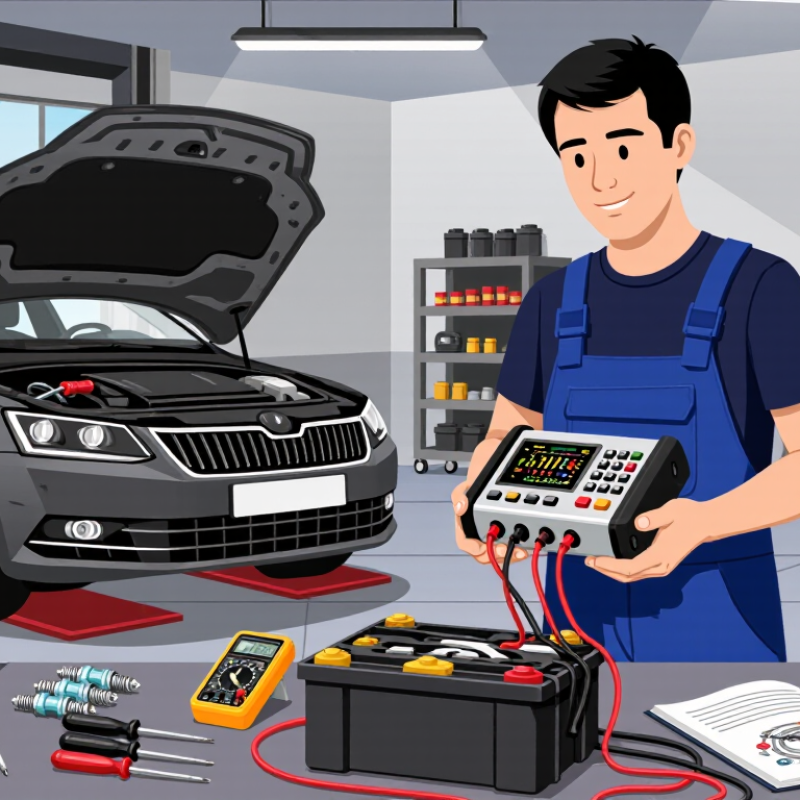
How to Choose the Best Automotive Motor Tester?

Identify Motor Type and Voltage Class: 12 V, 48 V, 400 V, or 800 V

Choosing a motor tester starts with the motor’s voltage class, not the vehicle’s age or size. A 12 V accessory motor may need basic resistance, continuity, and current checks. A 48 V mild-hybrid system calls for equipment rated for that voltage and its switching behavior. Traction motors in 400 V and 800 V vehicles require testers designed for high-voltage circuits, with suitable measurement limits and isolation. Close enough is not good enough.

Motor type matters too. Brushed DC motors, induction motors, and permanent-magnet motors produce different readings and need different test functions. Check the tester’s specifications for supported motor types, voltage range, and measurement method. For example, a resistance check on a disconnected 12 V blower motor is not the same task as assessing an EV traction motor’s phase windings. That distinction is easy to miss.

Before testing, confirm the circuit voltage from service information and inspect the tester leads for damage. Use equipment rated for the system, and follow the vehicle’s shutdown and isolation procedure for high-voltage work. Never assume a tester is suitable just because its display shows a large number. A clear display helps, but it does not prove safe isolation. I have seen voltage labels create false confidence; checking the actual measurement category and limits takes an extra minute.

How to Choose the Best Automotive Motor Tester? — Identify Motor Type and Voltage Class: 12 V, 48 V, 400 V, or 800 V

Voltage class Common automotive applications Typical motor types Tester capabilities to look for Checks and selection considerations Safety considerations
12 V Starter motors, cooling fans, fuel pumps, window lifts, seat adjusters, and other auxiliary loads. Brushed DC motors are common; some auxiliary systems use electronically commutated motors. Low-voltage power and load testing; current measurement; voltage-drop testing; continuity and resistance checks; support for the relevant motor-control electronics where applicable. Check operating current, starting current, supply polarity, connector pinout, and whether the motor is tested directly or through its controller. A basic multimeter alone may not reveal performance under load. Use appropriate fused leads and avoid shorting the battery supply. Follow vehicle procedures when working near high-current starter circuits.
48 V Mild-hybrid systems, belt starter-generators, integrated starter-generators, and higher-power auxiliary systems. Commonly three-phase permanent-magnet synchronous motors or other inverter-driven motor designs; exact configuration varies by vehicle. Testing compatible with the system’s maximum voltage; three-phase winding measurements; current and waveform analysis; communication or inverter diagnostics when supported. Confirm whether the system is a 48 V architecture and identify the motor and inverter separately. Select equipment for the actual maximum operating voltage, not only the nominal class. Although below typical high-voltage traction levels, 48 V systems can deliver hazardous current. Isolate and verify the circuit according to the vehicle service procedure.
400 V class High-voltage traction drive systems in battery-electric and plug-in hybrid vehicles. Usually inverter-driven three-phase permanent-magnet synchronous or induction motors. High-voltage-rated measurement inputs; phase-to-phase and winding-balance checks; suitable insulation-resistance testing for an isolated motor; inverter and position-sensor diagnostics where supported. Verify the tester’s maximum voltage rating, measurement category, leads, and accessories. Determine whether the required test is for the motor, inverter, or complete drive unit; these require different procedures. High-voltage work requires trained personnel, vehicle-specific isolation procedures, and verification of absence of voltage. Disconnect the motor from the inverter before insulation testing unless the manufacturer explicitly permits otherwise.
800 V class Higher-voltage battery-electric traction systems and associated drive units. Typically inverter-driven three-phase permanent-magnet synchronous or induction motors. Equipment and accessories rated for the system’s maximum possible voltage; appropriate high-voltage measurement and insulation-test functions; support for the specific motor and inverter diagnostic requirements. Do not assume an 800 V system operates at exactly 800 V. Check the battery’s voltage range and the manufacturer’s service specifications, then choose a tester with adequate ratings and margin. Use only equipment approved for the intended high-voltage task. Follow lockout, isolation, discharge, and voltage-verification procedures, and observe specified waiting times.

Selection note: Voltage class is only a starting point. Confirm the motor technology, inverter arrangement, maximum system voltage, connector and sensor type, and the vehicle manufacturer’s test procedure. Insulation-test voltage and connection methods must follow the relevant service documentation.


Compare Static, Inverter-Based, and Dynamometer Testing Capabilities

Choosing an automotive motor tester starts with the fault you need to expose, not the feature list. Static testers check winding resistance, insulation, and turn-to-turn integrity with the motor disconnected. They suit incoming inspection and maintenance, but cannot reproduce inverter switching or shaft load. A 2014 U.S. DOE motor-systems market assessment attributes about 68% of U.S. manufacturing electricity use to motor-driven systems. That scale makes repeatable condition checks more than paperwork.

Inverter-based testers apply pulse-width-modulated drive conditions to reveal problems that may appear only with the intended drive, including unusual current, heating, or insulation stress. Match voltage, switching frequency, cable length, and test protocol to the actual setup. IEC 60034-2-1:2014 defines motor-loss and efficiency test methods; treat it as guidance, not an application-specific limit.

Dynamometers measure torque and speed under controlled load, revealing output power, efficiency, and thermal behavior across operating points. They are valuable for validation, but fixtures, cooling, and setup time can complicate routine shop use. A practical arrangement combines static screening with inverter testing, then uses a dynamometer for performance questions. Limits matter. I would question a clean static result when a motor fails only at high speed. Bench conditions can hide the real fault.

Check Measurement Traceability Against ISO/IEC 17025 Calibration Practices

A motor tester is only as trustworthy as its measurement chain. Check that its calibration certificate identifies the instrument, measured functions, ranges, results, and uncertainty. ISO/IEC 17025:2017 requires laboratories to establish metrological traceability and report relevant uncertainty. NIST’s Policy on Metrological Traceability also stresses that traceability belongs to a measurement result, not simply to a device. Ask for calibration from a laboratory whose accredited scope covers the tester’s actual functions, such as voltage, current, resistance, or frequency. A certificate for voltage alone does not validate every function.

Look closely at uncertainty near your pass/fail limits. ANSI/NCSL Z540.3 uses a 4:1 test-uncertainty ratio as a common benchmark for measurement decisions, though the required ratio depends on risk and the agreed decision rule. NIST Technical Note 1297 explains that expanded uncertainty is often reported with coverage factor k=2, corresponding to roughly 95% coverage under stated assumptions. Read the certificate’s uncertainty and coverage notes, not just its “pass” stamp. That stamp can hide useful detail. On a workshop bench, a small probe slip or unstable ground can also distort readings; calibration cannot correct poor setup. Ask how often recalibration is needed, and review drift records before choosing an interval. Real use is messier. A tidy certificate is helpful, but it is not the whole measurement story.

Verify Efficiency and Loss Testing to IEC 60034-2-1

Choosing an automotive motor tester means checking more than its display range. Verify that its efficiency and loss-testing procedures align with IEC 60034-2-1 and suit the motor type under evaluation. The standard describes methods for determining losses and efficiency in rotating electrical machines. A useful tester should document the selected method, measured quantities, corrections, and test conditions.

Look for synchronized voltage, current, power, speed, and torque measurements. During a test, small timing differences can distort the power balance. Temperature matters, too: winding resistance changes as a motor warms. Ask whether the system records winding or ambient temperature and explains how corrections are applied. Clear uncertainty statements help engineers judge whether a reported efficiency difference is meaningful. No instrument removes every source of error.

Check the practical details. Can the tester capture stable readings across the expected speed and load range? Does its report separate measured values from calculated losses? A well-organized report might show input power, shaft output, and the loss components used to calculate efficiency. That makes a result easier to review later. Even a capable tester can mislead if sensors are poorly installed or calibration is overdue. I would not choose by headline accuracy alone; test method, setup, and traceable calibration deserve equal attention.

Assess Electrical Safety for High-Voltage EV Motor Testing

Selecting an automotive motor tester for an electric vehicle starts with the voltage and test method, not the display. High-voltage systems can retain charge after shutdown. Follow the vehicle’s service procedure, isolate the circuit, and allow the specified discharge time. Then verify zero voltage with a meter rated for the system and test environment. Check the meter on a known source before and after the measurement. Test, verify, then proceed.

Choose equipment with suitable voltage and measurement-category ratings, intact leads, finger guards, and clearly documented limits. Use the required protective equipment and insulated tools, and keep the work area dry and controlled.

For insulation testing, disconnect the motor from power electronics when the service procedure requires it; an unsuitable test voltage can damage connected components. Never treat a tester’s warning light as proof that a circuit is safe.

Small details matter: a cracked probe tip or damp glove changes the risk. The checklist can feel slow, and it is easy to rush when a vehicle is waiting. That is exactly when a pause and a second reading may prevent a serious mistake.

If the setup or readings are unclear, stop and consult qualified service guidance before continuing.

Powder Coat Booths

For those larger-sized parts, or smaller quantity runs, we have 2 independent powder coat booths and ovens. The quality, durability and affordability of today’s powder coating finishes make this the process of choice for world-class companies.

Powder coating advantages over other forms of coating are many. Materials used in the Powder coating process can be metals and non-metals that come in a multitude of thicknesses, textures, colors, etc. Another of Powder coating’s biggest advantages over conventional coatings is its ability to create finishes in many different textures. Powder Coating Booths allow us the ability to apply these advantages to large products.

Wet Paint Line

Tri-State Fabricators runs a full-service conveyor line for painting. Wet painting can provide protection or decoration to many different part styles. From start to finish, every project is easier to undergo random and point-based inspection by our skilled painting team.

Advantages to our Wet Paint Line are these lines start with product prep and ends with a thorough inspection of a high quality finished product. Our ability to complete large and small projects with a superior finish and doing so in a timely and economical fashion. This passes along the savings in production to our customers. When powder coating ins not an option, our Wet Paint Line gets the job done right the first time.

Wet Paint Booths

When the parts get big and heavy we roll-out our custom paint racks and oversize booth. By utilizing our partnerships with all the major paint brands, we can match virtually any color with wet paint.

The advantages of having access to a Wet Paint Booth are many. Large projects of many different shapes can be loaded into the booth. The Wet Paint Booth offers an environment that is much more controlled than a typical parts painting operation.

Not only are they used because of their controlled environment, but they’re are also advantageous when it comes to applying paint to parts that are needed in industries that require specialty coatings such as medical, aerospace, etc.

Military CARC

Our military forces have some very high standards when it comes to the finish of their vehicles and equipment. From the first pre-treatment step to final coat, it takes a great deal of knowledge and experience to protect the men and women of our armed forces. They deserve only the best, and Tri-State Fabricators provides it.

All of our processes are closely monitored by our staff and management teams. Both of which are highly trained in the processes of metal fabrication and finishing. Tri-State Fabricators’ goal is to always fully satisfy each and every customer, including the military. We will always put a 110% into what we do.

Glass-Bead Blasting

Abrasive media blasting is an excellent way to remove old paint, rust, and increase the paint/powder adhesion. Glass beads produce a much smoother and brighter finish than angular abrasives; leaving the part clean yet without any dimensional change. Chemically inert and environmentally friendly, we can recycle our beads approximately 30 times; making them a more preferred method of metal cleaning or surface finishing.

Advantages to Glass Bead Blasting are many. Glass bead blast media is used when a project is needing rough surfaces need to become smooth for applications of coatings such as paint. It is typically used to clean paint and rust from a product surface without deforming the surface it is being used on. Overall, compared to many other blasting media, Glass Bead Blasting is a very economical choice and those savings are always passed on to our customers.

Part Washing

Tri-State Fabricators utilize a zinc phosphate wash to clean and etch the material to ensure the best paint adhesion possible. The unique design of our 3-stage wash system does the work like a 5-stage. From Cleaning and rinsing to conversion coating and post-treatment, Our Part Washing process is a complete service and works throughout the fabrication service and the finishing service.

Along with the previously mentioned benefits, Curing is a vital chemical reaction that leaves the product finish hard and relatively safe from mild abrasion and aggressive corrosion. This process can be done in more than one way; ambient air-dry or in curing ovens at temps that exceed 240°.

Burn-Off Oven

From fixing paint mistakes (someone else’s of course) to simply cleaning our paint line hooks, our burn-off oven is put to good use. After a quick burn-off, a little clean up, and a fresh coat of paint, your parts will look better than new.

Why does our Burn-Off Oven work so well? Because super heating the air around parts turns the materials into ashes. From paint and powder coatings to rubber and machining oils, high temps do the job without degrading the integrity of the part.

Masking

Masking is a vital part of producing high quality products. We have die-cut masking patterns to protect machined surfaces as well as a wide range of plugs and caps to protect threaded holes and bolts. We provide permanent and temporary masking.

Masking allows the selected sections of a product to be protected from a fabrication or finishing service. This can be with both chemicals when etching and tapes, paints when only finishing just a section of the product. Masking is great in aiding the customization process of a project.

Screen Printing

Screen printing is a photographic process that transfers artwork onto a porous nylon screen which allows colored ink to flow through the screen and be deposited on an aluminum or plastic component. We can generally have just about any design created onto a screen for your parts.

Some of the advantages of Screen Printing are, brand recognition for your business displaying on your products, assembly instructions, product warnings/hazards, etc. Tri-State Fabricators produces Screen Printing of the highest quality so you know it’s durable.

Metal Finishing

Metal Finishing is the art of treating the exterior portion of product, often metal but can also be made of other materials, so that the surface is clean and free of any debris. Then the process of applying coats or either paint of powder coat takes place. This coating process improves the quality of the product in both appearance and resistance to wear and corrosion.

Tri-State Fabricators, Inc., understands that a project typically isn’t complete until a high-quality finish has been added to your product. This is why our painting and powder coating teams continuously inspect the products throughout the Metal Finishing process.
