


How to Choose the Best Automotive Battery Tester

A weak battery can turn a routine morning into a long wait beside a silent car. The right Automotive Battery Tester helps you check battery condition before replacing parts or calling for assistance. Yet choosing one is not as simple as comparing screen size or price. Different testers use different methods, and not every model suits every vehicle.

A useful tester should match your battery’s chemistry and rated cold-cranking amps (CCA). It should also explain results clearly, rather than displaying numbers without context. Some models measure voltage; others use conductance or apply a controlled load. Each method has limits. That matters. A low reading may reflect a discharged battery, cold weather, or poor terminal contact—not necessarily a failed battery. Not always.

This guide looks at practical features: supported battery types, CCA range, test functions, display readability, and ease of use. It also considers whether the instructions make sense when you are working in a dim garage with gloves on. Accuracy claims deserve careful attention, too; compare them with the manufacturer’s specifications and testing guidance. A tester cannot repair a battery or replace a professional diagnosis when symptoms persist. Still, a well-matched tool can provide useful evidence and help you make a more informed decision. Even experienced owners can misread a result, so the best choice is one that makes its limits clear.
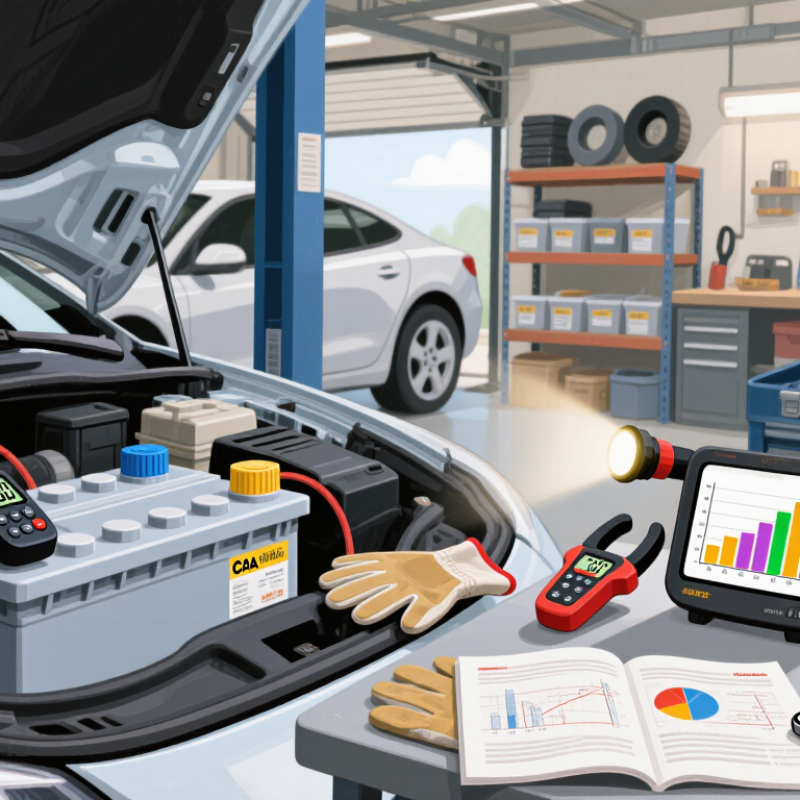
How to Choose the Best Automotive Battery Tester

Understand What an Automotive Battery Tester Measures

An automotive battery tester does more than display a green light. It estimates whether the battery can deliver starting power and how much charge remains. Most modern testers assess voltage and use conductance to estimate internal resistance and cold-cranking amps (CCA). Conductance is an estimate, not a direct test of the battery’s full capacity.

SAE J537 defines a standardized cold-cranking test at −18°C: a 12-volt battery must sustain its specified current for 30 seconds while staying above 7.2 volts. A handheld tester does not recreate that laboratory test; it estimates performance from measured electrical behavior. That distinction matters. Compare the displayed CCA with the rating printed on the battery, and enter the correct battery type when prompted.

Voltage gives a different clue. Battery Council International technical guidance places a fully charged, rested lead-acid battery near 12.6–12.8 volts; around 12.2 volts suggests a substantially discharged battery. Readings can shift after driving, charging, or temperature changes. A tester may also report state of health, but that figure is an algorithmic estimate, not a direct measurement. Numbers need context. If results look borderline, charge the battery, let it rest, and test again; a weak connection can distort the reading too.


Identify Your Battery Type and Vehicle Requirements

Before choosing an automotive battery tester, identify the battery chemistry and voltage. Most passenger vehicles use 12-volt lead-acid batteries, but some have AGM or EFB batteries, especially vehicles with stop-start systems. A tester must support the battery type; the wrong setting can produce misleading results. Check the battery label and vehicle manual for its rated cold-cranking amps (CCA) and rating standard. A faded label is easy to misread, so verify the numbers before testing.

Tips: Match the tester’s CCA range to your battery. Check whether it can test the charging system, too. Keep the battery terminals clean.

Consider how and where you will use the tester. A compact conductance tester is convenient for quick checks, while a load tester applies a heavier electrical demand and may need more careful handling. Confirm that the tester supports your vehicle’s voltage and battery location, particularly if access is awkward. Some vehicles have batteries in the trunk or under a seat. If your car uses a less common battery chemistry, confirm compatibility in the tester’s instructions rather than guessing. A result is only useful when the settings and battery details are correct.

Compare Tester Types, Functions, and Specifications

How to Choose the Best Automotive Battery Tester

Compare Tester Types, Functions, and Specifications

A digital voltmeter checks resting voltage, but it cannot reliably show how a battery performs under load. Conductance testers estimate cranking ability quickly, making them useful in a busy workshop or driveway. Carbon-pile load testers apply a real electrical load and reveal voltage drop, though they require more care and time. SAE J537 specifies a cold-cranking test at -18°C for 30 seconds; its 7.2-volt endpoint offers a useful reference for a 12-volt battery. That is a controlled test, not a promise that every handheld tester reproduces laboratory conditions.

Check that the tester supports your battery’s chemistry, such as flooded, AGM, or EFB, and accepts the battery’s stated CCA rating. The rating standard matters: SAE, EN, and DIN values are not interchangeable. Look for clear charging-state and health results, temperature compensation, reverse-polarity protection, and a usable clamp design. A printer or saved test record can help track a weak battery over time. Still, one reading can mislead. A discharged battery may test poorly, while a loose terminal can mimic battery trouble. Charge and retest when needed. A tester is a guide, not a complete diagnosis.

Assess Safety, Ease of Use, and Result Accuracy

A good automotive battery tester should protect both the user and the vehicle. Look for insulated clamps, clear polarity markings, and protection against reversed connections. Work with the ignition off, keep metal tools away from battery terminals, and use eye protection. If the battery is damaged, leaking, or swollen, do not test it yourself; seek qualified help. Safety comes first.

Ease of use matters on a cold morning or in a dim garage. A readable screen, flexible leads, and simple prompts make it easier to connect the clamps correctly. The tester should let you select the battery type and rated capacity, such as AGM or standard lead-acid. Check that its instructions explain the steps plainly. Small details matter. A short cable can make a cramped engine bay frustrating, even when the device itself seems simple.

For useful results, match the tester settings to the battery label and follow its guidance on charge level and temperature. A weakly charged battery may show a poor result even if it is not permanently failing. Some testers estimate condition through conductance; others apply a load. Neither number should be treated as the whole story. Still, a neat digital reading can be misleading. If readings seem inconsistent, clean the terminals, secure the clamps, and test again. Compare the result with symptoms such as slow cranking, and consult a technician when uncertainty remains.

Select a Tester That Fits Your Budget and Testing Needs

How to Choose the Best Automotive Battery Tester

Select a Tester That Fits Your Budget and Testing Needs

For occasional checks at home, a simple digital meter can show battery voltage. It cannot confirm whether a battery will start an engine under load. That difference matters. If you diagnose vehicles regularly, consider a tester that checks starting performance and charging-system output. Look for support for your battery’s chemistry, voltage, and rated CCA. A low-cost tool may cover basic checks, but it can leave you guessing when a battery acts inconsistently.

Pay for features you will actually use. A clear screen, sturdy clamps, and readable results are useful in a dim garage. Some testers save results or provide printouts, but those extras may not justify the cost for occasional use. Check that the instructions explain test conditions and result limits. Battery temperature and recent charging can affect readings, so even a capable tester needs careful use. It is easy to overvalue a precise-looking number.

Tips: Match the tester to the battery label before buying. Keep the clamps clean, follow the stated connection order, and compare results with the vehicle’s manual. If readings seem uncertain, repeat the test after the battery rests.

How to Choose the Best Automotive Battery Tester - Select a Tester That Fits Your Budget and Testing Needs

Tester Type Typical Price (USD) What It Measures Battery Compatibility Best For Key Limitations What to Check Before Buying
Digital voltmeter $10–$40 Battery voltage; some models also show charging-system voltage. Suitable for checking voltage on common 12-volt vehicle batteries. Budget-conscious owners who want a quick voltage check or basic charging-system check. Voltage alone cannot reliably determine remaining capacity, cold-cranking ability, or overall battery health. Look for clear voltage readings, protected probes, and a measurement range suitable for automotive use.
Conductance battery tester $40–$150 Estimates starting capability from the battery’s electrical response; many models also report voltage and a pass, recharge, or replace result. Often supports common flooded lead-acid, AGM, and sometimes EFB batteries; exact support varies by model. Home mechanics and small workshops that need quick, repeatable battery checks with little battery discharge. Results depend on correct battery type and rating entry. It is not a substitute for every capacity or reserve-capacity test. Confirm supported battery chemistries, rating standards (such as CCA or EN), rating range, and whether the tester checks the vehicle’s charging system.
Carbon-pile load tester $50–$180 Applies a controlled electrical load and observes battery voltage under load. Commonly used with 12-volt lead-acid starting batteries; follow the tester’s voltage and capacity limits. Experienced users who want a direct load test and are comfortable following a timed test procedure. Draws substantial current and can generate heat. Incorrect test duration, load, or connections can cause unsafe results or damage. Check the maximum test current, duty cycle, cable and clamp quality, safety instructions, and supported battery range.
Professional battery and system analyzer $150–$600+ Typically combines battery assessment with starter and alternator checks; some models store or print test reports. May support multiple 12-volt lead-acid types, including AGM and EFB. Verify compatibility for each battery type and vehicle system. Repair shops, fleet operators, and users who test many vehicles or need documented results. Costs more, and advanced features may be unnecessary for occasional personal use. Features differ substantially between models. Compare supported chemistries and rating standards, test functions, result storage, update requirements, and warranty terms.

Buying tip: Choose a tester that supports your battery’s chemistry and rating standard. Price ranges are approximate USD estimates and vary by features and region. A fully charged battery and clean, secure connections help produce more meaningful test results.

Powder Coat Booths

For those larger-sized parts, or smaller quantity runs, we have 2 independent powder coat booths and ovens. The quality, durability and affordability of today’s powder coating finishes make this the process of choice for world-class companies.

Powder coating advantages over other forms of coating are many. Materials used in the Powder coating process can be metals and non-metals that come in a multitude of thicknesses, textures, colors, etc. Another of Powder coating’s biggest advantages over conventional coatings is its ability to create finishes in many different textures. Powder Coating Booths allow us the ability to apply these advantages to large products.

Wet Paint Line

Tri-State Fabricators runs a full-service conveyor line for painting. Wet painting can provide protection or decoration to many different part styles. From start to finish, every project is easier to undergo random and point-based inspection by our skilled painting team.

Advantages to our Wet Paint Line are these lines start with product prep and ends with a thorough inspection of a high quality finished product. Our ability to complete large and small projects with a superior finish and doing so in a timely and economical fashion. This passes along the savings in production to our customers. When powder coating ins not an option, our Wet Paint Line gets the job done right the first time.

Wet Paint Booths

When the parts get big and heavy we roll-out our custom paint racks and oversize booth. By utilizing our partnerships with all the major paint brands, we can match virtually any color with wet paint.

The advantages of having access to a Wet Paint Booth are many. Large projects of many different shapes can be loaded into the booth. The Wet Paint Booth offers an environment that is much more controlled than a typical parts painting operation.

Not only are they used because of their controlled environment, but they’re are also advantageous when it comes to applying paint to parts that are needed in industries that require specialty coatings such as medical, aerospace, etc.

Military CARC

Our military forces have some very high standards when it comes to the finish of their vehicles and equipment. From the first pre-treatment step to final coat, it takes a great deal of knowledge and experience to protect the men and women of our armed forces. They deserve only the best, and Tri-State Fabricators provides it.

All of our processes are closely monitored by our staff and management teams. Both of which are highly trained in the processes of metal fabrication and finishing. Tri-State Fabricators’ goal is to always fully satisfy each and every customer, including the military. We will always put a 110% into what we do.

Glass-Bead Blasting

Abrasive media blasting is an excellent way to remove old paint, rust, and increase the paint/powder adhesion. Glass beads produce a much smoother and brighter finish than angular abrasives; leaving the part clean yet without any dimensional change. Chemically inert and environmentally friendly, we can recycle our beads approximately 30 times; making them a more preferred method of metal cleaning or surface finishing.

Advantages to Glass Bead Blasting are many. Glass bead blast media is used when a project is needing rough surfaces need to become smooth for applications of coatings such as paint. It is typically used to clean paint and rust from a product surface without deforming the surface it is being used on. Overall, compared to many other blasting media, Glass Bead Blasting is a very economical choice and those savings are always passed on to our customers.

Part Washing

Tri-State Fabricators utilize a zinc phosphate wash to clean and etch the material to ensure the best paint adhesion possible. The unique design of our 3-stage wash system does the work like a 5-stage. From Cleaning and rinsing to conversion coating and post-treatment, Our Part Washing process is a complete service and works throughout the fabrication service and the finishing service.

Along with the previously mentioned benefits, Curing is a vital chemical reaction that leaves the product finish hard and relatively safe from mild abrasion and aggressive corrosion. This process can be done in more than one way; ambient air-dry or in curing ovens at temps that exceed 240°.

Burn-Off Oven

From fixing paint mistakes (someone else’s of course) to simply cleaning our paint line hooks, our burn-off oven is put to good use. After a quick burn-off, a little clean up, and a fresh coat of paint, your parts will look better than new.

Why does our Burn-Off Oven work so well? Because super heating the air around parts turns the materials into ashes. From paint and powder coatings to rubber and machining oils, high temps do the job without degrading the integrity of the part.

Masking

Masking is a vital part of producing high quality products. We have die-cut masking patterns to protect machined surfaces as well as a wide range of plugs and caps to protect threaded holes and bolts. We provide permanent and temporary masking.

Masking allows the selected sections of a product to be protected from a fabrication or finishing service. This can be with both chemicals when etching and tapes, paints when only finishing just a section of the product. Masking is great in aiding the customization process of a project.

Screen Printing

Screen printing is a photographic process that transfers artwork onto a porous nylon screen which allows colored ink to flow through the screen and be deposited on an aluminum or plastic component. We can generally have just about any design created onto a screen for your parts.

Some of the advantages of Screen Printing are, brand recognition for your business displaying on your products, assembly instructions, product warnings/hazards, etc. Tri-State Fabricators produces Screen Printing of the highest quality so you know it’s durable.

Metal Finishing

Metal Finishing is the art of treating the exterior portion of product, often metal but can also be made of other materials, so that the surface is clean and free of any debris. Then the process of applying coats or either paint of powder coat takes place. This coating process improves the quality of the product in both appearance and resistance to wear and corrosion.

Tri-State Fabricators, Inc., understands that a project typically isn’t complete until a high-quality finish has been added to your product. This is why our painting and powder coating teams continuously inspect the products throughout the Metal Finishing process.
