


How to Choose the Best Aluminum Frying Pan Supplier?

Choosing the best Aluminum Frying Pan supplier requires more than comparing prices or polished product photographs. A reliable decision begins with material knowledge, factory evidence, and practical testing. Harold McGee, a respected food-science authority, explains, “Aluminum is a good conductor of heat, but it is also reactive.” This observation matters when evaluating pan construction, surface treatment, and food-contact safety.

Ask suppliers about alloy grades, wall thickness, base design, handle attachment, and coating performance. Request samples before placing a large order. Heat the pan on different burners and inspect the handle after repeated use. Watch for uneven browning, loose rivets, sharp edges, or coating bubbles. Small defects become expensive complaints.

Look closely at the factory, not only the catalog.

A dependable supplier should provide consistent dimensions, batch records, inspection procedures, and clear packaging specifications. Third-party testing can strengthen confidence, especially for coating durability and food-contact requirements. However, certificates alone are not enough. Visit the production line when possible, or request recent inspection videos and independent reports.

Communication also reveals experience. Does the supplier answer technical questions directly? Can they explain their acceptable defect rate? Do they offer replacement support when a shipment fails inspection?

The cheapest quotation may hide thin material, unstable coatings, or weak quality control. Still, premium pricing does not guarantee excellence. I would not pretend that every supplier can satisfy every market. Your cookware style, order volume, target users, and delivery expectations must guide the choice. The best partnership is measurable, transparent, and tested before commitment.
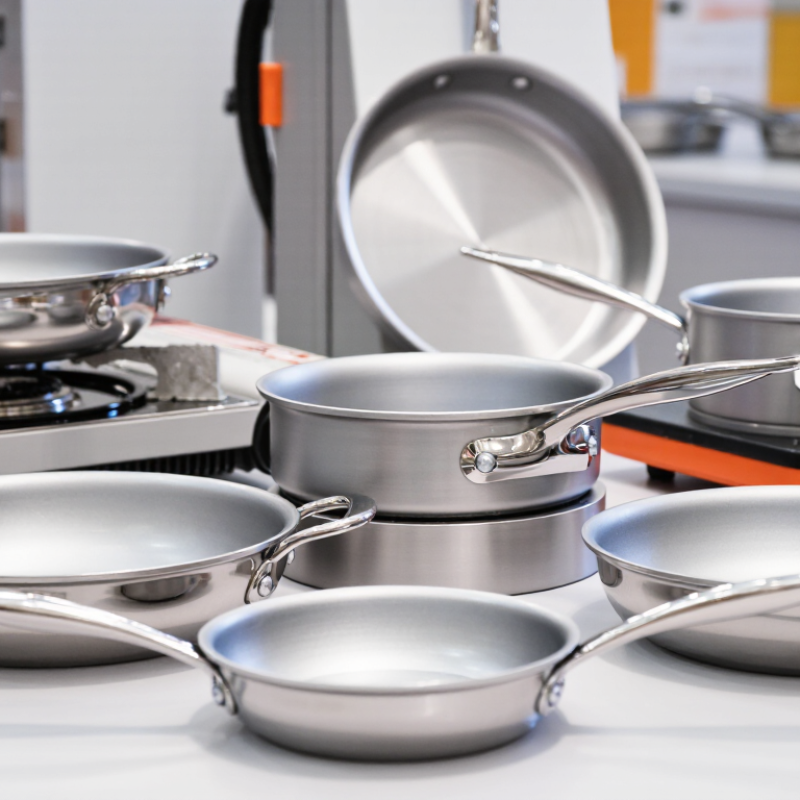
How to Choose the Best Aluminum Frying Pan Supplier?

Defining Your Aluminum Frying Pan Supplier Requirements

Defining Your Aluminum Frying Pan Supplier Requirements

When defining requirements, start with cooking performance, not catalog appearance. Specify the aluminum alloy, pan thickness, base design, handle attachment, and coating system. A 3-millimeter body may offer better heat stability than a thinner body, but it can increase shipping weight. Do not accept “food grade” as a complete specification. Request coating composition, adhesion results, abrasion testing, and temperature limits. That detail matters.

The International Aluminium Institute’s Aluminium Statistical Review 2024 recorded about 70.6 million tonnes of global primary aluminum production in 2023. Its industry pathway report also identifies aluminum production as responsible for roughly 2% of global greenhouse-gas emissions. Therefore, supplier requirements should include recycled-content claims, energy data, and traceable material certificates. Ask for batch numbers, inspection records, and corrective-action reports. Vague sustainability language is not enough.

Set measurable commercial limits. Define minimum order quantity, sample approval stages, monthly capacity, lead-time tolerance, packaging strength, and replacement procedures. A factory should explain how it controls warping, uneven coating, and loose handles. Request production samples from different batches. One sample can look perfect by chance. The checklist is not perfect. Buyers may also overvalue a low price and underestimate delayed deliveries. A stronger evaluation compares total landed cost, verified quality, and communication speed.


Evaluating Materials, Manufacturing Standards, and Product Quality

Choosing an aluminum frying pan supplier starts with the alloy, not the logo. Ask for the exact grade, temper, thickness, and material certificate. Common cookware alloys should offer consistent heat transfer, adequate strength, and safe food-contact performance. The International Aluminium Institute’s 2024 Global Aluminium Cycle report states that nearly 75% of all aluminum ever produced remains in use. That durability depends on material quality and responsible processing.

Manufacturing standards reveal more than attractive samples. Check whether the factory operates under ISO 9001 quality controls and follows recognized specifications, such as ASTM B209 for aluminum sheet and plate. Request records for rolling, stamping, heat treatment, coating, and final inspection. A reliable supplier should measure pan flatness, base thickness, handle strength, and coating adhesion. Small defects matter. A slightly warped base may create uneven heating on a glass cooktop. It is easy to miss.

Product testing should include repeated heating, dishwasher exposure, abrasion, and food-contact migration checks. Ask for independent laboratory reports, not only internal claims. The OECD’s due diligence guidance also supports traceable supplier records and documented risk controls across supply chains. Still, no checklist is perfect. I would inspect production samples personally, compare three batches, and test the pan after use. Certificates can age. Even a polished sample may hide inconsistent riveting or thin edges. Quality becomes credible when measured results repeat.

Comparing Supplier Certifications, Capacity, and Customization Options

How to Choose the Best Aluminum Frying Pan Supplier?

Comparing Supplier Certifications, Capacity, and Customization Options

A supplier’s certificate should be more than a framed document. Ask for its issuing body, validity dates, and covered production site. Confirm that food-contact testing matches your intended market and pan materials. ISO 9001 can indicate controlled processes, but it does not guarantee perfect cookware. Request batch records, material traceability, and recent inspection reports. I have found that clear answers matter more than impressive paperwork. Some suppliers hesitate here. That hesitation deserves attention.

Capacity should be checked on the factory floor, not only in a sales presentation. Ask about monthly output, press equipment, coating lines, and quality-control staff. Compare normal lead times with peak-season schedules. A supplier may produce 50,000 pans monthly, yet lack space for your order. Request a sample production plan. Include tooling, inspection, packaging, and shipment dates. Visit the facility when possible. Photos can hide bottlenecks.

Customization often reveals the supplier’s real technical ability. Discuss aluminum alloy, pan thickness, base shape, handle design, coating system, and packaging requirements. Ask whether the factory can prepare drawings and prototypes internally. Clarify mold ownership, minimum order quantities, and revision costs. Test samples under heat, abrasion, and handle-load conditions. Do not trust one attractive sample. I once focused too heavily on appearance and overlooked uneven heating. That mistake was expensive. A strong supplier welcomes documented testing and honest criticism.

How to Choose the Best Aluminum Frying Pan Supplier?

Use this weighted evaluation framework to compare anonymous suppliers. Certifications verify management and food-contact controls, capacity supports stable supply, and customization determines product flexibility.

Recommended evaluation weighting: certifications and compliance 35%, production capacity 30%, customization capability 20%, and quality consistency 15%.

Assessing Pricing, Minimum Orders, Shipping, and Customer Support

Choosing an aluminum frying pan supplier requires more than comparing unit prices. Aluminum costs fluctuate, and the World Bank Pink Sheet tracks these changes monthly. Request a quotation with alloy grade, coating, handle, packaging, and tooling costs listed separately. A cheap pan can become expensive after inspection and rework.

Minimum order quantity deserves equal attention. A supplier may offer a lower price at 5,000 pieces, but your storage space may support only 1,000. Ask for tiered pricing and a pilot order. Include sample approval and defect replacement terms. I would not trust a spreadsheet that ignores damaged cartons or slow-moving inventory.

Shipping terms also change the real cost. UNCTAD’s Review of Maritime Transport reports that ships carry over 80% of global merchandise trade by volume. Request the port, Incoterm, transit estimate, and insurance responsibility in writing. The World Bank’s 2023 Logistics Performance Index compares 139 economies across customs, infrastructure, and delivery reliability. Use it as a screening tool, not a final verdict. Customer support matters after the deposit is paid. Test response speed with technical questions, request inspection records, and confirm who handles coating failures. Fast replies feel reassuring. They are not proof. One overlooked detail can still delay a container.

How to Choose the Best Aluminum Frying Pan Supplier? - Assessing Pricing, Minimum Orders, Shipping, and Customer Support
Evaluation Dimension Typical Market Benchmark What to Verify Recommended Target Risk Indicator Suggested Score Weight
Unit Pricing Approximately USD 4–18 per aluminum frying pan for standard wholesale models, depending on diameter, coating, handle, and order volume. Confirm whether the quotation includes the pan body, non-stick coating, handle, packaging, inspection, and export documentation. Request tiered pricing for 100, 500, 1,000, and 5,000 units. Very low prices may indicate thinner aluminum, lower-grade coatings, simplified packaging, or excluded charges. 20%
Minimum Order Quantity Stock or catalog products may start at approximately 50–300 units; customized products commonly require 500–3,000 units. Ask whether the MOQ applies per model, size, color, coating, or packaging design. Choose a supplier with an MOQ that matches forecast demand and available storage capacity. A high MOQ can increase inventory costs and create excess stock if the product sells slowly. 15%
Aluminum Material Common cookware bodies use aluminum alloys selected for formability, heat conduction, and corrosion resistance; exact alloy grades vary by design. Request the declared alloy grade, material thickness, inspection standard, and test documentation. Use a documented material specification with agreed thickness tolerances and surface requirements. Unclear material specifications can lead to warping, uneven heating, or inconsistent production batches. 15%
Non-Stick Coating Coating systems vary by construction and use case. Performance depends on coating layers, application process, curing, and substrate preparation. Verify food-contact compliance documents, coating type, abrasion testing method, temperature guidance, and batch traceability. Require a pre-production sample and written acceptance criteria for adhesion, appearance, and release performance. Unverified coating claims or missing test reports increase food-safety and durability risks. 15%
Product Sizes and Compatibility Common frying pan diameters include approximately 20 cm, 24 cm, 26 cm, and 28 cm, although available sizes differ by supplier. Check base diameter, wall height, weight, handle attachment, lid compatibility, and suitability for gas, electric, or induction cooking. Select sizes that match the target market and clearly define compatible cooktops. Incorrect base dimensions or unclear compatibility information can cause product returns. 10%
Production Lead Time Standard stocked items may ship in approximately 7–20 days; customized production commonly takes 30–60 days after approval. Confirm sample approval time, production time, packaging preparation, inspection time, and holiday-related delays. Obtain a written production schedule with milestone dates and delay-notification procedures. Unclear lead times can disrupt promotions, seasonal launches, and retail replenishment. 10%
Shipping and Delivery Transit times vary by route and method. International ocean freight commonly takes several weeks, while air shipment is faster but more expensive. Compare EXW, FOB, CIF, and DDP quotations, and confirm carton dimensions, gross weight, port of loading, and insurance responsibility. Evaluate total landed cost rather than product price alone. Low product prices may be offset by high freight, customs, handling, or destination charges. 10%
Quality Control Reliable cookware production typically uses incoming-material checks, in-process inspections, final inspection, and packaging verification. Ask for the inspection checklist, sampling plan, defect classifications, corrective-action process, and inspection records. Use an agreed pre-shipment inspection standard and retain approval samples. Suppliers that cannot explain inspection procedures may deliver inconsistent quality. 10%
Customer Support Professional export suppliers generally provide a dedicated contact, quotation follow-up, order updates, and after-sales communication. Measure response speed, technical knowledge, documentation quality, language capability, and issue-resolution process. Prefer written replies within one business day and documented corrective actions for defects. Slow or unclear communication often creates delays during sampling, production, and claims handling. 5%
Practical selection method: Score each potential supplier from 1 to 5 for every dimension, multiply each score by the corresponding weight, and compare the total result. Pricing and MOQ should be evaluated together with landed cost, material documentation, coating compliance, quality control, delivery reliability, and customer support.

Selecting the Supplier Through Samples, Audits, and Contract Review

Choosing an aluminum frying pan supplier requires more than comparing prices. A supplier’s catalog is only a starting point. Request samples made with the proposed alloy, thickness, coating, and handle design. Do not rush this. Check the pan’s weight, flatness, rim finishing, and handle strength by hand. Heat the pan gradually and inspect for uneven heating, warping, discoloration, or coating damage. Ask whether the sample came from normal production, not a specially prepared batch. A polished sample can hide process weaknesses.

Supplier audits provide stronger evidence than sales claims. Review production capacity, incoming material checks, coating controls, and final inspection records. Confirm that measuring equipment is calibrated and quality issues are traceable by batch. Walk through storage areas, packaging stations, and corrective-action files. Clean floors are helpful, but consistent records matter more. A sample can pass while a later batch changes. That risk is easy to underestimate.

Contract review should convert observations into measurable obligations. Define alloy grade, thickness tolerance, coating performance, dimensions, packaging, labeling, and acceptable defect limits. Include pre-shipment inspection rights, reporting timelines, replacement procedures, and approval requirements for material or process changes. Lead times and payment conditions also need clear wording. Have qualified counsel review the agreement before signing, especially where international delivery is involved. One weakness remains: buyers sometimes document product specifications carefully but leave corrective actions vague. That gap can become expensive after production begins.

Powder Coat Booths

For those larger-sized parts, or smaller quantity runs, we have 2 independent powder coat booths and ovens. The quality, durability and affordability of today’s powder coating finishes make this the process of choice for world-class companies.

Powder coating advantages over other forms of coating are many. Materials used in the Powder coating process can be metals and non-metals that come in a multitude of thicknesses, textures, colors, etc. Another of Powder coating’s biggest advantages over conventional coatings is its ability to create finishes in many different textures. Powder Coating Booths allow us the ability to apply these advantages to large products.

Wet Paint Line

Tri-State Fabricators runs a full-service conveyor line for painting. Wet painting can provide protection or decoration to many different part styles. From start to finish, every project is easier to undergo random and point-based inspection by our skilled painting team.

Advantages to our Wet Paint Line are these lines start with product prep and ends with a thorough inspection of a high quality finished product. Our ability to complete large and small projects with a superior finish and doing so in a timely and economical fashion. This passes along the savings in production to our customers. When powder coating ins not an option, our Wet Paint Line gets the job done right the first time.

Wet Paint Booths

When the parts get big and heavy we roll-out our custom paint racks and oversize booth. By utilizing our partnerships with all the major paint brands, we can match virtually any color with wet paint.

The advantages of having access to a Wet Paint Booth are many. Large projects of many different shapes can be loaded into the booth. The Wet Paint Booth offers an environment that is much more controlled than a typical parts painting operation.

Not only are they used because of their controlled environment, but they’re are also advantageous when it comes to applying paint to parts that are needed in industries that require specialty coatings such as medical, aerospace, etc.

Military CARC

Our military forces have some very high standards when it comes to the finish of their vehicles and equipment. From the first pre-treatment step to final coat, it takes a great deal of knowledge and experience to protect the men and women of our armed forces. They deserve only the best, and Tri-State Fabricators provides it.

All of our processes are closely monitored by our staff and management teams. Both of which are highly trained in the processes of metal fabrication and finishing. Tri-State Fabricators’ goal is to always fully satisfy each and every customer, including the military. We will always put a 110% into what we do.

Glass-Bead Blasting

Abrasive media blasting is an excellent way to remove old paint, rust, and increase the paint/powder adhesion. Glass beads produce a much smoother and brighter finish than angular abrasives; leaving the part clean yet without any dimensional change. Chemically inert and environmentally friendly, we can recycle our beads approximately 30 times; making them a more preferred method of metal cleaning or surface finishing.

Advantages to Glass Bead Blasting are many. Glass bead blast media is used when a project is needing rough surfaces need to become smooth for applications of coatings such as paint. It is typically used to clean paint and rust from a product surface without deforming the surface it is being used on. Overall, compared to many other blasting media, Glass Bead Blasting is a very economical choice and those savings are always passed on to our customers.

Part Washing

Tri-State Fabricators utilize a zinc phosphate wash to clean and etch the material to ensure the best paint adhesion possible. The unique design of our 3-stage wash system does the work like a 5-stage. From Cleaning and rinsing to conversion coating and post-treatment, Our Part Washing process is a complete service and works throughout the fabrication service and the finishing service.

Along with the previously mentioned benefits, Curing is a vital chemical reaction that leaves the product finish hard and relatively safe from mild abrasion and aggressive corrosion. This process can be done in more than one way; ambient air-dry or in curing ovens at temps that exceed 240°.

Burn-Off Oven

From fixing paint mistakes (someone else’s of course) to simply cleaning our paint line hooks, our burn-off oven is put to good use. After a quick burn-off, a little clean up, and a fresh coat of paint, your parts will look better than new.

Why does our Burn-Off Oven work so well? Because super heating the air around parts turns the materials into ashes. From paint and powder coatings to rubber and machining oils, high temps do the job without degrading the integrity of the part.

Masking

Masking is a vital part of producing high quality products. We have die-cut masking patterns to protect machined surfaces as well as a wide range of plugs and caps to protect threaded holes and bolts. We provide permanent and temporary masking.

Masking allows the selected sections of a product to be protected from a fabrication or finishing service. This can be with both chemicals when etching and tapes, paints when only finishing just a section of the product. Masking is great in aiding the customization process of a project.

Screen Printing

Screen printing is a photographic process that transfers artwork onto a porous nylon screen which allows colored ink to flow through the screen and be deposited on an aluminum or plastic component. We can generally have just about any design created onto a screen for your parts.

Some of the advantages of Screen Printing are, brand recognition for your business displaying on your products, assembly instructions, product warnings/hazards, etc. Tri-State Fabricators produces Screen Printing of the highest quality so you know it’s durable.

Metal Finishing

Metal Finishing is the art of treating the exterior portion of product, often metal but can also be made of other materials, so that the surface is clean and free of any debris. Then the process of applying coats or either paint of powder coat takes place. This coating process improves the quality of the product in both appearance and resistance to wear and corrosion.

Tri-State Fabricators, Inc., understands that a project typically isn’t complete until a high-quality finish has been added to your product. This is why our painting and powder coating teams continuously inspect the products throughout the Metal Finishing process.
