How to Choose a Silicone Cookie Spatula for Bulk Orders

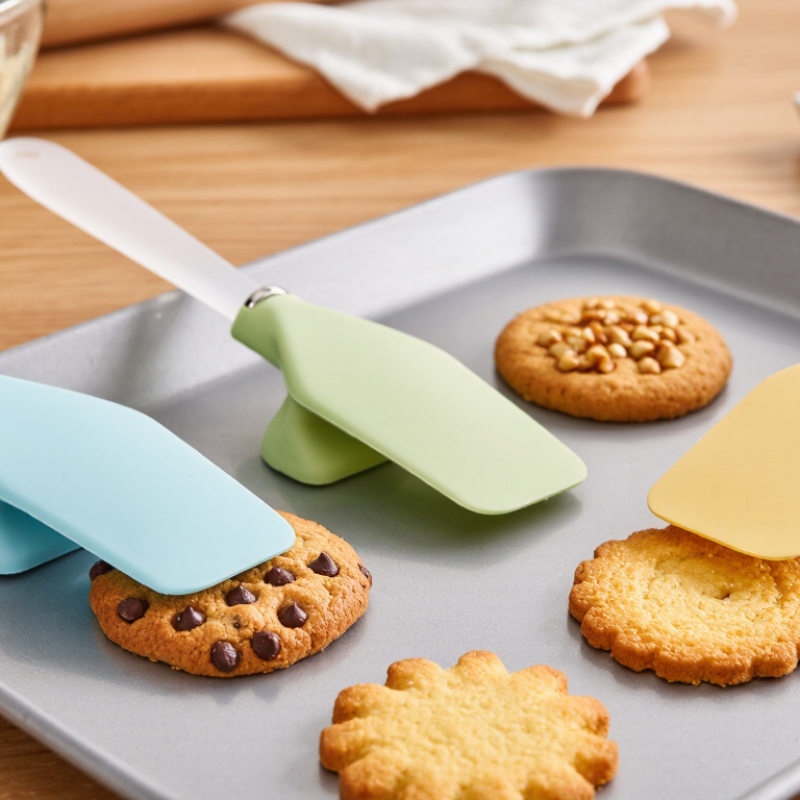
A Silicone Cookie Spatula can look convincing in a product photo yet struggle beneath a warm, delicate cookie. For bulk buyers, that difference can mean broken batches, customer complaints, and inventory that moves slowly. Details matter. A thin, tapered edge should slide under cookies without tearing their centers or scraping the baking surface. The head also needs enough support to lift a large cookie without folding. Choosing well means balancing flexibility, construction, documented material suitability, and the actual needs of your customers.

Start your evaluation with samples that reflect the exact materials and construction proposed for production. Test them on soft chocolate chip cookies, crisp butter cookies, and heavier cookies loaded with nuts. Check the handle joint for movement and inspect seams where dough or wash water could collect. Ask suppliers for food-contact compliance documentation relevant to your destination market, with clear identification of the tested material or product. A stated heat rating needs supporting evidence and clear use conditions. Claims need checking. Dishwasher suitability, odor retention, and handle comfort deserve attention too, especially when the spatula will see repeated daily use.

Bulk purchasing also brings practical questions about minimum quantities, packaging dimensions, lead times, and inspection criteria. A lower unit price may lose its appeal if oversized cartons increase freight costs or inconsistent edges cause returns. There is no perfect specification for every buyer, and an attractive sample cannot establish consistency across an entire shipment. Even a useful cookie test has limits. Use those findings to define measurable requirements, then agree on how production quality will be checked before shipment.
How to Choose a Silicone Cookie Spatula for Bulk Orders

Understanding Silicone Cookie Spatula Types and Uses

Silicone cookie spatulas serve different tasks, so bulk orders should match actual baking routines.

Thin, flexible turners slide beneath delicate cookies with less pressure on fragile edges. Wider heads support larger cookies, while narrow heads fit crowded trays. Scraper spatulas handle dough and bowl cleanup, but thick edges can struggle beneath baked cookies.

Shape matters. For purchasing specifications, record head width, edge thickness, handle length, and flexibility instead of relying on product names.

Material documentation deserves equal attention. Germany’s Federal Institute for Risk Assessment, in Recommendation XV on silicones, specifies a 0.5% limit for volatile organic components. This technical benchmark helps buyers assess documentation; it does not establish a spatula’s heat resistance or lifting performance.

Request testing that covers the finished utensil and its intended food-contact conditions. A seamless design also removes the head-to-handle joint where dough can collect. Still, seamless construction alone cannot prove durability.

Tips:

  • Request samples with different head widths, then test them on your usual trays.
  • Try warm, soft cookies and fully cooled batches. Check edge damage.
  • A wider head may improve support, yet make closely spaced cookies harder to reach. That tradeoff deserves testing.
  • For bulk approval, document sample dimensions and acceptable flex so later shipments can be checked against concrete requirements.

Defining Size, Flexibility, and Heat Resistance Requirements

For bulk orders, define blade dimensions around your actual cookies, trays, and packaging. A blade roughly 60–75 mm wide offers a practical starting point for testing medium cookies. Measure usable width. An oversized blade can crowd neighboring cookies on tightly packed trays. A narrow blade may leave soft cookies unsupported, increasing breakage during transfer. Specify handle length, too, especially when staff must reach across deep baking trays.

Flexibility needs a measurable purchasing specification, rather than descriptions such as “soft” or “professional.” Request samples with different blade thicknesses and compare them using the same cookie recipe. Test warm cookies. A thin edge should slide underneath without dragging, while the center should support the cookie during lifting. Greater flexibility is not always better; an overly soft blade may fold under a thick cookie. The ideal stiffness remains partly subjective, so record staff feedback alongside visible damage. An initial sample choice may need revision after a busy production shift.

Tips: Set heat resistance requirements from actual contact conditions, including hot trays and repeated washing. Ask suppliers for documented temperature limits, permitted contact duration, and relevant food-contact compliance evidence for your intended market. A maximum temperature alone does not establish suitability for prolonged contact. Inspect samples after repeated use for warping, cracks, or separation around any internal reinforcement. Include agreed dimensions, stiffness references, and acceptance criteria in the order specification. Keep one approved sample for comparison when the shipment arrives.

Evaluating Food Contact Safety, Materials, and Durability

A silicone cookie spatula for bulk orders needs more than a “food-grade” label. Ask for food-contact compliance documentation covering the finished utensil, including its pigments, for your intended sales market. Check the details. Reports should identify the tested product, laboratory, test conditions, and relevant requirements, rather than simply describe a generic silicone material. For hot cookies, confirm suitability for repeated contact with fatty foods at the temperatures your customers will actually encounter. A temperature claim alone does not establish food-contact safety.

Material quality affects both handling and service life. Request silicone specifications, reinforcement details, and information about how the head attaches to the handle. One-piece construction can reduce food-trapping seams, although an internal core may still create weak spots if molding quality varies. A thin edge should slide beneath a cookie without folding under its weight. Test actual cookies. A broad head may support large cookies well but feel clumsy when lifting small, closely spaced batches.

Before approving production, compare several samples through repeated lifting, gentle twisting, and dishwasher cycles if dishwasher suitability is claimed. Inspect the edge for tears, the handle for movement, and the surface for tackiness or persistent odor. Odor can flag a concern, but its absence cannot prove safety. Record sample weights, dimensions, and visible defects to establish practical acceptance limits. A few successful trials are reassuring; they cannot reliably predict years of use. Retain an approved sample and specify inspection criteria for incoming shipments.

Comparing Bulk Pricing, Minimum Orders, and Customization Options

Bulk pricing for silicone cookie spatulas depends on quantity, packaging, and customization. Request quotes for 500, 1,000, and 3,000 units using identical specifications. Compare landed costs, including freight, duties, and setup fees. A lower unit price may disappear after individual boxes and logo charges are added. Check the fine print. Ask whether minimum order quantities apply per color, design, or total shipment. A 1,000-piece minimum becomes restrictive when each color requires a separate order.

Customization options can include molded logos, printed handles, custom colors, and retail sleeves. Ask suppliers to quote each option separately. Molded details may require tooling fees, while printed logos need durability checks. Request samples made with the proposed silicone formulation and handle construction. For small cookies, compare blade widths around 5–7 centimeters against your actual baking trays. Check flexibility, edge thickness, and handle grip. Request food-contact documentation relevant to your sales market, plus evidence supporting any advertised heat-resistance claim.

Tips: Approve a physical sample before authorizing production, especially when matching colors or checking logo placement. Photos hide flaws. Record acceptable color variation, packaging details, and delivery dates in the purchase agreement. A cheaper sample may feel adequate initially but prove awkward when lifting delicate cookies. Sample checks have limits, though. They cannot guarantee consistency across thousands of pieces, so agree on inspection criteria and defect remedies before paying a deposit.


Verifying Samples, Supplier Quality Controls, and Delivery Terms

A bulk silicone cookie spatula order should begin with samples that match the proposed production materials and dimensions.

Test them on warm cookies, cooled biscuits, and a crowded baking tray. Check the edge. A thick lip may push soft cookies instead of lifting them cleanly.

  • Measure blade width, handle length, and weight against your specification sheet.
  • Bend the neck repeatedly and inspect the handle joint for gaps.

One successful baking session proves little; repeated washing may reveal looseness or lingering odors.

Ask suppliers how they inspect incoming silicone, monitor molding, and separate rejected pieces. Request recent inspection records with batch numbers, dates, and measurable acceptance limits. Photographs alone are insufficient.

For food contact documentation, confirm that reports cover the relevant material, intended conditions, and destination market requirements. An unrelated laboratory report offers little reassurance.

Agree on acceptable flash, surface marks, color variation, and handle alignment before production. Keep an approved sample. Small cosmetic flaws may be acceptable, but sharp molding residue deserves closer attention.

Delivery terms should specify quantity tolerances, packaging, inspection timing, and responsibility for damaged or missing goods. Put these details in writing before paying a deposit.

Separate production lead time from transit time, and identify the event that starts each period. A quoted shipping date can still leave customs clearance and local delivery unresolved.

For seasonal orders, build in a realistic buffer and document the process for reporting defects after arrival.

Powder Coat Booths

For those larger-sized parts, or smaller quantity runs, we have 2 independent powder coat booths and ovens. The quality, durability and affordability of today’s powder coating finishes make this the process of choice for world-class companies.

Powder coating advantages over other forms of coating are many. Materials used in the Powder coating process can be metals and non-metals that come in a multitude of thicknesses, textures, colors, etc. Another of Powder coating’s biggest advantages over conventional coatings is its ability to create finishes in many different textures. Powder Coating Booths allow us the ability to apply these advantages to large products.

Wet Paint Line

Tri-State Fabricators runs a full-service conveyor line for painting. Wet painting can provide protection or decoration to many different part styles. From start to finish, every project is easier to undergo random and point-based inspection by our skilled painting team.

Advantages to our Wet Paint Line are these lines start with product prep and ends with a thorough inspection of a high quality finished product. Our ability to complete large and small projects with a superior finish and doing so in a timely and economical fashion. This passes along the savings in production to our customers. When powder coating ins not an option, our Wet Paint Line gets the job done right the first time.

Wet Paint Booths

When the parts get big and heavy we roll-out our custom paint racks and oversize booth. By utilizing our partnerships with all the major paint brands, we can match virtually any color with wet paint.

The advantages of having access to a Wet Paint Booth are many. Large projects of many different shapes can be loaded into the booth. The Wet Paint Booth offers an environment that is much more controlled than a typical parts painting operation.

Not only are they used because of their controlled environment, but they’re are also advantageous when it comes to applying paint to parts that are needed in industries that require specialty coatings such as medical, aerospace, etc.

Military CARC

Our military forces have some very high standards when it comes to the finish of their vehicles and equipment. From the first pre-treatment step to final coat, it takes a great deal of knowledge and experience to protect the men and women of our armed forces. They deserve only the best, and Tri-State Fabricators provides it.

All of our processes are closely monitored by our staff and management teams. Both of which are highly trained in the processes of metal fabrication and finishing. Tri-State Fabricators’ goal is to always fully satisfy each and every customer, including the military. We will always put a 110% into what we do.

Glass-Bead Blasting

Abrasive media blasting is an excellent way to remove old paint, rust, and increase the paint/powder adhesion. Glass beads produce a much smoother and brighter finish than angular abrasives; leaving the part clean yet without any dimensional change. Chemically inert and environmentally friendly, we can recycle our beads approximately 30 times; making them a more preferred method of metal cleaning or surface finishing.

Advantages to Glass Bead Blasting are many. Glass bead blast media is used when a project is needing rough surfaces need to become smooth for applications of coatings such as paint. It is typically used to clean paint and rust from a product surface without deforming the surface it is being used on. Overall, compared to many other blasting media, Glass Bead Blasting is a very economical choice and those savings are always passed on to our customers.

Part Washing

Tri-State Fabricators utilize a zinc phosphate wash to clean and etch the material to ensure the best paint adhesion possible. The unique design of our 3-stage wash system does the work like a 5-stage. From Cleaning and rinsing to conversion coating and post-treatment, Our Part Washing process is a complete service and works throughout the fabrication service and the finishing service.

Along with the previously mentioned benefits, Curing is a vital chemical reaction that leaves the product finish hard and relatively safe from mild abrasion and aggressive corrosion. This process can be done in more than one way; ambient air-dry or in curing ovens at temps that exceed 240°.

Burn-Off Oven

From fixing paint mistakes (someone else’s of course) to simply cleaning our paint line hooks, our burn-off oven is put to good use. After a quick burn-off, a little clean up, and a fresh coat of paint, your parts will look better than new.

Why does our Burn-Off Oven work so well? Because super heating the air around parts turns the materials into ashes. From paint and powder coatings to rubber and machining oils, high temps do the job without degrading the integrity of the part.

Masking

Masking is a vital part of producing high quality products. We have die-cut masking patterns to protect machined surfaces as well as a wide range of plugs and caps to protect threaded holes and bolts. We provide permanent and temporary masking.

Masking allows the selected sections of a product to be protected from a fabrication or finishing service. This can be with both chemicals when etching and tapes, paints when only finishing just a section of the product. Masking is great in aiding the customization process of a project.

Screen Printing

Screen printing is a photographic process that transfers artwork onto a porous nylon screen which allows colored ink to flow through the screen and be deposited on an aluminum or plastic component. We can generally have just about any design created onto a screen for your parts.

Some of the advantages of Screen Printing are, brand recognition for your business displaying on your products, assembly instructions, product warnings/hazards, etc. Tri-State Fabricators produces Screen Printing of the highest quality so you know it’s durable.

Metal Finishing

Metal Finishing is the art of treating the exterior portion of product, often metal but can also be made of other materials, so that the surface is clean and free of any debris. Then the process of applying coats or either paint of powder coat takes place. This coating process improves the quality of the product in both appearance and resistance to wear and corrosion.

Tri-State Fabricators, Inc., understands that a project typically isn’t complete until a high-quality finish has been added to your product. This is why our painting and powder coating teams continuously inspect the products throughout the Metal Finishing process.



