


Choosing a Parchment Paper Envelope in 2026 takes more than matching a natural, softly translucent look to your brand. The paper must suit what goes inside, how the envelope will be handled, and the finish you want customers to notice. A crisp invitation, a product sample, and a handwritten note may need different weights, dimensions, and closures. Small details matter.
Start with the contents. Check the envelope’s usable space, paper thickness, opacity, and surface texture. Then consider whether it folds cleanly, accepts your chosen printing method, and seals securely. If the item is delicate, test a sample before ordering in bulk. Parchment-style papers can vary, and the word “parchment” alone does not guarantee a particular strength or performance. That distinction is easy to miss.
Packaging educator Walter Soroka is known for technical work in packaging. A practical editorial rule, informed by that materials-focused approach, is: “Choose the paper for the job, not just the appearance.” This is an original summary, not a verbatim quotation from Soroka. Use it as a prompt to compare real samples under ordinary conditions: hold one up to a window, fold it by hand, and check how the flap behaves. A beautiful paper can still disappoint if it wrinkles, feels too fragile, or hides the contents less than expected. This guide will help you weigh those trade-offs and choose with care.
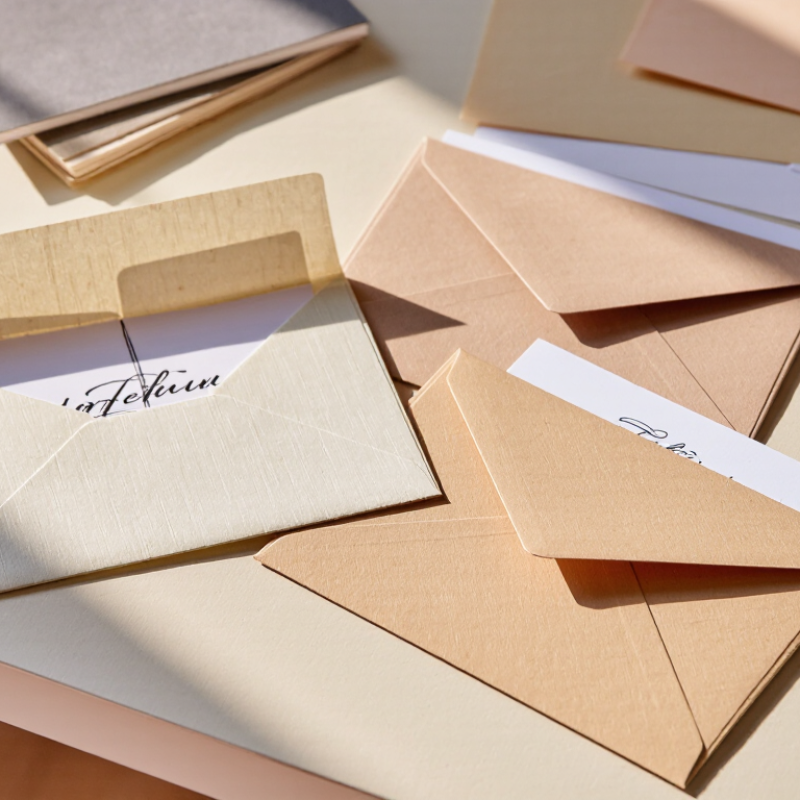
Parchment paper envelopes are stationery envelopes made from paper with a softly translucent, often lightly textured finish. In this context, “parchment” usually describes the paper’s appearance, not a guarantee that it is traditional parchment. The wording can vary between sellers, so check the material description rather than relying on the name alone. They feel distinctive. Hold one against a window and you may see a letter’s outline without being able to read every word.
These envelopes suit invitations, handwritten notes, certificates, and small keepsakes. Their warm, cloudy surface can make a simple card feel more considered, while a pale insert gives the contents a gentle contrast. They work especially well when the paper inside has dark, clear lettering. Very fine text may become harder to read through the envelope, though. A dark or heavily patterned insert can also muddy the effect.
Think about practical handling, too. Light, delicate paper may crease at a sharp fold or show marks from damp fingers. Test your pen or printer on a spare sheet; some finishes absorb ink unevenly, and printed colors may look softer than expected. A standard envelope seal may not hold well on every surface, so check the flap before mailing. And do not assume stationery parchment is suitable for food contact just because it shares a name with baking paper.

Choosing parchment paper envelopes starts with the contents. A flat invitation needs opacity and clean edges; a small photo or sample may need more stiffness. Check the paper’s weight, fold quality, and closure before ordering. If the contents are sensitive to moisture, ask for test results rather than assuming “parchment” means waterproof. It may not.
Then consider storage and handling. A dry office, a humid stockroom, and repeated hand delivery create different demands. Rub a sample gently, fold it, and leave it beside the actual contents overnight. Look for scuffing, curling, or ink transfer. Small flaws matter.
Recycling also depends on construction. The U.S. EPA’s 2018 Advancing Sustainable Materials Management report recorded a 68.2% recycling rate for paper and paperboard overall, not for coated envelopes specifically. That distinction is easy to miss. Ask whether coatings, windows, or adhesive strips affect local sorting, and confirm with the receiving recycler. Test a few samples under real packing conditions; specifications alone can feel reassuring, but they do not catch every awkward fit.
Use this guide to match envelope construction to the contents and handling conditions. Paper-weight ranges are practical starting points, not universal specifications; confirm the finished envelope with a sample and the supplier.
| Contents | Typical Conditions | Main Performance Need | Useful Starting Specification | Checks Before Ordering |
|---|---|---|---|---|
| Letters, forms, and lightweight inserts | Routine indoor storage and postal handling | Easy opening, adequate opacity, and resistance to everyday scuffing | About 70–100 gsm for the envelope body; choose a size that leaves room for the contents without excessive movement. | Check the actual contents fit, inspect seams and flap closure, and confirm whether the paper is opaque enough for private information. |
| Photographs, prints, or other items with easily marked surfaces | Dry storage; contents may rub against the envelope interior | A smooth, clean interior and a closure that does not press adhesive onto the item | Use a smooth paper surface and consider a protective inner sleeve or interleaf. Select the envelope size to avoid tight bending. | Test for surface transfer, abrasion, and adhesive contact. Do not assume that a parchment-style paper is archival or acid-free without documentation. |
| Dry powders, seeds, or small granular samples | Short-term storage or controlled handling; contents can escape through openings | Secure seams and a reliable closure | Choose a construction with sealed side seams and a closure suited to the contents; a secondary outer pouch may be appropriate for fine particles. | Test for leakage using the actual particle size. Paper envelopes are not a substitute for a hermetic or moisture-barrier package. |
| Greasy or oily items | Contact with fats or oils during packing and storage | Grease resistance on the contact surface | Specify genuine grease-resistant parchment paper or a documented grease-resistant lining; paper weight alone does not establish grease resistance. | Verify suitability for the specific oil, contact time, and temperature. For food use, request applicable food-contact documentation for the intended market. |
| Items exposed to humid rooms or brief handling near moisture | Variable indoor humidity; occasional damp hands or surfaces | Protection against handling wear, while recognizing paper absorbs moisture | Consider a heavier paper or a separate protective outer layer if contents must remain dry. | Test after conditioning in the expected environment. Parchment paper is not automatically waterproof or a high-moisture-barrier material. |
| Sharp-edged, bulky, or heavier small items | Repeated handling, stacking, or shipment | Tear resistance, reinforced seams, and protection from puncture | Use a heavier construction, reinforced seams, or a protective insert; select an envelope format designed for the item's shape and mass. | Run a pack-out and handling trial. A paper envelope alone may not protect fragile contents from impact or sharp edges. |
Start with the paper grade, not the color. “Parchment” may describe a translucent finish rather than a single paper specification. Compare weight in grams per square metre, opacity, stiffness, and tear resistance across physical samples. A heavier sheet can feel more secure, but may crease less neatly around a tight flap. Hold a sample over printed text; then fold it. Small details matter.
Match the envelope to its contents, with room for inserts and comfortable closure. Measure the item’s widest point and thickness, then allow clearance so corners do not push against the seams. Check whether the flap uses a remoistenable gum seal or a peel-and-seal strip. Test closure after handling; a seal that lifts at one corner is a warning. Also inspect seam placement and flap overlap. I still find this easy to overlook.
Construction choices affect material performance. Ask suppliers for fiber, basis-weight, and recycled-content specifications, rather than relying on appearance alone. AF&PA’s 2022 paper recycling report estimated a 68% U.S. paper recovery rate; this figure covers paper overall, not parchment envelopes specifically. Recycled fiber can vary in shade and surface, so request samples before approving a run. The smoothest sample is not always the most practical. Do a simple fit-and-seal test with the actual insert, and record any wrinkles, edge splits, or weak adhesive spots.
Choosing parchment paper envelopes in 2026 takes more than checking whether they look clean and sturdy. Food safety depends on the paper’s intended use, coatings, inks, and exposure conditions. Ask suppliers for food-contact documentation and test results that match the foods you package. Greasy pastries and warm, moist fillings can behave differently from dry cookies. Check the stated temperature limits, too. Details matter.
Sustainability claims deserve the same close reading. “Compostable” may depend on access to a particular composting process, while “recyclable” can vary by local collection systems. Request evidence for the exact envelope, not just a general statement about the supplier’s materials. Look for clear information about fiber sourcing, coatings, and disposal instructions. Vague labels are not proof.
Supplier reliability shows up in practical details. Can they identify the paper grade, provide current specifications, and explain how production batches are tracked? Request samples and test them with your actual food, including after storage. A small grease spot may reveal a weakness that a polished brochure misses. I would not assume every document tells the whole story; claims can be incomplete, and I have seen packaging perform differently in real use. Verify, then decide.
Choosing parchment paper envelopes in 2026 means matching the paper to its actual job. For a bakery, compare grease resistance, fold strength, and performance after contact with warm, oily food. For dry items, stiffness and clean opening may matter more. Check basis weight and caliper, but do not treat either as a quality score by itself. A thicker sheet can still split at a sharp fold. A neat appearance proves little.
Test samples with the real product, not just an empty envelope. Fill them, fold and seal them as intended, then check for oil marks, tears, and opening failures. TAPPI T 559 provides a repeatable kit-based method for assessing paper’s resistance to grease; use it alongside practical handling trials. I would not trust one pass. Repeat tests after cold storage or humid exposure if those conditions are likely. The U.S. EPA’s 2018 Advancing Sustainable Materials Management report estimated that 68.2% of U.S. paper and paperboard was recycled. That figure describes the material category, not every used envelope: food residue and local collection rules can change what is accepted. A disappointing sample is still useful data. Record the paper specification, test conditions, and failure point before choosing.


For those larger-sized parts, or smaller quantity runs, we have 2 independent powder coat booths and ovens. The quality, durability and affordability of today’s powder coating finishes make this the process of choice for world-class companies.
Powder coating advantages over other forms of coating are many. Materials used in the Powder coating process can be metals and non-metals that come in a multitude of thicknesses, textures, colors, etc. Another of Powder coating’s biggest advantages over conventional coatings is its ability to create finishes in many different textures. Powder Coating Booths allow us the ability to apply these advantages to large products.
Tri-State Fabricators runs a full-service conveyor line for painting. Wet painting can provide protection or decoration to many different part styles. From start to finish, every project is easier to undergo random and point-based inspection by our skilled painting team.
Advantages to our Wet Paint Line are these lines start with product prep and ends with a thorough inspection of a high quality finished product. Our ability to complete large and small projects with a superior finish and doing so in a timely and economical fashion. This passes along the savings in production to our customers. When powder coating ins not an option, our Wet Paint Line gets the job done right the first time.
When the parts get big and heavy we roll-out our custom paint racks and oversize booth. By utilizing our partnerships with all the major paint brands, we can match virtually any color with wet paint.
The advantages of having access to a Wet Paint Booth are many. Large projects of many different shapes can be loaded into the booth. The Wet Paint Booth offers an environment that is much more controlled than a typical parts painting operation.
Not only are they used because of their controlled environment, but they’re are also advantageous when it comes to applying paint to parts that are needed in industries that require specialty coatings such as medical, aerospace, etc.
Our military forces have some very high standards when it comes to the finish of their vehicles and equipment. From the first pre-treatment step to final coat, it takes a great deal of knowledge and experience to protect the men and women of our armed forces. They deserve only the best, and Tri-State Fabricators provides it.
All of our processes are closely monitored by our staff and management teams. Both of which are highly trained in the processes of metal fabrication and finishing. Tri-State Fabricators’ goal is to always fully satisfy each and every customer, including the military. We will always put a 110% into what we do.
Abrasive media blasting is an excellent way to remove old paint, rust, and increase the paint/powder adhesion. Glass beads produce a much smoother and brighter finish than angular abrasives; leaving the part clean yet without any dimensional change. Chemically inert and environmentally friendly, we can recycle our beads approximately 30 times; making them a more preferred method of metal cleaning or surface finishing.
Advantages to Glass Bead Blasting are many. Glass bead blast media is used when a project is needing rough surfaces need to become smooth for applications of coatings such as paint. It is typically used to clean paint and rust from a product surface without deforming the surface it is being used on. Overall, compared to many other blasting media, Glass Bead Blasting is a very economical choice and those savings are always passed on to our customers.
Tri-State Fabricators utilize a zinc phosphate wash to clean and etch the material to ensure the best paint adhesion possible. The unique design of our 3-stage wash system does the work like a 5-stage. From Cleaning and rinsing to conversion coating and post-treatment, Our Part Washing process is a complete service and works throughout the fabrication service and the finishing service.
Along with the previously mentioned benefits, Curing is a vital chemical reaction that leaves the product finish hard and relatively safe from mild abrasion and aggressive corrosion. This process can be done in more than one way; ambient air-dry or in curing ovens at temps that exceed 240°.
From fixing paint mistakes (someone else’s of course) to simply cleaning our paint line hooks, our burn-off oven is put to good use. After a quick burn-off, a little clean up, and a fresh coat of paint, your parts will look better than new.
Why does our Burn-Off Oven work so well? Because super heating the air around parts turns the materials into ashes. From paint and powder coatings to rubber and machining oils, high temps do the job without degrading the integrity of the part.
Masking is a vital part of producing high quality products. We have die-cut masking patterns to protect machined surfaces as well as a wide range of plugs and caps to protect threaded holes and bolts. We provide permanent and temporary masking.
Masking allows the selected sections of a product to be protected from a fabrication or finishing service. This can be with both chemicals when etching and tapes, paints when only finishing just a section of the product. Masking is great in aiding the customization process of a project.
Screen printing is a photographic process that transfers artwork onto a porous nylon screen which allows colored ink to flow through the screen and be deposited on an aluminum or plastic component. We can generally have just about any design created onto a screen for your parts.
Some of the advantages of Screen Printing are, brand recognition for your business displaying on your products, assembly instructions, product warnings/hazards, etc. Tri-State Fabricators produces Screen Printing of the highest quality so you know it’s durable.
Metal Finishing is the art of treating the exterior portion of product, often metal but can also be made of other materials, so that the surface is clean and free of any debris. Then the process of applying coats or either paint of powder coat takes place. This coating process improves the quality of the product in both appearance and resistance to wear and corrosion.
Tri-State Fabricators, Inc., understands that a project typically isn’t complete until a high-quality finish has been added to your product. This is why our painting and powder coating teams continuously inspect the products throughout the Metal Finishing process.

