


How to Choose Packaging Paper Bags for Your Business

Choosing Packaging Paper Bags is not simply a branding decision. For a retailer, café, or product maker, each bag must fit the item, the customer, and the way it will be carried. A bag that looks elegant on a shelf may crease around jars or feel awkward with a takeaway box. Start with real use.

This guide explores the practical choices behind a dependable bag: size, paper weight, handle style, finish, and print. A small shop may need compact bags that stack neatly behind the counter, while a bakery may value room for pastry boxes and handles that stay comfortable on a short walk. Small details matter. Paper strength should suit the load, not just the product photograph. For food packaging, confirm that the materials and any coatings are appropriate for the intended contact, and ask suppliers for clear product specifications.

Cost, appearance, and environmental claims also deserve careful review. Recycled content, responsible sourcing, and recyclability can vary by product and local collection systems, so verify claims rather than relying on a green label alone. Request samples when possible. Fill them with typical products, check the handles, and see how they look after a few minutes of carrying. That test may reveal a detail the catalogue misses. There is no perfect bag for every business, and the first choice may need revisiting. A considered selection can still make everyday packaging feel more useful, consistent, and true to your brand.
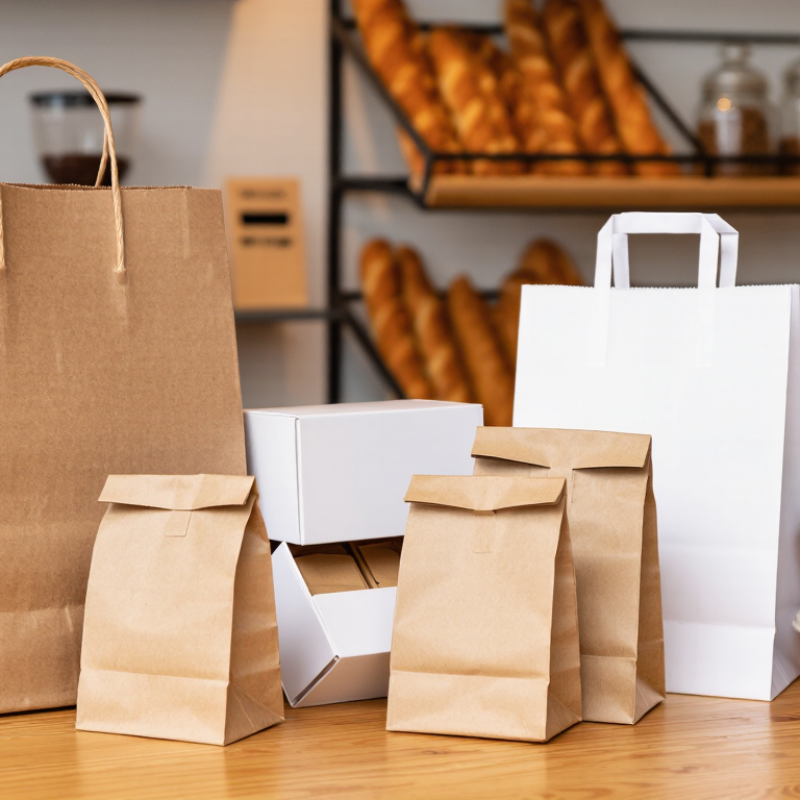
How to Choose Packaging Paper Bags for Your Business

Identify Your Products, Customers, and Packaging Requirements

A paper bag should suit the product before it suits a design preference. Note each item’s weight, shape, and surface: a loaf needs room without being crushed, while a jar needs a stable base and enough strength around its corners. For takeaway food, consider grease resistance and whether the contents may be warm. Paper can soften when damp. Test it under realistic conditions.

Then consider who carries the bag and where. A customer walking several blocks may value sturdy handles; someone buying a small gift may prefer a compact bag that looks considered. Ask staff how bags are actually used. Do customers carry one item or several? Do handles tear when bags are packed quickly? Small observations matter. A sample filled with typical products can reveal awkward sizing, tipping, or difficult opening better than a product photo can. It is tempting to choose one bag for every order, but that can create excess material for small purchases and poor support for heavier ones. Compare a few sizes and paper weights, and check storage space before ordering. A perfect specification is not always practical.


Compare Paper Types, Strength, and Bag Construction

Choose paper by product weight, surface, and handling conditions, not appearance alone. Unbleached kraft suits many grocery and takeaway uses because its fibers provide useful tear resistance. Recycled grades can work well, but strength varies with fiber mix and manufacturing quality. Coated paper resists light splashes and sharpens print, though coatings may affect recycling options locally. Check disposal guidance.

Paper weight is only one clue. A heavier sheet can still fail if the bottom fold is shallow or poorly glued. Look at gusset depth, side seams, and handle attachment; each carries stress when the bag swings. Flat paper handles suit lighter loads, while twisted handles often feel steadier for heavier purchases. Pull gently.

Test samples with actual products, not empty bags on a desk. Load each bag with the heaviest expected item, then lift and carry it several times. Watch for seam creep, handle stretching, and a base that bows near the corners. Humidity matters too: paper can soften in damp storage, and printed surfaces may scuff. It is tempting to judge a bag by paper weight alone; that shortcut misses weak seams.

Choose a Bag Size, Shape, and Handle Style

Choosing the right paper bag starts with the item, not the shelf display. Measure the product at its widest point and leave room for tissue or a protective sleeve. A bag that fits too tightly can strain its seams; one that is oversized may let items slide around. Check the base width too. A glass jar needs more stable support than a flat greeting card.

Shape affects both packing and presentation. A square-bottom bag stands upright on a counter and suits boxed goods, while a slim gusseted style works well for books or folded clothing. Handle style matters when customers carry purchases farther. Twisted paper handles feel comfortable for everyday loads, while flat handles can suit lighter items. For heavier products, test the handle attachment and bag bottom with the actual contents. Don’t guess.

Tips: Make a simple paper mock-up before ordering. Put a sample product inside, add any wrapping, and lift the bag several times. Check whether fingers fit through the handles and whether the bag tips when set down. Small details can be easy to miss. I once underestimated how much tissue adds to the fit, so allow a little extra space and adjust after testing.

How to Choose Packaging Paper Bags for Your Business — Choose a Bag Size, Shape, and Handle Style
Typical Use Suggested Bag Size (W × Gusset × H) Shape and Base Handle Style Paper and Construction Selection Notes
Small gifts, accessories, and cosmetics 6 × 3 × 8 in (15 × 8 × 20 cm) Compact rectangular bag with a flat bottom Twisted paper handles Approximately 100–120 gsm paper Check that the item fits with room for tissue or protective wrapping. Suitable for lightweight purchases.
Books, folded clothing, and boxed goods 10 × 5 × 12 in (25 × 13 × 30 cm) Medium rectangular bag with a reinforced bottom Flat paper handles or twisted paper handles Approximately 120–150 gsm paper Choose the gusset based on the depth of the products. Reinforced base construction helps support everyday retail items.
Shoes, larger apparel, and gift sets 14 × 6 × 16 in (36 × 15 × 41 cm) Wide rectangular bag with a broad base Twisted paper handles Approximately 140–170 gsm paper Measure the packed product, not just the item. A wider opening makes bulky or boxed products easier to pack.
Takeaway meals and bakery orders 10 × 6 × 12 in (25 × 15 × 30 cm) Square-bottom bag for stable, upright packing Flat paper handles Food-contact-suitable paper where required; use a separate barrier or liner for greasy or moist foods Confirm food-contact requirements for the intended market. Keep hot and cold items, and wet products, in appropriate packaging.
Wine bottles and tall packaged products 5 × 4 × 14 in (13 × 10 × 36 cm) per bottle Narrow, tall bag with a reinforced base Twisted paper handles or a reinforced die-cut handle Approximately 150 gsm or heavier, with suitable base reinforcement Match the bag height and base to the bottle. For heavier contents, verify the handle and bottom construction with a load test.
Lightweight produce and market purchases 12 × 7 × 14 in (30 × 18 × 36 cm) Open-top bag with a wide gusset Flat paper handles or no handle Approximately 100–140 gsm paper, depending on the load Paper can weaken when wet. Use a suitable bag design and avoid overloading with damp or unusually heavy produce.
Premium gifts and presentation packaging 8 × 4 × 10 in (20 × 10 × 25 cm) Structured rectangular bag with a reinforced base Ribbon or cord handles with reinforced attachment points Approximately 150–200 gsm paper Choose the handle for comfort and appearance, and check that the attachment points are suitable for the intended contents.

Assess Printing, Sustainability, and Regulatory Needs

When choosing packaging paper bags, begin with the print details customers will actually see. Ask for a press proof on the intended paper, not just a screen image. Brown kraft can mute pale colors, while coated stock may show fine lines more clearly. Check the logo near folds and handles, where creases can distort it. Small details matter. Keep a sample.

Sustainability claims need evidence. Confirm recycled-fiber percentages and ask what documentation supports them. A glossy coating or plastic window may complicate recycling, depending on local facilities. That trade-off is easy to overlook. Test a finished bag in the waste stream your customers use, and avoid broad claims such as “eco-friendly” unless you can explain what they mean. Stronger paper is not automatically the better choice if it adds material without improving performance.

Regulatory needs vary by location, product, and how the bag is used. If the bag will touch food, check applicable food-contact requirements before approving inks, coatings, or adhesives. Review any required labeling and the rules for environmental claims in your sales markets. Keep supplier specifications and test records with the final artwork. Requirements can change, so verify them with a qualified local source before a large order. A little checking now can prevent costly reprints, though it may slow approval.

Evaluate Suppliers, Costs, and Sample Performance

When evaluating suppliers, ask for the paper weight, handle construction, and production tolerances in writing. A clear specification makes repeat orders easier to compare. Ask how the supplier checks print alignment and bag dimensions, and whether rejected units are included in its quality records. Request a production sample, not only a showroom piece. Small details matter.

Compare the full landed cost, not just the price per bag. Include setup charges, shipping, minimum order quantities, and the cost of storage. A lower unit price may become less attractive if you must order more bags than you can use. Ask for quotes at several quantities, then compare the price against your actual monthly demand. I once focused too much on unit cost; unused stock would have tied up cash and shelf space.

Test samples with the products they will carry. Load each bag with a typical order, lift it by the handles, and check for stretching, tearing, or awkward balance. Leave one sample in a damp area and inspect the paper and print the next day. This is only a practical screening test, not a guarantee of performance in every setting. Record results, including failures, and ask the supplier what changes are possible before approving a larger run.

How to Choose Packaging Paper Bags for Your Business

Suggested supplier evaluation weights (%)

Use these suggested weights as a starting point, then score each supplier against the same criteria. Request samples to check strength, print quality, dimensions, and handle performance before placing an order. Compare like-for-like quotes, including setup, shipping, and minimum-order costs.

Powder Coat Booths

For those larger-sized parts, or smaller quantity runs, we have 2 independent powder coat booths and ovens. The quality, durability and affordability of today’s powder coating finishes make this the process of choice for world-class companies.

Powder coating advantages over other forms of coating are many. Materials used in the Powder coating process can be metals and non-metals that come in a multitude of thicknesses, textures, colors, etc. Another of Powder coating’s biggest advantages over conventional coatings is its ability to create finishes in many different textures. Powder Coating Booths allow us the ability to apply these advantages to large products.

Wet Paint Line

Tri-State Fabricators runs a full-service conveyor line for painting. Wet painting can provide protection or decoration to many different part styles. From start to finish, every project is easier to undergo random and point-based inspection by our skilled painting team.

Advantages to our Wet Paint Line are these lines start with product prep and ends with a thorough inspection of a high quality finished product. Our ability to complete large and small projects with a superior finish and doing so in a timely and economical fashion. This passes along the savings in production to our customers. When powder coating ins not an option, our Wet Paint Line gets the job done right the first time.

Wet Paint Booths

When the parts get big and heavy we roll-out our custom paint racks and oversize booth. By utilizing our partnerships with all the major paint brands, we can match virtually any color with wet paint.

The advantages of having access to a Wet Paint Booth are many. Large projects of many different shapes can be loaded into the booth. The Wet Paint Booth offers an environment that is much more controlled than a typical parts painting operation.

Not only are they used because of their controlled environment, but they’re are also advantageous when it comes to applying paint to parts that are needed in industries that require specialty coatings such as medical, aerospace, etc.

Military CARC

Our military forces have some very high standards when it comes to the finish of their vehicles and equipment. From the first pre-treatment step to final coat, it takes a great deal of knowledge and experience to protect the men and women of our armed forces. They deserve only the best, and Tri-State Fabricators provides it.

All of our processes are closely monitored by our staff and management teams. Both of which are highly trained in the processes of metal fabrication and finishing. Tri-State Fabricators’ goal is to always fully satisfy each and every customer, including the military. We will always put a 110% into what we do.

Glass-Bead Blasting

Abrasive media blasting is an excellent way to remove old paint, rust, and increase the paint/powder adhesion. Glass beads produce a much smoother and brighter finish than angular abrasives; leaving the part clean yet without any dimensional change. Chemically inert and environmentally friendly, we can recycle our beads approximately 30 times; making them a more preferred method of metal cleaning or surface finishing.

Advantages to Glass Bead Blasting are many. Glass bead blast media is used when a project is needing rough surfaces need to become smooth for applications of coatings such as paint. It is typically used to clean paint and rust from a product surface without deforming the surface it is being used on. Overall, compared to many other blasting media, Glass Bead Blasting is a very economical choice and those savings are always passed on to our customers.

Part Washing

Tri-State Fabricators utilize a zinc phosphate wash to clean and etch the material to ensure the best paint adhesion possible. The unique design of our 3-stage wash system does the work like a 5-stage. From Cleaning and rinsing to conversion coating and post-treatment, Our Part Washing process is a complete service and works throughout the fabrication service and the finishing service.

Along with the previously mentioned benefits, Curing is a vital chemical reaction that leaves the product finish hard and relatively safe from mild abrasion and aggressive corrosion. This process can be done in more than one way; ambient air-dry or in curing ovens at temps that exceed 240°.

Burn-Off Oven

From fixing paint mistakes (someone else’s of course) to simply cleaning our paint line hooks, our burn-off oven is put to good use. After a quick burn-off, a little clean up, and a fresh coat of paint, your parts will look better than new.

Why does our Burn-Off Oven work so well? Because super heating the air around parts turns the materials into ashes. From paint and powder coatings to rubber and machining oils, high temps do the job without degrading the integrity of the part.

Masking

Masking is a vital part of producing high quality products. We have die-cut masking patterns to protect machined surfaces as well as a wide range of plugs and caps to protect threaded holes and bolts. We provide permanent and temporary masking.

Masking allows the selected sections of a product to be protected from a fabrication or finishing service. This can be with both chemicals when etching and tapes, paints when only finishing just a section of the product. Masking is great in aiding the customization process of a project.

Screen Printing

Screen printing is a photographic process that transfers artwork onto a porous nylon screen which allows colored ink to flow through the screen and be deposited on an aluminum or plastic component. We can generally have just about any design created onto a screen for your parts.

Some of the advantages of Screen Printing are, brand recognition for your business displaying on your products, assembly instructions, product warnings/hazards, etc. Tri-State Fabricators produces Screen Printing of the highest quality so you know it’s durable.

Metal Finishing

Metal Finishing is the art of treating the exterior portion of product, often metal but can also be made of other materials, so that the surface is clean and free of any debris. Then the process of applying coats or either paint of powder coat takes place. This coating process improves the quality of the product in both appearance and resistance to wear and corrosion.

Tri-State Fabricators, Inc., understands that a project typically isn’t complete until a high-quality finish has been added to your product. This is why our painting and powder coating teams continuously inspect the products throughout the Metal Finishing process.
