


How to Choose Injection Molding Equipment in 2026?

Choosing Injection Molding Equipment in 2026 is not simply a matter of buying the largest or newest press. The right machine must match part geometry, resin behavior, production targets, and available floor space. A thin-walled packaging part may need fast, repeatable cycles, while a thick technical component requires careful control of cooling and packing. Small details matter. Clamp force, screw design, shot capacity, and tie-bar spacing can determine whether a mold runs reliably or causes avoidable delays. A machine that fits today’s order may also limit tomorrow’s product plans, so forecast volume and expected mold changes deserve a realistic review.

This guide examines hydraulic, all-electric, and hybrid presses, along with automation, energy use, service access, and total ownership costs. It encourages buyers to look beyond brochure specifications. Check how cycle-time claims were measured, whether technicians can reach your facility, and how quickly critical spare parts are available. A quoted energy figure means little unless the resin, mold, and production conditions are comparable. That caveat is easy to miss. Even a well-matched press can underperform when setup, operator training, or mold maintenance is overlooked. Compare supplier data with production trials and verified customer references where possible. No single machine is perfect; the sound choice is the one that meets defined requirements and leaves room for measured growth.
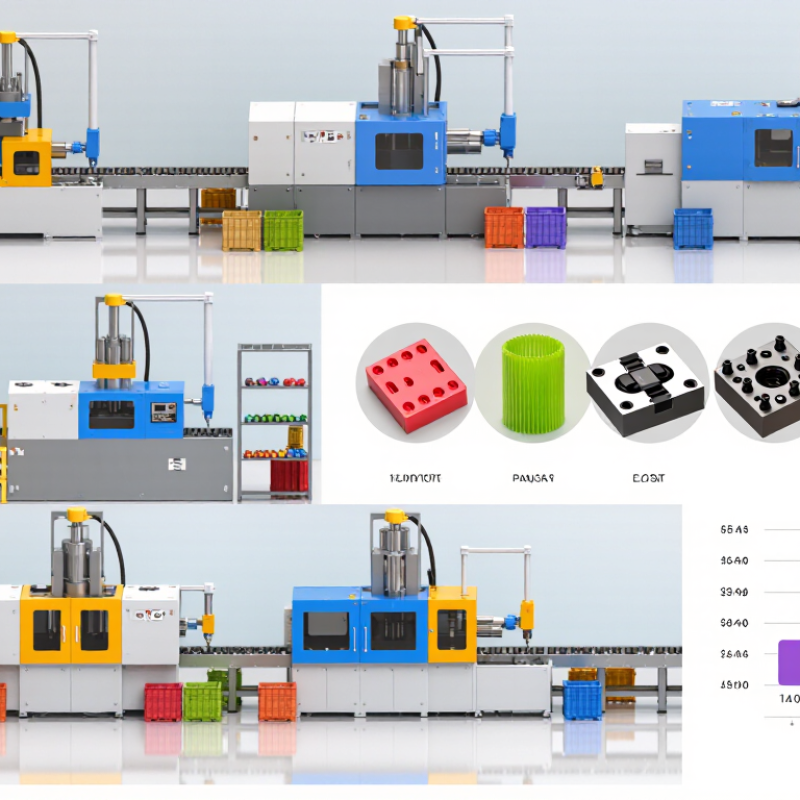
How to Choose Injection Molding Equipment in 2026?

Define Production Requirements and Part Specifications

How to Choose Injection Molding Equipment in 2026?

Define Production Requirements and Part Specifications

Start with the job the machine must perform, not its advertised capacity. Estimate annual demand, peak monthly output, operating shifts, and acceptable cycle time. Include likely product changes; forecasts are rarely perfect. A machine sized only for today’s volume may become a bottleneck.

Document each part’s material, dimensions, weight, wall thickness, tolerance, and surface requirements. A thin-walled tray may need fast, consistent filling, while a thick component may require longer cooling and careful pressure control. Record the expected number of cavities and whether the mold uses a cold or hot runner. Small details matter. In equipment reviews, projected area and cavity count help inform clamping-force estimates, while part and runner weight guide shot-size selection. These are starting points, not substitutes for checking the actual mold and process.

Ask suppliers to verify the proposed machine against your part drawings, mold dimensions, material data, and target cycle. Check platen size, tie-bar spacing, injection pressure, and available control features. Also account for dryers, temperature-control units, robots, and floor space. A specification sheet can look convincing. The real setup may differ. Pilot trials can expose issues such as uneven filling or difficult part removal before production begins. Keep the assumptions visible, especially when drawings or demand figures are still changing.


Select the Machine Type and Required Clamping Force

Select the machine type around the part, process, and production rhythm. Hydraulic machines suit broad applications and high clamping-force needs; all-electric machines offer precise, repeatable motion, while hybrid designs balance force and control. Check shot capacity, tie-bar spacing, and mold dimensions before comparing tonnage. A machine that fits the force calculation can still be the wrong fit.

Estimate clamping force from the projected area of all cavities and runners, then multiply by the material’s tonnage factor. Plastics Technology’s published clamp-tonnage guidance gives a common starting range of 2–5 tons per square inch. For example, an 18-square-inch projected area at 3 tons per square inch suggests about 54 tons. Treat this as an estimate, not a guarantee: resin, wall thickness, flow length, and injection pressure affect the result. Excessive force can hide parting-line problems and waste energy. I would verify the estimate with mold trials.

Tips: Include runners in the area. Ask the mold maker for projected-area and pressure data, then leave a modest operating margin. Record flash, part weight, and cycle stability during trials; the first calculation may need revision.

Match Injection Capacity to Materials and Mold Design

Choosing injection molding equipment in 2026 means matching the machine’s usable shot capacity to both the resin and the mold. Do not size a machine from part weight alone. Include every cavity, runner, and expected cushion, then convert the total shot mass using the material’s density. A dense resin can require less volume than a lighter one at the same weight. Check the machine’s recommended shot-size range; operating at the extreme ends can make dosing less consistent.

Material behavior matters. A glass-filled resin may need a suitable screw design and enough recovery time, while a shear-sensitive resin can suffer if it is pushed too hard. The mold adds another constraint: cavity count and runner layout change shot volume, while projected area and cavity pressure influence required clamp force. A large machine is not automatically safer. It can bring higher energy use and less precise control for a small mold.

Use the resin data sheet and actual mold details to estimate capacity, then verify the choice with a molding trial. Watch for stable cushion, repeatable part weight, and recovery time—not just a machine’s maximum shot figure. Estimates can still miss the mark. That is normal; revise them when trial data disagrees.

Assess Automation, Energy Use, Controls, and Safety

How to Choose Injection Molding Equipment in 2026?

Assess the full production cell, not just the press. The International Federation of Robotics reported 541,302 industrial robots installed worldwide in 2023, showing how common automation has become. That figure does not mean every molding line needs a robot. Match automation to part weight, insert handling, shift patterns, and operator access. Watch a real cycle: a robot that waits for the mold to open can erase its expected time savings. Small details matter.

Energy deserves the same scrutiny. The U.S. Department of Energy reports that motor-driven systems use about 54% of U.S. manufacturing electricity. Compare machine energy per accepted part, not just the rated motor power. Ask suppliers for measured data at your expected cycle and material, then verify it with a meter during trials. Controls should make alarms, recipe changes, and downtime causes easy to review; a crowded screen is not useful just because it offers more settings. I would also question any energy estimate that excludes auxiliaries.

Safety is practical, not decorative. Check guarding, interlocks, emergency stops, and safe access around the clamp and robot path. Involve operators in the review; they notice awkward reach points that a specification sheet misses. A near-perfect cycle time can still hide a frustrating setup. Keep the evidence.

How to Choose Injection Molding Equipment in 2026?

Assess automation, energy use, controls, and safety

Typical reported energy savings are ranges, not guarantees; actual results depend on the machine, material, and process. Compare specific energy consumption in kWh/kg under equivalent production conditions. Also assess automation and integration needs, control-system capability and data access, and conformity with applicable machine-safety requirements.

Compare Total Ownership Costs and Supplier Support

In 2026, compare injection molding machines by total ownership cost, not purchase price alone. Include energy, maintenance, tooling changes, labor, financing, and production losses in your calculation. EUROMAP 60.1 provides a common method for reporting machine energy use in kilowatt-hours per kilogram. Compare figures only when the material, part, cycle, and measurement conditions match. Otherwise, the numbers can mislead. The U.S. Department of Energy’s 2017 Bandwidth Study on Energy Use and Potential Energy Saving Opportunities in the U.S. Plastics Industry also identifies energy efficiency as an important improvement area. Ask suppliers for measured consumption data under your expected operating conditions.

Support affects the calculation, too. A slow service response can turn a minor fault into hours of lost production. Request written response targets, local technician availability, spare-parts lead times, commissioning details, and operator training. Then price the likely downtime against your actual hourly output. Get service terms in writing. A useful supplier should explain assumptions, not just promise savings. Their estimate may still miss something; yours might, too. Track actual energy use, cycle time, and maintenance during acceptance testing, then compare those readings with the proposal. This gives your team evidence for a decision—and a clear baseline if performance falls short.

How to Choose Injection Molding Equipment in 2026? - Compare Total Ownership Costs and Supplier Support

Comparison basis: These are general equipment characteristics, not quotations or guaranteed performance figures. Actual energy use, maintenance costs, cycle time, and purchase price depend on machine size, mold, material, process settings, utilization, local utility rates, and service arrangements. Compare machines using the same part, mold, production schedule, and quality requirements.

Evaluation dimension Hydraulic machine Hybrid machine All-electric machine What to verify before purchase
Typical drive configuration Hydraulic pumps and actuators provide clamping and injection movement. Combines hydraulic and electric drives; the configuration differs by model and function. Electric servo drives power the main machine movements; some designs may retain hydraulic functions. Request a written description of which axes are electric or hydraulic, including clamping, injection, and ejection.
Upfront purchase cost Often a lower initial-cost option, depending on tonnage and configuration. Often positioned between conventional hydraulic and all-electric options, but pricing varies. Often carries a higher initial price than a comparable conventional hydraulic machine. Compare complete, like-for-like quotations, including options, installation, training, taxes, and commissioning.
Energy-use considerations Energy demand depends on pump design and operating profile. A continuously running pump can use energy when the machine is not actively moving. Energy use depends on the electric/hydraulic split and how each drive operates during the cycle. Servo drives can use energy in response to machine demand; actual savings depend on the application and baseline machine. Ask for measured or validated kWh per kilogram or kWh per cycle for your part and cycle, with test conditions stated. Do not rely on a generic savings percentage.
Maintenance considerations Requires hydraulic-fluid care and inspection of items such as filters, hoses, seals, and pump components. May require both hydraulic-system upkeep and maintenance of electric drives and controls. Does not require hydraulic-fluid maintenance for axes that are fully electric; lubrication, cooling, and electrical-system upkeep may still be required. Request the maintenance schedule, consumables list, recommended service intervals, and expected labor requirements.
Process fit Can suit a broad range of molding applications; assess repeatability, motion control, and the required cycle. Can balance different drive requirements; suitability depends on the machine design and process. Can be attractive where precise, repeatable motion or a clean production environment is important; confirm it meets the required force and process window. Run a mold or application trial and review part quality, cycle stability, scrap, and process capability.
Supplier support and service Support needs depend on the machine controls, hydraulic components, local technician coverage, and parts availability. Technicians may need expertise across both hydraulic and electric systems. Support may require expertise in servo drives, controls, and electrical diagnostics. Confirm local service coverage, support hours, response-time commitments, escalation contacts, parts lead times, warranty terms, and remote-diagnostic availability in writing.
Potential ownership-cost drivers Purchase price, electricity, hydraulic-fluid service, filters, parts, labor, downtime, and production yield. Purchase price, electricity, hydraulic and electric-system service, parts, labor, downtime, and production yield. Purchase price, electricity, lubrication and cooling service, electrical parts, labor, downtime, and production yield. Use your own utility tariff, annual operating hours, maintenance plan, staffing costs, and downtime assumptions.
Best comparison approach Compare total cost over the same ownership period and production volume—not purchase price alone. Include energy, planned maintenance, repairs, downtime, and scrap, and apply the same assumptions to each option. Ask each supplier to identify assumptions and provide supporting test data or a clear method for every estimate.

Total cost of ownership worksheet

Cost component How to estimate it Information to collect
Initial investment Machine and options + installation + commissioning + training Itemized quotation, site-preparation requirements, and any excluded costs
Electricity Measured energy consumption × annual production hours or cycles × applicable electricity rate Application-specific energy data, test conditions, and local utility tariff
Maintenance and repairs Planned service + consumables + expected repair parts and labor Maintenance schedule, parts prices, service rates, and warranty coverage
Downtime and yield Expected lost production and scrap cost attributable to equipment availability or process performance Availability assumptions, trial results, quality data, and support commitments
Ownership-period total Initial investment + electricity + maintenance and repairs + downtime and yield costs Use the same ownership period, output target, and cost assumptions for every machine under review.

Decision tip: Choose the machine that meets the process and production requirements at the lowest defensible ownership cost, with supplier support that is documented and available where the machine will operate.

Powder Coat Booths

For those larger-sized parts, or smaller quantity runs, we have 2 independent powder coat booths and ovens. The quality, durability and affordability of today’s powder coating finishes make this the process of choice for world-class companies.

Powder coating advantages over other forms of coating are many. Materials used in the Powder coating process can be metals and non-metals that come in a multitude of thicknesses, textures, colors, etc. Another of Powder coating’s biggest advantages over conventional coatings is its ability to create finishes in many different textures. Powder Coating Booths allow us the ability to apply these advantages to large products.

Wet Paint Line

Tri-State Fabricators runs a full-service conveyor line for painting. Wet painting can provide protection or decoration to many different part styles. From start to finish, every project is easier to undergo random and point-based inspection by our skilled painting team.

Advantages to our Wet Paint Line are these lines start with product prep and ends with a thorough inspection of a high quality finished product. Our ability to complete large and small projects with a superior finish and doing so in a timely and economical fashion. This passes along the savings in production to our customers. When powder coating ins not an option, our Wet Paint Line gets the job done right the first time.

Wet Paint Booths

When the parts get big and heavy we roll-out our custom paint racks and oversize booth. By utilizing our partnerships with all the major paint brands, we can match virtually any color with wet paint.

The advantages of having access to a Wet Paint Booth are many. Large projects of many different shapes can be loaded into the booth. The Wet Paint Booth offers an environment that is much more controlled than a typical parts painting operation.

Not only are they used because of their controlled environment, but they’re are also advantageous when it comes to applying paint to parts that are needed in industries that require specialty coatings such as medical, aerospace, etc.

Military CARC

Our military forces have some very high standards when it comes to the finish of their vehicles and equipment. From the first pre-treatment step to final coat, it takes a great deal of knowledge and experience to protect the men and women of our armed forces. They deserve only the best, and Tri-State Fabricators provides it.

All of our processes are closely monitored by our staff and management teams. Both of which are highly trained in the processes of metal fabrication and finishing. Tri-State Fabricators’ goal is to always fully satisfy each and every customer, including the military. We will always put a 110% into what we do.

Glass-Bead Blasting

Abrasive media blasting is an excellent way to remove old paint, rust, and increase the paint/powder adhesion. Glass beads produce a much smoother and brighter finish than angular abrasives; leaving the part clean yet without any dimensional change. Chemically inert and environmentally friendly, we can recycle our beads approximately 30 times; making them a more preferred method of metal cleaning or surface finishing.

Advantages to Glass Bead Blasting are many. Glass bead blast media is used when a project is needing rough surfaces need to become smooth for applications of coatings such as paint. It is typically used to clean paint and rust from a product surface without deforming the surface it is being used on. Overall, compared to many other blasting media, Glass Bead Blasting is a very economical choice and those savings are always passed on to our customers.

Part Washing

Tri-State Fabricators utilize a zinc phosphate wash to clean and etch the material to ensure the best paint adhesion possible. The unique design of our 3-stage wash system does the work like a 5-stage. From Cleaning and rinsing to conversion coating and post-treatment, Our Part Washing process is a complete service and works throughout the fabrication service and the finishing service.

Along with the previously mentioned benefits, Curing is a vital chemical reaction that leaves the product finish hard and relatively safe from mild abrasion and aggressive corrosion. This process can be done in more than one way; ambient air-dry or in curing ovens at temps that exceed 240°.

Burn-Off Oven

From fixing paint mistakes (someone else’s of course) to simply cleaning our paint line hooks, our burn-off oven is put to good use. After a quick burn-off, a little clean up, and a fresh coat of paint, your parts will look better than new.

Why does our Burn-Off Oven work so well? Because super heating the air around parts turns the materials into ashes. From paint and powder coatings to rubber and machining oils, high temps do the job without degrading the integrity of the part.

Masking

Masking is a vital part of producing high quality products. We have die-cut masking patterns to protect machined surfaces as well as a wide range of plugs and caps to protect threaded holes and bolts. We provide permanent and temporary masking.

Masking allows the selected sections of a product to be protected from a fabrication or finishing service. This can be with both chemicals when etching and tapes, paints when only finishing just a section of the product. Masking is great in aiding the customization process of a project.

Screen Printing

Screen printing is a photographic process that transfers artwork onto a porous nylon screen which allows colored ink to flow through the screen and be deposited on an aluminum or plastic component. We can generally have just about any design created onto a screen for your parts.

Some of the advantages of Screen Printing are, brand recognition for your business displaying on your products, assembly instructions, product warnings/hazards, etc. Tri-State Fabricators produces Screen Printing of the highest quality so you know it’s durable.

Metal Finishing

Metal Finishing is the art of treating the exterior portion of product, often metal but can also be made of other materials, so that the surface is clean and free of any debris. Then the process of applying coats or either paint of powder coat takes place. This coating process improves the quality of the product in both appearance and resistance to wear and corrosion.

Tri-State Fabricators, Inc., understands that a project typically isn’t complete until a high-quality finish has been added to your product. This is why our painting and powder coating teams continuously inspect the products throughout the Metal Finishing process.
