Choosing High Alumina Castable for industrial service requires more than checking the alumina percentage. Furnace temperature, slag chemistry, abrasion, thermal cycling, installation method, and drying conditions all affect performance. A castable that survives a kiln roof may fail quickly in a steel ladle. The details matter.
The U.S. Geological Survey reported approximately 390 million metric tons of global bauxite mine production in 2023, with alumina refining remaining concentrated in major industrial regions. The World Steel Association reported crude steel production near 1.9 billion tonnes in 2023. These figures show why refractory reliability remains commercially important. They also reveal a limitation: raw-material volume does not prove castable quality.
Refractory specialist Dr. John H. Chesters stated, “The life of a refractory depends on the conditions under which it is used.” That principle still deserves attention. Select low-cement or ultra-low-cement grades when reduced porosity and stronger corrosion resistance are needed. Consider calcium aluminate cement, reactive alumina, silicon carbide, and suitable aggregates as a complete system. Do not compare products by alumina content alone.
A practical evaluation should examine bulk density, apparent porosity, permanent linear change, cold crushing strength, thermal shock resistance, and slag penetration. Ask for test conditions, not only impressive numbers. Site experience is useful, but it can be incomplete. Even experienced engineers may overlook mixing water, vibration, curing, or rapid drying. The right High Alumina Castable is therefore the one matched to the actual heat, load, chemistry, and installation environment.
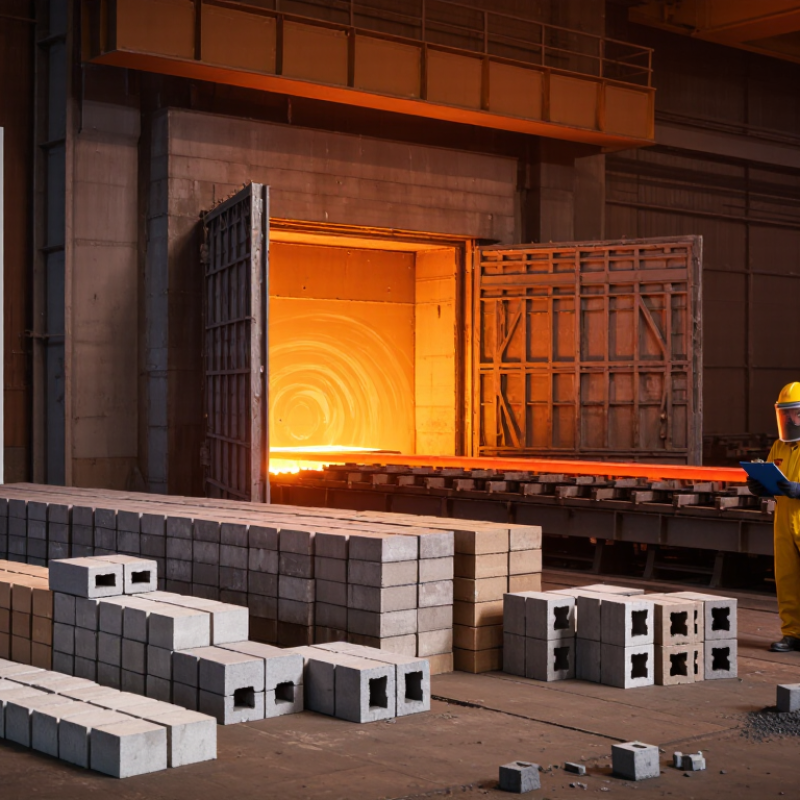
High alumina castable is a cement-bonded refractory concrete containing a high proportion of alumina-rich aggregates. It is mixed with water, poured into a steel form, and cured before controlled drying. Alumina improves resistance to heat, abrasion, and chemical attack. The material is not simply “more alumina, more performance.” Aggregate grading, calcium aluminate cement, porosity, and installation quality also control service life.
Its main uses are demanding furnace zones. Steel plants apply high alumina castable around ladles, tundish linings, burner blocks, and reheating furnace floors. The World Steel Association reported 1.89 billion tonnes of crude steel production in 2023. That volume explains the constant need for durable linings. Cement plants use high alumina castable in kiln hoods, coolers, preheaters, and transition zones. The International Energy Agency estimates global cement production at roughly 4.1 billion tonnes annually. Nonferrous smelters, waste-to-energy units, and heat-treatment furnaces also use it where abrasion and thermal cycling overlap.
Selection should begin with operating conditions, not a catalogue percentage. Check service temperature, atmosphere, slag chemistry, mechanical impact, and repair access. A 70% alumina grade may outperform a richer grade when installation is better controlled. Drying is often underestimated. Trapped water can create explosive steam pressure during heat-up. Field records, test certificates, and trial panels provide stronger evidence than marketing claims. Even careful specifications can fail when local water, vibration, or curing time changes. That is the uncomfortable part.
Alumina content should follow the operating conditions, not marketing labels. A 45–60% alumina castable may suit moderate heat and limited abrasion. For hotter zones, 70–80% alumina commonly offers better resistance to slag and mechanical wear. Above 85%, materials can support severe thermal exposure, but thermal shock may become a greater concern. These ranges are practical starting points, not guarantees.
The uncomfortable truth: more alumina can still fail. Field inspections often find cracking caused by rapid heating, poor curing, or incompatible slag. ASTM C401 provides a useful framework for testing castable performance, including strength and volume stability. The USGS Mineral Commodity Summaries 2024 reported about 140 million metric tons of global alumina production in 2023. This large supply does not make every alumina source equal. Impurities, particle grading, cement level, and installation quality strongly affect performance. World Steel Association data recorded about 1.89 billion tonnes of crude steel production in 2023, showing why refractory zones face intense thermal and chemical demands.
Tips: Map each zone first. Record temperature, heating rate, slag chemistry, abrasion, and shutdown frequency. Choose the lowest alumina content that safely meets those demands. It may reduce cost and improve thermal-shock resistance. Ask for test results, not only percentages. Review permanent linear change, cold crushing strength, and abrasion data. A small laboratory trial is wiser than a large blind purchase.
How to Choose High Alumina Castable for Industrial Use
Thermal performance begins with the operating temperature, heating rate, and furnace atmosphere. Check refractoriness under load, thermal conductivity, and permanent linear change. A castable that survives high heat may still crack during rapid cycling. Low thermal conductivity can reduce heat loss, but excessive insulation may weaken the hot face. Review test data from controlled laboratory conditions. Real furnace conditions are less polite. Drying and curing deserve equal attention. Trapped moisture can cause explosive spalling during the first heat-up.
Mechanical performance should match the area’s physical stress. Compare cold crushing strength, modulus of rupture, abrasion resistance, and thermal shock behavior. A kiln floor may need strong abrasion resistance, while a burner zone may need better thermal shock tolerance. Test samples should follow recognized procedures, such as ASTM methods, when applicable. Installation quality changes the result. Incorrect water addition, poor vibration, or uneven thickness can damage even a well-designed castable. Field inspection often reveals these weaknesses.
Chemical performance depends on contact with slag, molten material, alkalis, and furnace gases. Examine alumina content, calcium oxide level, porosity, and apparent density. Low cement systems may offer cleaner high-temperature behavior, but they require stricter mixing control. Chemical compatibility should be checked through slag cup tests or service simulations. Do not rely on a single brochure value. Ask for batch records, test temperatures, and curing conditions. Some data look impressive until the test method is examined. Recheck assumptions before choosing the final grade.
Choosing high alumina castable begins with service conditions, not a catalog number. In furnace repairs, I have compared hot-face temperature, abrasion, chemical exposure, and installation space before selecting materials. A binder must match the curing schedule. Calcium aluminate cement gives reliable early strength, while low-cement systems reduce water demand and porosity. However, a faster set can punish careless mixing. That detail is easy to overlook.
Select dense alumina aggregate for abrasion and heat resistance. Use graded particles, from coarse grains to fine powder, so the castable packs tightly around anchors and corners. Aggregate purity matters when slag or molten metal contacts the lining. Reactive alumina can improve matrix strength, but excessive fines may increase mixing difficulty. I prefer trial batches that measure flow, bulk density, and fired strength at the intended temperature. Laboratory results need site verification.
Additives should solve a defined problem. Dispersants can lower water demand; microsilica can refine pores; stainless or polypropylene fibers may control drying cracks. Use fibers only after checking dryout procedures and ventilation requirements. Too much additive can weaken workability or create unexpected shrinkage. I once accepted a smooth mix that later dried unevenly because the water content was guessed. That mistake changed my practice: record batch moisture, mixing time, and installation temperature every time. Ask the installer to test a small panel. It often reveals more than a datasheet.

Choosing high alumina castable starts with evidence, not a bright bag or a high alumina percentage. Ask for a recent test report showing chemical composition, bulk density, apparent porosity, cold crushing strength, and refractoriness under load. Check the test method and sample date. Results without traceable methods deserve caution. Request a sealed batch sample and compare its color, grain size, and mixing behavior with the delivered material. It should not contain damp lumps. Small details matter.
Installation needs must match furnace temperature, abrasion, atmosphere, and heating schedule. A castable for a burner zone may fail in a slag-contact area. Confirm aggregate size, required water addition, mixing time, anchor spacing, and minimum lining thickness with the technical data sheet.
During installation, record water quantity and ambient temperature. Too much water improves workability but creates pores. That mistake is common. Vibrate evenly without separating coarse aggregate. Cure under controlled conditions, then dry out slowly. I have seen rushed heat-ups produce steam spalling within hours.
Service life depends on more than laboratory strength. Review expected thermal cycles, shutdown frequency, chemical exposure, and repair access. Ask for field references from similar equipment, not only generic case studies. Inspect cracks after the first campaign and document their location, width, and depth. This evidence helps distinguish installation errors from material limitations. Be realistic: no castable lasts forever. An apparently minor anchor problem can shorten service life sharply.


For those larger-sized parts, or smaller quantity runs, we have 2 independent powder coat booths and ovens. The quality, durability and affordability of today’s powder coating finishes make this the process of choice for world-class companies.
Powder coating advantages over other forms of coating are many. Materials used in the Powder coating process can be metals and non-metals that come in a multitude of thicknesses, textures, colors, etc. Another of Powder coating’s biggest advantages over conventional coatings is its ability to create finishes in many different textures. Powder Coating Booths allow us the ability to apply these advantages to large products.
Tri-State Fabricators runs a full-service conveyor line for painting. Wet painting can provide protection or decoration to many different part styles. From start to finish, every project is easier to undergo random and point-based inspection by our skilled painting team.
Advantages to our Wet Paint Line are these lines start with product prep and ends with a thorough inspection of a high quality finished product. Our ability to complete large and small projects with a superior finish and doing so in a timely and economical fashion. This passes along the savings in production to our customers. When powder coating ins not an option, our Wet Paint Line gets the job done right the first time.
When the parts get big and heavy we roll-out our custom paint racks and oversize booth. By utilizing our partnerships with all the major paint brands, we can match virtually any color with wet paint.
The advantages of having access to a Wet Paint Booth are many. Large projects of many different shapes can be loaded into the booth. The Wet Paint Booth offers an environment that is much more controlled than a typical parts painting operation.
Not only are they used because of their controlled environment, but they’re are also advantageous when it comes to applying paint to parts that are needed in industries that require specialty coatings such as medical, aerospace, etc.
Our military forces have some very high standards when it comes to the finish of their vehicles and equipment. From the first pre-treatment step to final coat, it takes a great deal of knowledge and experience to protect the men and women of our armed forces. They deserve only the best, and Tri-State Fabricators provides it.
All of our processes are closely monitored by our staff and management teams. Both of which are highly trained in the processes of metal fabrication and finishing. Tri-State Fabricators’ goal is to always fully satisfy each and every customer, including the military. We will always put a 110% into what we do.
Abrasive media blasting is an excellent way to remove old paint, rust, and increase the paint/powder adhesion. Glass beads produce a much smoother and brighter finish than angular abrasives; leaving the part clean yet without any dimensional change. Chemically inert and environmentally friendly, we can recycle our beads approximately 30 times; making them a more preferred method of metal cleaning or surface finishing.
Advantages to Glass Bead Blasting are many. Glass bead blast media is used when a project is needing rough surfaces need to become smooth for applications of coatings such as paint. It is typically used to clean paint and rust from a product surface without deforming the surface it is being used on. Overall, compared to many other blasting media, Glass Bead Blasting is a very economical choice and those savings are always passed on to our customers.
Tri-State Fabricators utilize a zinc phosphate wash to clean and etch the material to ensure the best paint adhesion possible. The unique design of our 3-stage wash system does the work like a 5-stage. From Cleaning and rinsing to conversion coating and post-treatment, Our Part Washing process is a complete service and works throughout the fabrication service and the finishing service.
Along with the previously mentioned benefits, Curing is a vital chemical reaction that leaves the product finish hard and relatively safe from mild abrasion and aggressive corrosion. This process can be done in more than one way; ambient air-dry or in curing ovens at temps that exceed 240°.
From fixing paint mistakes (someone else’s of course) to simply cleaning our paint line hooks, our burn-off oven is put to good use. After a quick burn-off, a little clean up, and a fresh coat of paint, your parts will look better than new.
Why does our Burn-Off Oven work so well? Because super heating the air around parts turns the materials into ashes. From paint and powder coatings to rubber and machining oils, high temps do the job without degrading the integrity of the part.
Masking is a vital part of producing high quality products. We have die-cut masking patterns to protect machined surfaces as well as a wide range of plugs and caps to protect threaded holes and bolts. We provide permanent and temporary masking.
Masking allows the selected sections of a product to be protected from a fabrication or finishing service. This can be with both chemicals when etching and tapes, paints when only finishing just a section of the product. Masking is great in aiding the customization process of a project.
Screen printing is a photographic process that transfers artwork onto a porous nylon screen which allows colored ink to flow through the screen and be deposited on an aluminum or plastic component. We can generally have just about any design created onto a screen for your parts.
Some of the advantages of Screen Printing are, brand recognition for your business displaying on your products, assembly instructions, product warnings/hazards, etc. Tri-State Fabricators produces Screen Printing of the highest quality so you know it’s durable.
Metal Finishing is the art of treating the exterior portion of product, often metal but can also be made of other materials, so that the surface is clean and free of any debris. Then the process of applying coats or either paint of powder coat takes place. This coating process improves the quality of the product in both appearance and resistance to wear and corrosion.
Tri-State Fabricators, Inc., understands that a project typically isn’t complete until a high-quality finish has been added to your product. This is why our painting and powder coating teams continuously inspect the products throughout the Metal Finishing process.




