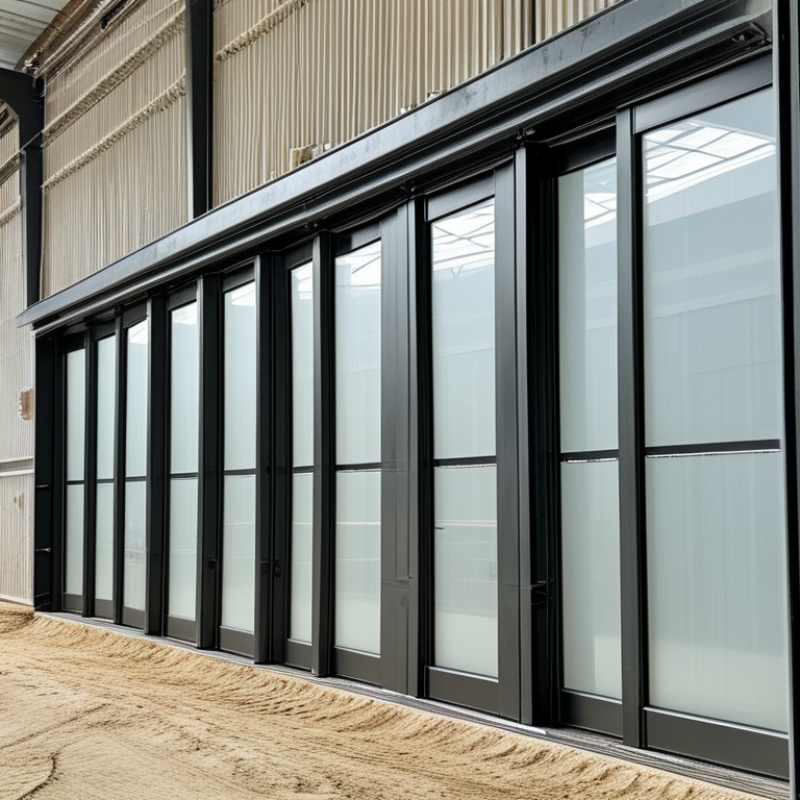
Choosing Heavy-Duty Sliding & Folding Doors requires more than comparing appearance and price. These systems must match the building’s structure, traffic patterns, climate, and daily workload. A warehouse may need wide clear openings for forklifts, while a commercial entrance may prioritize smooth movement and thermal comfort. The right decision begins with accurate site measurements, including opening width, headroom, floor levels, and available stacking space. Small errors matter. A few millimeters can affect alignment, sealing, and long-term operation.
Material selection also deserves careful attention. Steel offers strength for demanding industrial use, while aluminum can reduce weight and support corrosion resistance. Glass panels improve visibility, but they require suitable safety specifications and reliable framing. Track design is equally important. A floor track exposed to dust, grit, or water may need stronger drainage and regular cleaning. In coastal locations, protective finishes and corrosion-resistant hardware can prevent premature wear. These details often appear minor during installation.
Real-world performance depends on more than the door leaf itself. Hinges, rollers, locks, seals, and guide systems must work together. A supplier should provide tested load information, maintenance guidance, warranty terms, and installation records. Ask how the system performs after thousands of opening cycles. Ask what happens when one roller wears out. The answer may reveal more than a polished brochure.
There is no universal solution. Careful evaluation may take longer, but it reduces costly adjustments later. A dependable choice balances strength, access, safety, maintenance, and the building’s actual routine.
Heavy-duty sliding and folding doors come in several practical types. Each type handles weight, space, and traffic differently. Top-hung sliding doors carry their panels from an overhead track. They keep the floor clear, which helps forklifts and cleaning equipment move smoothly. Bottom-rolling doors use floor rails and strong wheels. They suit very wide openings, but dirt and ice can affect rail movement. Telescopic sliding doors use overlapping panels. They save wall space while creating a broad opening.
Folding doors use hinged panels that stack beside the opening. Bi-fold doors fold in pairs and need less side clearance than standard sliding doors. Multi-fold systems can cover large entrances, although their hinges and guides need regular inspection. In busy warehouses, I check the opening width, panel weight, wind exposure, and daily cycle count before recommending a type. A quiet showroom needs different hardware from a loading bay with constant vibration.
I once favored bottom-rolling systems for every large entrance. That choice was too simple. On a dusty site, cleaning the floor rails became a daily task. Top-hung designs performed better there, despite needing stronger overhead support. Folding doors also require careful alignment. A small frame error can make panels drag or refuse to stack neatly. Look closely at drainage, track protection, emergency access, and available maintenance space. The best choice may not be the widest or heaviest door.
A heavy-duty door should begin with a site survey, not a product brochure. Measure the clear opening at three points. Record width, height, headroom, and floor level. A 10-millimeter floor variation can affect rollers, seals, and folding alignment. Check whether the wall can carry the track and operating forces. Concrete, steel, and insulated panels require different fixing methods. Confirm drainage, standing water, dust, temperature, and wind exposure. These details often decide whether sliding or folding operation will remain reliable.
Traffic patterns matter. Count daily cycles and identify forklifts, pallets, pedestrians, and emergency routes. A sliding door needs lateral wall space for its leaves. A folding door needs safe stacking clearance beside the opening. Keep the operating path separate from pedestrian movement. NFPA 101 requirements should guide egress planning, while applicable machinery-safety standards should govern powered movement. Do not assume an existing frame is square. It often is not.
Energy performance also deserves attention. The International Energy Agency’s Energy Efficiency 2023 report identifies buildings as responsible for about 30% of global final energy use.
The U.S. Energy Information Administration’s 2018 CBECS reports space heating at approximately 32% of commercial building energy consumption.
Effective perimeter seals, sensible opening speeds, and reduced door-open time can therefore support operational efficiency. Yet perfect sealing is unrealistic in dusty, high-traffic facilities. I would rather specify replaceable seals and accessible hardware than promise maintenance-free performance. Inspect the doorway after installation, because drawings rarely reveal every site problem.
Material choice affects weight, maintenance, and service life. Steel frames carry heavy panels well, but exposed edges can rust in damp areas. Stainless steel resists corrosion better, although its higher cost may not suit every project. Aluminum is lighter and easier to operate, yet it may flex under large loads. For folding systems, rigid hinges and reinforced pivots matter as much as the frame material. A strong panel is useless with weak hardware.
Check the load rating for the complete door assembly, not only one roller or hinge. The rating should include panel weight, glass weight, operating forces, and repeated movement. Sliding doors need rollers matched to the track and floor condition. Folding doors place extra stress on pivots when several panels stack together. Ask for cycle-test data, fastener details, and allowable deflection. Numbers without test conditions can mislead.
Field experience shows that dust, uneven floors, and poor alignment cause many failures. Keep that in mind. A door rated for a high load may still operate badly when the track collects grit. I have seen lightweight doors last longer than heavier ones because they received better cleaning and adjustment. That observation is not universal, but it deserves attention. Inspect welds, seals, drainage paths, and replaceable wear parts before installation. In coastal or humid areas, specify suitable coatings and corrosion-resistant fasteners. Leave room for maintenance, because access often decides whether a repair is completed properly.
How to Choose Heavy Duty Sliding and Folding Doors
Heavy duty doors depend on hardware more than appearance. Check the door weight, opening frequency, and expected wind exposure before selecting rollers or hinges. Undersized components may operate smoothly at first, then develop noise, dragging, or uneven gaps. Choose corrosion-resistant tracks, sealed bearings, and adjustable guides for demanding environments. A level threshold matters. Even a small floor error can increase rolling resistance.
Safety features deserve equal attention. Look for anti-lift devices, secure locking points, finger protection, and controlled closing speed. Glazing should resist impact and remain safely contained if damaged. Sensors can stop powered doors when people or equipment enter the travel zone. Manual release access is essential during power loss. Keep controls visible and separate from crowded walkways. A qualified installer should verify clearances and test every safety function after installation.
The operating system should match daily use, not just the largest available specification. Manual doors suit low-traffic areas and offer simple maintenance. Electric systems improve convenience but require reliable controls, backup procedures, and scheduled inspections. Folding doors need balanced panels and synchronized movement. Sliding doors need clean tracks and properly aligned rollers. A common mistake is focusing on motor strength while ignoring maintenance access. That choice can make future repairs slower and more expensive. Real conditions are often messier than drawings suggest.
A practical specification review should give the greatest attention to hardware durability and safety. The weighting below is an engineering-oriented evaluation framework for comparing heavy-duty sliding and folding door systems; actual requirements should be confirmed against the project’s traffic, opening size, wind exposure, and applicable local regulations.
Hardware durability covers rollers, hinges, tracks, guides, and load capacity. Safety features include guarding, controlled closing, emergency release, and entrapment protection. Operating-system selection should consider manual effort, powered controls, backup operation, and maintenance access.
Choosing heavy duty sliding and folding doors requires more than comparing steel thickness. Installation quality affects alignment, safety, air control, and service life. The U.S. Energy Information Administration’s 2018 Commercial Buildings Energy Consumption Survey reported that space heating represented about 32% of commercial building energy use. Poorly sealed doors can increase drafts and operating costs, especially in warehouses with frequent traffic.
Specify trained installers who understand floor levels, structural loads, drainage, and operating clearances. Request documented commissioning, including roller adjustment, locking tests, and opening-force checks. Maintenance should follow actual usage, not only the calendar. Inspect tracks, hinges, seals, fasteners, and safety edges every month in busy facilities. Keep written service records with photographs. They reveal gradual wear.
Tips: Ask for spare rollers, seals, and hardware before installation. Confirm response times, inspection intervals, and technician coverage in the support agreement. The International Facility Management Association identifies preventive maintenance as a core tool for controlling asset risk, yet many plans remain too generic. That is a weakness worth admitting. A door may look sound while its track is carrying uneven loads. In my experience, small alignment problems become expensive after repeated forklift impacts. Select suppliers that provide manuals, training, measurable warranty terms, and long-term parts availability. Test the real workflow, including cold mornings, emergency access, and peak delivery periods. A perfect plan is unrealistic. A documented one is far more useful.
| Selection Dimension | Bottom-Rolling Sliding Door | Top-Hung Sliding Door | Heavy-Duty Folding Door | What to Verify Before Purchase |
|---|---|---|---|---|
| Best Application | Large industrial, warehouse, agricultural, and equipment openings where the structure can support a floor track. | Clean floor areas, service bays, interior partitions, and openings where a recessed or unobstructed floor track is preferred. | Locations requiring a wide clear opening with limited side or stacking space, including hangars, workshops, and logistics areas. | Confirm the opening dimensions, available stacking area, traffic pattern, wind exposure, and frequency of operation. |
| Typical Clear Opening | Often suitable for very wide openings; the practical limit is determined by panel weight, track design, structural support, and site conditions. | Suitable for wide openings when the header, carrier system, and building structure are engineered for the total suspended load. | Commonly used for wide openings because panels fold into compact stacks; the final width depends on panel count and folding geometry. | Request an engineered layout rather than selecting a door from opening width alone. |
| Load Transfer | Most door weight transfers to the floor through rollers and a properly supported track. | Most door weight transfers to the header, beam, or supporting structure through hangers and carriers. | Weight is transferred through hinges, guides, rollers, and either the floor or header, depending on the configuration. | Obtain structural calculations for headers, jambs, slabs, foundations, and any attachment points. |
| Floor Requirements | Requires a level, durable surface and an accurately aligned track. Drainage and debris control are important outdoors. | Can reduce floor-track obstructions, but the bottom guide or floor receiver still needs a stable and accurately aligned surface. | Requires a level operating area and adequate support for floor guides, hinges, or bottom rollers where used. | Check slab flatness, expansion joints, drainage, corrosion exposure, and the ability to repair the track area. |
| Header and Structural Support | Usually requires less suspended load at the header, although wind, guide, and operating forces still require proper support. | Requires careful header and beam design because the door assembly is suspended above the opening. | Requires support for the folding hardware and wind loads; the support arrangement varies by top-hung or bottom-rolling design. | Have a qualified engineer verify dead load, wind load, impact load, deflection limits, and connection details. |
| Manual Operation | Can be practical for moderate-use openings when panels are balanced and rollers are correctly adjusted. | Can operate smoothly with low rolling resistance, but misalignment or excessive header deflection can increase effort. | Manual operation is practical for smaller panel groups; larger assemblies may require assisted or powered operation. | Measure the expected opening cycles per day and specify an acceptable opening force for operators. |
| Powered Operation | Suitable for frequent traffic when the drive system includes appropriate controls, safety devices, and emergency release provisions. | Suitable for automated operation when the carrier, drive, and header structure are rated for the complete door assembly. | May use synchronized drives or powered operators; folding movement requires careful control of panel sequence and pinch points. | Specify duty cycle, travel speed, power supply, control location, emergency operation, and safety interlocks. |
| Wind and Weather Exposure | Can perform well outdoors when the track, guides, locks, seals, and frame are designed for the site wind conditions. | Needs robust guides and locking points to control movement caused by wind and pressure differences. | Requires strong hinges, guides, locking hardware, and panel connections because folded leaves can experience concentrated forces. | Use the project-specific design wind speed and exposure category; do not rely only on nominal door size. |
| Security and Locking | Can incorporate multiple locking points, floor receivers, drop bolts, and personnel access hardware. | Can provide secure locking, but suspended panels must be held against movement at the floor and jambs. | Requires coordinated locking across meeting stiles, jambs, and intermediate panel joints. | Define security level, forced-entry resistance, padlock or cylinder requirements, and emergency egress needs. |
| Personnel Door Integration | May include a wicket or personnel door, provided the design maintains safe clearances and structural integrity. | May include a personnel door, but the suspended system must accommodate the additional weight and hardware. | Can integrate a personnel door, although hinge zones, thresholds, and safety interlocks need special attention. | Confirm accessibility, threshold height, panic hardware, self-closing requirements, and interlock logic. |
| Routine Inspection | Inspect tracks, rollers, guides, stops, locks, seals, fasteners, and drainage paths at least periodically and more often in harsh environments. | Inspect carriers, hangers, header connections, guides, anti-jump devices, stops, and locking hardware. | Inspect hinges, rollers, guides, panel joints, locks, cables or drives, and pinch-point guards. | Set inspection intervals according to usage, environment, manufacturer instructions, and applicable safety requirements. |
| Lubrication | Lubricate serviceable bearings, hinges, and hardware only with products compatible with the door system; keep rolling tracks clean. | Lubricate approved carrier and hinge points while preventing excess lubricant from attracting dust to tracks or guides. | Lubricate hinges, pivots, rollers, and approved drive components according to the maintenance schedule. | Use a written lubrication chart that identifies the component, lubricant type, quantity, and service interval. |
| Cleaning and Corrosion Control | Remove dirt, gravel, ice, and standing water from tracks; inspect exposed steel, welds, fasteners, and coatings. | Keep the floor guide and carrier path free of debris; inspect suspended components for corrosion or cracking. | Clean between folding leaves and around hinges; check coatings, seals, fasteners, and drainage areas. | Select finishes and materials based on humidity, salt spray, chemicals, temperature, and wash-down procedures. |
| Expected Service Life | Service life depends on engineering, materials, environment, maintenance, impact frequency, and operating cycles. | Service life depends strongly on header rigidity, carrier condition, alignment, and the number of operating cycles. | Service life is influenced by hinge and roller wear, panel alignment, wind exposure, and operating discipline. | Ask for a cycle rating, replaceable wear-part list, inspection criteria, and documented maintenance requirements. |
| Spare Parts Planning | Keep critical rollers, bearings, guides, seals, locks, fasteners, and drive components available for the expected service period. | Keep carriers, hangers, anti-jump devices, guides, stops, seals, and locking parts identified by a service drawing. | Keep hinges, rollers, guides, cables or belts, locks, seals, and control components appropriate to the operating system. | Require part numbers, material specifications, lead times, interchangeability information, and storage recommendations. |
| Warranty and Documentation | Request written coverage for structure, finish, hardware, drives, controls, and workmanship with clear exclusions. | Request documentation covering suspended hardware, carriers, structural attachments, controls, and adjustment procedures. | Request separate coverage details for panels, hinges, rollers, guides, operators, controls, and safety devices. | Review warranty duration, required maintenance records, response limits, site exclusions, and commissioning requirements. |
| Long-Term Technical Support | Choose a supplier or service provider able to support alignment, roller replacement, automation, and weather-seal renewal. | Choose support that can inspect header attachments, carrier wear, deflection, alignment, and operating controls. | Choose support that can maintain hinge geometry, synchronized movement, guides, locks, and safety systems. | Verify service coverage, emergency response process, technician qualifications, remote troubleshooting, and planned modernization options. |
| Best Overall Choice When | Floor capacity is strong, extremely wide access is needed, and a robust floor track is acceptable. | Floor clearance is important and the building can safely support the suspended door load. | Maximum opening width and compact stacking are priorities, and the site can accommodate folding hardware and maintenance access. | Compare total installed cost, downtime risk, maintenance access, spare-parts availability, energy requirements, and lifecycle cost. |

Note: Dimensions, load capacities, cycle ratings, wind resistance, and service intervals must be confirmed through project-specific engineering, site measurements, applicable building codes, and the selected door system’s technical documentation.


For those larger-sized parts, or smaller quantity runs, we have 2 independent powder coat booths and ovens. The quality, durability and affordability of today’s powder coating finishes make this the process of choice for world-class companies.
Powder coating advantages over other forms of coating are many. Materials used in the Powder coating process can be metals and non-metals that come in a multitude of thicknesses, textures, colors, etc. Another of Powder coating’s biggest advantages over conventional coatings is its ability to create finishes in many different textures. Powder Coating Booths allow us the ability to apply these advantages to large products.
Tri-State Fabricators runs a full-service conveyor line for painting. Wet painting can provide protection or decoration to many different part styles. From start to finish, every project is easier to undergo random and point-based inspection by our skilled painting team.
Advantages to our Wet Paint Line are these lines start with product prep and ends with a thorough inspection of a high quality finished product. Our ability to complete large and small projects with a superior finish and doing so in a timely and economical fashion. This passes along the savings in production to our customers. When powder coating ins not an option, our Wet Paint Line gets the job done right the first time.
When the parts get big and heavy we roll-out our custom paint racks and oversize booth. By utilizing our partnerships with all the major paint brands, we can match virtually any color with wet paint.
The advantages of having access to a Wet Paint Booth are many. Large projects of many different shapes can be loaded into the booth. The Wet Paint Booth offers an environment that is much more controlled than a typical parts painting operation.
Not only are they used because of their controlled environment, but they’re are also advantageous when it comes to applying paint to parts that are needed in industries that require specialty coatings such as medical, aerospace, etc.
Our military forces have some very high standards when it comes to the finish of their vehicles and equipment. From the first pre-treatment step to final coat, it takes a great deal of knowledge and experience to protect the men and women of our armed forces. They deserve only the best, and Tri-State Fabricators provides it.
All of our processes are closely monitored by our staff and management teams. Both of which are highly trained in the processes of metal fabrication and finishing. Tri-State Fabricators’ goal is to always fully satisfy each and every customer, including the military. We will always put a 110% into what we do.
Abrasive media blasting is an excellent way to remove old paint, rust, and increase the paint/powder adhesion. Glass beads produce a much smoother and brighter finish than angular abrasives; leaving the part clean yet without any dimensional change. Chemically inert and environmentally friendly, we can recycle our beads approximately 30 times; making them a more preferred method of metal cleaning or surface finishing.
Advantages to Glass Bead Blasting are many. Glass bead blast media is used when a project is needing rough surfaces need to become smooth for applications of coatings such as paint. It is typically used to clean paint and rust from a product surface without deforming the surface it is being used on. Overall, compared to many other blasting media, Glass Bead Blasting is a very economical choice and those savings are always passed on to our customers.
Tri-State Fabricators utilize a zinc phosphate wash to clean and etch the material to ensure the best paint adhesion possible. The unique design of our 3-stage wash system does the work like a 5-stage. From Cleaning and rinsing to conversion coating and post-treatment, Our Part Washing process is a complete service and works throughout the fabrication service and the finishing service.
Along with the previously mentioned benefits, Curing is a vital chemical reaction that leaves the product finish hard and relatively safe from mild abrasion and aggressive corrosion. This process can be done in more than one way; ambient air-dry or in curing ovens at temps that exceed 240°.
From fixing paint mistakes (someone else’s of course) to simply cleaning our paint line hooks, our burn-off oven is put to good use. After a quick burn-off, a little clean up, and a fresh coat of paint, your parts will look better than new.
Why does our Burn-Off Oven work so well? Because super heating the air around parts turns the materials into ashes. From paint and powder coatings to rubber and machining oils, high temps do the job without degrading the integrity of the part.
Masking is a vital part of producing high quality products. We have die-cut masking patterns to protect machined surfaces as well as a wide range of plugs and caps to protect threaded holes and bolts. We provide permanent and temporary masking.
Masking allows the selected sections of a product to be protected from a fabrication or finishing service. This can be with both chemicals when etching and tapes, paints when only finishing just a section of the product. Masking is great in aiding the customization process of a project.
Screen printing is a photographic process that transfers artwork onto a porous nylon screen which allows colored ink to flow through the screen and be deposited on an aluminum or plastic component. We can generally have just about any design created onto a screen for your parts.
Some of the advantages of Screen Printing are, brand recognition for your business displaying on your products, assembly instructions, product warnings/hazards, etc. Tri-State Fabricators produces Screen Printing of the highest quality so you know it’s durable.
Metal Finishing is the art of treating the exterior portion of product, often metal but can also be made of other materials, so that the surface is clean and free of any debris. Then the process of applying coats or either paint of powder coat takes place. This coating process improves the quality of the product in both appearance and resistance to wear and corrosion.
Tri-State Fabricators, Inc., understands that a project typically isn’t complete until a high-quality finish has been added to your product. This is why our painting and powder coating teams continuously inspect the products throughout the Metal Finishing process.