


Choosing an Equipment Vibration Isolator in 2026 is not simply a matter of picking rubber mounts from a catalog. The right choice depends on the machine, its operating speed, its weight, and the floor beneath it. A compressor that hums steadily places different demands on an isolator than a press that delivers sharp, repeated impacts. Small mismatches can cause excess movement, noise, or premature wear.
A practical paraphrase of David A. Bies’s noise-control work is: “Control the transmission path, not just the source.” Bies co-authored Engineering Noise Control, a reference on managing sound and vibration. The principle is useful here: an isolator must suit both the equipment and the structure receiving its vibration. It is not a universal fix.
This guide outlines the key decisions: identifying the vibration, checking load and deflection, comparing isolator materials, and reviewing installation conditions. Begin with real operating data, not a guess based on machine size. Measure where possible. Consider temperature, oil exposure, available clearance, and maintenance access. These details matter on a crowded factory floor, where a mount may sit beside a warm motor or beneath a machine that must stay level. Manufacturer data can narrow the options, but it cannot replace a site-specific assessment. Some installations still require testing and adjustment. That uncertainty deserves attention. A careful selection process can reduce transmitted vibration and help equipment run more reliably, but results depend on the complete installation.
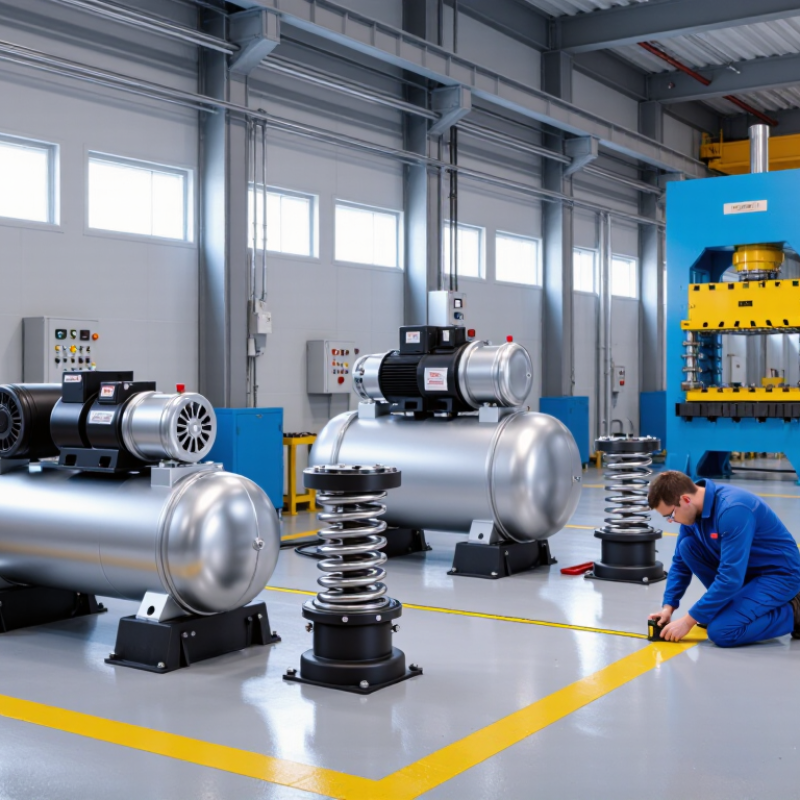
How to Choose an Equipment Vibration Isolator in 2026?
Start by defining the machine’s real operating range, not just its nameplate speed. For rotating equipment, convert shaft speed to excitation frequency: f = RPM / 60. A motor running at 1,800 RPM produces a 30 Hz rotational frequency. Record minimum, typical, and maximum speeds, including startup and shutdown. Measure, do not guess. Variable-speed drives can shift vibration frequencies while the machine runs.
The shaft frequency is only a starting point. Imbalance often creates vibration at 1× shaft speed, while misalignment, blade pass, or gear mesh can add other frequencies. Compare measured or calculated excitation frequencies with the isolator-and-equipment system’s natural frequency. Resonance can amplify motion instead of reducing it. Check the supported mass at each mounting point, expected movement, and changes in load; a pump’s operating condition may differ between a full and nearly empty tank. A neat calculation still needs field verification.
Tips: Log RPM and vibration during normal operation, then check the full speed range. Confirm that the isolator’s rated load suits each support, not only the total machine weight. If speeds vary widely, get a qualified vibration review before choosing stiffness. Real installations are imperfect; piping and uneven floors can alter results.

When choosing an equipment vibration isolator in 2026, start with the isolation target: frequency ratio r = f/fₙ must exceed √2. Here, f is the equipment’s operating vibration frequency, and fₙ is the mounted system’s natural frequency. Below this threshold, an isolator can amplify vibration rather than reduce it. Real installations are messier.
Check the machine’s full speed range, not just its steady operating speed. A pump running at 30 Hz, for example, may also produce vibration at 60 Hz from a second harmonic. Compare each important excitation frequency with the isolator’s natural frequency. A ratio just above √2 marks the theoretical start of isolation, not necessarily a useful design margin. Aim higher when practical, while checking the isolator’s load rating and available deflection.
Soft mounts can allow excessive movement. Too much damping can also reduce isolation at higher frequency ratios, even as it controls motion near resonance. Measure vibration on the equipment and supporting floor before and after installation. An accelerometer reading during startup can reveal a resonance that steady-state checks miss. Recheck the calculation if the load changes; real machines rarely match a tidy specification sheet.
The chart shows theoretical force transmissibility for a single-degree-of-freedom system with 5% damping. For this model, transmissibility falls below 1 when the frequency ratio r = f/fₙ exceeds √2. The curve is illustrative; actual performance depends on the equipment, isolator, and installation.
Choosing an equipment vibration isolator starts with its load and operating speed. For a spring isolator, estimate natural frequency with fₙ = 15.76/√δ, where δ is static spring deflection in millimeters and fₙ is in hertz. A 25 mm deflection gives about 3.15 Hz. Greater deflection generally lowers natural frequency, improving isolation above resonance. It also requires more travel and clearance beneath the equipment. Check the load at each support; uneven weight distribution can make one spring deflect differently from another. The equation is a useful estimate, not a complete selection method. Mount geometry, damping, and installation conditions matter too.
Tips: Measure the supported load carefully. Confirm available clearance. Compare natural frequency with operating and start-up speeds.
Do not select a spring by deflection alone. Check whether the equipment passes through resonance during start-up or shutdown, when vibration can briefly increase. Review the isolator’s rated load range and ensure the calculated deflection falls within it. A pump on a flexible floor may behave differently from the same pump on a rigid slab. That detail is easy to miss. If readings or floor conditions are uncertain, verify the design with a qualified vibration specialist before installation. After fitting, inspect for uneven settling and unexpected movement under normal operation.
Use the static spring deflection under the supported load to estimate the isolator’s undamped natural frequency. The values below are calculated examples, not product specifications.
| Static Deflection, δ (mm) | Estimated Natural Frequency, fₙ (Hz) | Natural Period (s) | Initial Selection Insight |
|---|---|---|---|
| 2 | 11.14 | 0.090 | Relatively stiff spring; check carefully against the equipment’s operating speeds. |
| 3 | 9.10 | 0.110 | Higher estimated natural frequency than the larger-deflection options below. |
| 4 | 7.88 | 0.127 | Compare the estimated frequency with the lowest significant excitation frequency. |
| 5 | 7.04 | 0.142 | A moderate deflection example; verify the spring’s rated load and working travel. |
| 6 | 6.43 | 0.156 | Lower estimated natural frequency than at 2–5 mm deflection. |
| 8 | 5.57 | 0.180 | Check available clearance and any limits on movement or equipment connections. |
| 10 | 4.98 | 0.201 | Use the actual loaded deflection, not the spring’s unloaded dimensions. |
| 12 | 4.55 | 0.220 | Assess whether the equipment and connected services can accommodate the movement. |
| 15 | 4.07 | 0.246 | Confirm spring stability, lateral restraint needs, and available operating travel. |
| 20 | 3.52 | 0.284 | Lower estimated natural frequency; check load distribution and installation constraints. |
| 25 | 3.15 | 0.317 | Evaluate movement limits, flexible connections, and any required restraints. |
| 30 | 2.88 | 0.347 | Large deflection example; confirm that the equipment and installation can safely accommodate it. |
Calculation: fₙ = 15.76/√δ, where δ is the loaded static deflection in millimeters and fₙ is in hertz. The period is calculated as 1/fₙ. These estimates assume a vertical linear spring; final selection should also account for operating speed range, damping, load per isolator, travel, stability, and applicable restraint requirements.
Choose elastomer, spring, or pneumatic mounts by load and environment
Load comes first. Weigh the operating equipment, including fluids, accessories, and uneven load distribution. Elastomer mounts suit compact pumps and fans where deflection is modest and the surroundings are relatively clean. They are simple to install, but heat, oil, and aging can change rubber stiffness. Check the maker’s temperature and chemical-resistance data; the same elastomer will not suit every plant room.
Spring mounts provide greater deflection for heavier machinery and lower-frequency vibration. ASHRAE’s Handbook—HVAC Applications describes isolator selection in relation to equipment forcing frequency and mount natural frequency. As a practical illustration, a 10 Hz mount under 30 Hz excitation has a frequency ratio of 3; a standard transmissibility calculation with 10% damping predicts roughly 14% vibration transmission. Real installations may perform worse.
Pneumatic mounts can provide very low natural frequencies and adjustable leveling, which helps with sensitive instruments or changing loads. They also need a reliable air supply and attention to leaks. Not always. Dust, washdown, temperature swings, and corrosion matter as much as the catalog load rating. ISO 10846-1:2008 sets out laboratory methods for measuring resilient elements’ vibration-transfer properties, but a lab result cannot reproduce every floor or pipe connection.
Check the installed system: rigid services can bridge the isolator, and a soft mount may allow excessive movement. I would verify load per mount, operating frequency, available deflection, and environmental limits before choosing; I have seen “correct” selections disappoint when field conditions were overlooked.
Choosing an equipment vibration isolator starts with the full speed range, not just the rated speed. Record operating speeds and note start-up and shutdown times. A fan may pass through a strong resonance band before reaching steady operation. Transmissibility compares vibration transmitted through the mount with vibration at its source. A high peak near the system’s natural frequency can cause noisy panels, moving pipes, or loose fasteners. Damping can control that peak, but too much damping may transmit more vibration at higher frequencies.
Tips: Ask for damping and transmissibility data across the actual speed range, including start-up. Check test conditions, supported load, and mount deflection. If possible, measure vibration on the equipment and its supporting floor during a real run. Measure both. A catalogue curve is useful, but it may not match uneven loading or a flexible frame.
Check the isolator under the heaviest and lightest expected loads. Load changes shift natural frequency, so one test point is rarely enough. Allow for temperature, ageing, and nearby vibration sources, too. These details are easy to miss. I would treat calculated performance as a starting estimate, then compare it with field measurements after installation. If start-up vibration remains high, review the mount layout and operating sequence before changing isolator stiffness.


For those larger-sized parts, or smaller quantity runs, we have 2 independent powder coat booths and ovens. The quality, durability and affordability of today’s powder coating finishes make this the process of choice for world-class companies.
Powder coating advantages over other forms of coating are many. Materials used in the Powder coating process can be metals and non-metals that come in a multitude of thicknesses, textures, colors, etc. Another of Powder coating’s biggest advantages over conventional coatings is its ability to create finishes in many different textures. Powder Coating Booths allow us the ability to apply these advantages to large products.
Tri-State Fabricators runs a full-service conveyor line for painting. Wet painting can provide protection or decoration to many different part styles. From start to finish, every project is easier to undergo random and point-based inspection by our skilled painting team.
Advantages to our Wet Paint Line are these lines start with product prep and ends with a thorough inspection of a high quality finished product. Our ability to complete large and small projects with a superior finish and doing so in a timely and economical fashion. This passes along the savings in production to our customers. When powder coating ins not an option, our Wet Paint Line gets the job done right the first time.
When the parts get big and heavy we roll-out our custom paint racks and oversize booth. By utilizing our partnerships with all the major paint brands, we can match virtually any color with wet paint.
The advantages of having access to a Wet Paint Booth are many. Large projects of many different shapes can be loaded into the booth. The Wet Paint Booth offers an environment that is much more controlled than a typical parts painting operation.
Not only are they used because of their controlled environment, but they’re are also advantageous when it comes to applying paint to parts that are needed in industries that require specialty coatings such as medical, aerospace, etc.
Our military forces have some very high standards when it comes to the finish of their vehicles and equipment. From the first pre-treatment step to final coat, it takes a great deal of knowledge and experience to protect the men and women of our armed forces. They deserve only the best, and Tri-State Fabricators provides it.
All of our processes are closely monitored by our staff and management teams. Both of which are highly trained in the processes of metal fabrication and finishing. Tri-State Fabricators’ goal is to always fully satisfy each and every customer, including the military. We will always put a 110% into what we do.
Abrasive media blasting is an excellent way to remove old paint, rust, and increase the paint/powder adhesion. Glass beads produce a much smoother and brighter finish than angular abrasives; leaving the part clean yet without any dimensional change. Chemically inert and environmentally friendly, we can recycle our beads approximately 30 times; making them a more preferred method of metal cleaning or surface finishing.
Advantages to Glass Bead Blasting are many. Glass bead blast media is used when a project is needing rough surfaces need to become smooth for applications of coatings such as paint. It is typically used to clean paint and rust from a product surface without deforming the surface it is being used on. Overall, compared to many other blasting media, Glass Bead Blasting is a very economical choice and those savings are always passed on to our customers.
Tri-State Fabricators utilize a zinc phosphate wash to clean and etch the material to ensure the best paint adhesion possible. The unique design of our 3-stage wash system does the work like a 5-stage. From Cleaning and rinsing to conversion coating and post-treatment, Our Part Washing process is a complete service and works throughout the fabrication service and the finishing service.
Along with the previously mentioned benefits, Curing is a vital chemical reaction that leaves the product finish hard and relatively safe from mild abrasion and aggressive corrosion. This process can be done in more than one way; ambient air-dry or in curing ovens at temps that exceed 240°.
From fixing paint mistakes (someone else’s of course) to simply cleaning our paint line hooks, our burn-off oven is put to good use. After a quick burn-off, a little clean up, and a fresh coat of paint, your parts will look better than new.
Why does our Burn-Off Oven work so well? Because super heating the air around parts turns the materials into ashes. From paint and powder coatings to rubber and machining oils, high temps do the job without degrading the integrity of the part.
Masking is a vital part of producing high quality products. We have die-cut masking patterns to protect machined surfaces as well as a wide range of plugs and caps to protect threaded holes and bolts. We provide permanent and temporary masking.
Masking allows the selected sections of a product to be protected from a fabrication or finishing service. This can be with both chemicals when etching and tapes, paints when only finishing just a section of the product. Masking is great in aiding the customization process of a project.
Screen printing is a photographic process that transfers artwork onto a porous nylon screen which allows colored ink to flow through the screen and be deposited on an aluminum or plastic component. We can generally have just about any design created onto a screen for your parts.
Some of the advantages of Screen Printing are, brand recognition for your business displaying on your products, assembly instructions, product warnings/hazards, etc. Tri-State Fabricators produces Screen Printing of the highest quality so you know it’s durable.
Metal Finishing is the art of treating the exterior portion of product, often metal but can also be made of other materials, so that the surface is clean and free of any debris. Then the process of applying coats or either paint of powder coat takes place. This coating process improves the quality of the product in both appearance and resistance to wear and corrosion.
Tri-State Fabricators, Inc., understands that a project typically isn’t complete until a high-quality finish has been added to your product. This is why our painting and powder coating teams continuously inspect the products throughout the Metal Finishing process.

