Industrial automation is growing, and operator interfaces must keep pace. The International Federation of Robotics reported 4,281,585 industrial robots operating in factories worldwide in 2023, a 10% rise from 2022. Its World Robotics 2024 report also recorded 541,302 new installations that year. These figures do not measure monitor demand directly. They do show why dependable, readable machine interfaces matter on busy production floors.
An Industrial Panel Mount Monitor connects people with machines, so choosing one involves more than matching screen size. Consider the control cabinet opening, viewing distance, ambient light, and available mounting depth. A bright screen may help beside a sunlit loading bay, while a sealed front can matter near washdown areas. Dust gets everywhere. Touch performance, operating temperature, connector placement, and the computer’s video output deserve equal attention. A technically impressive display can still fail the job if gloved operators struggle to use it or maintenance staff cannot reach its cables.
This guide explains how to compare panel size, resolution, brightness, touch technology, ingress protection, and mounting options in 2026. It also covers compatibility, service life, and supplier support, because the purchase price is only part of the cost. Fit comes first. Specifications can look clear on a datasheet, yet real installations are often messier. Measure the cutout, check the environment, and verify the interface before ordering. That extra check may feel obvious, but it is easy to skip.
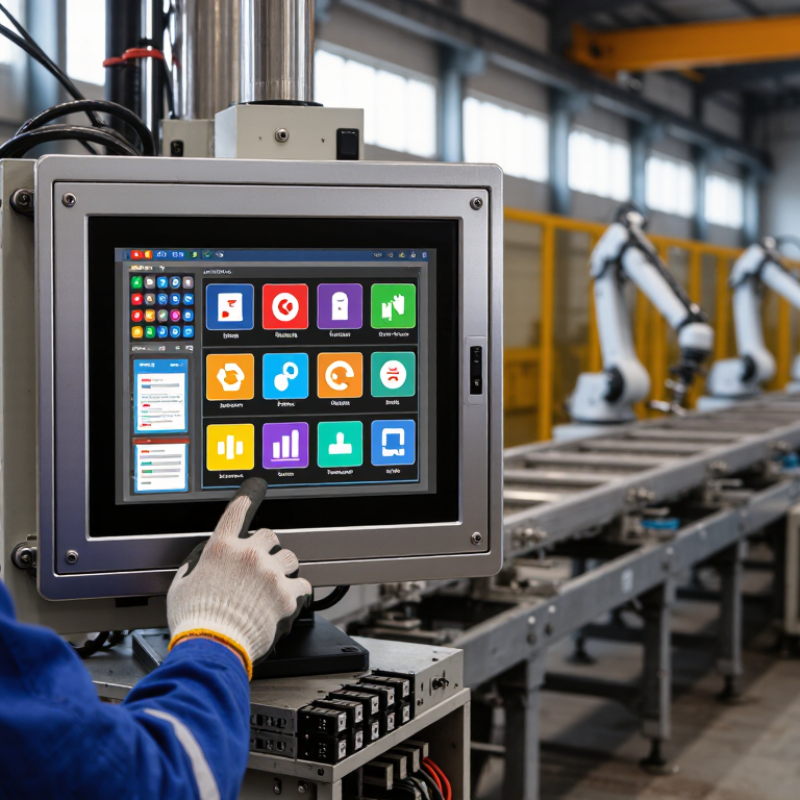
Start with the site. An industrial panel mount monitor may sit beside a warm machine, face a loading bay, or operate inside a washdown area. Record the expected temperature range, humidity, dust, splashes, vibration, and direct sunlight. Dust matters. A cabinet door can reduce exposure, but it may also trap heat. Check the temperature inside the enclosure during a normal production shift, not only the room temperature.
Then define the task. Will operators view alarms from several feet away, enter data with gloves, or inspect detailed graphics at close range? These needs affect screen size, brightness, touch technology, and viewing angle. Note how often the display will be used and which computer or control system it must connect to. Measure the panel cutout and available depth before choosing a unit. Measure twice. A connector that fits on paper may still collide with wiring behind the panel.
A common planning miss is focusing on the screen while overlooking cleaning routines and service access. If operators use thick gloves, test touch response with those gloves on; published specifications may not reflect the real workflow. If sunlight strikes the display at certain hours, check readability from the operator’s usual position. There is no perfect configuration. Extra brightness or sealing can bring trade-offs, so match each feature to a real site condition rather than guessing.
How to Choose an Industrial Panel Mount Monitor in 2026?
Compare Screen, Touch, and Visibility Requirements
Start with the task, not the largest screen available. Check how far operators stand from the panel and which details they must read. A 10-inch display may suit a compact machine, while a wider screen can keep process trends visible beside control buttons. Match resolution to the interface; extra pixels offer little value if labels remain tiny. Measure the cutout and bezel clearance before ordering. Measure twice.
Touch selection depends on the work environment. Projected capacitive touch supports familiar gestures, but thick gloves or moisture can interfere with input. Resistive touch may work better with gloves or a stylus, though its surface can feel less smooth. Test with the actual gloves, tools, and cleaning routine. A clean-room demo is not the whole story.
Visibility changes with lighting and viewing angle. Near a bright window or factory doorway, compare brightness and anti-glare performance under real conditions, not just a specification sheet. Check whether colors and text remain readable from the operator’s usual position. Avoid choosing maximum brightness automatically; it can add heat and discomfort in dim areas. There is no perfect panel. A small compromise in screen size may be sensible if touch accuracy and viewing comfort improve.
For an industrial panel mount monitor, begin with the cabinet opening, not the screen’s advertised size. Measure the cutout width and height, then check the bezel dimensions and mounting depth. A monitor can match the opening but still collide with a rear support, cable bend, or closed cabinet door. Small errors matter. Leave room for ventilation and service access, especially where heat or vibration is present.
Tips: Measure the cutout at several points; older panels may not be perfectly square. Compare the monitor’s mounting drawing with the actual enclosure before ordering. Measure twice.
System compatibility is just as important. Confirm the required resolution, video input, touch interface, and operating-system support. Check connector locations and cable lengths against the installed computer. If the display will be used with gloves or near splashing liquids, verify that its touch technology and front-panel protection suit those conditions. Do not assume that a familiar connector guarantees compatibility; signal formats and power requirements can differ. Record the measurements and interface details for the installation team. It is easy to overlook one cable or mounting tab, and correcting that mistake after installation costs time.
In 2026, assess an industrial panel mount monitor as part of the machine enclosure, not as a standalone screen. IEC 60529 defines IP ratings: IP65 means dust-tight protection and resistance to water jets. But a rating applies only to the tested configuration. Check the bezel, seals, connectors, and cable entry points together. A washdown area and a dusty packaging line need different protection. Review temperature and vibration limits, too. Ask for test conditions, not just a certificate number. No rating travels alone.
Downtime makes support a practical risk. Siemens’ 2024 True Cost of Downtime report estimates unplanned downtime costs large industrial companies about 11% of annual revenue, or roughly $1.4 trillion overall. That estimate is not monitor-specific, but it shows why replacement delays matter. Confirm the expected product lifecycle, repair options, spare-part availability, and lead times in writing. Check whether firmware updates and technical documentation remain available after installation. If your site needs a display for ten years, a short warranty may not tell the whole story. I would also verify the actual service route before purchase; support promises can sound clearer on paper than they feel during a shift.
When choosing an industrial panel mount monitor, compare more than purchase prices. Include installation, power use, cleaning, spare units, repair labor, and replacement time in your ownership-cost estimate. The U.S. Department of Energy’s life-cycle cost guidance recommends assessing costs across an asset’s full service life, not just at purchase. A low-cost display can become expensive if a failed touch layer requires a full unit replacement.
Supplier reliability matters when a line is waiting. Uptime Institute’s 2024 Annual Outage Analysis found that 54% of surveyed organizations reported their most recent significant outage cost more than $100,000. That figure concerns data-center outages, not monitor failures, so treat it as context—not a direct forecast. Still, it shows why support response time and available spares deserve attention. Ask suppliers for repair turnaround, warranty terms, component availability, and documented environmental test results. Get the answers in writing.
McKinsey has reported that predictive maintenance can reduce machine downtime by 30–50%; this is a broad industrial benchmark, not a promise for any monitor. Check whether the supplier offers diagnostics that help detect touch or backlight problems early. Then price a realistic spare strategy. One detail is easy to miss: a technically sound product may still be a poor choice if replacement units arrive slowly. Supplier claims also need checking. A response-time promise means little without a clear service process.



For those larger-sized parts, or smaller quantity runs, we have 2 independent powder coat booths and ovens. The quality, durability and affordability of today’s powder coating finishes make this the process of choice for world-class companies.
Powder coating advantages over other forms of coating are many. Materials used in the Powder coating process can be metals and non-metals that come in a multitude of thicknesses, textures, colors, etc. Another of Powder coating’s biggest advantages over conventional coatings is its ability to create finishes in many different textures. Powder Coating Booths allow us the ability to apply these advantages to large products.
Tri-State Fabricators runs a full-service conveyor line for painting. Wet painting can provide protection or decoration to many different part styles. From start to finish, every project is easier to undergo random and point-based inspection by our skilled painting team.
Advantages to our Wet Paint Line are these lines start with product prep and ends with a thorough inspection of a high quality finished product. Our ability to complete large and small projects with a superior finish and doing so in a timely and economical fashion. This passes along the savings in production to our customers. When powder coating ins not an option, our Wet Paint Line gets the job done right the first time.
When the parts get big and heavy we roll-out our custom paint racks and oversize booth. By utilizing our partnerships with all the major paint brands, we can match virtually any color with wet paint.
The advantages of having access to a Wet Paint Booth are many. Large projects of many different shapes can be loaded into the booth. The Wet Paint Booth offers an environment that is much more controlled than a typical parts painting operation.
Not only are they used because of their controlled environment, but they’re are also advantageous when it comes to applying paint to parts that are needed in industries that require specialty coatings such as medical, aerospace, etc.
Our military forces have some very high standards when it comes to the finish of their vehicles and equipment. From the first pre-treatment step to final coat, it takes a great deal of knowledge and experience to protect the men and women of our armed forces. They deserve only the best, and Tri-State Fabricators provides it.
All of our processes are closely monitored by our staff and management teams. Both of which are highly trained in the processes of metal fabrication and finishing. Tri-State Fabricators’ goal is to always fully satisfy each and every customer, including the military. We will always put a 110% into what we do.
Abrasive media blasting is an excellent way to remove old paint, rust, and increase the paint/powder adhesion. Glass beads produce a much smoother and brighter finish than angular abrasives; leaving the part clean yet without any dimensional change. Chemically inert and environmentally friendly, we can recycle our beads approximately 30 times; making them a more preferred method of metal cleaning or surface finishing.
Advantages to Glass Bead Blasting are many. Glass bead blast media is used when a project is needing rough surfaces need to become smooth for applications of coatings such as paint. It is typically used to clean paint and rust from a product surface without deforming the surface it is being used on. Overall, compared to many other blasting media, Glass Bead Blasting is a very economical choice and those savings are always passed on to our customers.
Tri-State Fabricators utilize a zinc phosphate wash to clean and etch the material to ensure the best paint adhesion possible. The unique design of our 3-stage wash system does the work like a 5-stage. From Cleaning and rinsing to conversion coating and post-treatment, Our Part Washing process is a complete service and works throughout the fabrication service and the finishing service.
Along with the previously mentioned benefits, Curing is a vital chemical reaction that leaves the product finish hard and relatively safe from mild abrasion and aggressive corrosion. This process can be done in more than one way; ambient air-dry or in curing ovens at temps that exceed 240°.
From fixing paint mistakes (someone else’s of course) to simply cleaning our paint line hooks, our burn-off oven is put to good use. After a quick burn-off, a little clean up, and a fresh coat of paint, your parts will look better than new.
Why does our Burn-Off Oven work so well? Because super heating the air around parts turns the materials into ashes. From paint and powder coatings to rubber and machining oils, high temps do the job without degrading the integrity of the part.
Masking is a vital part of producing high quality products. We have die-cut masking patterns to protect machined surfaces as well as a wide range of plugs and caps to protect threaded holes and bolts. We provide permanent and temporary masking.
Masking allows the selected sections of a product to be protected from a fabrication or finishing service. This can be with both chemicals when etching and tapes, paints when only finishing just a section of the product. Masking is great in aiding the customization process of a project.
Screen printing is a photographic process that transfers artwork onto a porous nylon screen which allows colored ink to flow through the screen and be deposited on an aluminum or plastic component. We can generally have just about any design created onto a screen for your parts.
Some of the advantages of Screen Printing are, brand recognition for your business displaying on your products, assembly instructions, product warnings/hazards, etc. Tri-State Fabricators produces Screen Printing of the highest quality so you know it’s durable.
Metal Finishing is the art of treating the exterior portion of product, often metal but can also be made of other materials, so that the surface is clean and free of any debris. Then the process of applying coats or either paint of powder coat takes place. This coating process improves the quality of the product in both appearance and resistance to wear and corrosion.
Tri-State Fabricators, Inc., understands that a project typically isn’t complete until a high-quality finish has been added to your product. This is why our painting and powder coating teams continuously inspect the products throughout the Metal Finishing process.


