

Choosing an Alloy Wheel Curing Oven is not just a matter of picking the largest chamber or the lowest quote. The right oven must match your wheel sizes, coating process, production volume, and available floor space. A compact workshop curing a few wheels each day has different needs from a busy line handling varied batches. Small details matter. Check the usable chamber dimensions, loading access, temperature range, and how evenly heat reaches wheels placed near the corners. A warm display reading does not prove every wheel receives the same cure.
Reliable selection starts with clear process requirements. Ask coating suppliers for their recommended curing temperatures and dwell times, then compare those values with the oven’s documented operating range. Review insulation, airflow, controls, and temperature monitoring, too. These features affect consistency, energy use, and the operator’s ability to spot problems. Request technical specifications and, where possible, discuss test results from applications similar to yours. A demonstration can reveal practical issues that a brochure may miss, such as awkward loading or slow recovery after the door opens.
There is no perfect oven for every shop. I would be cautious about claims that sound precise but lack supporting test conditions; even a good system may need adjustments after installation. This guide explains the main factors to compare, from capacity and temperature uniformity to safety features, maintenance, and supplier support. The aim is a practical choice that fits your actual workflow—not an impressive specification sheet alone.
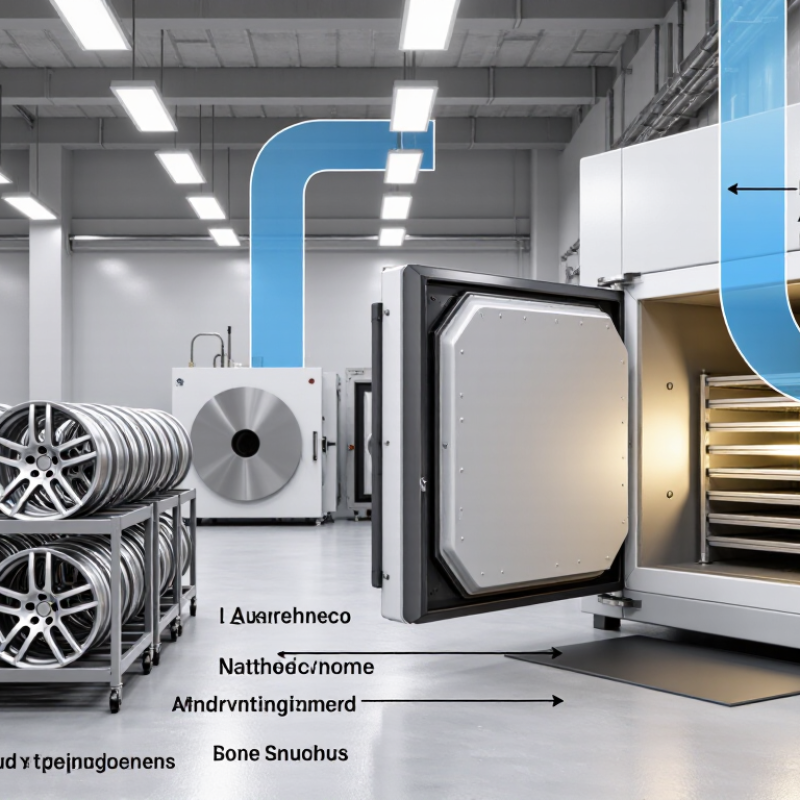
Define the wheel range before specifying an alloy wheel curing oven. Measure the smallest and largest diameters, widths, and finished weights. Note whether wheels enter on racks or a conveyor. A heavy wheel can shield inner surfaces from airflow, while crowded racks can create uneven heating. Small details matter. Also set a realistic hourly output target, including loading and unloading time. A quoted oven temperature alone is not a complete requirement.
The coating supplier’s technical data sheet should define the required part-metal temperature and cure duration. Oven air temperature is not the same as wheel temperature; verify the profile with temperature sensors attached to representative wheels. The U.S. Department of Energy’s 2015 Bandwidth Study on Energy Use and Potential Energy Savings Opportunities in U.S. Manufacturing estimates that process heating accounts for about 51% of manufacturing energy use. This broad figure is not specific to wheel finishing, but it shows why insulation, heat recovery, and operating hours belong in the specification. Ask for temperature-uniformity test results under a realistic load. I would not rely on an empty-oven reading. Include available floor space, power or fuel supply, ventilation, and future wheel sizes. A little uncertainty is normal; record assumptions and validate them in a production trial.

Choosing an alloy wheel curing oven starts with the wheel’s shape, batch size, and coating process. Batch ovens suit mixed production and allow operators to load wheels by hand. Continuous ovens move parts through a controlled cycle, helping maintain steady output. They need predictable loading, though. A wheel’s spokes and recessed barrel can create uneven airflow, so check temperature uniformity across the actual load, not just the empty chamber.
Heating method changes the result. Forced convection circulates hot air around the wheel and generally suits complex shapes, but the metal needs time to reach curing temperature. Infrared can heat surfaces quickly, yet spokes may cast thermal shadows and leave cooler areas. Hybrid systems combine radiant heat with convection, but add controls and commissioning work. The U.S. Department of Energy’s 2015 Quadrennial Technology Review estimates process heating uses roughly 17% of U.S. industrial energy. That makes insulation, airflow, and recovery time practical selection factors, not small details.
Ask suppliers to run a loaded test with thermocouples attached to representative wheel locations. Measure the metal temperature, not only the oven air. Coating cure schedules depend on part temperature and time; a fast air-temperature reading can mislead. I would also compare results across wheel sizes. One test may look perfect, while a heavier wheel exposes slow heat-up. That is easy to overlook.
| Comparison Factor | Batch Convection Oven | Conveyor Convection Oven | Infrared-Assisted Oven |
|---|---|---|---|
| Typical configuration | One or more wheels are loaded into an insulated chamber and cured as a batch. | Wheels travel through a heated tunnel on a conveyor at a controlled rate. | Infrared emitters provide radiant heat; the oven may also use convection to improve temperature distribution. |
| Heating method | Usually forced hot-air convection, heated by gas or electricity. | Usually forced hot-air convection, heated by gas or electricity. | Radiant infrared heats exposed surfaces; hybrid systems combine radiation with circulating hot air. |
| Best suited to | Low-to-medium output, varied wheel sizes, and flexible production schedules. | Steady, higher-volume production with repeatable loading and process settings. | Processes where faster surface heating is useful and the coating and wheel geometry are suitable for radiant heating. |
| Heat distribution | Can provide broadly uniform heating when airflow, loading, and spacing are properly designed and validated. | Can maintain consistent conditions along the line when airflow, conveyor loading, and line speed are controlled. | Heating can vary with distance, angle, surface finish, and shadowing; complex wheel features may need additional convection or careful emitter placement. |
| Wheel geometry and loading | Flexible for different wheel dimensions, but racks and spacing must allow airflow around each wheel. | Works best with consistent wheel spacing and a conveyor arrangement that avoids obstructing airflow. | Direct exposure matters; spokes, barrel surfaces, and recessed areas may receive different radiant heat levels. |
| Production workflow | Load, heat, hold, and unload cycles; convenient for mixed jobs but requires batch scheduling. | Continuous flow; supports a steady production pace but depends on reliable upstream and downstream handling. | May be installed as a separate heating stage or integrated into a batch or conveyor process. |
| Temperature control | Chamber temperature and cycle time are controlled; verify the wheel’s actual metal temperature during process qualification. | Temperature zones and conveyor speed control exposure; validate the wheel’s metal-temperature profile at operating load. | Emitter output and exposure time need control; surface temperature should be checked at representative wheel locations. |
| Space and installation | Requires chamber access and room for loading, unloading, and safe handling of hot wheels. | Typically needs more line length and space for conveyor, loading, and unloading areas. | Requirements depend on the emitter layout and whether the system is standalone or integrated with convection equipment. |
| Main selection considerations | Chamber capacity, airflow, rack design, batch size, and recovery time between loads. | Required throughput, tunnel length, zone control, conveyor speed, and loading consistency. | Coating compatibility, wheel shape, line-of-sight exposure, temperature monitoring, and need for supplementary convection. |
| Practical limitation | Production is interrupted between batches, and poor loading or airflow can create temperature variation. | Less flexible when production changes frequently; line speed and loading affect the cure profile. | Radiant heating may be uneven on intricate shapes and should not be assumed to cure every powder coating without testing. |
| Selection note: Follow the coating manufacturer’s specified cure schedule. Cure time is generally based on the part reaching the specified metal temperature, not simply on oven air temperature. Confirm the process with temperature measurements on representative wheels under actual loading conditions. | |||
Capacity is not just the number of wheels that fit inside an oven. Check wheel diameter, rack clearance, and space for air to move around each part. A tightly packed load can leave cool patches between spokes. Allow room for the largest wheel and the actual production rack, not an empty chamber.
Temperature control should track the wheel’s metal temperature, not only the oven’s display. Use a probe on a representative wheel during commissioning, then compare readings across rack positions. The U.S. Department of Energy’s process-heating sourcebook estimates that process heating accounts for about 36% of manufacturing energy use. That makes stable control and sensible loading relevant to both cure quality and operating cost. The figure is broad, though; it is not specific to wheel coating.
Airflow needs equal attention. Look for circulation that reaches the inner barrel and spoke pockets without leaving stagnant corners. Ask for temperature-uniformity data from a loaded oven, and check it with wheels arranged as they will be in production. Empty-oven readings can be misleading. I would still verify the cure schedule against the coating supplier’s instructions; airflow alone cannot fix an incorrect time or metal temperature. Source: U.S. DOE, Improving Process Heating System Performance: A Sourcebook for Industry.
How to Choose an Alloy Wheel Curing Oven?
Check Safety Features, Energy Use, and Maintenance Needs
An alloy wheel curing oven should protect operators and deliver steady, repeatable heat. Look for accessible emergency stops, guarded hot surfaces, and door interlocks that stop heating when opened. Over-temperature protection matters; ask how the oven responds if a sensor fails. Check that airflow and exhaust arrangements suit your coating process and workspace. The required curing schedule should come from the coating supplier, not guesswork. Check twice.
Energy use depends on more than the heater rating. Ask for typical consumption during warm-up and a full production cycle. Compare insulation thickness, door-seal design, and temperature recovery after loading. A poorly sealed door can waste heat, especially during frequent wheel changes. Batch planning helps, though oversized loads may heat unevenly. A temperature display alone cannot confirm every wheel reaches the required cure; ask whether temperature profiling is available.
Maintenance access is easy to overlook. Inspect fan blades, filters, seals, and electrical connections at intervals recommended by the oven maker. Ask how sensors are calibrated and whether replacement parts are straightforward to source. Keep a simple log of faults, cleaning, and temperature checks. I would also ask to see the maintenance instructions before purchase. A shiny control panel tells you little about the work needed behind it.
Compare the ideal heat required for different aluminum-alloy batch loads. This estimate assumes a starting temperature of 20°C, a target of 180°C, and a specific heat capacity of 0.9 kJ/kg·°C. It excludes energy used to heat the oven and losses through insulation, ventilation, and door openings, so actual electricity or fuel consumption will be higher.
When evaluating an oven, check for an independent over-temperature cutoff, suitable door interlocks, and effective ventilation. For energy efficiency, compare insulation and real-world consumption under your operating conditions. For easier maintenance, look for accessible filters, heating elements, and service panels. Always follow the coating supplier’s specified cure schedule and verify the required part-metal temperature.
An alloy wheel curing oven is only as dependable as its installation. Ask whether the supplier surveys the site before delivery, checks doorways and floor access, and confirms utilities, exhaust, and clearance requirements. Request a written commissioning plan. It should cover airflow checks, temperature mapping, controller calibration, and operator training—not just power-up.
The U.S. Department of Energy’s Industrial Process Heating overview estimates that process heating uses about 36% of manufacturing energy. The IEA’s Energy Efficiency 2023 report places industry’s share at roughly 37% of global energy use. These figures are broad, not wheel-shop benchmarks, but they underline why burner setup, insulation, and temperature control deserve careful verification. Ask for sample commissioning records and an explanation of how the supplier tests temperature uniformity across a loaded oven.
Check the supplier’s qualifications, too. Look for documented experience with industrial ovens, trained installation technicians, and clear service-response arrangements. Ask who handles electrical or fuel-system connections, and whether subcontractors are supervised. Get training materials, spare-parts guidance, and warranty terms in writing. A checklist can still miss a weak point. Observe the handover: can operators explain alarm responses and routine checks without guessing? If the supplier cannot show calibration records or explain a proposed site modification plainly, pause and ask for evidence.


For those larger-sized parts, or smaller quantity runs, we have 2 independent powder coat booths and ovens. The quality, durability and affordability of today’s powder coating finishes make this the process of choice for world-class companies.
Powder coating advantages over other forms of coating are many. Materials used in the Powder coating process can be metals and non-metals that come in a multitude of thicknesses, textures, colors, etc. Another of Powder coating’s biggest advantages over conventional coatings is its ability to create finishes in many different textures. Powder Coating Booths allow us the ability to apply these advantages to large products.
Tri-State Fabricators runs a full-service conveyor line for painting. Wet painting can provide protection or decoration to many different part styles. From start to finish, every project is easier to undergo random and point-based inspection by our skilled painting team.
Advantages to our Wet Paint Line are these lines start with product prep and ends with a thorough inspection of a high quality finished product. Our ability to complete large and small projects with a superior finish and doing so in a timely and economical fashion. This passes along the savings in production to our customers. When powder coating ins not an option, our Wet Paint Line gets the job done right the first time.
When the parts get big and heavy we roll-out our custom paint racks and oversize booth. By utilizing our partnerships with all the major paint brands, we can match virtually any color with wet paint.
The advantages of having access to a Wet Paint Booth are many. Large projects of many different shapes can be loaded into the booth. The Wet Paint Booth offers an environment that is much more controlled than a typical parts painting operation.
Not only are they used because of their controlled environment, but they’re are also advantageous when it comes to applying paint to parts that are needed in industries that require specialty coatings such as medical, aerospace, etc.
Our military forces have some very high standards when it comes to the finish of their vehicles and equipment. From the first pre-treatment step to final coat, it takes a great deal of knowledge and experience to protect the men and women of our armed forces. They deserve only the best, and Tri-State Fabricators provides it.
All of our processes are closely monitored by our staff and management teams. Both of which are highly trained in the processes of metal fabrication and finishing. Tri-State Fabricators’ goal is to always fully satisfy each and every customer, including the military. We will always put a 110% into what we do.
Abrasive media blasting is an excellent way to remove old paint, rust, and increase the paint/powder adhesion. Glass beads produce a much smoother and brighter finish than angular abrasives; leaving the part clean yet without any dimensional change. Chemically inert and environmentally friendly, we can recycle our beads approximately 30 times; making them a more preferred method of metal cleaning or surface finishing.
Advantages to Glass Bead Blasting are many. Glass bead blast media is used when a project is needing rough surfaces need to become smooth for applications of coatings such as paint. It is typically used to clean paint and rust from a product surface without deforming the surface it is being used on. Overall, compared to many other blasting media, Glass Bead Blasting is a very economical choice and those savings are always passed on to our customers.
Tri-State Fabricators utilize a zinc phosphate wash to clean and etch the material to ensure the best paint adhesion possible. The unique design of our 3-stage wash system does the work like a 5-stage. From Cleaning and rinsing to conversion coating and post-treatment, Our Part Washing process is a complete service and works throughout the fabrication service and the finishing service.
Along with the previously mentioned benefits, Curing is a vital chemical reaction that leaves the product finish hard and relatively safe from mild abrasion and aggressive corrosion. This process can be done in more than one way; ambient air-dry or in curing ovens at temps that exceed 240°.
From fixing paint mistakes (someone else’s of course) to simply cleaning our paint line hooks, our burn-off oven is put to good use. After a quick burn-off, a little clean up, and a fresh coat of paint, your parts will look better than new.
Why does our Burn-Off Oven work so well? Because super heating the air around parts turns the materials into ashes. From paint and powder coatings to rubber and machining oils, high temps do the job without degrading the integrity of the part.
Masking is a vital part of producing high quality products. We have die-cut masking patterns to protect machined surfaces as well as a wide range of plugs and caps to protect threaded holes and bolts. We provide permanent and temporary masking.
Masking allows the selected sections of a product to be protected from a fabrication or finishing service. This can be with both chemicals when etching and tapes, paints when only finishing just a section of the product. Masking is great in aiding the customization process of a project.
Screen printing is a photographic process that transfers artwork onto a porous nylon screen which allows colored ink to flow through the screen and be deposited on an aluminum or plastic component. We can generally have just about any design created onto a screen for your parts.
Some of the advantages of Screen Printing are, brand recognition for your business displaying on your products, assembly instructions, product warnings/hazards, etc. Tri-State Fabricators produces Screen Printing of the highest quality so you know it’s durable.
Metal Finishing is the art of treating the exterior portion of product, often metal but can also be made of other materials, so that the surface is clean and free of any debris. Then the process of applying coats or either paint of powder coat takes place. This coating process improves the quality of the product in both appearance and resistance to wear and corrosion.
Tri-State Fabricators, Inc., understands that a project typically isn’t complete until a high-quality finish has been added to your product. This is why our painting and powder coating teams continuously inspect the products throughout the Metal Finishing process.