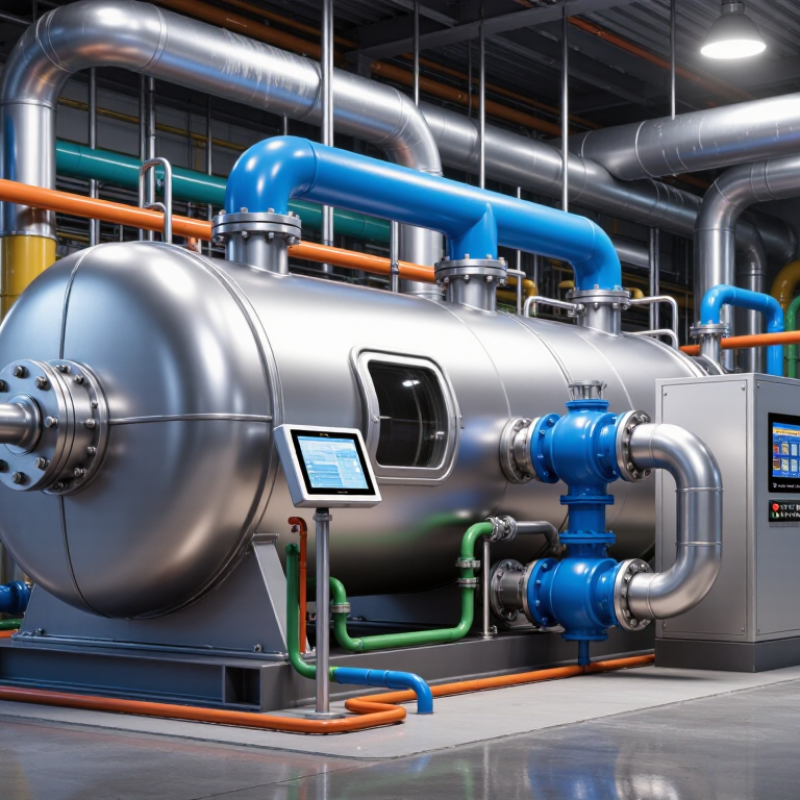
Choosing a Liquid Ring Vacuum Pump in 2026 requires more than comparing catalog prices. The correct pump must match the process, liquid, gas load, operating temperature, and required vacuum level. A paper mill, refinery, food plant, and wastewater facility may all need vacuum, but their operating conditions are rarely alike. That difference matters.
Dr. Karl Busch, founder of Busch Vacuum Solutions, expressed a practical principle: “Vacuum is not a product; it is a process.” This idea remains valuable when evaluating modern equipment. A reliable selection begins with real operating data. Measure the target pressure, inlet temperature, gas composition, moisture level, and expected running hours. Then examine the sealing liquid. Water may be suitable for one application, while another may require a compatible fluid with better vapor-pressure performance. Small details can change the final result.
Efficiency matters in 2026. Look beyond motor power. Review specific energy consumption, cooling-water demand, noise, maintenance intervals, and spare-parts access. Ask how the pump behaves during startup and fluctuating loads. That question is often missed.
A Liquid Ring Vacuum Pump can tolerate wet gases and carryover better than many dry technologies. However, it is not automatically the best choice. Poor sizing can create unstable vacuum, excessive liquid consumption, or disappointing performance. Real installations are messier than brochures suggest. Condensation, corrosion, and seasonal water changes may affect results.
This guide explains how to compare pump capacity, materials, control systems, lifecycle cost, and supplier support. It also highlights common selection mistakes. Some recommendations may require adjustment after site testing. That is not failure. It is responsible engineering.
A liquid ring vacuum pump creates vacuum with a rotating impeller and a sealing liquid. As the impeller turns, the liquid forms a moving ring inside the casing. Gas enters, becomes compressed, and leaves through the discharge port.
This design handles wet gases, condensable vapors, and small amounts of dust better than many dry systems. It is commonly used in chemical processing, food production, pharmaceuticals, pulp and paper, power plants, and wastewater treatment.
In practical plant rooms, the sealing liquid often determines performance. Water may work, but its vapor pressure can limit the final vacuum on hot days. A process-compatible liquid can improve results, but it may increase operating costs. Check gas temperature, required vacuum level, flow rate, corrosion risk, and liquid contamination before choosing.
In 2026, variable-speed control and basic condition monitoring can reduce wasted energy. Still, sensors cannot repair an incorrectly sized pump. A perfect selection rarely exists; operating conditions change, and early calculations may prove incomplete.
Tips: Request a tested performance curve at your actual liquid temperature. Confirm materials against every gas and cleaning chemical. Leave space for a separator, cooler, and maintenance access. Watch discharge temperature, vibration, and liquid consumption during commissioning. Small details matter.
Material selection starts with the process, not the pump price. Map the gas composition, liquid temperature, chloride level, solids, and expected vacuum range. Water is often suitable for clean air service. It becomes risky with acidic vapors, salty condensate, or high oxygen content. Corrosion can reduce wall thickness quietly. The AMPP IMPACT study estimates global corrosion costs at about 3.4% of global GDP. That figure makes material review more than a maintenance detail.
For aggressive gases, consider stainless steel, duplex alloys, or engineered coatings after checking chemical compatibility. Nickel alloys may suit severe acid exposure, but higher purchase cost does not guarantee longer life. Liquid temperature also changes vapor pressure and pump capacity. The wrong seal material can swell, crack, or leak within weeks. ISO 5389 provides a useful framework for testing centrifugal and liquid ring pump performance, but site conditions still control the result. A neat material chart can mislead. Real condensate often contains impurities missing from laboratory samples.
Tips: Request a condensate analysis before selecting materials. Include pH, chlorides, dissolved solids, and temperature changes. Ask for corrosion allowances and seal compatibility in writing. The U.S. Department of Energy notes that pumping systems can represent roughly 25% of industrial motor energy use. Efficient operation matters, but avoiding premature corrosion matters more. Leave room for uncertainty. Process chemistry can change after cleaning cycles, upset conditions, or seasonal production. Recheck the selection annually.
How to Choose a Liquid Ring Vacuum Pump in 2026?
Selecting a liquid ring vacuum pump starts with the process, not the catalog. Define the required absolute pressure at the vessel inlet. Do not confuse vacuum gauge readings with absolute pressure. A reading of -0.8 bar gauge is about 0.2 bar absolute at sea level. That difference changes the selection.
Estimate the gas load from vessel volume, leak rate, evaporation, and incoming air. Include moisture from wet products or cleaning cycles. Then match capacity at the actual operating pressure. A pump rated for high displacement may deliver much less flow near its maximum vacuum. Use the required evacuation time to check the calculation. For example, a 10 m³ vessel needing 100 mbar absolute pressure requires a different pump than a dry 10 m³ vessel. The calculation is simple, but the assumptions are often weak.
Seal-liquid temperature deserves careful attention. Warm liquid raises vapor pressure and can reduce the achievable vacuum. Check available flow, cooling capacity, discharge pressure, motor power, and material compatibility. Measure pressure near the vessel, not only at the pump inlet. Field tests often reveal small leaks around valves and flexible connections. A 15 to 25 percent capacity margin is practical, though it should not replace testing. I have seen tidy sizing sheets fail because they ignored humid air and seasonal water temperatures. Real operation is less clean than the spreadsheet.
| Target Condition | Absolute Pressure | Gauge Vacuum at Sea Level | Approximate Vacuum Percentage | Typical Engineering Use |
|---|---|---|---|---|
| Atmospheric pressure | 101.3 kPa abs | 0 kPa(g) | 0% | Reference pressure before evacuation |
| Coarse vacuum | 40 kPa abs | -61.3 kPa(g) | 60.5% | Vacuum conveying, rough degassing, and priming |
| Medium vacuum | 10 kPa abs | -91.3 kPa(g) | 90.1% | Filtration, evaporation, and vessel evacuation |
| Deep vacuum with cool seal water | 5 kPa abs | -96.3 kPa(g) | 95.1% | Drying, deaeration, and process holding |
| Approximate water-ring limit at 20°C | 2.34 kPa abs | -99.0 kPa(g) | 97.7% | Approximate thermodynamic limit for water-sealed operation |
| Seal-Water Temperature | Approximate Water Vapor Pressure | Practical Meaning for a Water-Sealed Pump | Recommended Engineering Action |
|---|---|---|---|
| 10°C | 1.23 kPa abs | Provides the lowest theoretical vapor-pressure limit in this range | Use when deep vacuum and stable cooling are required |
| 15°C | 1.71 kPa abs | Suitable for many deep-vacuum applications | Maintain a controlled supply and monitor temperature at the pump inlet |
| 20°C | 2.34 kPa abs | Common design reference for water-ring systems | Allow operating margin above the vapor-pressure limit |
| 30°C | 4.24 kPa abs | Deep-vacuum capability is significantly reduced | Improve cooling or select a higher-temperature sealing liquid |
| 40°C | 7.38 kPa abs | May prevent operation at low absolute pressures | Do not size the pump using cold-water performance data |
| Calculation Item | Formula or Method | Required Input | Example |
|---|---|---|---|
| Required pumping speed | Effective speed, S = Gas throughput, Q ÷ Suction pressure, P | Gas load in Pa·m³/s and target pressure in Pa abs | 0.12 Pa·m³/s ÷ 8,000 Pa = 0.000015 m³/s |
| Convert pumping speed to hourly capacity | Capacity in m³/h = Speed in m³/s × 3,600 | Calculated speed in m³/s | 0.000015 × 3,600 = 0.054 m³/h |
| Practical sizing margin | Select approximately 25% to 40% above the calculated duty point | Uncertainty in leakage, vapor release, temperature, and fouling | 54 m³/h calculated process load → approximately 68–76 m³/h minimum selected capacity |
| Gas-load conversion | 1 mbar·L/s = 0.1 Pa·m³/s | Gas load commonly stated in mbar·L/s | 1,200 mbar·L/s = 120 Pa·m³/s |
| Capacity conversion | 1 m³/h = 0.5886 ft³/min | Metric capacity requiring conversion to CFM | 100 m³/h ≈ 58.9 CFM |
| Application | Typical Target Pressure | Typical Capacity Range | Important Load to Include | Initial Selection Guidance |
|---|---|---|---|---|
| Small vessel evacuation | 20–60 kPa abs | 5–50 m³/h | Vessel volume, evacuation time, and leakage | Prioritize rapid evacuation and stable control |
| Vacuum filtration | 10–40 kPa abs | 20–250 m³/h | Filter cake resistance, filtrate vapor, and continuous air ingress | Check performance at the actual operating pressure |
| Deaeration and degassing | 2–20 kPa abs | 50–500 m³/h | Dissolved gas release, foaming, and liquid vapor | Use a separator or demister where carryover is possible |
| Evaporation | 5–40 kPa abs | 50–1,000 m³/h | High vapor load and condenser performance | Size from the vapor mass flow, not vessel volume alone |
| Vacuum drying | 2–20 kPa abs | 50–750 m³/h | Moisture evaporation rate and non-condensable leakage | Confirm that the condenser removes most condensable vapor |
| Priming and liquid transfer | 20–80 kPa abs | 10–150 m³/h | Pipe volume, liquid temperature, and entrained liquid | Provide liquid-separator protection at the suction inlet |
| Requirement | Recommended Design Check | Why It Matters | Typical Acceptance Target |
|---|---|---|---|
| Seal-liquid temperature | Measure temperature at the pump inlet and outlet | Vapor pressure rises rapidly as temperature increases | Keep the temperature within the selected pump curve conditions |
| Seal-liquid flow | Verify minimum and maximum flow at operating pressure | Insufficient liquid reduces sealing; excessive flow increases power and separator load | Follow the certified operating range for the selected pump |
| Gas composition | Identify air, oxygen, corrosive gases, solvents, and condensable vapors | Materials, safety classification, and sealing liquid may need to change | Confirm compatibility with all process gases and liquids |
| Inlet liquid carryover | Install a suction separator, knockout pot, or demister when required | Liquid slugs can damage the pump and overload the motor | No uncontrolled liquid slugging at the pump inlet |
| Discharge backpressure | Calculate separator, condenser, silencer, and piping pressure losses | High discharge pressure increases power and may reduce capacity | Keep backpressure below the pump’s certified limit |
| Motor power | Check absorbed power at the complete operating envelope | Power demand can change with suction and discharge pressure | Motor service factor should cover the maximum expected duty |
| Control method | Consider a variable-frequency drive, throttling valve, or seal-liquid control | Process demand often changes during evacuation and holding | Maintain stable pressure without excessive energy consumption |
| Noise and vibration | Check foundation, alignment, piping support, and operating speed | Two-phase flow and cavitation-like operation can increase vibration | Meet the applicable site and machinery vibration limits |
| Selection Question | If the Answer Is “Yes” | Recommended Direction |
|---|---|---|
| Is the target pressure close to the vapor pressure of the seal liquid? | Stable vacuum may be difficult to maintain | Lower the seal-liquid temperature, change the liquid, or select another vacuum technology |
| Does the process contain a large amount of condensable vapor? | The pump may experience a high thermal and volumetric load | Use a condenser or separator upstream and include remaining vapor in the gas-load calculation |
| Is the gas corrosive or chemically reactive? | Standard materials may not be suitable | Specify compatible metallurgy, elastomers, coatings, and seal liquid |
| Does the duty cycle change significantly? | Full-speed operation may waste energy during holding | Consider variable-speed control or an automatic vacuum regulation system |
| Is liquid carryover possible? | The pump may be exposed to liquid slugs or solids | Add inlet protection and confirm separator drainage arrangements |
| Is the required capacity stated only at free-air conditions? | The figure may not represent actual process performance | Use the certified capacity at the required suction pressure and seal-liquid temperature |
| Data Category | Minimum Information to Provide | Preferred Unit |
|---|---|---|
| Vacuum duty | Minimum, normal, and maximum suction pressure | kPa abs or mbar abs |
| Capacity | Gas load at the normal and worst-case operating points | m³/h, Nm³/h, kg/h, or mbar·L/s |
| Evacuation requirement | Vessel volume and required time from atmospheric pressure to target pressure | m³ and minutes |
| Vapor load | Condensable vapor type, mass flow, temperature, and expected condensation rate | kg/h and °C |
| Seal liquid | Liquid type, supply temperature, flow, quality, and disposal or recirculation method | °C and m³/h |
| Discharge conditions | Discharge pressure, piping length, separator pressure loss, and vent arrangement | kPa(g) or kPa abs |
| Installation conditions | Altitude, ambient temperature, available voltage, frequency, and hazardous-area classification | m, °C, V, Hz |

How to Choose a Liquid Ring Vacuum Pump in 2026?
Which Pump Configuration Fits Your Process and Installation Limits
Selecting a liquid ring vacuum pump starts with the process, not the catalog rating. Define the required vacuum level, gas flow, vapor load, and operating temperature. A single-stage configuration may suit moderate vacuum duties with steady gas flow. A two-stage design can reach deeper vacuum, but it usually requires more space, power, and careful liquid management. Small differences matter.
Installation limits often decide the practical configuration. A once-through liquid system can simplify piping where clean seal liquid is available. A recirculating system reduces liquid consumption but needs a separator, cooler, and reliable filtration. Check the available footprint, pipe direction, foundation strength, motor capacity, and discharge height. Measure twice. Retrofitting a cooler later is rarely simple.
Process liquid compatibility also deserves close attention. Contaminated liquid may damage internal surfaces or reduce sealing performance. Hot vapor can raise seal-liquid temperature and weaken vacuum stability. In field commissioning, operators should record suction pressure, liquid temperature, flow, vibration, and motor load. These readings reveal problems that a selection sheet may hide. A neat calculation can still mislead when the process changes during a shift. I would leave service access around the pump, even when space appears limited. That choice may feel wasteful today. It can prevent difficult maintenance tomorrow.
Which pump configuration fits your process and installation limits?
Typical minimum operating pressure is shown for water-sealed systems with approximately 15°C seal water, low non-condensable gas load, and stable operating conditions. Lower pressure indicates a deeper achievable vacuum. Actual performance depends on seal-liquid temperature, vapor pressure, gas composition, leakage, capacity, and available cooling.
How to Choose a Liquid Ring Vacuum Pump in 2026?
How to Compare Efficiency, Maintenance Needs, and Total Ownership Cost
A liquid ring vacuum pump should match the actual duty, not a brochure’s peak rating. Check suction pressure, gas temperature, vapor load, and operating hours. A pump running far below its design point may consume excessive power. Measure energy use in kilowatt-hours per cubic meter of displaced gas. Small details matter. Cooling water temperature can change performance noticeably during summer operation.
Maintenance needs deserve equal attention. During site inspections, I look for seal-water scaling, bearing heat, unusual vibration, and corrosion around the separator. Ask how quickly technicians can inspect the impeller and mechanical seals. Simple access reduces labor time. However, easy access does not guarantee low maintenance. Poor water quality can still create deposits within weeks.
Total ownership cost includes electricity, water, replacement parts, labor, downtime, and disposal expenses. Compare these costs over several years, using your real load profile. A lower purchase price can become expensive when the pump requires frequent seal replacement. Request service intervals and documented performance data. Independent testing is more useful than unsupported efficiency claims. I have seen calculations fail because standby hours and seasonal water use were ignored. That mistake is easy to repeat. A careful comparison should also examine noise, available spare parts, installation space, and local technical support.


For those larger-sized parts, or smaller quantity runs, we have 2 independent powder coat booths and ovens. The quality, durability and affordability of today’s powder coating finishes make this the process of choice for world-class companies.
Powder coating advantages over other forms of coating are many. Materials used in the Powder coating process can be metals and non-metals that come in a multitude of thicknesses, textures, colors, etc. Another of Powder coating’s biggest advantages over conventional coatings is its ability to create finishes in many different textures. Powder Coating Booths allow us the ability to apply these advantages to large products.
Tri-State Fabricators runs a full-service conveyor line for painting. Wet painting can provide protection or decoration to many different part styles. From start to finish, every project is easier to undergo random and point-based inspection by our skilled painting team.
Advantages to our Wet Paint Line are these lines start with product prep and ends with a thorough inspection of a high quality finished product. Our ability to complete large and small projects with a superior finish and doing so in a timely and economical fashion. This passes along the savings in production to our customers. When powder coating ins not an option, our Wet Paint Line gets the job done right the first time.
When the parts get big and heavy we roll-out our custom paint racks and oversize booth. By utilizing our partnerships with all the major paint brands, we can match virtually any color with wet paint.
The advantages of having access to a Wet Paint Booth are many. Large projects of many different shapes can be loaded into the booth. The Wet Paint Booth offers an environment that is much more controlled than a typical parts painting operation.
Not only are they used because of their controlled environment, but they’re are also advantageous when it comes to applying paint to parts that are needed in industries that require specialty coatings such as medical, aerospace, etc.
Our military forces have some very high standards when it comes to the finish of their vehicles and equipment. From the first pre-treatment step to final coat, it takes a great deal of knowledge and experience to protect the men and women of our armed forces. They deserve only the best, and Tri-State Fabricators provides it.
All of our processes are closely monitored by our staff and management teams. Both of which are highly trained in the processes of metal fabrication and finishing. Tri-State Fabricators’ goal is to always fully satisfy each and every customer, including the military. We will always put a 110% into what we do.
Abrasive media blasting is an excellent way to remove old paint, rust, and increase the paint/powder adhesion. Glass beads produce a much smoother and brighter finish than angular abrasives; leaving the part clean yet without any dimensional change. Chemically inert and environmentally friendly, we can recycle our beads approximately 30 times; making them a more preferred method of metal cleaning or surface finishing.
Advantages to Glass Bead Blasting are many. Glass bead blast media is used when a project is needing rough surfaces need to become smooth for applications of coatings such as paint. It is typically used to clean paint and rust from a product surface without deforming the surface it is being used on. Overall, compared to many other blasting media, Glass Bead Blasting is a very economical choice and those savings are always passed on to our customers.
Tri-State Fabricators utilize a zinc phosphate wash to clean and etch the material to ensure the best paint adhesion possible. The unique design of our 3-stage wash system does the work like a 5-stage. From Cleaning and rinsing to conversion coating and post-treatment, Our Part Washing process is a complete service and works throughout the fabrication service and the finishing service.
Along with the previously mentioned benefits, Curing is a vital chemical reaction that leaves the product finish hard and relatively safe from mild abrasion and aggressive corrosion. This process can be done in more than one way; ambient air-dry or in curing ovens at temps that exceed 240°.
From fixing paint mistakes (someone else’s of course) to simply cleaning our paint line hooks, our burn-off oven is put to good use. After a quick burn-off, a little clean up, and a fresh coat of paint, your parts will look better than new.
Why does our Burn-Off Oven work so well? Because super heating the air around parts turns the materials into ashes. From paint and powder coatings to rubber and machining oils, high temps do the job without degrading the integrity of the part.
Masking is a vital part of producing high quality products. We have die-cut masking patterns to protect machined surfaces as well as a wide range of plugs and caps to protect threaded holes and bolts. We provide permanent and temporary masking.
Masking allows the selected sections of a product to be protected from a fabrication or finishing service. This can be with both chemicals when etching and tapes, paints when only finishing just a section of the product. Masking is great in aiding the customization process of a project.
Screen printing is a photographic process that transfers artwork onto a porous nylon screen which allows colored ink to flow through the screen and be deposited on an aluminum or plastic component. We can generally have just about any design created onto a screen for your parts.
Some of the advantages of Screen Printing are, brand recognition for your business displaying on your products, assembly instructions, product warnings/hazards, etc. Tri-State Fabricators produces Screen Printing of the highest quality so you know it’s durable.
Metal Finishing is the art of treating the exterior portion of product, often metal but can also be made of other materials, so that the surface is clean and free of any debris. Then the process of applying coats or either paint of powder coat takes place. This coating process improves the quality of the product in both appearance and resistance to wear and corrosion.
Tri-State Fabricators, Inc., understands that a project typically isn’t complete until a high-quality finish has been added to your product. This is why our painting and powder coating teams continuously inspect the products throughout the Metal Finishing process.