A welding job can begin far from a reliable outlet: beside a pipeline, on a farm, or at a repair site with mud around the service truck. In these conditions, choosing a Heavy Duty Diesel Engine Welding Machine is about more than amperage. It is a decision about dependable power, transport, fuel use, and the demands of the workday. The right machine can support welding and, where equipped, provide auxiliary power for compatible tools.
The U.S. Bureau of Labor Statistics reports that welders, cutters, solderers, and brazers held about 418,200 jobs in 2023. Its Occupational Outlook Handbook projects roughly 45,800 openings each year from 2023 to 2033, including openings from workers leaving the occupation. These figures describe the wider workforce, not machine sales, but they show how much industrial and repair work depends on welding skills. Equipment choices matter.
Still, diesel power is not automatically the best fit. A buyer should compare rated welding output, duty cycle, engine service requirements, fuel capacity, noise, and the actual load expected on site. Look closely at the nameplate and manufacturer specifications. A larger machine may bring unnecessary weight and operating cost for light repairs. That trade-off is easy to overlook. This guide explains where heavy-duty diesel units make practical sense, what performance figures mean, and which questions help prevent a costly mismatch.
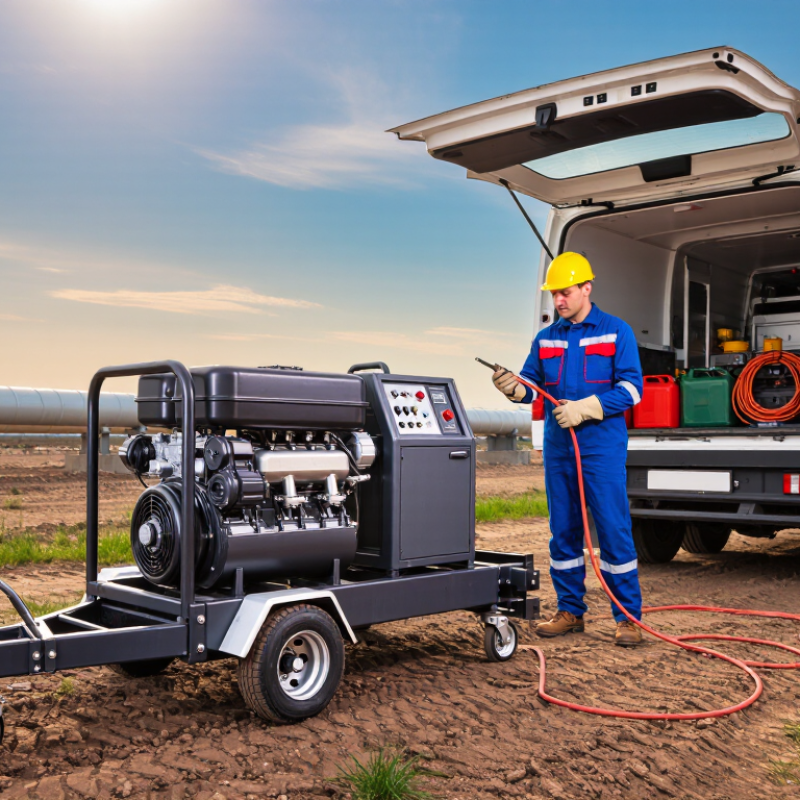
A heavy-duty diesel engine welding machine is a self-contained field unit. A diesel engine drives an alternator, which supplies welding current and, on many models, auxiliary electrical power. It can operate where utility power is unavailable, making it useful for remote repairs, construction sites, and maintenance yards. Operators should compare rated welding output, duty cycle, and auxiliary power rather than relying on the “heavy-duty” label alone. That label is not a universal performance standard.
Fuel choice matters, but the numbers need context. The U.S. Energy Information Administration reports that diesel contains about 10% more energy per gallon than gasoline. This describes fuel energy, not guaranteed machine runtime. Actual consumption depends on load, engine condition, and maintenance. A machine running a steady arc may use fuel differently from one powering tools between welds.
Tips: Check the duty-cycle rating at the amperage you expect to use. Inspect cables, air filters, and cooling passages before a long shift. Keep a simple fuel-and-runtime log; it can reveal patterns, though site conditions make comparisons imperfect. A common oversight is sizing only for welding output and forgetting the generator load.
A heavy-duty diesel engine welding machine links two systems: a power source and an arc controller. The engine turns the generator, which produces electricity for welding. That chain matters. When an electrode touches steel, the welding circuit must deliver enough current to establish and maintain an arc. Controls adjust output to suit the process and material thickness, while the engine governor responds to changing electrical demand by regulating engine speed.
On a worksite, these parts are only as useful as their setup. A long cable run can cause voltage drop, and loose connections may make the arc erratic. Check the leads, work clamp, fuel, and ventilation before striking an arc. Small details count. During a steady weld, the engine may sound consistent, but the control system is doing the finer work of managing current. This pairing supports welding away from grid power, though it does not remove the need to match output and duty cycle to the job. Cold starts, dust, and altitude can also affect performance. Real conditions are rarely perfect. The machine still needs sensible setup and regular inspection.
Why Choose a Heavy Duty Diesel Engine Welding Machine?
What Features Support Reliable Field Performance?
A heavy-duty diesel engine welding machine must deliver steady output far from a workshop. On a repair site, it may run beside a muddy access road or beneath a temporary shelter. Stable current helps maintain an even arc when welding thick sections. Check the rated output and duty cycle against the actual job, not just the machine’s peak rating. That matters.
A well-sized fuel tank can reduce refueling stops during long shifts. Clear gauges make fuel level and engine temperature easier to monitor outdoors. Reliable cold starting is useful on frosty mornings, while effective cooling helps during sustained work in warm weather. Still, no machine performs well if its air intake is clogged with dust. Accessible filters and service points can make routine maintenance less frustrating.
Field-ready construction also counts. A sturdy frame, secure lifting points, and practical wheel placement help with uneven ground. Vibration isolation can protect components over time, though it does not replace regular inspection. Look for controls that remain legible in poor light and connections that are protected from dirt and moisture. Small detail. Before choosing, consider whether the machine can power the electrodes and accessories your crew uses. A little extra capacity may help, but excessive size adds weight and fuel needs.
Diesel engine welding machines are often used where mains power is unavailable or unreliable. Think of a rural jobsite, a roadside repair area, or a farm several fields from the workshop. Their built-in engines supply welding power without a separate generator. That can reduce equipment to haul and set up. It helps, but it does not remove the need for proper planning.
On construction projects, crews use them for structural repairs, equipment maintenance, and field fabrication. Utility and pipeline teams may use them for approved repair work along long, remote routes. In agriculture, they can handle repairs to gates, trailers, and machinery during busy seasons. Forestry and mining operations also value portable welding power when equipment breaks far from a service bay. Access matters.
A heavy-duty unit suits repeated work, but the right choice depends on the job. Check its rated output, duty cycle, and compatibility with the intended welding process. A machine that looks powerful may still struggle with a particular electrode or long work cycle. Diesel exhaust also requires careful ventilation, especially in enclosed spaces. Portability can be overrated if the unit is too heavy for the site. Measure the route, not just the work area.
Choosing a heavy duty diesel engine welding machine starts with the work, not the largest amperage on the specification sheet. Check the electrode sizes, material thickness, and welding processes your crew uses most. A machine for occasional repairs on steel gates may not suit continuous work on thick structural sections. Look at rated output and duty cycle together. A high current rating means little if the machine must cool after brief operation.
Consider where the machine will run. On a remote site, measure access routes, estimate daily operating hours, and check whether the fuel tank supports a full shift. Muddy ground and frequent repositioning make frame design and lifting points important. Listen to the machine under load, if possible. Noise matters near occupied work areas. Also compare auxiliary power needs, since grinders and lights may share the generator. Small details add up.
Match the controls and connections to the operators. Clear current adjustment and accessible terminals can reduce setup delays, especially when gloves are on. Review service access, filter availability, and the maintenance schedule before buying. A machine that is hard to service can lose valuable work time. I would also leave some capacity for future jobs, but not pay for output that will sit unused. That balance is easy to misjudge. Test the machine with the actual leads, rods, and materials planned for the job.



For those larger-sized parts, or smaller quantity runs, we have 2 independent powder coat booths and ovens. The quality, durability and affordability of today’s powder coating finishes make this the process of choice for world-class companies.
Powder coating advantages over other forms of coating are many. Materials used in the Powder coating process can be metals and non-metals that come in a multitude of thicknesses, textures, colors, etc. Another of Powder coating’s biggest advantages over conventional coatings is its ability to create finishes in many different textures. Powder Coating Booths allow us the ability to apply these advantages to large products.
Tri-State Fabricators runs a full-service conveyor line for painting. Wet painting can provide protection or decoration to many different part styles. From start to finish, every project is easier to undergo random and point-based inspection by our skilled painting team.
Advantages to our Wet Paint Line are these lines start with product prep and ends with a thorough inspection of a high quality finished product. Our ability to complete large and small projects with a superior finish and doing so in a timely and economical fashion. This passes along the savings in production to our customers. When powder coating ins not an option, our Wet Paint Line gets the job done right the first time.
When the parts get big and heavy we roll-out our custom paint racks and oversize booth. By utilizing our partnerships with all the major paint brands, we can match virtually any color with wet paint.
The advantages of having access to a Wet Paint Booth are many. Large projects of many different shapes can be loaded into the booth. The Wet Paint Booth offers an environment that is much more controlled than a typical parts painting operation.
Not only are they used because of their controlled environment, but they’re are also advantageous when it comes to applying paint to parts that are needed in industries that require specialty coatings such as medical, aerospace, etc.
Our military forces have some very high standards when it comes to the finish of their vehicles and equipment. From the first pre-treatment step to final coat, it takes a great deal of knowledge and experience to protect the men and women of our armed forces. They deserve only the best, and Tri-State Fabricators provides it.
All of our processes are closely monitored by our staff and management teams. Both of which are highly trained in the processes of metal fabrication and finishing. Tri-State Fabricators’ goal is to always fully satisfy each and every customer, including the military. We will always put a 110% into what we do.
Abrasive media blasting is an excellent way to remove old paint, rust, and increase the paint/powder adhesion. Glass beads produce a much smoother and brighter finish than angular abrasives; leaving the part clean yet without any dimensional change. Chemically inert and environmentally friendly, we can recycle our beads approximately 30 times; making them a more preferred method of metal cleaning or surface finishing.
Advantages to Glass Bead Blasting are many. Glass bead blast media is used when a project is needing rough surfaces need to become smooth for applications of coatings such as paint. It is typically used to clean paint and rust from a product surface without deforming the surface it is being used on. Overall, compared to many other blasting media, Glass Bead Blasting is a very economical choice and those savings are always passed on to our customers.
Tri-State Fabricators utilize a zinc phosphate wash to clean and etch the material to ensure the best paint adhesion possible. The unique design of our 3-stage wash system does the work like a 5-stage. From Cleaning and rinsing to conversion coating and post-treatment, Our Part Washing process is a complete service and works throughout the fabrication service and the finishing service.
Along with the previously mentioned benefits, Curing is a vital chemical reaction that leaves the product finish hard and relatively safe from mild abrasion and aggressive corrosion. This process can be done in more than one way; ambient air-dry or in curing ovens at temps that exceed 240°.
From fixing paint mistakes (someone else’s of course) to simply cleaning our paint line hooks, our burn-off oven is put to good use. After a quick burn-off, a little clean up, and a fresh coat of paint, your parts will look better than new.
Why does our Burn-Off Oven work so well? Because super heating the air around parts turns the materials into ashes. From paint and powder coatings to rubber and machining oils, high temps do the job without degrading the integrity of the part.
Masking is a vital part of producing high quality products. We have die-cut masking patterns to protect machined surfaces as well as a wide range of plugs and caps to protect threaded holes and bolts. We provide permanent and temporary masking.
Masking allows the selected sections of a product to be protected from a fabrication or finishing service. This can be with both chemicals when etching and tapes, paints when only finishing just a section of the product. Masking is great in aiding the customization process of a project.
Screen printing is a photographic process that transfers artwork onto a porous nylon screen which allows colored ink to flow through the screen and be deposited on an aluminum or plastic component. We can generally have just about any design created onto a screen for your parts.
Some of the advantages of Screen Printing are, brand recognition for your business displaying on your products, assembly instructions, product warnings/hazards, etc. Tri-State Fabricators produces Screen Printing of the highest quality so you know it’s durable.
Metal Finishing is the art of treating the exterior portion of product, often metal but can also be made of other materials, so that the surface is clean and free of any debris. Then the process of applying coats or either paint of powder coat takes place. This coating process improves the quality of the product in both appearance and resistance to wear and corrosion.
Tri-State Fabricators, Inc., understands that a project typically isn’t complete until a high-quality finish has been added to your product. This is why our painting and powder coating teams continuously inspect the products throughout the Metal Finishing process.


