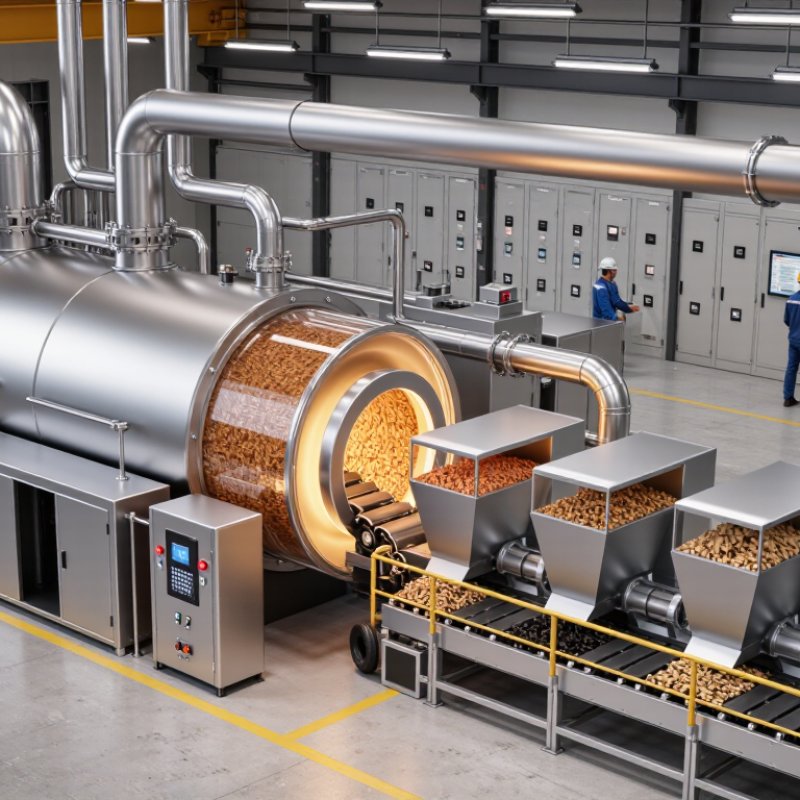
Choosing a Fully Electric Continuous Pyrolysis Plant requires more than comparing advertised capacity. The right system must match your feedstock, operating conditions, energy goals, and product requirements. Wood chips, agricultural residues, and waste tires behave differently inside a reactor. Moisture content matters. So does particle size.
Dr. Michael J. Antal Jr., a respected pyrolysis researcher, has emphasized a practical principle: pyrolysis performance should be proven through measured yields, energy balances, and emissions data. That principle remains highly relevant today. Buyers should request verified records for heating stability, residence time, power consumption, and output quality. A factory visit can reveal details that brochures often hide, such as uneven insulation, difficult cleaning points, or oversized electrical cabinets.
Look closely at the complete operating picture. A fully electric design may reduce direct combustion emissions, but it still depends on the electricity source and grid reliability. Ask how the plant manages sudden voltage changes, startup heating, emergency shutdowns, and continuous feeding. Review temperature sensors, control software, maintenance access, and spare-part availability. These details affect real production.
There is no perfect plant.
A supplier may provide impressive laboratory results, yet commercial performance can differ. That gap deserves attention. Independent testing, transparent calculations, and realistic guarantees support a safer decision. This guide explains how to compare reactor design, electrical efficiency, automation, safety provisions, after-sales service, and lifecycle costs before investing in a Fully Electric Continuous Pyrolysis Plant.
Wood chips, rice husks, and sewage sludge behave differently inside a reactor. Record moisture, ash, particle size, bulk density, and contamination levels. A wet feedstock can consume much more electricity during drying. That cost is easy to overlook.
Request laboratory testing using your actual material, not a generic sample. The results should include char quality, gas composition, oil yield, and residue levels.
Ask whether the quoted throughput means wet tonnes or dry tonnes per hour. A plant rated at five wet tonnes may process far less solid material after moisture removal. Check the feeder design, drying section, reactor residence time, and continuous discharge system.
Also examine expected uptime, maintenance intervals, and start-up energy demand. A smaller stable line may outperform a larger system that frequently stops.
Decide whether your priority is high fixed-carbon char, liquid products, combustible gas, or balanced output. Each target changes temperature, residence time, and energy requirements.
Build a simple mass and energy balance from measured feedstock data. Then compare electrical load per processed tonne.
The spreadsheet may still be wrong. Real feedstock varies by season, storage condition, and supplier. Include a pilot run and require documented test methods, safety controls, and performance limits before making a purchase.
Choosing a fully electric continuous pyrolysis plant requires more than reading its rated temperature. The heating system must prove stable performance between 500 and 800°C under real operating conditions. Ask for test records showing temperature uniformity, power consumption, and recovery time after feed changes. Independent thermocouples should verify the control system. Calibration records matter.
Hot spots matter. A reactor may display 650°C while material near the wall overheats. Request zone-by-zone data from the reactor, transfer sections, and discharge area. Then examine continuous operation. A reliable design should maintain steady heating during 24/7 production, not only during short demonstrations. Test it with a representative, lawful feedstock, rather than an empty chamber. Measure startup time, energy use, discharge temperature, and recovery after interruptions.
Run a sustained trial before purchasing. Inspect feeders, seals, motors, insulation, control cabinets, and emergency shutdown functions. Ask how alarms respond to power loss, temperature drift, or blocked discharge. Remote monitoring helps, but it cannot replace physical inspections. Do not accept smooth charts without raw data. Real operators should review maintenance intervals and spare-part access. Even strong equipment has weak points. I would check them early. A small temperature fluctuation may be acceptable, but repeated drift can increase energy use and reduce product consistency. Independent engineering review can expose gaps that sales demonstrations miss.
Choosing a fully electric continuous pyrolysis plant requires more than checking installed power. Measure electricity use in kWh per tonne of prepared feedstock. The U.S. Department of Energy’s Industrial Decarbonization Roadmap (2022) identifies process heating as roughly 51% of manufacturing energy demand. This makes thermal control a major operating cost, even without direct combustion.
Thermal efficiency should be tested during stable operation, not during a short demonstration. Request data for feed moisture, throughput, reactor temperature, and product yield. IEA Bioenergy Task 34 reports that pyrolysis performance changes significantly with feedstock and operating conditions.
A wet feed consumes more energy before useful conversion begins. Small details matter. Insulation quality matters too.
Some equipment specifications advertise 80–95% heat-recovery potential. Treat this range carefully.
It should describe recoverable process heat, not total electrical input or guaranteed savings. Ask whether recovered heat supports drying, feed preheating, or electricity generation. The European Commission’s Best Available Techniques reference documents emphasize measuring useful heat recovery under defined operating conditions.
A good test includes inlet and outlet temperatures, flow rates, and continuous meter records. A cold-start figure can mislead.
I would also compare seasonal performance, because summer heat demand may be lower. The strongest choice is the plant with independently verified data, transparent boundaries, and realistic maintenance assumptions.
One uncomfortable question remains: is the recovered heat actually usable every day?
Choosing a fully electric continuous pyrolysis plant starts with the reactor, not the brochure. A well-designed reactor should heat feedstock evenly while preventing cold pockets near the inlet. Electric heating can offer accurate control, but insulation quality still affects energy use. In practical operation, thermocouples should measure several zones, including the feeding and discharge areas. Small details matter.
Residence time must match the feedstock’s moisture, particle size, and target products. A short residence time may leave unconverted material, while excessive heating can reduce liquid yield or damage useful gases. Adjustable screw speed helps operators respond to changing feedstock conditions. However, laboratory settings do not always transfer perfectly to continuous production. That assumption can fail.
Throughput claims deserve careful testing under realistic conditions. Ask for data using similar moisture levels and particle sizes, not idealized samples. Product quality control should include routine checks of char moisture, ash content, particle structure, and liquid composition. Gas monitoring also supports safer, more consistent operation. Keep clear records for every batch and operating change. In my experience, trends reveal problems earlier than occasional inspections. A stable reactor temperature does not guarantee stable products. Feedstock variation, feeder wear, and sensor drift can quietly alter results. Operators should review these weaknesses instead of treating automation as a substitute for judgment.
| Assessment Dimension | Practical Reference Data | What to Look For in a Fully Electric System | Recommended Verification Method |
|---|---|---|---|
| Reactor Configuration | Common continuous designs include rotary kilns, screw reactors, moving-bed reactors, and fluidized-bed reactors. | Select a design that matches particle size, bulk density, stickiness, abrasion, and desired residence-time control. The reactor should provide uniform solids movement without oxygen ingress. | Review the mass-flow path, sealing arrangement, heat-transfer area, clean-out access, and demonstrated operation with the intended feedstock. |
| Operating Temperature | Slow and intermediate pyrolysis commonly operate around 350–600 °C; fast pyrolysis generally uses approximately 450–550 °C with rapid vapor removal. | Use independently controlled electric heating zones, accurate thermocouples, and automatic temperature adjustment along the reactor length. | Request temperature maps from multiple operating zones and confirm that measured solids temperature, not only wall temperature, is controlled. |
| Solids Residence Time | A practical continuous range is often about 10–60 minutes for solid material, depending on reactor type, particle size, temperature, and target product. | The feed rate, reactor speed, fill level, and discharge device should allow residence time to be adjusted without destabilizing temperature or pressure. | Use a tracer test or measured solids mass balance to determine actual residence-time distribution rather than relying only on theoretical calculations. |
| Vapor Residence Time | Fast vapor removal is typically required when maximizing condensable liquids; vapor residence time is often measured in seconds rather than minutes. | The vapor path should be short, insulated, and designed to limit secondary cracking, uncontrolled condensation, and tar deposition. | Check vapor-line temperature profiles, pressure drop, condensate collection efficiency, and inspection records for deposits. |
| Feedstock Moisture | Many systems perform more consistently when feed moisture is reduced to approximately 10–15% wet basis, although acceptable limits vary by design. | Include a reliable drying stage, moisture measurement, and automatic feed-rate adjustment. Excess water increases energy demand and can reduce liquid-product quality. | Test representative samples using a calibrated moisture analyzer and record moisture variation over several production shifts. |
| Particle Size and Preparation | Uniform particles commonly improve heat transfer and feeding stability; many systems use particles in the approximate 5–30 mm range. | The plant should include screening, metal removal, and a feeder suitable for the actual particle-size distribution and bulk density. | Measure particle-size distribution, bulk density, bridging tendency, and feeder torque using production feedstock. |
| Oxygen Exclusion | Pyrolysis requires an oxygen-limited environment; excessive oxygen can cause combustion, temperature excursions, and product loss. | Look for airlocks, nitrogen or recycled-gas purging where required, sealed discharge equipment, pressure monitoring, and automatic emergency isolation. | Review oxygen-analyzer readings, pressure-control performance, leak-testing procedures, and emergency shutdown logic. |
| Electric Heating Design | Electric heating demand depends on feed moisture, feed rate, heat losses, operating temperature, and heat recovery; it must be calculated from a complete energy balance. | Prefer staged heating zones, insulated hot surfaces, variable-power control, electrical protection, and a documented specific electricity-consumption target in kWh per tonne of feed. | Request a guaranteed energy balance covering drying, pyrolysis, vapor condensation, gas handling, and auxiliary equipment. |
| Throughput Stability | Continuous lines may range from laboratory and pilot scale below 0.1 t/h to commercial modules above 1 t/h; actual capacity is highly feedstock-specific. | Evaluate stable throughput, not only maximum nameplate capacity. The system should maintain temperature, pressure, and product quality during turndown and start-up. | Require a continuous performance test covering at least one full operating cycle, with recorded feed rate, uptime, energy use, and product yields. |
| Char Quality Control | Important indicators include moisture, ash, volatile matter, fixed carbon, pH, electrical conductivity, surface area, particle size, and contaminant content. | Provide consistent discharge cooling, screening, sampling, and sealed storage to prevent moisture uptake and cross-contamination. | Use representative composite samples and test them through a qualified laboratory against the intended end-use specification. |
| Pyrolysis Oil Quality | Relevant properties include water content, density, viscosity, acidity, ash, solids, stability, and heating value. Values vary substantially with feedstock and process conditions. | Use staged condensation, filtration, temperature control, and separate collection of heavy fractions where required. | Define acceptance limits before procurement and verify them through repeated laboratory analysis during the performance test. |
| Non-Condensable Gas | Product gas commonly contains combustible components such as carbon monoxide, hydrogen, methane, and light hydrocarbons, together with carbon dioxide and nitrogen. | Include gas cleaning, pressure regulation, flare or safe venting, and a controlled recycle or burner system for process heat. | Analyze gas composition, lower heating value, flow rate, and contaminant levels under different feed rates. |
| Yield and Mass Balance | Typical product distribution can vary widely: char, condensable vapors, and gas depend on feedstock composition, temperature, heating rate, and residence time. | Choose a plant based on guaranteed mass-balance ranges rather than a single ideal yield percentage. | Require measured input and output weighing, moisture correction, gas-flow measurement, and a documented mass-balance closure. |
| Control and Data Logging | Core variables include feed rate, zone temperatures, reactor pressure, oxygen concentration, motor load, power consumption, gas flow, and product temperatures. | Use automated alarms, trend records, recipe control, interlocks, and secure data export for quality traceability. | Inspect the control philosophy, alarm list, calibration schedule, historical trends, and manual override procedures. |
| Maintenance and Availability | Wear commonly occurs at feeders, seals, screws, bearings, refractory or insulation, condensers, filters, and gas-cleaning components. | Prioritize modular access, replaceable wear parts, clean-out ports, spare-parts availability, and a realistic planned-maintenance schedule. | Request preventive-maintenance intervals, expected service life of critical components, and historical availability data from comparable installations. |
| Emission and Safety Control | Potential hazards include combustible gas, carbon monoxide, hot surfaces, dust, pressure excursions, and oxygen-deficient atmospheres. | Include gas detection, ventilation, pressure relief, flame-failure protection, dust control, emergency shutdown, and documented operating procedures. | Complete a process hazard assessment and verify compliance with applicable local electrical, pressure, fire, environmental, and occupational-safety requirements. |

Choosing a fully electric continuous pyrolysis plant starts with emissions, not the electric label. Electric heating removes direct combustion, but purchased electricity still carries emissions. Request measured electricity use per tonne, startup demand, off-gas composition, and treatment efficiency. The IEA’s Global Methane Tracker 2024 estimates 120 million tonnes of methane emissions from fossil fuel operations in 2023. This supports strict leak detection, even when feedstocks are not fossil fuels. The European Commission’s 2019 Waste Incineration BAT report lists dust benchmarks of 2–5 mg/Nm³. These values are not pyrolysis limits, but they provide useful engineering context.
Safety requires more than a sealed reactor. Specify oxygen monitoring, inert-gas blanketing, pressure relief, explosion isolation, cooling circuits, and independent emergency shutdowns. NFPA 68 and NFPA 69 provide recognized guidance for deflagration venting and explosion prevention. Automation should record temperature across each heating zone, reactor pressure, oxygen concentration, feed rate, and motor current. Alarms need clear priorities. More sensors are not automatically safer.
Maintenance determines whether the business case survives. Ask for heater replacement intervals, screw and seal wear rates, calibration schedules, spare-part lead times, and planned downtime. Include labor, electricity tariffs, peak-demand charges, off-gas treatment, consumables, insurance, and lost production in the total cost of ownership. The U.S. Department of Energy notes that compressed-air leaks commonly waste 20–30% of compressor output; similar hidden losses can undermine auxiliary systems. I would challenge every optimistic payback period. Forecasts are useful, but plant data is better.


For those larger-sized parts, or smaller quantity runs, we have 2 independent powder coat booths and ovens. The quality, durability and affordability of today’s powder coating finishes make this the process of choice for world-class companies.
Powder coating advantages over other forms of coating are many. Materials used in the Powder coating process can be metals and non-metals that come in a multitude of thicknesses, textures, colors, etc. Another of Powder coating’s biggest advantages over conventional coatings is its ability to create finishes in many different textures. Powder Coating Booths allow us the ability to apply these advantages to large products.
Tri-State Fabricators runs a full-service conveyor line for painting. Wet painting can provide protection or decoration to many different part styles. From start to finish, every project is easier to undergo random and point-based inspection by our skilled painting team.
Advantages to our Wet Paint Line are these lines start with product prep and ends with a thorough inspection of a high quality finished product. Our ability to complete large and small projects with a superior finish and doing so in a timely and economical fashion. This passes along the savings in production to our customers. When powder coating ins not an option, our Wet Paint Line gets the job done right the first time.
When the parts get big and heavy we roll-out our custom paint racks and oversize booth. By utilizing our partnerships with all the major paint brands, we can match virtually any color with wet paint.
The advantages of having access to a Wet Paint Booth are many. Large projects of many different shapes can be loaded into the booth. The Wet Paint Booth offers an environment that is much more controlled than a typical parts painting operation.
Not only are they used because of their controlled environment, but they’re are also advantageous when it comes to applying paint to parts that are needed in industries that require specialty coatings such as medical, aerospace, etc.
Our military forces have some very high standards when it comes to the finish of their vehicles and equipment. From the first pre-treatment step to final coat, it takes a great deal of knowledge and experience to protect the men and women of our armed forces. They deserve only the best, and Tri-State Fabricators provides it.
All of our processes are closely monitored by our staff and management teams. Both of which are highly trained in the processes of metal fabrication and finishing. Tri-State Fabricators’ goal is to always fully satisfy each and every customer, including the military. We will always put a 110% into what we do.
Abrasive media blasting is an excellent way to remove old paint, rust, and increase the paint/powder adhesion. Glass beads produce a much smoother and brighter finish than angular abrasives; leaving the part clean yet without any dimensional change. Chemically inert and environmentally friendly, we can recycle our beads approximately 30 times; making them a more preferred method of metal cleaning or surface finishing.
Advantages to Glass Bead Blasting are many. Glass bead blast media is used when a project is needing rough surfaces need to become smooth for applications of coatings such as paint. It is typically used to clean paint and rust from a product surface without deforming the surface it is being used on. Overall, compared to many other blasting media, Glass Bead Blasting is a very economical choice and those savings are always passed on to our customers.
Tri-State Fabricators utilize a zinc phosphate wash to clean and etch the material to ensure the best paint adhesion possible. The unique design of our 3-stage wash system does the work like a 5-stage. From Cleaning and rinsing to conversion coating and post-treatment, Our Part Washing process is a complete service and works throughout the fabrication service and the finishing service.
Along with the previously mentioned benefits, Curing is a vital chemical reaction that leaves the product finish hard and relatively safe from mild abrasion and aggressive corrosion. This process can be done in more than one way; ambient air-dry or in curing ovens at temps that exceed 240°.
From fixing paint mistakes (someone else’s of course) to simply cleaning our paint line hooks, our burn-off oven is put to good use. After a quick burn-off, a little clean up, and a fresh coat of paint, your parts will look better than new.
Why does our Burn-Off Oven work so well? Because super heating the air around parts turns the materials into ashes. From paint and powder coatings to rubber and machining oils, high temps do the job without degrading the integrity of the part.
Masking is a vital part of producing high quality products. We have die-cut masking patterns to protect machined surfaces as well as a wide range of plugs and caps to protect threaded holes and bolts. We provide permanent and temporary masking.
Masking allows the selected sections of a product to be protected from a fabrication or finishing service. This can be with both chemicals when etching and tapes, paints when only finishing just a section of the product. Masking is great in aiding the customization process of a project.
Screen printing is a photographic process that transfers artwork onto a porous nylon screen which allows colored ink to flow through the screen and be deposited on an aluminum or plastic component. We can generally have just about any design created onto a screen for your parts.
Some of the advantages of Screen Printing are, brand recognition for your business displaying on your products, assembly instructions, product warnings/hazards, etc. Tri-State Fabricators produces Screen Printing of the highest quality so you know it’s durable.
Metal Finishing is the art of treating the exterior portion of product, often metal but can also be made of other materials, so that the surface is clean and free of any debris. Then the process of applying coats or either paint of powder coat takes place. This coating process improves the quality of the product in both appearance and resistance to wear and corrosion.
Tri-State Fabricators, Inc., understands that a project typically isn’t complete until a high-quality finish has been added to your product. This is why our painting and powder coating teams continuously inspect the products throughout the Metal Finishing process.