


Choosing a Commercial Drain Cleaning Machine in 2026 starts with the pipe, not the product brochure. A 3-inch kitchen branch with a grease buildup needs a different setup from a long, root-filled building drain. Cable diameter, reach, cutter options, and access points all matter. So do transport weight and the space around the cleanout. A machine that clears the line but strains the operator is not a complete solution.
The right choice depends on the work you actually handle. Compare cable machines with sectional units and water-jetting equipment for your typical pipe sizes, blockage types, and call volume. Check how quickly crews can change tools, contain debris, and maintain the machine. Ask about service access and replacement parts, too. Downtime has a price. Noise, splash, and a wet floor are practical details, not footnotes.
A note on attribution: I can’t verify a published statement from a named Commercial Drain Cleaning Machine expert, so I won’t invent one. The selection principle here is simple: match the machine to the pipe, blockage, and crew. It sounds obvious. It is easy to overlook when a powerful unit looks impressive in a showroom. This guide examines the trade-offs and leaves room for a less tidy truth: no single machine fits every job.
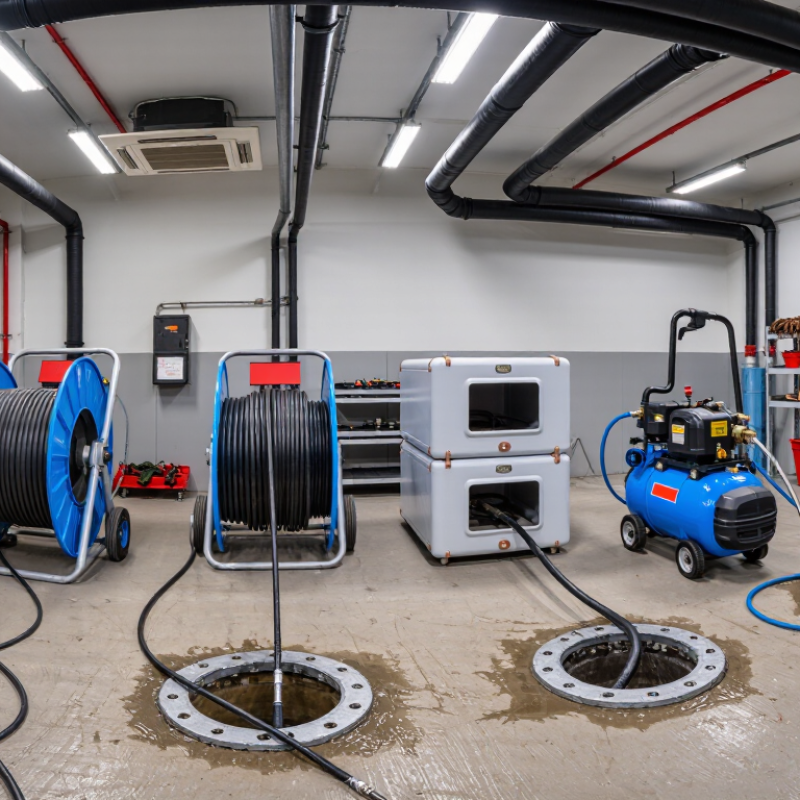
Choosing a commercial drain cleaning machine in 2026 starts with the drains your team handles most. Kitchen lines often contain grease and food residue, while restroom branches may collect paper and hair. Confirm pipe diameter, access points, and run length. A cable suited to a four-inch line may be awkward in a narrow branch. Check bends and cleanout locations, too. Paper specifications rarely show every snag.
Tips: Match the cable and cutter to the pipe material and blockage. Keep a simple record of recurring line sizes and trouble spots. If the pipe condition is uncertain, inspect it before choosing aggressive tooling.
Workload matters as much as pipe size. A crew clearing several lines each day may need a machine that moves easily between floors and handles repeated use. For occasional calls, a lighter unit may be easier to store and set up. Consider cable loading, controls, cleaning, and replacement parts; these affect real job time. Ask operators to test the machine on a representative line when possible. I would not choose by motor power alone. A powerful machine can still be the wrong fit for tight access or fragile piping.

Compare typical pipe-size ranges to narrow down the machine type for your work.
Smaller lines are often handled with handheld or drum machines; sectional machines suit a broader range of pipe sizes, while jetters are commonly selected for larger lines and grease or residue removal. These are general planning ranges, not guaranteed machine limits—check cable, nozzle, and machine specifications for the pipe material and blockage.
Cable machines solve localized clogs, such as grease or soft debris in a branch line. Its rotating head can cut through stubborn buildup, but it may leave residue on pipe walls. Match cable diameter and reach to the pipe; excessive force can damage weak or corroded sections. Small details matter.
Jetting machines use pressurized water to scour pipe walls and move sediment downstream. They can suit longer lines with heavy grease or scale, provided the pipe condition and drainage capacity are known. Jetting is not a safe default for every old or damaged pipe.
Inspection machines use a camera to locate blockages, check pipe condition, and confirm cleaning results. They diagnose; they do not clear the obstruction.
Tips: Identify pipe diameter, access points, and likely debris before choosing equipment. Use a camera when the cause is unclear or clogs return. Check hose, cable, and nozzle compatibility, and follow the machine’s operating guidance. A tempting shortcut is buying the most powerful unit, but power alone does not ensure a clean or undamaged line.
Choose a commercial drain cleaning machine by matching its power, reach, and tooling to the pipes you actually service. Small branch lines may need a compact cable unit, while long, heavily restricted runs can require greater torque and longer cable capacity. More power is not always better; an oversized machine can be difficult to control in smaller pipes. Check pipe diameter, material, access points, and typical blockage depth before comparing specifications. A tidy spec sheet can still mislead. That matters.
Tips: Measure common runs before purchasing. Keep enough cable for the furthest access point, but avoid feeding excess cable into a line. Match cutters to the obstruction: a retrieval head for soft debris, or a suitable cutting head for roots and scale. Follow the machine manual, wear appropriate protective equipment, and inspect cables for kinks or wear before each job.
Think about setup and cleanup, too. A machine that reaches the blockage but cannot pass through a doorway may slow the crew down. Test handling in realistic conditions when possible. I would not choose tooling from pipe size alone; bends and old joints can change what works. Leave room in the plan for a cautious first pass and a tool change.
When choosing a commercial drain cleaning machine in 2026, inspect its safety controls before comparing speed or cable capacity. Look for a functioning foot switch, cable guards, an accessible emergency stop, and clear instructions for handling rotating cables. A guarded cable opening can help limit contact, but it does not replace careful operation. Small details matter.
The U.S. Bureau of Labor Statistics reported 5,283 fatal work injuries in 2023, with a rate of 3.5 per 100,000 full-time-equivalent workers. That figure covers all industries, not drain cleaning specifically, but it reinforces why equipment hazards deserve attention. Ask whether operators receive hands-on practice with cable feeding, jam response, electrical checks, and personal protective equipment. A quick demonstration is not enough. Keep training practical.
Maintenance access affects safety, too. Check whether staff can inspect the cable, clean the drum, and reach wear parts without awkward lifting or improvised tools. Ask for a maintenance schedule and confirm that routine checks can be completed on site. I would not judge a machine by its service panel alone; access can look easy in a showroom and feel different in a cramped utility room. Test it there, if possible.
A commercial drain cleaning machine should be compared by its full working-life cost, not only its purchase price. Add the cutter set, replacement cables, protective equipment, transport, and staff training to the initial estimate. A machine that handles a 100-foot line may need extra cable for deeper runs. Check the actual configuration before comparing quotes. Small parts add up.
Build a three-to-five-year budget for routine service, wear items, and likely repairs. Ask what maintenance the operator can perform in-house and which tasks require a service technician. A lower-cost unit may become expensive if a common cable or motor part takes weeks to arrive. Downtime has a cost, too: crews wait, appointments shift, and customers may need a second visit. A spreadsheet helps, though estimates can still be optimistic when repair frequency is unknown.
Vendor support deserves specific questions. Confirm warranty coverage, response hours, service locations, parts availability, and whether phone troubleshooting is included. Ask for a sample maintenance schedule and realistic repair turnaround times. If possible, speak with a nearby contractor who uses similar equipment in comparable pipe sizes. That matters. Clear answers are more useful than broad promises, but support quality can vary by region and season. Record the quoted terms in writing, then revisit them against your expected workload before choosing.


For those larger-sized parts, or smaller quantity runs, we have 2 independent powder coat booths and ovens. The quality, durability and affordability of today’s powder coating finishes make this the process of choice for world-class companies.
Powder coating advantages over other forms of coating are many. Materials used in the Powder coating process can be metals and non-metals that come in a multitude of thicknesses, textures, colors, etc. Another of Powder coating’s biggest advantages over conventional coatings is its ability to create finishes in many different textures. Powder Coating Booths allow us the ability to apply these advantages to large products.
Tri-State Fabricators runs a full-service conveyor line for painting. Wet painting can provide protection or decoration to many different part styles. From start to finish, every project is easier to undergo random and point-based inspection by our skilled painting team.
Advantages to our Wet Paint Line are these lines start with product prep and ends with a thorough inspection of a high quality finished product. Our ability to complete large and small projects with a superior finish and doing so in a timely and economical fashion. This passes along the savings in production to our customers. When powder coating ins not an option, our Wet Paint Line gets the job done right the first time.
When the parts get big and heavy we roll-out our custom paint racks and oversize booth. By utilizing our partnerships with all the major paint brands, we can match virtually any color with wet paint.
The advantages of having access to a Wet Paint Booth are many. Large projects of many different shapes can be loaded into the booth. The Wet Paint Booth offers an environment that is much more controlled than a typical parts painting operation.
Not only are they used because of their controlled environment, but they’re are also advantageous when it comes to applying paint to parts that are needed in industries that require specialty coatings such as medical, aerospace, etc.
Our military forces have some very high standards when it comes to the finish of their vehicles and equipment. From the first pre-treatment step to final coat, it takes a great deal of knowledge and experience to protect the men and women of our armed forces. They deserve only the best, and Tri-State Fabricators provides it.
All of our processes are closely monitored by our staff and management teams. Both of which are highly trained in the processes of metal fabrication and finishing. Tri-State Fabricators’ goal is to always fully satisfy each and every customer, including the military. We will always put a 110% into what we do.
Abrasive media blasting is an excellent way to remove old paint, rust, and increase the paint/powder adhesion. Glass beads produce a much smoother and brighter finish than angular abrasives; leaving the part clean yet without any dimensional change. Chemically inert and environmentally friendly, we can recycle our beads approximately 30 times; making them a more preferred method of metal cleaning or surface finishing.
Advantages to Glass Bead Blasting are many. Glass bead blast media is used when a project is needing rough surfaces need to become smooth for applications of coatings such as paint. It is typically used to clean paint and rust from a product surface without deforming the surface it is being used on. Overall, compared to many other blasting media, Glass Bead Blasting is a very economical choice and those savings are always passed on to our customers.
Tri-State Fabricators utilize a zinc phosphate wash to clean and etch the material to ensure the best paint adhesion possible. The unique design of our 3-stage wash system does the work like a 5-stage. From Cleaning and rinsing to conversion coating and post-treatment, Our Part Washing process is a complete service and works throughout the fabrication service and the finishing service.
Along with the previously mentioned benefits, Curing is a vital chemical reaction that leaves the product finish hard and relatively safe from mild abrasion and aggressive corrosion. This process can be done in more than one way; ambient air-dry or in curing ovens at temps that exceed 240°.
From fixing paint mistakes (someone else’s of course) to simply cleaning our paint line hooks, our burn-off oven is put to good use. After a quick burn-off, a little clean up, and a fresh coat of paint, your parts will look better than new.
Why does our Burn-Off Oven work so well? Because super heating the air around parts turns the materials into ashes. From paint and powder coatings to rubber and machining oils, high temps do the job without degrading the integrity of the part.
Masking is a vital part of producing high quality products. We have die-cut masking patterns to protect machined surfaces as well as a wide range of plugs and caps to protect threaded holes and bolts. We provide permanent and temporary masking.
Masking allows the selected sections of a product to be protected from a fabrication or finishing service. This can be with both chemicals when etching and tapes, paints when only finishing just a section of the product. Masking is great in aiding the customization process of a project.
Screen printing is a photographic process that transfers artwork onto a porous nylon screen which allows colored ink to flow through the screen and be deposited on an aluminum or plastic component. We can generally have just about any design created onto a screen for your parts.
Some of the advantages of Screen Printing are, brand recognition for your business displaying on your products, assembly instructions, product warnings/hazards, etc. Tri-State Fabricators produces Screen Printing of the highest quality so you know it’s durable.
Metal Finishing is the art of treating the exterior portion of product, often metal but can also be made of other materials, so that the surface is clean and free of any debris. Then the process of applying coats or either paint of powder coat takes place. This coating process improves the quality of the product in both appearance and resistance to wear and corrosion.
Tri-State Fabricators, Inc., understands that a project typically isn’t complete until a high-quality finish has been added to your product. This is why our painting and powder coating teams continuously inspect the products throughout the Metal Finishing process.

