How to Choose a Cold Storage Condensing Unit in 2026?

Choosing a Cold Storage Condensing Unit in 2026 requires more than comparing horsepower and purchase prices. The right choice begins with the room’s real workload. Measure product pull-down, door openings, lighting, fan motors, wall insulation, and outdoor temperature. A freezer storing seafood may need very different performance from a chiller holding fresh vegetables.

Dr. Andy Pearson, a respected refrigeration engineer and former Star Refrigeration innovation director, has stated, “Good refrigeration design starts with understanding the application, not selecting equipment from a catalogue.” That principle remains useful. Review the required evaporating temperature, condensing temperature, refrigerant compatibility, oil return, defrost method, and control strategy. A unit that looks efficient on paper may struggle during a 40°C summer afternoon. Small details matter. Service access matters too.

In 2026, buyers should also examine low-GWP refrigerant options, seasonal efficiency, leak detection, sound levels, and long-term parts support. Check the manufacturer’s performance tables at your actual operating conditions. Do not rely only on nominal capacity. A system rated at one temperature can deliver far less capacity at another. Energy monitoring can expose poor settings after installation. It may also reveal that the original load estimate was wrong. That is not a failure; it is useful evidence.

This guide will compare practical selection factors, including capacity sizing, refrigerant choice, controls, installation conditions, maintenance access, and lifecycle cost. No single Cold Storage Condensing Unit fits every facility. The best decision balances reliable cooling, manageable energy use, safe operation, and realistic service support. Perfect forecasting is impossible. Careful measurement is still the strongest starting point.
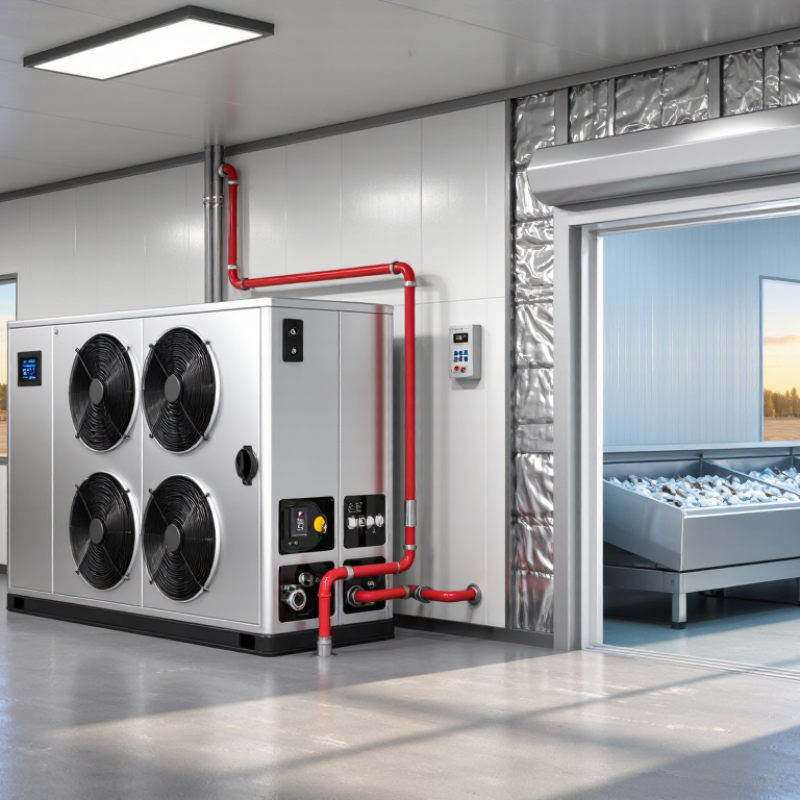
How to Choose a Cold Storage Condensing Unit in 2026?

Define Cold Storage Requirements and Operating Conditions

How to Choose a Cold Storage Condensing Unit in 2026?

Define Cold Storage Requirements and Operating Conditions

Start with the product, not the condensing unit. Fresh produce may need 0–5°C, while frozen goods commonly require temperatures near −18°C. However, the product’s respiration, packaging, loading temperature, and storage duration also affect the design. FAO reported that 13.2% of food was lost between harvest and retail in 2021. Poor temperature control remains one practical contributor.

Measure the real operating environment. Record the outdoor design temperature, room volume, insulation thickness, door openings, lighting, workers, and product load. ASHRAE Handbook—Refrigeration recommends evaluating transmission, infiltration, product pull-down, internal heat, and defrost loads. A unit sized only from room dimensions may fail during loading. It may also cycle excessively at night.

Small details matter. A busy door can introduce warm, humid air every few minutes. A pallet entering at 20°C creates a temporary refrigeration surge. Select evaporating temperature, condensing temperature, refrigerant compatibility, defrost method, and electrical capacity together. IEA reports that cooling demand is rising worldwide, increasing the value of efficient operation. Yet efficiency should not replace capacity checks. My own design reviews often find incomplete door-use records. That weakness deserves attention. Use measured data where possible, then test the selection against the hottest day and the heaviest loading period.

Calculate Cooling Capacity and Refrigeration Load

How to Choose a Cold Storage Condensing Unit in 2026?

Choosing a condensing unit starts with the refrigeration load, not the equipment catalogue. Measure room length, width, height, insulation thickness, and target temperature. A freezer at -18°C needs a different capacity than a chiller at 2°C. Calculate heat entering through walls, ceiling, floor, doors, products, lighting, fans, and workers.

Product load often changes the result dramatically. For example, cooling 500 kilograms of vegetables from 20°C to 2°C requires more capacity than maintaining already chilled goods. Use the product’s specific heat, pull-down time, and daily quantity. Add transmission and infiltration loads for an hourly estimate. Then apply a modest safety margin, commonly 10–20 percent. Oversizing is not always safer. It can cause short cycling, poor humidity control, and unnecessary energy use.

Tips: Record door openings during busy hours. Check the actual product temperature, not only the room display. Leave space around the evaporator for airflow. Select a unit whose rated capacity matches the required evaporating and condensing conditions. I once treated lighting as insignificant, but several high-output fixtures noticeably increased the load. That mistake was small, yet it changed the final selection. Recheck assumptions with a refrigeration technician, especially when temperatures, product loads, or ambient conditions vary.

Choose the Refrigerant and Compressor Configuration

Choosing a refrigerant is the first practical decision for a cold storage condensing unit. Match its temperature range to the room, product, and evaporator design. A freezer operating near -25°C needs different performance from a chiller at 2°C. Check cooling capacity at the actual evaporating and condensing temperatures. Catalog ratings can mislead when site conditions differ.

Consider environmental impact, availability, safety class, and service requirements. Refrigerant pressure affects component selection and installation practices. Some refrigerants also show temperature glide, which can influence charging and system diagnosis. Compressor configuration matters equally. A single compressor may suit a small, steady load. Tandem or parallel compressors can improve capacity control and provide partial operation during low demand. Variable-speed compressors may reduce cycling, but their controls require careful commissioning. More flexibility means more points to inspect.

Tips: Record the room temperature, product load, door openings, and ambient temperature before sizing. Ask the installer to confirm oil compatibility, suction-line sizing, receiver volume, and defrost interaction. Watch the unit during a warm afternoon, not only during a factory test. Short cycling is a warning. Frost on the suction line may indicate poor airflow, incorrect superheat, or an inaccurate sensor. No choice is perfect. I have seen efficient systems underperform because the load schedule was guessed rather than measured. Leave room for seasonal changes and future maintenance.

Match Condensing Unit Features to the Cold Room

How to Choose a Cold Storage Condensing Unit in 2026?

Choosing a condensing unit in 2026 starts with the cold room, not the catalog. Record room volume, target temperature, insulation thickness, door openings, and stored product. A freezer at -18°C needs different evaporating conditions from a chilled room at 2°C. These differences affect compressor capacity, refrigerant control, defrost planning, and electrical demand. Measure real usage, not only design assumptions. Frequent loading can add more heat than a basic product calculation shows. Leave service space around the unit, especially in dusty or humid locations. Poor airflow can reduce capacity and shorten component life.

Compare the unit’s rated capacity at your actual evaporating and condensing temperatures. A large capacity number can mislead when tested under different conditions. Check fan control, receiver size, oil return, noise limits, and low-ambient operation. For a small cold room, oversized equipment may cycle too often and create unstable temperatures. For a busy room, an undersized unit may run continuously. Neither choice is harmless. The first estimate is rarely perfect, so review it against expected door traffic and product loading. A qualified technician should verify pipe length, voltage, safety protection, and commissioning settings.

Tips: Sketch a 24-hour door-opening pattern. Include delivery periods. Record pressure, superheat, subcooling, and room recovery time after installation. These practical readings often reveal problems that a brochure cannot.


Compare Efficiency, Controls, Maintenance, and Total Cost

How to Choose a Cold Storage Condensing Unit in 2026?

Compare Efficiency, Controls, Maintenance, and Total Cost

Choosing a cold storage condensing unit requires more than comparing the purchase price. Start with the room temperature, product load, door openings, insulation quality, and local ambient conditions. A unit that looks efficient in a catalogue may consume more energy when exposed to dust, heat, or frequent defrost cycles. Check seasonal efficiency, compressor modulation, fan control, and part-load performance. These details often matter more than the headline rating.

Controls should provide stable temperatures without creating unnecessary complexity. Sensors must be positioned correctly, while alarms should identify high temperature, pressure faults, and repeated cycling. Remote monitoring can reduce emergency visits, but poor commissioning may produce misleading data. Keep it practical. Operators still need clear displays and simple recovery procedures during network failures.

Maintenance access directly affects operating cost. Look for removable panels, accessible filters, service valves, and commonly available components. A technician should be able to inspect the condenser without moving half the installation. Schedule coil cleaning, electrical checks, refrigerant leak inspections, and performance testing. Small neglect becomes expensive. Total cost includes energy, labor, downtime, replacement parts, and disposal requirements. A slightly cheaper unit may be the wrong choice if it needs frequent specialist service. I would also question oversized equipment; it can cycle excessively and reduce control stability. A careful load calculation remains the safer investment.

Powder Coat Booths

For those larger-sized parts, or smaller quantity runs, we have 2 independent powder coat booths and ovens. The quality, durability and affordability of today’s powder coating finishes make this the process of choice for world-class companies.

Powder coating advantages over other forms of coating are many. Materials used in the Powder coating process can be metals and non-metals that come in a multitude of thicknesses, textures, colors, etc. Another of Powder coating’s biggest advantages over conventional coatings is its ability to create finishes in many different textures. Powder Coating Booths allow us the ability to apply these advantages to large products.

Wet Paint Line

Tri-State Fabricators runs a full-service conveyor line for painting. Wet painting can provide protection or decoration to many different part styles. From start to finish, every project is easier to undergo random and point-based inspection by our skilled painting team.

Advantages to our Wet Paint Line are these lines start with product prep and ends with a thorough inspection of a high quality finished product. Our ability to complete large and small projects with a superior finish and doing so in a timely and economical fashion. This passes along the savings in production to our customers. When powder coating ins not an option, our Wet Paint Line gets the job done right the first time.

Wet Paint Booths

When the parts get big and heavy we roll-out our custom paint racks and oversize booth. By utilizing our partnerships with all the major paint brands, we can match virtually any color with wet paint.

The advantages of having access to a Wet Paint Booth are many. Large projects of many different shapes can be loaded into the booth. The Wet Paint Booth offers an environment that is much more controlled than a typical parts painting operation.

Not only are they used because of their controlled environment, but they’re are also advantageous when it comes to applying paint to parts that are needed in industries that require specialty coatings such as medical, aerospace, etc.

Military CARC

Our military forces have some very high standards when it comes to the finish of their vehicles and equipment. From the first pre-treatment step to final coat, it takes a great deal of knowledge and experience to protect the men and women of our armed forces. They deserve only the best, and Tri-State Fabricators provides it.

All of our processes are closely monitored by our staff and management teams. Both of which are highly trained in the processes of metal fabrication and finishing. Tri-State Fabricators’ goal is to always fully satisfy each and every customer, including the military. We will always put a 110% into what we do.

Glass-Bead Blasting

Abrasive media blasting is an excellent way to remove old paint, rust, and increase the paint/powder adhesion. Glass beads produce a much smoother and brighter finish than angular abrasives; leaving the part clean yet without any dimensional change. Chemically inert and environmentally friendly, we can recycle our beads approximately 30 times; making them a more preferred method of metal cleaning or surface finishing.

Advantages to Glass Bead Blasting are many. Glass bead blast media is used when a project is needing rough surfaces need to become smooth for applications of coatings such as paint. It is typically used to clean paint and rust from a product surface without deforming the surface it is being used on. Overall, compared to many other blasting media, Glass Bead Blasting is a very economical choice and those savings are always passed on to our customers.

Part Washing

Tri-State Fabricators utilize a zinc phosphate wash to clean and etch the material to ensure the best paint adhesion possible. The unique design of our 3-stage wash system does the work like a 5-stage. From Cleaning and rinsing to conversion coating and post-treatment, Our Part Washing process is a complete service and works throughout the fabrication service and the finishing service.

Along with the previously mentioned benefits, Curing is a vital chemical reaction that leaves the product finish hard and relatively safe from mild abrasion and aggressive corrosion. This process can be done in more than one way; ambient air-dry or in curing ovens at temps that exceed 240°.

Burn-Off Oven

From fixing paint mistakes (someone else’s of course) to simply cleaning our paint line hooks, our burn-off oven is put to good use. After a quick burn-off, a little clean up, and a fresh coat of paint, your parts will look better than new.

Why does our Burn-Off Oven work so well? Because super heating the air around parts turns the materials into ashes. From paint and powder coatings to rubber and machining oils, high temps do the job without degrading the integrity of the part.

Masking

Masking is a vital part of producing high quality products. We have die-cut masking patterns to protect machined surfaces as well as a wide range of plugs and caps to protect threaded holes and bolts. We provide permanent and temporary masking.

Masking allows the selected sections of a product to be protected from a fabrication or finishing service. This can be with both chemicals when etching and tapes, paints when only finishing just a section of the product. Masking is great in aiding the customization process of a project.

Screen Printing

Screen printing is a photographic process that transfers artwork onto a porous nylon screen which allows colored ink to flow through the screen and be deposited on an aluminum or plastic component. We can generally have just about any design created onto a screen for your parts.

Some of the advantages of Screen Printing are, brand recognition for your business displaying on your products, assembly instructions, product warnings/hazards, etc. Tri-State Fabricators produces Screen Printing of the highest quality so you know it’s durable.

Metal Finishing

Metal Finishing is the art of treating the exterior portion of product, often metal but can also be made of other materials, so that the surface is clean and free of any debris. Then the process of applying coats or either paint of powder coat takes place. This coating process improves the quality of the product in both appearance and resistance to wear and corrosion.

Tri-State Fabricators, Inc., understands that a project typically isn’t complete until a high-quality finish has been added to your product. This is why our painting and powder coating teams continuously inspect the products throughout the Metal Finishing process.



