


Choosing a Carbon fiber production line factory in 2026 requires more than comparing machine prices. It requires evidence, process knowledge, and careful questioning. Carbon fiber demand is expanding with electric vehicles, wind turbines, aircraft, and pressure vessels. The International Energy Agency reported that global electric car sales exceeded 17 million in 2024, representing more than one-fifth of new car sales. This trend increases pressure for lighter, stronger, and more energy-efficient materials.
Market forecasts also suggest continued growth, although estimates differ. Grand View Research valued the global carbon fiber market at approximately USD 3.9 billion in 2023 and projected strong growth through 2030. Such forecasts are useful, but they are not guarantees. A serious buyer should test every assumption against actual production capacity, customer references, and regional demand.
The right factory must demonstrate stable precursor handling, oxidation, carbonization, surface treatment, sizing, winding, and quality inspection. Ask to see production records, not only polished brochures. Check furnace temperature uniformity, line tension control, energy consumption, and batch traceability. A factory should explain its defect rate with measurable evidence. It should also provide realistic commissioning schedules, operator training, spare-parts planning, and emissions-control documentation.
Small details matter. Look at the cable routing, sensor calibration, and cleanliness around the sizing station. These details often reveal operational discipline. No supplier is perfect. I would still challenge any factory that promises zero defects or instant mass production. Reliable selection means comparing technical capability, lifecycle cost, compliance readiness, and after-sales support before signing a contract.
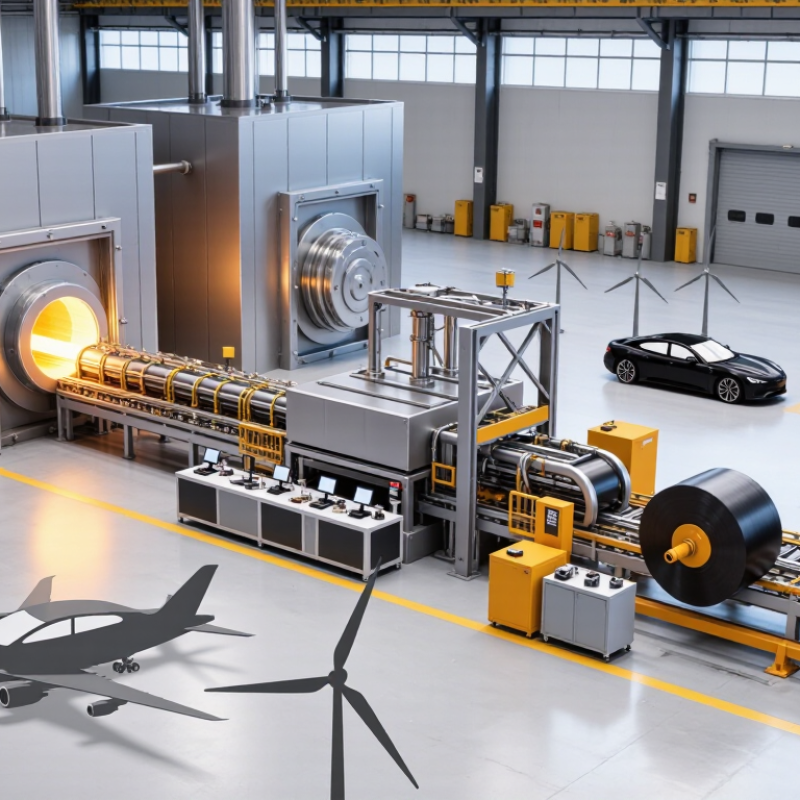
Before choosing a carbon fiber production line factory, define the product and capacity target precisely.
Specify precursor type, tow size, tensile grade, modulus range, and required annual output. A 12K aerospace-grade line needs different tension control than a 50K industrial line. Do not copy another plant’s specification blindly.
Market signals also matter. The International Energy Agency reported more than 17 million electric-car sales worldwide in 2024. The Global Wind Energy Council recorded 117 gigawatts of new wind capacity in 2023.
These figures indicate continuing demand for lightweight composite materials, but they do not guarantee demand for your exact fiber grade. That part requires honest research.
Convert annual output into daily production, planned utilization, and realistic yield.
For example, a 1,000-ton annual target may require more than 3.3 tons per day at full operation. Allow room for maintenance, trial runs, and imperfect conversion.
A factory should provide verified data for line speed, energy use, furnace temperature stability, scrap rate, and quality variation.
Request sample test reports, not only brochures.
Ask how the supplier handles broken tow, uneven oxidation, and startup waste.
Small details become expensive quickly.
Use recognized references such as ISO 11566 for tensile testing and ISO 10618 for carbon fiber terminology.
Independent acceptance testing is valuable.
IEA, Global EV Outlook 2025; Global Wind Energy Council, Global Wind Report 2024.

Choosing a carbon fiber production line factory in 2026 requires more than viewing polished machinery. Evaluate how the factory controls each stage, from precursor preparation to final winding. Ask to see operating data, not only equipment brochures. A credible supplier can explain furnace temperature zones, line speed, tension control, and atmosphere management. These details affect fiber strength, consistency, and production yield. Request a documented trial using your intended precursor and target specifications.
Inspect the equipment directly, if possible. Look for stable pay-off systems, accurate tension sensors, sealed furnaces, and responsive cooling sections. Check whether control software records alarms, temperature trends, speed changes, and batch identity. Calibration certificates should be current and traceable to recognized measurement standards. A reliable factory also maintains spare-part plans and technician training records. Ask how operators respond to broken filaments or uneven surface treatment. The answer should describe a controlled procedure, not vague promises.
Manufacturing expertise appears in the factory’s questions. Experienced engineers will examine your fiber grade, throughput, residence time, and quality tolerances. They should discuss pilot testing before recommending full-scale capacity. No factory gets every trial right. I would value honest failure analysis more than perfect presentation. Review sample test reports, customer acceptance criteria, maintenance history, and production records. If data is incomplete, pause the decision. A technically impressive line can still underperform without disciplined operators and repeatable process control.
Choosing a carbon fiber production line factory in 2026 requires more than comparing machine prices. Verify the factory’s quality system through current, traceable records. ISO 9001 certification is useful, but the certificate alone proves little. Ask for audit dates, corrective-action reports, and process-control samples. Check whether carbonization temperature, tension, line speed, and surface treatment are recorded automatically. Small gaps often reveal larger risks.
Request evidence from a recent production line. Review factory acceptance test results, calibration certificates, and material traceability documents. A reliable supplier should explain how it controls defects, handles design changes, and protects production data. Certification scope matters. It should cover the relevant equipment and manufacturing activities, not only an office address. If electrical or environmental standards apply to your market, confirm compliance with the correct requirements.
Reliability must be measured in operating conditions. Ask for documented uptime, maintenance intervals, spare-parts availability, and service response times. Speak with customers who run similar tow sizes and output targets, where possible. During an inspection, watch the line start after a shutdown. Listen for unstable motors, inspect cable routing, and check whether operators can access safety controls easily. A clean showroom can mislead. I would also leave room for doubt: promised output may depend on skilled operators, stable utilities, and disciplined maintenance. That dependency should appear in the contract, training plan, and acceptance criteria.
Choosing a carbon fiber production line factory in 2026 requires more than comparing equipment prices. A low quotation may exclude installation, tooling, training, spare parts, or energy upgrades. Request a full cost breakdown for oxidation, carbonization, surface treatment, and winding sections. Include expected yield, power consumption, maintenance hours, and replacement intervals. Numbers can mislead.
Delivery terms deserve equal attention. Ask for a production schedule with factory acceptance testing, packing, shipping, installation, and commissioning milestones. Define responsibility for delays, damaged components, and performance testing. A reliable factory should provide process documents, inspection records, and realistic lead times. Promises without dates are weak evidence. Ask again.
Support becomes critical when a line operates continuously. Evaluate response times, remote diagnostics, on-site engineers, operator training, and local spare-part availability. Check whether technical manuals explain actual adjustment procedures, not only theory. Long-term value also depends on software updates, capacity expansion, energy improvements, and transparent warranty conditions. During factory visits, inspect cable routing, safety access, calibration records, and test samples. Small details reveal working habits. Some buyers focus heavily on initial cost and overlook poor communication after delivery. That mistake is understandable, but expensive. A strong partnership should include regular performance reviews, honest troubleshooting, and practical improvements as production changes.
A credible factory should pass a documented audit before commercial discussions deepen. Use ISO 19011 principles to review process control, calibration, maintenance, traceability, and worker competence. Ask to inspect the oxidation, carbonization, surface treatment, and winding areas. Check actual records, not only clean showroom equipment. The IEA reported nearly 14 million electric cars sold worldwide in 2023, increasing pressure on lightweight material supply and consistent production. A factory serving this market must show stable throughput under realistic conditions.
Testing should begin with the buyer’s own precursor and process requirements. Request sample fiber from several production runs. Independent laboratories can verify tensile strength, modulus, sizing content, and filament consistency using relevant ASTM methods, including ASTM D4018. During factory acceptance testing, record line speed, temperature uniformity, energy use, downtime, and scrap rates. Site acceptance testing should repeat these checks with production materials. Small details matter. A clean result from one batch proves little.
The contract should define measurable output, yield, tolerances, delivery milestones, training, spare parts, software access, and response times. Include a clear procedure for failed acceptance tests and delayed performance. Warranty language needs practical remedies, not vague promises. Ask for a deviation history and unresolved corrective actions. No factory is flawless. That is acceptable. Hidden problems are not. Industry demand forecasts can change, so flexibility for future fiber grades and controlled upgrades deserves a written clause. I would also challenge impressive OEE figures unless their calculation method is disclosed. Percentages can mislead. A signed contract should protect evidence, not optimism.


For those larger-sized parts, or smaller quantity runs, we have 2 independent powder coat booths and ovens. The quality, durability and affordability of today’s powder coating finishes make this the process of choice for world-class companies.
Powder coating advantages over other forms of coating are many. Materials used in the Powder coating process can be metals and non-metals that come in a multitude of thicknesses, textures, colors, etc. Another of Powder coating’s biggest advantages over conventional coatings is its ability to create finishes in many different textures. Powder Coating Booths allow us the ability to apply these advantages to large products.
Tri-State Fabricators runs a full-service conveyor line for painting. Wet painting can provide protection or decoration to many different part styles. From start to finish, every project is easier to undergo random and point-based inspection by our skilled painting team.
Advantages to our Wet Paint Line are these lines start with product prep and ends with a thorough inspection of a high quality finished product. Our ability to complete large and small projects with a superior finish and doing so in a timely and economical fashion. This passes along the savings in production to our customers. When powder coating ins not an option, our Wet Paint Line gets the job done right the first time.
When the parts get big and heavy we roll-out our custom paint racks and oversize booth. By utilizing our partnerships with all the major paint brands, we can match virtually any color with wet paint.
The advantages of having access to a Wet Paint Booth are many. Large projects of many different shapes can be loaded into the booth. The Wet Paint Booth offers an environment that is much more controlled than a typical parts painting operation.
Not only are they used because of their controlled environment, but they’re are also advantageous when it comes to applying paint to parts that are needed in industries that require specialty coatings such as medical, aerospace, etc.
Our military forces have some very high standards when it comes to the finish of their vehicles and equipment. From the first pre-treatment step to final coat, it takes a great deal of knowledge and experience to protect the men and women of our armed forces. They deserve only the best, and Tri-State Fabricators provides it.
All of our processes are closely monitored by our staff and management teams. Both of which are highly trained in the processes of metal fabrication and finishing. Tri-State Fabricators’ goal is to always fully satisfy each and every customer, including the military. We will always put a 110% into what we do.
Abrasive media blasting is an excellent way to remove old paint, rust, and increase the paint/powder adhesion. Glass beads produce a much smoother and brighter finish than angular abrasives; leaving the part clean yet without any dimensional change. Chemically inert and environmentally friendly, we can recycle our beads approximately 30 times; making them a more preferred method of metal cleaning or surface finishing.
Advantages to Glass Bead Blasting are many. Glass bead blast media is used when a project is needing rough surfaces need to become smooth for applications of coatings such as paint. It is typically used to clean paint and rust from a product surface without deforming the surface it is being used on. Overall, compared to many other blasting media, Glass Bead Blasting is a very economical choice and those savings are always passed on to our customers.
Tri-State Fabricators utilize a zinc phosphate wash to clean and etch the material to ensure the best paint adhesion possible. The unique design of our 3-stage wash system does the work like a 5-stage. From Cleaning and rinsing to conversion coating and post-treatment, Our Part Washing process is a complete service and works throughout the fabrication service and the finishing service.
Along with the previously mentioned benefits, Curing is a vital chemical reaction that leaves the product finish hard and relatively safe from mild abrasion and aggressive corrosion. This process can be done in more than one way; ambient air-dry or in curing ovens at temps that exceed 240°.
From fixing paint mistakes (someone else’s of course) to simply cleaning our paint line hooks, our burn-off oven is put to good use. After a quick burn-off, a little clean up, and a fresh coat of paint, your parts will look better than new.
Why does our Burn-Off Oven work so well? Because super heating the air around parts turns the materials into ashes. From paint and powder coatings to rubber and machining oils, high temps do the job without degrading the integrity of the part.
Masking is a vital part of producing high quality products. We have die-cut masking patterns to protect machined surfaces as well as a wide range of plugs and caps to protect threaded holes and bolts. We provide permanent and temporary masking.
Masking allows the selected sections of a product to be protected from a fabrication or finishing service. This can be with both chemicals when etching and tapes, paints when only finishing just a section of the product. Masking is great in aiding the customization process of a project.
Screen printing is a photographic process that transfers artwork onto a porous nylon screen which allows colored ink to flow through the screen and be deposited on an aluminum or plastic component. We can generally have just about any design created onto a screen for your parts.
Some of the advantages of Screen Printing are, brand recognition for your business displaying on your products, assembly instructions, product warnings/hazards, etc. Tri-State Fabricators produces Screen Printing of the highest quality so you know it’s durable.
Metal Finishing is the art of treating the exterior portion of product, often metal but can also be made of other materials, so that the surface is clean and free of any debris. Then the process of applying coats or either paint of powder coat takes place. This coating process improves the quality of the product in both appearance and resistance to wear and corrosion.
Tri-State Fabricators, Inc., understands that a project typically isn’t complete until a high-quality finish has been added to your product. This is why our painting and powder coating teams continuously inspect the products throughout the Metal Finishing process.

