


Choosing a Fiber Disc manufacturer for international purchasing involves more than comparing unit prices. Disc life, cut rate, and finish quality can change with abrasive grain, grit, backing stiffness, and bond design. A disc that performs well on stainless steel may behave differently on painted metal or hardwood. Small differences matter. This guide introduces ten China-based manufacturers for global buyers seeking practical options across workshop, fabrication, and industrial applications. It is a starting point, not a universal ranking: production scale, export experience, and product range vary by supplier. Some information may change.
To assess a supplier, buyers can compare more than catalog claims. Ask for clear specifications, including disc diameter, grit range, attachment system, hole pattern, and recommended operating conditions. Where possible, request samples and test them on the same material, tool, and workload used in production. Record removal rate, edge wear, heat buildup, and surface consistency. These checks make comparisons more useful. Also review quality-control procedures, packaging, minimum order quantities, communication, and realistic lead times. A polished website cannot replace a repeatable test. The manufacturers covered here should be evaluated against your own requirements, rather than broad promises or a single headline price. That takes time. The aim is a clearer shortlist, with enough detail to support informed inquiries and reduce avoidable purchasing surprises.
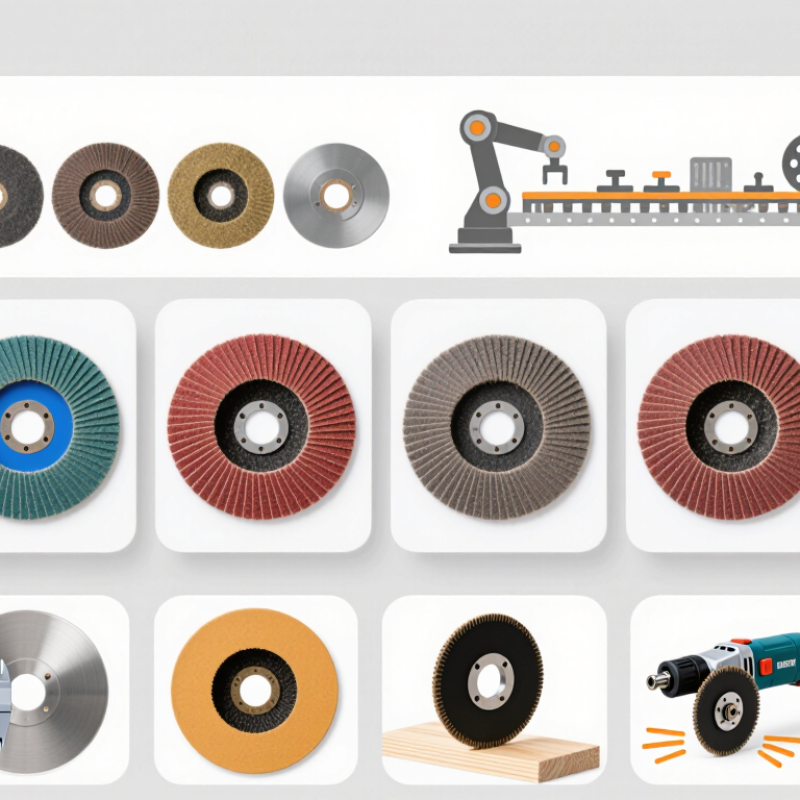
A fiber disc combines abrasive grains, a resin bond, and a vulcanized-fiber backing. Each part affects how it cuts and wears. Aluminum oxide is a common choice for general steel grinding. Zirconia-alumina can suit heavier stock removal, while silicon carbide cuts nonferrous materials and some coatings effectively. They are not interchangeable. Grain shape, grit size, and pressure all change the finish. The backing is compressed cellulose fiber, not ordinary paper; it supports firm grinding while remaining flexible enough to follow curved surfaces. Resin holds the grains in place, but heat and excessive pressure can still shorten disc life.
The scale of the market is substantial: Allied Market Research valued the global abrasives market at 47.7 billion dollars in 2022 and forecast 72.9 billion dollars by 2032. This covers abrasives broadly, not fiber discs alone. For buyers, that distinction matters. A large market figure does not tell you how a disc performs on a weld bead. Check the disc’s rated speed, grit, and intended material, then test it on a small area. Watch for loading, edge wear, and heat discoloration. A specification sheet helps, but it cannot replace a controlled trial on the actual workpiece. That part is easy to overlook.

Abrasive grain size affects how aggressively a fiber disc cuts and the finish it leaves. Coarser FEPA P-grades use larger particles; finer grades use smaller ones.
Particle sizes shown are nominal values in micrometres for selected FEPA P-grades (FEPA 42-1). Actual disc performance also depends on abrasive grain type, vulcanized-fiber backing, resin bond, and operating conditions.
Global buyers comparing fiber disc manufacturers should check diameter, grit, and bore size before reviewing price. Common disc diameters range from 115 to 180 mm, but the right choice depends on the grinder and backing pad. A 115 mm disc can reach tighter areas; a 180 mm disc covers more surface per pass. Larger is not always better. On a small workpiece, it may feel awkward and remove material too quickly.
FEPA P-grit markings help buyers compare abrasive grades across quotations. Lower numbers, such as P36, generally indicate coarser grains for heavier stock removal; higher numbers suit finer finishing. Still, grit alone does not predict the final result. Pressure, workpiece material, and disc condition matter too. I have seen a nominally finer disc leave visible scratches when operators pressed too hard. That detail is easy to overlook.
Bore size must match the spindle or the specified backing-pad system. Check the listed hole diameter, not just the outside diameter, and confirm the pad is compatible with the disc. Measure twice. Also compare maximum operating speed and product documentation before ordering in bulk. Supplier tables can be incomplete, and I would not assume two similar-looking discs share the same fit. A sample order can reveal fit or finish issues before a full shipment.
For global buyers, fibre-disc safety starts with the marked maximum speed, not the grinder’s headline rating. EN 13743 sets safety requirements for coated abrasive products, including fibre discs. FEPA’s Safety Code for Coated Abrasives gives 80 m/s as a maximum operating-speed reference for fibre discs. Check the disc, backing pad, and machine ratings together; use the lowest limit.
The calculation is concrete. A 125 mm disc running at 12,200 rpm reaches about 80 m/s at its edge (π × diameter × rpm ÷ 60). Treat this as a cross-check, not permission to exceed the product marking. Small diameter changes matter. So does an incorrect speed setting. It is easy to overlook.
Testing should be documented, not reduced to a quick visual glance. Inspect the centre hole, backing surface, and disc edges for damage before mounting. Confirm correct fit, then assess vibration and unusual heat during controlled operation. EN 13743 provides the safety framework; buyers should request traceable test records and clear speed markings from suppliers. A single sample tells little. Batch variation deserves attention, and inspection routines can still miss defects. FEPA Safety Code for Coated Abrasives and EN 13743 are useful reference points when comparing supplier documentation.
For global buyers, comparing China’s top ten fiber disc manufacturers should begin with evidence, not catalog claims. Grand View Research estimates the global abrasives market reached USD 46.5 billion in 2023, with projected annual growth of 4.8% from 2024 to 2030. This broad figure does not measure fiber discs alone, but it shows why dependable supply and quality control matter.
Request product-level records: grit range, disc diameter, maximum operating speed, backing material, resin system, and batch traceability. Compare adhesion, balance, and wear test results under consistent conditions. Check applicable coated-abrasive safety requirements, including EN 13743 where relevant, and confirm documents match the exact product code. Test samples on the intended material. Watch for glazing, grain loss, and excess heat. Real trials matter.
Look beyond one impressive sample. Review calibration logs, incoming grain checks, retained batches, complaint handling, and change-control procedures. ISO 9001 certification can support confidence in a quality system, but it does not certify a disc’s cutting performance. Compare lead times, moisture-resistant packaging, and repeat-order consistency. A low quotation may conceal specification changes. Supplier questionnaires can feel tedious; still, record gaps and revisit them after trial orders.
For global buyers, OEM capability means more than changing a label. Ask whether a factory can hold disc diameter, backing stiffness, abrasive grain, and bond strength steady across repeat orders. Request a sample made to your actual machine speed and workpiece, then compare it with a production batch. Check grit size against recognized FEPA conventions, and review inspection records for grain shedding, runout, and bond consistency. Small details matter. Grand View Research estimated the global abrasives market at USD 47.2 billion in 2022, with projected growth through 2030. That scale makes supplier selection consequential, but market growth alone says nothing about one factory’s process control.
Quality control should be visible in dated batch records, calibrated equipment, and clear acceptance limits—not just a certificate on a wall. ISO 9001 certification can indicate a quality-management system, but it does not guarantee each fiber disc performs well. Ask for test results covering dimensions, balance, and maximum operating speed, and confirm how nonconforming lots are handled. Even a strong audit can miss variation between shifts; buyers should verify samples from more than one production run. This is a practical safeguard, not a perfect one.
Export readiness shows up in details: moisture-resistant packaging, readable product labels, consistent carton counts, and accurate shipping documents. Confirm that the supplier can provide the specifications and destination-market documentation your shipment requires. A trial order can expose weak points in packing or communication before volume rises. Do not assume a smooth sales conversation proves reliable delivery.
Buyer-facing comparison framework: Company names and unverified supplier claims are intentionally omitted. The ten entries below are anonymous evaluation slots, not a verified ranking of specific manufacturers. Confirm each capability directly with the supplier before shortlisting.
| Supplier slot | Product scope to confirm | OEM capability to assess | Quality-control evidence | Export-readiness checks | Buyer verification status |
|---|---|---|---|---|---|
| Candidate 01 | Fiber-backed abrasive discs; confirm disc diameter, abrasive grain, grit range, and backing specifications. | Ask about private-label packaging, custom labels, and minimum order quantities for customized runs. | Request product specifications, batch identification methods, and records for incoming-material and finished-product inspections. | Confirm export packing, carton markings, shipping terms, and the export documents available for the destination market. | Not independently verified; request documentary evidence. |
| Candidate 02 | Discs intended for angle-grinder applications; verify the permitted operating speed and compatible backing-pad requirements. | Check whether artwork, label language, packaging quantities, and product specifications can be customized. | Request documented checks for dimensions, bonding, appearance, and applicable product-safety requirements. | Confirm experience preparing commercial invoices, packing lists, and other shipment documents required by the buyer. | Not independently verified; request documentary evidence. |
| Candidate 03 | Discs for metalworking; confirm suitable grain and grit options with application-specific testing rather than relying on a generic claim. | Ask whether the supplier can make samples to an agreed specification and reproduce approved samples in production. | Request inspection plans, acceptance criteria, and traceability from production lot to shipped goods. | Check export carton strength, palletization options, and the supplier’s process for handling shipping damage claims. | Not independently verified; request documentary evidence. |
| Candidate 04 | Discs for wood or paint-removal work; confirm the recommended application and test performance on the buyer’s material. | Confirm availability of custom assortments, branded inserts, and mixed-grit packaging where commercially feasible. | Ask for consistency checks across grit, coating coverage, adhesion, and finished-disc dimensions. | Verify lead-time commitments, production scheduling, and communication procedures for export orders. | Not independently verified; request documentary evidence. |
| Candidate 05 | Hook-and-loop or other attachment formats; confirm the attachment type, backing construction, and compatibility with the intended tool. | Request confirmation that custom dimensions and attachment configurations can be specified in a written purchase specification. | Request checks for attachment performance, disc flatness, and batch-to-batch consistency under agreed test conditions. | Confirm whether samples and production orders can be packed and labeled to the buyer’s import requirements. | Not independently verified; request documentary evidence. |
| Candidate 06 | Discs with different backing or coating options; request a technical data sheet for each proposed construction. | Assess ability to support buyer-specific specifications, approval samples, and controlled revisions to artwork or product details. | Ask how nonconforming products are identified, segregated, investigated, and corrected. | Check whether the supplier can provide origin and product documentation required for the buyer’s customs process. | Not independently verified; request documentary evidence. |
| Candidate 07 | Discs supplied in retail or industrial pack formats; verify pack count, labeling, and product identification requirements. | Confirm options for barcodes, language-specific labels, inserts, and private-label packaging approvals. | Request packaging inspections and a process for matching labels and carton contents to the approved order specification. | Verify carton dimensions, gross weight, pallet details, and packing-list accuracy before booking freight. | Not independently verified; request documentary evidence. |
| Candidate 08 | General-purpose fiber discs; establish the intended material, operation, machine, and performance criteria before comparison. | Ask about prototype sampling, specification review, and the supplier’s process for confirming changes before mass production. | Request sample test results and agree on measurable acceptance criteria for the first production order. | Confirm factory contact, order-status updates, production lead time, and escalation route for shipment issues. | Not independently verified; request documentary evidence. |
| Candidate 09 | Special-purpose or customized discs; verify that the proposed construction is suitable for the buyer’s intended use. | Assess technical communication, custom sampling, feasibility review, and change-control practices. | Request risk-based inspection details and evidence that approved product specifications are used on the production line. | Check shipment terms, export packing method, insurance responsibilities, and the process for resolving delivery discrepancies. | Not independently verified; request documentary evidence. |
| Candidate 10 | Broad fiber-disc assortment; compare only products with clearly stated, matching specifications and intended applications. | Confirm the supplier’s capacity to manage multiple SKUs, order-specific packaging, and repeat orders to an approved standard. | Request lot-level records, inspection results, and a written corrective-action process for quality complaints. | Verify export experience for the target country, document accuracy, packing suitability, and realistic shipping timelines. | Not independently verified; request documentary evidence. |
Recommended sourcing practice: Compare like-for-like specifications, test pre-production samples, define acceptance criteria in writing, and independently verify company identity, certifications, production capability, and export documentation. No supplier ranking or capability is asserted by this framework.


For those larger-sized parts, or smaller quantity runs, we have 2 independent powder coat booths and ovens. The quality, durability and affordability of today’s powder coating finishes make this the process of choice for world-class companies.
Powder coating advantages over other forms of coating are many. Materials used in the Powder coating process can be metals and non-metals that come in a multitude of thicknesses, textures, colors, etc. Another of Powder coating’s biggest advantages over conventional coatings is its ability to create finishes in many different textures. Powder Coating Booths allow us the ability to apply these advantages to large products.
Tri-State Fabricators runs a full-service conveyor line for painting. Wet painting can provide protection or decoration to many different part styles. From start to finish, every project is easier to undergo random and point-based inspection by our skilled painting team.
Advantages to our Wet Paint Line are these lines start with product prep and ends with a thorough inspection of a high quality finished product. Our ability to complete large and small projects with a superior finish and doing so in a timely and economical fashion. This passes along the savings in production to our customers. When powder coating ins not an option, our Wet Paint Line gets the job done right the first time.
When the parts get big and heavy we roll-out our custom paint racks and oversize booth. By utilizing our partnerships with all the major paint brands, we can match virtually any color with wet paint.
The advantages of having access to a Wet Paint Booth are many. Large projects of many different shapes can be loaded into the booth. The Wet Paint Booth offers an environment that is much more controlled than a typical parts painting operation.
Not only are they used because of their controlled environment, but they’re are also advantageous when it comes to applying paint to parts that are needed in industries that require specialty coatings such as medical, aerospace, etc.
Our military forces have some very high standards when it comes to the finish of their vehicles and equipment. From the first pre-treatment step to final coat, it takes a great deal of knowledge and experience to protect the men and women of our armed forces. They deserve only the best, and Tri-State Fabricators provides it.
All of our processes are closely monitored by our staff and management teams. Both of which are highly trained in the processes of metal fabrication and finishing. Tri-State Fabricators’ goal is to always fully satisfy each and every customer, including the military. We will always put a 110% into what we do.
Abrasive media blasting is an excellent way to remove old paint, rust, and increase the paint/powder adhesion. Glass beads produce a much smoother and brighter finish than angular abrasives; leaving the part clean yet without any dimensional change. Chemically inert and environmentally friendly, we can recycle our beads approximately 30 times; making them a more preferred method of metal cleaning or surface finishing.
Advantages to Glass Bead Blasting are many. Glass bead blast media is used when a project is needing rough surfaces need to become smooth for applications of coatings such as paint. It is typically used to clean paint and rust from a product surface without deforming the surface it is being used on. Overall, compared to many other blasting media, Glass Bead Blasting is a very economical choice and those savings are always passed on to our customers.
Tri-State Fabricators utilize a zinc phosphate wash to clean and etch the material to ensure the best paint adhesion possible. The unique design of our 3-stage wash system does the work like a 5-stage. From Cleaning and rinsing to conversion coating and post-treatment, Our Part Washing process is a complete service and works throughout the fabrication service and the finishing service.
Along with the previously mentioned benefits, Curing is a vital chemical reaction that leaves the product finish hard and relatively safe from mild abrasion and aggressive corrosion. This process can be done in more than one way; ambient air-dry or in curing ovens at temps that exceed 240°.
From fixing paint mistakes (someone else’s of course) to simply cleaning our paint line hooks, our burn-off oven is put to good use. After a quick burn-off, a little clean up, and a fresh coat of paint, your parts will look better than new.
Why does our Burn-Off Oven work so well? Because super heating the air around parts turns the materials into ashes. From paint and powder coatings to rubber and machining oils, high temps do the job without degrading the integrity of the part.
Masking is a vital part of producing high quality products. We have die-cut masking patterns to protect machined surfaces as well as a wide range of plugs and caps to protect threaded holes and bolts. We provide permanent and temporary masking.
Masking allows the selected sections of a product to be protected from a fabrication or finishing service. This can be with both chemicals when etching and tapes, paints when only finishing just a section of the product. Masking is great in aiding the customization process of a project.
Screen printing is a photographic process that transfers artwork onto a porous nylon screen which allows colored ink to flow through the screen and be deposited on an aluminum or plastic component. We can generally have just about any design created onto a screen for your parts.
Some of the advantages of Screen Printing are, brand recognition for your business displaying on your products, assembly instructions, product warnings/hazards, etc. Tri-State Fabricators produces Screen Printing of the highest quality so you know it’s durable.
Metal Finishing is the art of treating the exterior portion of product, often metal but can also be made of other materials, so that the surface is clean and free of any debris. Then the process of applying coats or either paint of powder coat takes place. This coating process improves the quality of the product in both appearance and resistance to wear and corrosion.
Tri-State Fabricators, Inc., understands that a project typically isn’t complete until a high-quality finish has been added to your product. This is why our painting and powder coating teams continuously inspect the products throughout the Metal Finishing process.

