


China Top Dishwasher Tub Assembly Line Manufacturer?

Choosing a China-based Dishwasher Tub Assembly Line manufacturer requires more than comparing machine prices. The line must handle sheet forming, seam joining, leak testing, and precise tub transfers without creating bottlenecks. A buyer should inspect fixture accuracy, guarding, changeover time, and the way rejected parts are tracked. Ask to see a sample tub move through the actual process. Look closely at the weld area and listen for irregular vibration. Small details matter.

Manufacturing engineer Daniel Wu offers this illustrative viewpoint, not a verified published quotation: “A reliable tub line is measured not only by its output, but by how consistently it controls forming, joining, and inspection.” Treat that as a useful question for supplier discussions, rather than a substitute for documented performance data. Request cycle-time records, quality results, commissioning plans, and references from comparable installations. A polished factory tour is helpful, but it cannot prove long-term uptime. That deserves a closer look.

This article explores how to assess Chinese manufacturers, compare automation levels, and review technical support before investing. It also considers customization, spare parts, and project risks. Some lines look efficient on paper yet struggle with product changes or uneven material flow. No supplier is perfect. A careful comparison should make those limits visible, not hide them behind impressive production claims.
China Top Dishwasher Tub Assembly Line Manufacturer?

What Is a Dishwasher Tub Assembly Line?

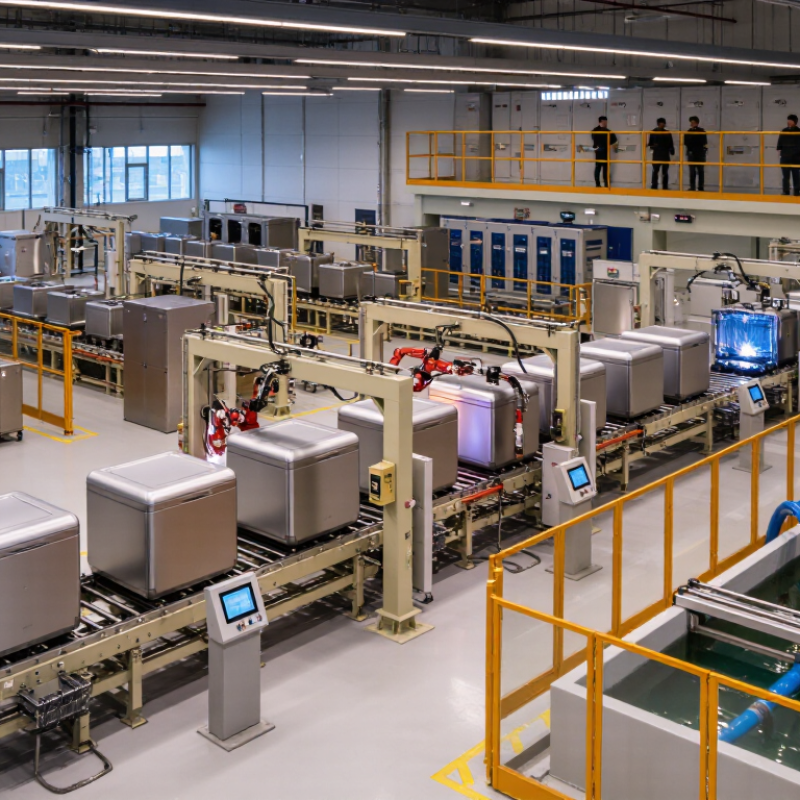
A dishwasher tub assembly line is a coordinated production system for forming, joining, and inspecting the machine’s inner cabinet. The tub usually begins as stainless steel sheet or coated metal. Presses shape the panels through stamping and deep drawing. Trimming removes excess edges. Forming tools create channels for racks, seals, and drainage components.

The line then uses fixtures to position each part accurately. Robotic or semi-automatic welding joins the tub sections. Controlled pressure and heat help prevent distortion. Operators inspect welds, corners, and sharp edges during production.

Sealing equipment applies protective material around selected joints. Even a small gap can cause leakage later. That detail deserves careful attention.

A reliable line includes leak testing, dimensional checks, and barcode-based traceability. Sensors can monitor temperature, force, cycle time, and fixture position. Vision systems may detect incomplete welds or surface defects. In practical factory evaluations, maintenance access matters as much as speed. A fast line becomes expensive when technicians cannot reach a sensor safely. No line is perfect. Misalignment, worn dies, and unstable material thickness still create problems. Regular calibration and sample testing reduce these risks. Quality records should connect each tub with its process data. That evidence supports consistent production and more credible supplier evaluations.


How Dishwasher Tub Assembly Lines Work

A dishwasher tub assembly line turns flat stainless-steel sheet into a leak-resistant chamber through a sequence of controlled operations. Coils are cut into blanks, then pressed into shape, with deep-drawing dies forming the tub’s floor and sidewalls. Operators check edges for cracks and confirm key dimensions before parts move to joining stations. Depending on the design, seams are welded or mechanically joined. The tub then receives brackets, insulation, and mounting features. Small misalignments matter: even a slight distortion can complicate door sealing or later cabinet installation.

Automation helps keep these steps repeatable. The International Federation of Robotics reported a global average of 162 industrial robots per 10,000 manufacturing employees in 2023, in World Robotics 2024. That figure describes manufacturing broadly, not dishwasher lines specifically. On a tub line, robots may handle heavy blanks or perform consistent welds, while workers inspect corners and sensor readings. Water or pressure tests can reveal leaks before the tub enters final appliance assembly. The sequence sounds tidy. Real lines are not. Tool wear, sheet variation, and missed checks can still create rework, so inspection records and preventive maintenance matter as much as production speed.

China Top Dishwasher Tub Assembly Line Manufacturer? — How Dishwasher Tub Assembly Lines Work

A dishwasher tub assembly line typically combines sheet-metal forming, trimming, hole punching, edge hemming, leak testing, and final inspection. The chart shows representative processing time per tub for each major stage on an automated production line.

Reference values are representative engineering benchmarks for a stainless-steel dishwasher tub line; actual cycle times vary according to tub geometry, automation level, material thickness, and line layout.

Key Equipment and Technologies in Tub Manufacturing

China Top Dishwasher Tub Assembly Line Manufacturer?

A reliable tub assembly line starts with controlled forming, not fast assembly. Stainless-steel tubs need deep-drawing presses, progressive dies, and accurate trimming stations. Plastic tubs require injection-molding machines with stable temperature control. Small variations can affect door sealing and rack movement. Practical lines also use robotic seam welding, automatic flange forming, and inline dimensional gauges. These systems reduce manual inconsistency, although they cannot eliminate every defect.

The European Commission’s Ecodesign requirements measure dishwasher performance through water use, energy use, cleaning, and drying results. The International Energy Agency’s Energy Efficiency 2023 report also identifies household appliances as an important efficiency opportunity. Therefore, tub manufacturing should support low-leakage designs and smooth internal surfaces. Vision inspection can detect scratches, wrinkles, and incomplete welds. Helium or pressure-based leak testing adds another safety layer. ISO 9001 procedures help, but paperwork alone does not guarantee a strong tub.

Tips: Ask manufacturers for cycle-time records, weld sample reports, and traceability data. Check whether every tub receives a leak test. Inspect one unfinished tub by hand. It may reveal more than a presentation.

A complete line should connect forming, washing, drying, inspection, and packing. Servo-controlled presses improve repeatability. Automatic torque tools prevent loose fasteners. Yet production teams still need experienced technicians. Even advanced equipment can produce poor results when dies wear, sensors drift, or operators ignore unusual noise. That weakness deserves honest review.

China Top Dishwasher Tub Assembly Line Manufacturer? - Key Equipment and Technologies in Tub Manufacturing
Process Stage Key Equipment Purpose and Technology Typical Materials or Controls Quality Checks
Material receiving and feeding Coil or sheet loading system, decoiler, straightener, servo feeder Feeds flat stock consistently to stamping equipment and helps control coil handling and sheet alignment. Stainless-steel sheet is common for metal tubs; material grade and thickness are specified by the product design. Some dishwasher tubs use molded polymers instead. Incoming material certificate, thickness, surface condition, flatness, and feed alignment.
Blanking Mechanical or hydraulic press with blanking die; optional laser cutting for prototypes or flexible production Cuts sheet stock into the blank used for subsequent forming. Die layout and blank shape influence material use and forming behavior. Blank dimensions and edge condition are defined by the part drawing and forming process. Blank size, burrs, edge cracks, and surface marks.
Deep drawing and forming Forming press, matched die set, blank holder, lubrication system, and automated part transfer Forms a flat metal blank into a tub shell. Tool geometry, press settings, lubrication, and material properties are developed together to limit wrinkling and tearing. Some stainless-steel appliance sheet applications use thicknesses around 0.4–0.8 mm; the correct gauge depends on tub design, strength, and forming requirements. Wall and base geometry, thinning, wrinkles, splits, and surface appearance.
Trimming and feature punching Trim press, piercing dies, CNC laser, or robotic cutting cell Removes excess material and creates design-specific openings, mounting features, or interface details. Cutting sequence and tooling are matched to the formed tub geometry and required edge quality. Opening location, edge burrs, cut quality, and dimensional conformity.
Flanging and edge finishing Flanging or hemming press, roller-forming station, dedicated forming tools Forms perimeter edges and mounting flanges for assembly, stiffness, and safe handling. The edge design depends on the cabinet and door interfaces. Tooling is designed around the specified flange profile, bend radius, and material springback. Flange height and angle, edge condition, and fit to adjoining components.
Joining, where required Resistance spot-welding equipment, laser-welding cell, or other design-approved joining system Joins separate tub sections or brackets when the design is not formed as a single shell. A one-piece drawn tub may need fewer tub-shell joints. Joining method, fixture design, and process settings depend on material, joint geometry, and functional requirements. Joint position, weld appearance, strength, distortion, and leak performance where applicable.
Polymer tub molding, for applicable designs Injection-molding machine, tub mold, material drying and conveying system, part handling robot Produces a polymer tub or tub component directly in a mold. This is a different manufacturing route from sheet-metal stamping and forming. Resin type, drying conditions, melt temperature, mold temperature, and cycle settings are determined by the material and part design. Fill, warpage, sink marks, dimensions, surface defects, and molded interface features.
Cleaning and surface treatment Industrial washing or degreasing system, rinse and drying equipment; optional specified surface-finishing process Removes forming residues and prepares surfaces for downstream assembly or finishing as required by the product specification. Cleaning chemistry and treatment route must be compatible with the material and any subsequent coating or assembly steps. Cleanliness, residue, corrosion-related requirements, and surface appearance.
Tub assembly and handling Locating fixtures, robotic or manual assembly stations, torque-controlled tools, conveyor and buffer system Positions the tub and attaches design-specific brackets, seals, or interfaces while protecting finished surfaces. Fixture datums, fastening sequence, and component presence checks are established from the assembly drawing. Part presence, orientation, fastening results, interface alignment, and handling damage.
Inspection and line monitoring Coordinate measuring equipment or gauges, vision inspection, process sensors, traceability system, leak-test equipment where specified Checks critical features and records process results. Automated inspection can be combined with operator verification. Inspection limits, leak-test method, and acceptance criteria are set by the product specification and validated process plan. Critical dimensions, joint or seal performance, defect records, and traceability data.
Note: Equipment configuration and process parameters vary with tub material, product geometry, production volume, and applicable quality requirements. The figures and process examples shown are general engineering references, not universal specifications.

How to Evaluate a Dishwasher Tub Assembly Line Manufacturer in China

How to Evaluate a Dishwasher Tub Assembly Line Manufacturer in China

Choosing a dishwasher tub assembly line manufacturer requires more than reviewing a catalog. Ask for verified production records, process drawings, and recent factory references. An experienced supplier should explain forming, trimming, welding, sealing, inspection, and final testing in clear sequence. Walk through the line layout. Check whether operators can reach fixtures safely. Confirm that sensors record pressure, temperature, torque, and cycle time.

Energy performance also matters. ENERGY STAR’s current dishwasher specification limits standard-size models to 240 kWh annually and 3.2 gallons per cycle. Your line should support stable production tolerances for these targets. The International Energy Agency’s Energy Efficiency 2023 report highlights efficiency as a major route to lower industrial and household emissions. Ask the manufacturer how its equipment controls leakage, insulation quality, spray-arm alignment, and water usage. Request sample inspection data, not only promises.

Tips: Run a witnessed factory acceptance test with your own tub samples. Measure output for several continuous hours. Review OEE, reject rates, changeover time, and spare-parts availability. Check ISO 9001 quality procedures and risk controls aligned with ISO 12100. Ask for traceability from sheet material to finished tub. A small detail can expose a large weakness. I have seen impressive trial runs fail during shift changes. Therefore, evaluate maintenance response, software access, training records, and after-sales engineering support. The cheapest quotation may quietly exclude commissioning, tooling adjustments, or replacement fixtures.

Industry Applications and Emerging Trends

China Top Dishwasher Tub Assembly Line Manufacturer?

Dishwasher tub assembly lines now serve residential, commercial, and compact hospitality applications. Grand View Research valued the global dishwasher market at approximately USD 7.1 billion in 2023. It also projects an 8.6% compound annual growth rate from 2024 to 2030. This expansion increases demand for stable tub forming, sealing, insulation, and leak-testing processes.

Stainless steel tubs support high-temperature washing and long service life. Polymer tubs reduce weight and may lower production costs. Each material needs different welding, fastening, and inspection methods. A capable Chinese assembly line manufacturer should integrate servo positioning, automated adhesive application, vision inspection, and pressure testing.

The International Energy Agency reports that modern dishwashers can use substantially less water than hand washing under controlled conditions. Therefore, accurate tub geometry matters. Small distortions can affect spray coverage, noise, and water consumption.

Emerging lines increasingly connect sensors with production software. Operators can track torque, sealant quantity, cycle time, and rejection causes in real time. The International Federation of Robotics identifies manufacturing automation as a continuing global investment trend, although adoption differs widely by factory size. Automation is not a complete answer. Poor calibration still creates poor products. I have seen highly automated stations require frequent manual adjustment when incoming sheets vary. Material traceability, preventive maintenance, and repeatable testing remain essential for export-oriented production. The stronger opportunity lies in flexible lines that handle several tub sizes without excessive tooling changes.

Powder Coat Booths

For those larger-sized parts, or smaller quantity runs, we have 2 independent powder coat booths and ovens. The quality, durability and affordability of today’s powder coating finishes make this the process of choice for world-class companies.

Powder coating advantages over other forms of coating are many. Materials used in the Powder coating process can be metals and non-metals that come in a multitude of thicknesses, textures, colors, etc. Another of Powder coating’s biggest advantages over conventional coatings is its ability to create finishes in many different textures. Powder Coating Booths allow us the ability to apply these advantages to large products.

Wet Paint Line

Tri-State Fabricators runs a full-service conveyor line for painting. Wet painting can provide protection or decoration to many different part styles. From start to finish, every project is easier to undergo random and point-based inspection by our skilled painting team.

Advantages to our Wet Paint Line are these lines start with product prep and ends with a thorough inspection of a high quality finished product. Our ability to complete large and small projects with a superior finish and doing so in a timely and economical fashion. This passes along the savings in production to our customers. When powder coating ins not an option, our Wet Paint Line gets the job done right the first time.

Wet Paint Booths

When the parts get big and heavy we roll-out our custom paint racks and oversize booth. By utilizing our partnerships with all the major paint brands, we can match virtually any color with wet paint.

The advantages of having access to a Wet Paint Booth are many. Large projects of many different shapes can be loaded into the booth. The Wet Paint Booth offers an environment that is much more controlled than a typical parts painting operation.

Not only are they used because of their controlled environment, but they’re are also advantageous when it comes to applying paint to parts that are needed in industries that require specialty coatings such as medical, aerospace, etc.

Military CARC

Our military forces have some very high standards when it comes to the finish of their vehicles and equipment. From the first pre-treatment step to final coat, it takes a great deal of knowledge and experience to protect the men and women of our armed forces. They deserve only the best, and Tri-State Fabricators provides it.

All of our processes are closely monitored by our staff and management teams. Both of which are highly trained in the processes of metal fabrication and finishing. Tri-State Fabricators’ goal is to always fully satisfy each and every customer, including the military. We will always put a 110% into what we do.

Glass-Bead Blasting

Abrasive media blasting is an excellent way to remove old paint, rust, and increase the paint/powder adhesion. Glass beads produce a much smoother and brighter finish than angular abrasives; leaving the part clean yet without any dimensional change. Chemically inert and environmentally friendly, we can recycle our beads approximately 30 times; making them a more preferred method of metal cleaning or surface finishing.

Advantages to Glass Bead Blasting are many. Glass bead blast media is used when a project is needing rough surfaces need to become smooth for applications of coatings such as paint. It is typically used to clean paint and rust from a product surface without deforming the surface it is being used on. Overall, compared to many other blasting media, Glass Bead Blasting is a very economical choice and those savings are always passed on to our customers.

Part Washing

Tri-State Fabricators utilize a zinc phosphate wash to clean and etch the material to ensure the best paint adhesion possible. The unique design of our 3-stage wash system does the work like a 5-stage. From Cleaning and rinsing to conversion coating and post-treatment, Our Part Washing process is a complete service and works throughout the fabrication service and the finishing service.

Along with the previously mentioned benefits, Curing is a vital chemical reaction that leaves the product finish hard and relatively safe from mild abrasion and aggressive corrosion. This process can be done in more than one way; ambient air-dry or in curing ovens at temps that exceed 240°.

Burn-Off Oven

From fixing paint mistakes (someone else’s of course) to simply cleaning our paint line hooks, our burn-off oven is put to good use. After a quick burn-off, a little clean up, and a fresh coat of paint, your parts will look better than new.

Why does our Burn-Off Oven work so well? Because super heating the air around parts turns the materials into ashes. From paint and powder coatings to rubber and machining oils, high temps do the job without degrading the integrity of the part.

Masking

Masking is a vital part of producing high quality products. We have die-cut masking patterns to protect machined surfaces as well as a wide range of plugs and caps to protect threaded holes and bolts. We provide permanent and temporary masking.

Masking allows the selected sections of a product to be protected from a fabrication or finishing service. This can be with both chemicals when etching and tapes, paints when only finishing just a section of the product. Masking is great in aiding the customization process of a project.

Screen Printing

Screen printing is a photographic process that transfers artwork onto a porous nylon screen which allows colored ink to flow through the screen and be deposited on an aluminum or plastic component. We can generally have just about any design created onto a screen for your parts.

Some of the advantages of Screen Printing are, brand recognition for your business displaying on your products, assembly instructions, product warnings/hazards, etc. Tri-State Fabricators produces Screen Printing of the highest quality so you know it’s durable.

Metal Finishing

Metal Finishing is the art of treating the exterior portion of product, often metal but can also be made of other materials, so that the surface is clean and free of any debris. Then the process of applying coats or either paint of powder coat takes place. This coating process improves the quality of the product in both appearance and resistance to wear and corrosion.

Tri-State Fabricators, Inc., understands that a project typically isn’t complete until a high-quality finish has been added to your product. This is why our painting and powder coating teams continuously inspect the products throughout the Metal Finishing process.
