China Top 10 Micron Pleated Filter Cartridge Suppliers
Choosing a reliable Micron Pleated Filter Cartridge supplier requires more than comparing catalog prices. This guide examines ten notable Chinese manufacturers serving industrial, commercial, and water-treatment markets. It considers filtration accuracy, cartridge construction, production capability, and after-sales support.
We look closely.
The assessment includes membrane and media options, micron ratings, flow performance, pressure resistance, and compatibility with common housings. Practical details matter. A cartridge may claim a fine rating, yet perform differently under real operating conditions. Supplier experience with food processing, pharmaceuticals, electronics, chemicals, and municipal water systems also deserves attention. Those applications demand different cleanliness levels and validation methods.
Factory audits, sample testing, and document checks remain essential. Useful evidence may include ISO certifications, material traceability, batch records, test reports, and clear export experience. However, certificates alone cannot prove consistent product quality. Buyers should request samples and compare them under matching pressure, temperature, and fluid conditions.
This guide is not a permanent verdict. Supplier capabilities can change, and public information may be incomplete. Some manufacturers communicate technical strengths clearly; others provide limited data. That difference should influence purchasing confidence. Pricing is another imperfect signal. A low quote may exclude testing, customized fittings, or replacement support.
The selected companies represent different strengths, not identical business models. Some focus on standard cartridges, while others support custom designs and high-volume orders. Readers should verify current certifications, lead times, factory capacity, and application suitability before making a contract decision. A careful trial order often reveals more than a polished brochure.
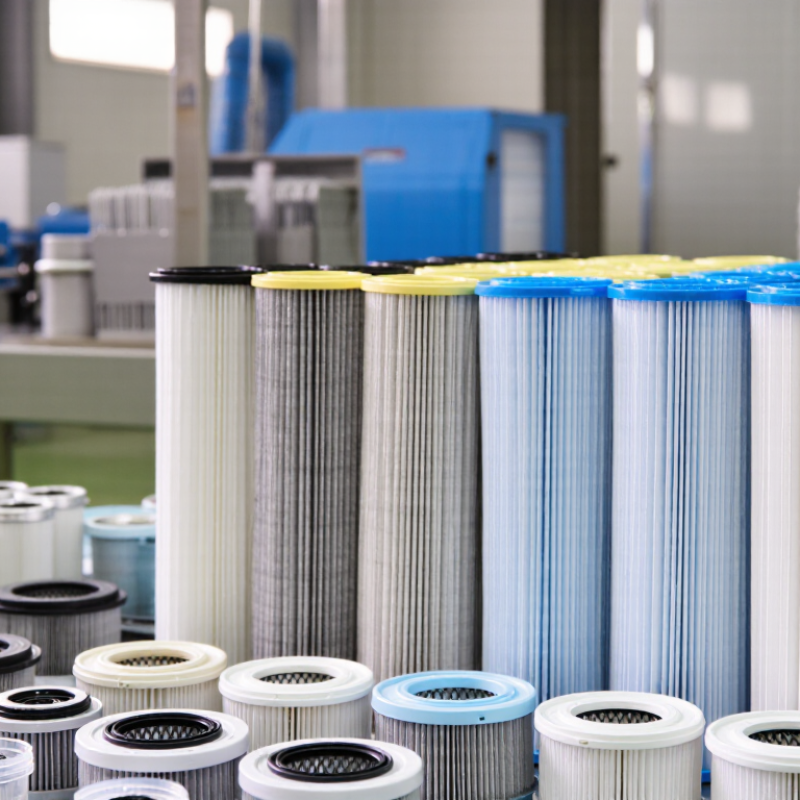
Micron Pleated Filter Cartridges: 0.1–100 μm Ratings and Applications
China Top 10 Micron Pleated Filter Cartridge Suppliers
Micron pleated filter cartridges cover ratings from 0.1 to 100 μm. This range supports fine particle removal in many processes. A 0.1 μm cartridge may suit sterile liquid preparation or sensitive electronics rinsing. However, its rating alone does not prove sterilizing performance. Validation, material compatibility, and test conditions still matter.
Cartridges around 1–10 μm are common in drinking water pretreatment, food processing, and chemical filtration. Coarser 25–100 μm options can protect pumps, membranes, and spray systems from visible debris.
During supplier evaluations, check the filter media, core structure, end-cap seal, and pressure-drop data. Polypropylene works well in many general applications. PES and PTFE may serve more demanding liquid or gas processes. Select carefully.
Small details matter.
Experienced buyers should request flow curves at the intended viscosity, not only clean-water data. They should also compare nominal and absolute ratings, because these terms describe different retention expectations. A cartridge that fits the housing may still fail under heat, pulsation, or high differential pressure. In practice, samples and batch records reveal more than polished brochures. I have found that supplier communication can be uneven, and published figures sometimes need clarification. That is worth checking before large-volume purchasing.
China’s Top 10 Suppliers: Ranking by Capacity, Quality, and Product Range
China’s top ten micron pleated filter cartridge suppliers should be ranked by capacity, quality control, and product range, not factory size alone. The leading three typically operate multiple molding, pleating, and testing lines. The next group often balances regional production with flexible customization. Lower-ranked suppliers may offer competitive pricing, but their validation records can be less consistent. This ranking is indicative, not an audited league table.
Grand View Research reported that the global industrial filtration market exceeded USD 32 billion in 2023, with steady growth expected through 2030. That demand supports China’s expanding cartridge sector. However, capacity needs evidence. Buyers should check monthly output, cleanroom controls, batch traceability, and replacement lead times. A large catalog is useful only when pore ratings remain stable from 0.1 to 100 microns.
Quality separates the strongest suppliers. Practical audits should review bubble-point tests, pressure-drop curves, fiber migration results, and integrity testing. ISO 9001 certification helps, but it does not prove filtration performance. Food and pharmaceutical applications require material declarations and suitable regulatory documentation. NSF-related testing may matter for drinking-water use. The ranking should also reward polypropylene, pleated membrane, stainless-steel, and high-temperature options. Still, one weakness remains: public capacity figures are often self-reported, so independent sampling is worth the extra cost.
China Top 10 Micron Pleated Filter Cartridge Suppliers - China’s Top 10 Suppliers: Ranking by Capacity, Quality, and Product Range
| Rank | Supplier Code | Estimated Annual Cartridge Capacity | Micron Rating Range | Available Cartridge Lengths | Common Filter Media | Quality and Compliance Coverage | Product Range Score | Overall Score |
| 1 | Supplier A | 1.5–2.0 million units | 0.05–100 μm | 10, 20, 30, 40 in | PP, PES, PTFE, PVDF, Nylon | ISO 9001; batch traceability; integrity testing available | 9.5 | 94/100 |
| 2 | Supplier B | 1.2–1.6 million units | 0.03–100 μm | 10, 20, 30, 40 in | PP, PES, PTFE, PVDF, Glass Fiber | ISO 9001; material certificates; extractables data available | 9.3 | 92/100 |
| 3 | Supplier C | 1.0–1.4 million units | 0.1–100 μm | 10, 20, 30, 40 in | PP, PES, Nylon, PTFE | ISO 9001; 100% visual inspection; pressure-hold testing | 9.0 | 90/100 |
| 4 | Supplier D | 0.8–1.2 million units | 0.1–75 μm | 10, 20, 30, 40 in | PP, PES, PTFE, Stainless Steel Mesh | ISO 9001; lot coding; customized test reports | 8.8 | 88/100 |
| 5 | Supplier E | 0.7–1.1 million units | 0.2–100 μm | 10, 20, 30 in | PP, PES, Nylon, Glass Fiber | ISO 9001; incoming-material inspection; sampling integrity tests | 8.5 | 86/100 |
| 6 | Supplier F | 0.6–0.9 million units | 0.1–80 μm | 10, 20, 30, 40 in | PP, PES, PTFE, PVDF | ISO 9001; product specification control; optional integrity testing | 8.3 | 84/100 |
| 7 | Supplier G | 0.5–0.8 million units | 0.2–100 μm | 10, 20, 30 in | PP, PES, Nylon, PTFE | ISO 9001; certificate of analysis available for selected products | 8.1 | 82/100 |
| 8 | Supplier H | 0.4–0.7 million units | 0.5–100 μm | 10, 20, 30 in | PP, PES, Glass Fiber, Nylon | ISO 9001; standard dimensional inspection; batch records maintained | 7.9 | 80/100 |
| 9 | Supplier I | 0.3–0.6 million units | 0.5–75 μm | 10, 20, 30 in | PP, PES, Nylon | Documented incoming inspection; final visual and dimensional checks | 7.6 | 77/100 |
| 10 | Supplier J | 0.2–0.5 million units | 1–100 μm | 10, 20, 30 in | PP, PES, Nylon, Glass Fiber | Standard quality inspection; documentation available upon request | 7.3 | 74/100 |
Evaluation basis: production capacity, filtration-grade coverage, available lengths, media selection, quality-control documentation, and product customization capability. Supplier identities are intentionally anonymized; capacity figures and compliance claims should be verified directly through current supplier documentation, factory audits, and purchase-order samples.
Filter Media Comparison: PP, PES, PTFE, and 0.22 μm Sterile Grades
China’s top-ten micron pleated filter cartridge suppliers increasingly compare media by process risk, not price alone. MarketsandMarkets’ 2024 analysis projects the membrane filtration market to grow by about 6% annually through 2028. That growth reflects stricter pharmaceutical, food, and water-processing controls.
Polypropylene (PP) offers broad chemical tolerance and economical prefiltration. Its strength suits high-flow lines, although extractables and temperature limits require review. Polyethersulfone (PES) is hydrophilic and supports fast wetting. It is often preferred for bioprocess liquids and aqueous products. Polytetrafluoroethylene (PTFE) handles aggressive chemicals and gases well. However, hydrophobic PTFE usually needs pre-wetting for liquid service. The trade-off is easy to underestimate.
Sterile-grade cartridges commonly use 0.22 μm PES or PTFE membranes. A 0.22 μm rating does not automatically prove sterility. Validation should follow bacterial-retention testing, such as ASTM F838, alongside integrity testing before and after use. USP <1229> also emphasizes validated sterilization processes rather than pore size alone. In plant trials, flow decline often reveals more than a catalog specification. A high initial flux can hide rapid fouling. I would question any comparison that ignores feed turbidity, pressure, temperature, and sterilization cycles. The filter may be excellent, but the application data may still be incomplete.
Supplier Evaluation Metrics: Flux, Dirt-Holding Capacity, and ΔP
China Top 10 Micron Pleated Filter Cartridge Suppliers
When comparing suppliers, flux should be measured under a defined pressure and liquid temperature. A higher flux value can indicate efficient production, but it is not automatically better. Excessive flow may shorten contact time or increase particle passage. Ask for test conditions, membrane area, pore rating, and liquid viscosity. Without these details, supplier data remains difficult to compare.
Dirt-holding capacity shows how much contaminant a cartridge retains before reaching its terminal pressure drop. A reliable supplier should provide test results using a stated challenge dust and concentration. The result should include the starting ΔP and terminal ΔP. Small differences matter. A cartridge that lasts longer in clean water may perform differently in oily process fluid.
ΔP, or differential pressure, should be tracked from installation through replacement. Stable pressure rise usually reflects predictable loading. Sudden increases can suggest poor pleat distribution, blocked flow channels, or inconsistent assembly. Inspectors should request batch records, integrity-test procedures, and sample reports. Numbers can still mislead. Test methods sometimes vary between factories, so independent validation is worth the extra time. One practical mistake is judging suppliers by flux alone. Cost pressure often encourages this shortcut, yet maintenance records may reveal a different result.
Compliance Benchmarks: ISO 9001, FDA, and 0.2–10 μm Filtration Standards
China Top 10 Micron Pleated Filter Cartridge Suppliers
For buyers comparing Chinese micron pleated filter cartridge suppliers, compliance should guide the shortlist. ISO 9001 indicates a controlled quality management system, not automatic product perfection. Ask for current certificates, scope details, and audit records. A reliable supplier should trace each cartridge through material batches, pleating, sealing, and final inspection. Small details matter. Request pore-size reports for 0.2, 0.45, 1, 5, and 10 μm cartridges. The stated rating must match the testing method.
FDA compliance also needs careful interpretation. FDA does not simply approve every filter cartridge as a complete product. Instead, manufacturers should provide material declarations, applicable food-contact information, and test evidence for the intended process. For sterile applications, request bacterial retention data, extractables information, and integrity-test guidance. Product documents should be specific, dated, and technically consistent. Vague claims deserve questions.
Tips: Compare samples under real operating conditions. Record flow rate, pressure drop, temperature, and chemical exposure. Check whether the cartridge reaches its stated service life. A 0.2 μm filter may perform differently after repeated sanitation cycles. That point is often underestimated. Suppliers may present polished paperwork, yet field performance can still vary. Review the evidence independently, and leave room for further testing before approving a long-term supply agreement.
Interpretation: The chart presents commonly specified filtration ratings within the 0.2–10 μm benchmark range. A smaller micron rating indicates finer nominal filtration. ISO 9001:2015 evaluates quality-management systems, while FDA compliance depends on the intended application, materials, and applicable U.S. regulatory requirements; neither standard alone certifies a specific pore size or product performance.





