China Top Magnetic Hooks Suppliers for Bulk Buyers
China’s magnetic hardware market offers many options for bulk buyers, but a polished catalog is not proof of dependable performance. Magnetic Hooks should be assessed by more than appearance. Buyers need to compare holding-force ratings, magnet material, coating, hook dimensions, and test conditions. A rating measured on a thick, clean steel plate may not match performance on a thin cabinet door. Details matter.
Michael Faraday, whose work shaped the study of electromagnetism, wrote, “Nothing is too wonderful to be true, if it be consistent with the laws of nature.” For buyers, that is a useful reminder to ask how a supplier supports its claims. Request product specifications, sample units, packaging details, and clear explanations of load testing. Check whether the hook stays secure when attached to the actual surface and used at the intended angle. Small trials can reveal issues that a spreadsheet misses.
This guide examines China-based suppliers through practical sourcing questions: product range, customization, quality controls, communication, and bulk-order readiness. No supplier should be treated as the best fit without verification. A missed detail can become a costly one. Even a promising sample may not represent every production batch, so follow-up checks are sensible. The goal is not to chase the lowest quoted price. It is to find Magnetic Hooks that suit the application, arrive consistently, and perform as expected—with evidence buyers can review.
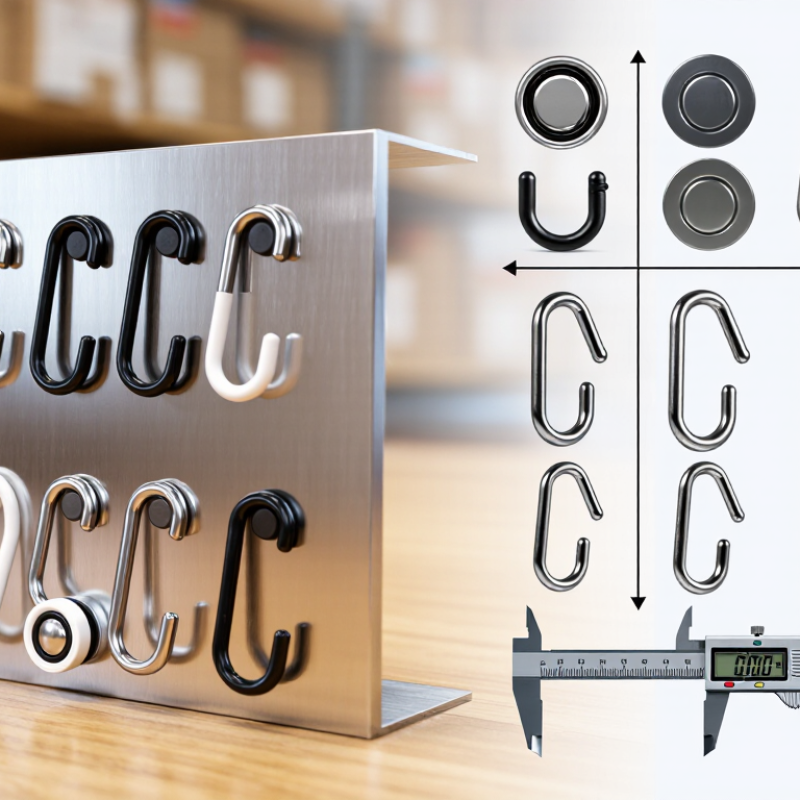
Magnetic Hook Basics: NdFeB Grades N35–N52 and the Typical 80°C Limit
For bulk magnetic hooks, N35 to N52 describes magnetic energy product, not heat resistance. Representative sintered NdFeB grade tables place N35 remanence near 1.17–1.22 tesla and N52 near 1.42–1.48 tesla. Higher numbers can provide stronger magnets in a similar size, but hook capacity also depends on steel thickness, contact area, and surface gaps. IEC 60404-8-1:2015 provides a framework for specifying permanent-magnet materials. Not a heat rating.
The often-quoted 80°C limit applies to many standard-grade NdFeB magnets, including common N grades. It is a typical maximum operating temperature, not a guaranteed safe point for every hook. Heat and opposing magnetic fields can reduce holding force, sometimes irreversibly. A hot warehouse door or sunlit steel panel may matter more than the room-temperature pull-force figure. Small hooks still slip.
For procurement, ask suppliers to state the magnet grade, temperature rating, and test conditions behind their holding-force data. High-coercivity variants, such as H or SH grades, can tolerate higher temperatures, though their magnetic output and price may differ. Check the finished hook, not only the loose magnet: coatings, steel cups, adhesive, and hook geometry all affect performance. A real-load test still matters; catalog figures can flatter. USGS Mineral Commodity Summaries 2025 reports China’s 2024 rare-earth mine output at 270,000 metric tons of rare-earth-oxide equivalent. That figure describes upstream mining, not magnet production or hook quality.
Comparing Hook Performance: Pull Force in N or kgf on Flat Steel
For bulk buyers comparing magnetic hooks, pull force is useful only when the test conditions are clear. Newtons (N) and kilogram-force (kgf) are different units for force: 1 kgf is approximately 9.81 N. A rating of 100 N is therefore close to 10.2 kgf, not 100 kgf. On a clean, thick, flat steel plate, a hook is usually pulled straight away from the surface. Real installations may perform differently. Paint, dust, curved surfaces, or thin steel can reduce contact and holding force. Small details matter.
Tips: Ask suppliers for the test plate material, thickness, and surface condition. Confirm whether the result measures direct pull or resistance to sliding. Compare products tested under matching conditions.
A high direct-pull rating does not guarantee that a hook will hold the same load on a vertical panel. Sideways force can make it slide, especially when a hanging item swings or its weight sits far from the magnet. For a fair comparison, request test data in both N and kgf, then check the measurement method and repeatability. One number may look reassuring, but it can hide practical differences. I would leave a safety margin and test a sample on the intended steel before placing a large order. Even then, results can vary between surfaces.
Evaluating China Suppliers: MOQ, Certifications, and Batch Consistency
A low minimum order quantity can help buyers test magnetic hooks before committing to a full container. Ask suppliers to quote the MOQ by hook size, coating, packaging, and magnet grade; these options can change the production run. Small orders matter. Confirm whether a “sample” comes from normal production or was specially prepared, since those are not always comparable.
Certification needs careful checking. The ISO Survey 2022 reported 1,265,216 valid ISO 9001 certificates worldwide, but that figure does not prove any individual factory’s quality. Request a current certificate and verify its scope and issuing body. ISO 9001 covers a quality-management system; it does not certify a hook’s holding force. I would not treat a certificate logo as a substitute for test records.
For batch consistency, request measurements from several units across a production lot, not one handpicked sample. Check hook dimensions, coating condition, and pull force using the same steel plate, surface gap, and test direction each time. Ask how the supplier handles failed checks and whether production records can be tied to the shipped batch. ISO 2859-1 offers a recognized approach to acceptance sampling, though buyers still need to agree on inspection levels and defect limits. A neat spreadsheet helps, but it cannot capture every scratch or loose hook in a carton. Include a small incoming inspection in your purchasing plan.
China Magnetic Hook Supplier Evaluation: What Bulk Buyers Should Verify
Suggested buyer-defined review weights, not measured supplier-market data. There is no universal MOQ or batch-consistency benchmark for magnetic hooks, so compare suppliers using your order requirements, applicable documentation, and inspection results from samples and production batches.
Setting Bulk Specifications: Air Gaps, Load Ratings, and Safety Factors
For bulk orders, specify magnetic pull at a stated air gap, not just a headline load. Ask for test results on clean, flat, low-carbon steel, with plate thickness and pull direction recorded. Then request repeat measurements with nonmagnetic shims matching your coating or surface gap. Even a thin gap can reduce holding force; paint, rust, and curved surfaces make real installations less predictable. Small details matter.
IEC 60404-5:2015 sets methods for measuring permanent-magnet properties, but it does not certify a finished hook’s working load. ASME B30.20-2021 covers requirements for below-the-hook lifting devices, including magnetic devices. Ask suppliers to distinguish breakaway force from working load, and document the test setup for each figure. Set a safety factor for the actual task and applicable equipment standard; do not assume one multiplier fits every hook. For incoming inspection, test sample units on the intended steel thickness and surface condition. Record failures, too. This step is easy to skip when schedules tighten. It should not be.
Verifying Orders: Sample Testing and ISO 2859-1 AQL Inspection
For bulk magnetic-hook orders, sample testing should happen before cartons are sealed. Check hook dimensions, coating, magnet seating, and holding force on a clean steel plate. Record the test surface and pull direction; both can change the result. Test several units from different cartons, not only the polished sample sent during quotation. Small details matter.
Then agree on an attribute-sampling plan using ISO 2859-1:1999, the international standard for lot-by-lot inspection. For example, a lot of 3,201–10,000 pieces, General Inspection Level II, uses a sample of 200. At AQL 1.0, the standard’s normal single-sampling table gives acceptance at five defective units and rejection at six. These figures are an example, not a universal rule; the agreed inspection level and AQL determine the plan. AQL is not permission to ship a fixed number of defects.
Separate critical, major, and minor defects before inspection. A loose magnet may stop a hook from carrying its stated load; a small paint mark may be cosmetic. Photograph failed samples beside a ruler and label each carton number. Keep the inspection record with the approved sample and test results. Sampling can miss a defect. It is not perfect, so repeat checks when results look uneven. Refer to ISO 2859-1’s lot-size and acceptance tables when confirming the plan with a supplier.





