


China Top 10 IoT Devices for Energy Monitoring

China’s energy transition is creating a practical need for better visibility inside factories, offices, and homes. The International Energy Agency’s Energy Efficiency 2023 report notes that buildings account for about 30% of global final energy consumption. That figure makes small measurement gaps worth investigating. A high idle load, a compressor cycling too often, or a meter that misses peak demand can quietly raise costs.

This guide examines Iot Devices For Energy Monitoring available to Chinese buyers, from smart meters and power-quality analyzers to wireless sensors and gateways. It compares what each device measures, how readings are connected, and where installation or data compatibility may become difficult. The aim is useful selection, not a claim that one product suits every site. No device is perfect.

The International Energy Agency describes energy efficiency as “the first fuel,” a phrase used by its Executive Director, Dr. Fatih Birol. The idea fits monitoring: measured consumption can reveal opportunities, but sensors alone do not guarantee savings. The ten-device overview therefore focuses on specifications, deployment context, and limitations, while treating manufacturer claims cautiously. Buyers should verify local connectivity, electrical ratings, cybersecurity documentation, and integration requirements before installation. Those details matter on a noisy factory floor, where wireless signals may drop and readings can be misinterpreted. The ranking is a starting point, not a substitute for site testing.
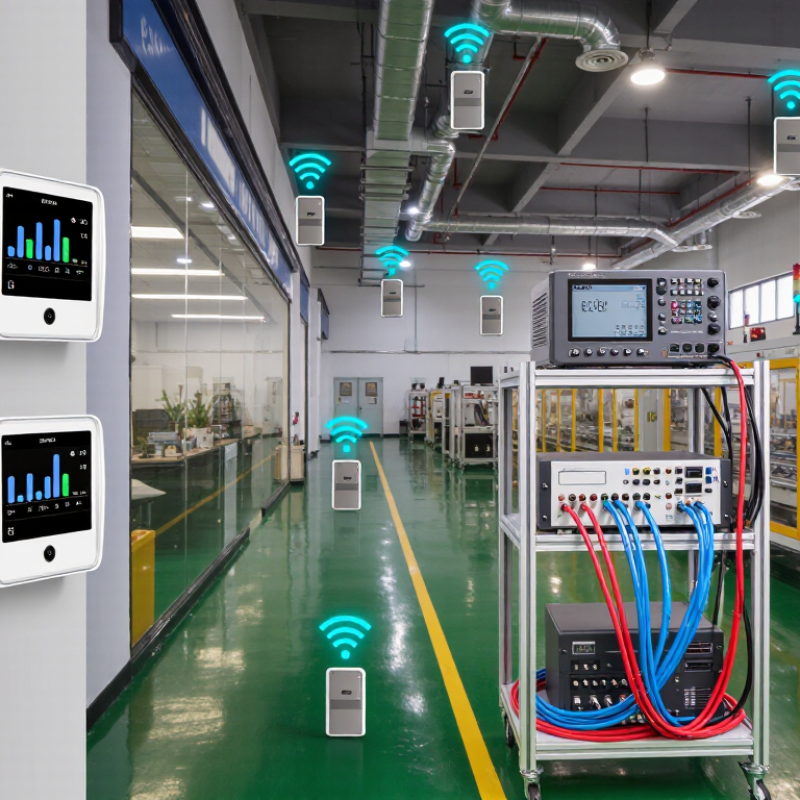
China Top 10 IoT Devices for Energy Monitoring

What IoT Energy Monitoring Devices Measure and How They Work

IoT energy monitoring devices turn electrical activity into readings that operators can inspect. Current sensors, often clamped around a wire, detect how much electricity flows without interrupting the circuit. Voltage measurements add context. Together, these values help calculate power in kilowatts and energy use in kilowatt-hours.

That distinction matters.

Some devices also record frequency, power factor, and voltage changes. These measurements can reveal an overloaded motor or an unusual load pattern. In a workshop, a sensor might show a compressor drawing more current during repeated starts.

Smart meters may measure whole-building consumption, while circuit-level monitors identify which areas use the most energy. Timing matters. Frequent samples can capture short peaks, but they also create more data to manage.

Readings travel through a local gateway or network connection to software for viewing and analysis. A dashboard might compare this week’s overnight use with last week’s, or send an alert when consumption rises unexpectedly. Yet a precise-looking chart is not automatically a precise measurement. Incorrect sensor placement, poor calibration, or missing data can distort the picture. Sensor placement deserves care. Operators should check readings against known equipment behavior and investigate surprising changes before treating them as confirmed faults.


China’s IoT Energy Monitoring Market and Device Categories

China Top 10 IoT Devices for Energy Monitoring

China’s IoT energy-monitoring market serves factories, commercial buildings, campuses, and infrastructure operators. Their needs differ: a production line may require equipment-level readings, while an office may focus on floor-by-floor consumption. Device selection depends on the measurement point, existing electrical systems, and how quickly staff need to act on unusual readings.

The main categories include smart electricity meters, power-quality analyzers, current sensors, temperature sensors, and communication gateways. Meters record energy use over time; analyzers can reveal voltage changes or phase imbalance. Current sensors can be fitted around cables, making them useful where rewiring is impractical. Gateways collect readings from multiple devices and send them to monitoring software. Small devices matter.

In practice, an installation might track a chiller’s power draw, a distribution panel’s temperature, and a workshop’s hourly load. The category boundaries are not always neat. A meter may offer basic power-quality data, while a gateway may perform limited local checks. Still, gaps remain. Poor sensor placement, inconsistent intervals, or weak network coverage can make precise-looking dashboards misleading. Reliable monitoring depends on installation checks, clear device specifications, and regular comparison with verified meter readings.

China’s Top 10 IoT Energy Monitoring Devices: Market Context

China’s electricity consumption by sector, 2023 (TWh)

Industry accounts for the largest share of electricity use, making it a major setting for IoT energy monitoring. Common device categories include smart meters, power meters, power-quality analyzers, smart circuit breakers, current sensors, and energy gateways. Sector figures are from China’s National Energy Administration; device categories are examples, not market rankings.

The Top 10 IoT Devices for Energy Monitoring in China

China Top 10 IoT Devices for Energy Monitoring
The Top 10 IoT Devices for Energy Monitoring in China

China’s monitoring needs span factories, office towers, apartment blocks, and distributed energy sites. The International Energy Agency estimates that buildings consume about 30% of global final energy. The scale matters. China’s National Energy Administration reported electricity consumption of about 9.85 trillion kWh in 2024. Monitoring devices can help operators locate waste, but only when readings are reliable and acted upon.

A practical top-ten shortlist includes smart electricity meters, circuit-level submeters, current sensors, power-quality analyzers, smart plugs, HVAC meters, building-control gateways, wireless temperature sensors, solar inverter monitors, and battery monitoring units. Together, they track consumption, voltage, equipment conditions, and on-site generation. IoT Analytics estimated 18.8 billion connected IoT devices worldwide at the end of 2024, reflecting the expanding infrastructure behind these systems. Yet more data does not automatically mean lower bills.

For a Chinese facility, match devices to the load: a submeter can reveal a production line’s overnight draw, while temperature sensors can flag uneven cooling across floors. Check measurement accuracy, communication stability, data access, and compatibility with existing meters before deployment. No shortlist is perfect. Older buildings may have cramped panels, patchy wireless coverage, or incomplete circuit records; those constraints can make installation slower than expected. Begin with a small area and compare device readings against utility-meter data.

China Top 10 IoT Devices for Energy Monitoring - The Top 10 IoT Devices for Energy Monitoring in China

# Device type What it monitors Typical measurement performance Common connectivity Typical use
1 Smart electricity meter Voltage, current, active power, power factor, and cumulative energy Meter accuracy class commonly 1 or 0.5S, depending on the meter and application RS-485/Modbus, cellular, or other meter-network interfaces Building incomers, factories, and utility or facility metering
2 Multi-circuit power monitor Current and energy across multiple branch circuits; some models also measure voltage and power Often specified around 1% to 2%; accuracy depends on the meter, current transformers, and installation RS-485/Modbus, Ethernet, or wireless gateway Distribution panels, tenant billing, and circuit-level energy tracking
3 Wireless split-core current sensor AC current; some systems estimate power when paired with voltage or meter data Current accuracy is model-dependent; confirm the sensor range and stated error in its datasheet Sub-GHz wireless, LoRaWAN, or a proprietary radio link to a gateway Retrofits where opening existing wiring is impractical
4 Power quality analyzer Voltage, current, frequency, harmonics, power factor, and energy; advanced models record disturbances Measurement and energy accuracy vary by instrument class and configuration Ethernet, RS-485/Modbus, or data-logging interface Industrial sites investigating energy quality and equipment loads
5 DIN-rail submeter Electricity use for a defined machine, floor, tenant, or distribution branch Common meter classes include 1 and 0.5S; select according to the required measurement purpose RS-485/Modbus, pulse output, or wireless gateway Commercial buildings, workshops, and equipment-level monitoring
6 Smart plug with energy measurement Plug-load voltage, current, power, and accumulated energy Accuracy is product-dependent and generally intended for monitoring rather than revenue metering Wi-Fi, Zigbee, or Bluetooth through a compatible hub or network Appliances, office equipment, and small plug-in loads
7 HVAC energy monitoring controller HVAC electrical consumption, run time, operating status, and selected temperature data Energy accuracy depends on its integrated meter or external metering inputs BACnet, Modbus, Ethernet, or building-management gateway Chillers, pumps, air-handling units, and building energy management
8 Thermal energy meter Heat or cooling energy calculated from fluid flow and supply/return temperature difference Performance depends on the flow sensor, temperature sensors, installation, and meter class M-Bus, RS-485/Modbus, pulse output, or wireless interface District heating, chilled-water systems, and thermal submetering
9 Gas meter with IoT pulse or digital interface Gas volume or meter pulses, with consumption totals transmitted for monitoring Depends on the underlying gas meter and its approved measurement specification Pulse input, M-Bus, NB-IoT, or another cellular/wireless link Commercial kitchens, campuses, and building gas-use tracking
10 Energy data gateway Collects and forwards readings from meters and sensors; typically does not measure energy itself Data quality depends on connected instruments, polling settings, and communications RS-485/Modbus, Ethernet, Wi-Fi, or cellular backhaul Aggregating site data for dashboards, alarms, and energy-management platforms

Note: This is a category-based overview, not a manufacturer ranking. Specifications and communication options vary by model; verify the applicable datasheet and installation requirements before selection.

Energy Monitoring Applications in Homes, Buildings, and Industry

China Top 10 IoT Devices for Energy Monitoring

In Chinese homes, smart meters and circuit-level monitors show when heating, cooling, or cooking drives electricity use. Room sensors add context: a warm, empty bedroom may signal wasted heating. Small signals matter. The International Energy Agency’s Buildings 2023 report says buildings account for about 30% of global energy consumption and 26% of energy-related emissions. These figures make accurate, timely measurement useful, not merely convenient.

In commercial buildings, submeters can separate consumption by floor, tenant, or system. Temperature, occupancy, and equipment sensors help operators compare HVAC demand with actual use. A morning load spike becomes easier to investigate when the data includes room conditions and operating schedules. Yet dashboards can mislead. A missing sensor or poorly placed meter may make a tidy chart look convincing.

Factories need a different level of detail. Networked power meters can track production lines, while current and temperature sensors help reveal inefficient motors or compressed-air equipment. The IEA’s Energy Efficiency 2023 report places industry at nearly 40% of global energy consumption. That scale makes reliable readings valuable, but devices alone do not deliver savings. Teams still need to check calibration, match energy data to production, and investigate unexplained changes. Not every spike has a neat explanation.

How to Choose an IoT Device for Energy Monitoring

Choosing an IoT energy-monitoring device starts with the question it must answer: whole-building trends, machine-level loads, or tenant usage. Start at the panel. The IEA’s Energy Efficiency 2023 report estimates that buildings use about 30% of global final energy. The IEA’s Electricity 2024 report projects global electricity demand will grow by an average of 3.4% annually from 2024 to 2026. Those figures make useful monitoring important, but they do not tell you which meter fits your site.

Check the electrical system before comparing dashboards. Confirm single- or three-phase service, voltage, current range, and whether clamp-on sensors fit the panel safely. Review accuracy at low loads, not only at full capacity. A device that misses overnight standby power can distort savings estimates. For factories, verify that its communication protocols work with existing controls. For distributed sites, check whether it stores readings during network outages.

Look for clear sampling intervals, exportable data, and role-based access. These details matter when staff need to compare a machine’s 15-minute load profile with a monthly bill. In China, confirm local technical support and compatibility with the site’s network setup. A polished dashboard can still hide gaps. Ask for a trial on one circuit, then compare its readings with a calibrated reference meter. That extra check takes time, and it may reveal that the original monitoring plan needs revision.

Powder Coat Booths

For those larger-sized parts, or smaller quantity runs, we have 2 independent powder coat booths and ovens. The quality, durability and affordability of today’s powder coating finishes make this the process of choice for world-class companies.

Powder coating advantages over other forms of coating are many. Materials used in the Powder coating process can be metals and non-metals that come in a multitude of thicknesses, textures, colors, etc. Another of Powder coating’s biggest advantages over conventional coatings is its ability to create finishes in many different textures. Powder Coating Booths allow us the ability to apply these advantages to large products.

Wet Paint Line

Tri-State Fabricators runs a full-service conveyor line for painting. Wet painting can provide protection or decoration to many different part styles. From start to finish, every project is easier to undergo random and point-based inspection by our skilled painting team.

Advantages to our Wet Paint Line are these lines start with product prep and ends with a thorough inspection of a high quality finished product. Our ability to complete large and small projects with a superior finish and doing so in a timely and economical fashion. This passes along the savings in production to our customers. When powder coating ins not an option, our Wet Paint Line gets the job done right the first time.

Wet Paint Booths

When the parts get big and heavy we roll-out our custom paint racks and oversize booth. By utilizing our partnerships with all the major paint brands, we can match virtually any color with wet paint.

The advantages of having access to a Wet Paint Booth are many. Large projects of many different shapes can be loaded into the booth. The Wet Paint Booth offers an environment that is much more controlled than a typical parts painting operation.

Not only are they used because of their controlled environment, but they’re are also advantageous when it comes to applying paint to parts that are needed in industries that require specialty coatings such as medical, aerospace, etc.

Military CARC

Our military forces have some very high standards when it comes to the finish of their vehicles and equipment. From the first pre-treatment step to final coat, it takes a great deal of knowledge and experience to protect the men and women of our armed forces. They deserve only the best, and Tri-State Fabricators provides it.

All of our processes are closely monitored by our staff and management teams. Both of which are highly trained in the processes of metal fabrication and finishing. Tri-State Fabricators’ goal is to always fully satisfy each and every customer, including the military. We will always put a 110% into what we do.

Glass-Bead Blasting

Abrasive media blasting is an excellent way to remove old paint, rust, and increase the paint/powder adhesion. Glass beads produce a much smoother and brighter finish than angular abrasives; leaving the part clean yet without any dimensional change. Chemically inert and environmentally friendly, we can recycle our beads approximately 30 times; making them a more preferred method of metal cleaning or surface finishing.

Advantages to Glass Bead Blasting are many. Glass bead blast media is used when a project is needing rough surfaces need to become smooth for applications of coatings such as paint. It is typically used to clean paint and rust from a product surface without deforming the surface it is being used on. Overall, compared to many other blasting media, Glass Bead Blasting is a very economical choice and those savings are always passed on to our customers.

Part Washing

Tri-State Fabricators utilize a zinc phosphate wash to clean and etch the material to ensure the best paint adhesion possible. The unique design of our 3-stage wash system does the work like a 5-stage. From Cleaning and rinsing to conversion coating and post-treatment, Our Part Washing process is a complete service and works throughout the fabrication service and the finishing service.

Along with the previously mentioned benefits, Curing is a vital chemical reaction that leaves the product finish hard and relatively safe from mild abrasion and aggressive corrosion. This process can be done in more than one way; ambient air-dry or in curing ovens at temps that exceed 240°.

Burn-Off Oven

From fixing paint mistakes (someone else’s of course) to simply cleaning our paint line hooks, our burn-off oven is put to good use. After a quick burn-off, a little clean up, and a fresh coat of paint, your parts will look better than new.

Why does our Burn-Off Oven work so well? Because super heating the air around parts turns the materials into ashes. From paint and powder coatings to rubber and machining oils, high temps do the job without degrading the integrity of the part.

Masking

Masking is a vital part of producing high quality products. We have die-cut masking patterns to protect machined surfaces as well as a wide range of plugs and caps to protect threaded holes and bolts. We provide permanent and temporary masking.

Masking allows the selected sections of a product to be protected from a fabrication or finishing service. This can be with both chemicals when etching and tapes, paints when only finishing just a section of the product. Masking is great in aiding the customization process of a project.

Screen Printing

Screen printing is a photographic process that transfers artwork onto a porous nylon screen which allows colored ink to flow through the screen and be deposited on an aluminum or plastic component. We can generally have just about any design created onto a screen for your parts.

Some of the advantages of Screen Printing are, brand recognition for your business displaying on your products, assembly instructions, product warnings/hazards, etc. Tri-State Fabricators produces Screen Printing of the highest quality so you know it’s durable.

Metal Finishing

Metal Finishing is the art of treating the exterior portion of product, often metal but can also be made of other materials, so that the surface is clean and free of any debris. Then the process of applying coats or either paint of powder coat takes place. This coating process improves the quality of the product in both appearance and resistance to wear and corrosion.

Tri-State Fabricators, Inc., understands that a project typically isn’t complete until a high-quality finish has been added to your product. This is why our painting and powder coating teams continuously inspect the products throughout the Metal Finishing process.
