


Choosing a dependable explosion-proof led floodlight manufacturer begins with the conditions the fixture must withstand. Picture a refinery walkway at dusk: fine dust settles on the housing, heat lingers near process equipment, and maintenance access is limited. In such places, a bright beam alone is not enough. Buyers should examine enclosure design, thermal management, optical performance, ingress protection, certifications, and product documentation. Details matter.
Industrial lighting consultant Daniel Chen offers this practical principle: “A floodlight is only suitable when its protection, beam pattern, and service life match the actual site.” This is a selection guideline, not a substitute for project-specific engineering review. A product sheet may look convincing, yet vague test information or unclear model variations deserve a closer look. That uncomfortable gap can be easy to miss.
This guide introduces leading explosion-proof LED floodlight manufacturers in China and compares the factors that help buyers assess them. It considers product ranges, manufacturing capability, customization, quality controls, and support after delivery. It also explains what to verify before requesting a quotation, from fixture dimensions to operating temperature and beam angle. No single supplier fits every project. The right shortlist depends on the environment, required lighting levels, installation constraints, and evidence the manufacturer can provide. Use the comparisons as a starting point, then confirm technical claims directly with each supplier and qualified project professionals.
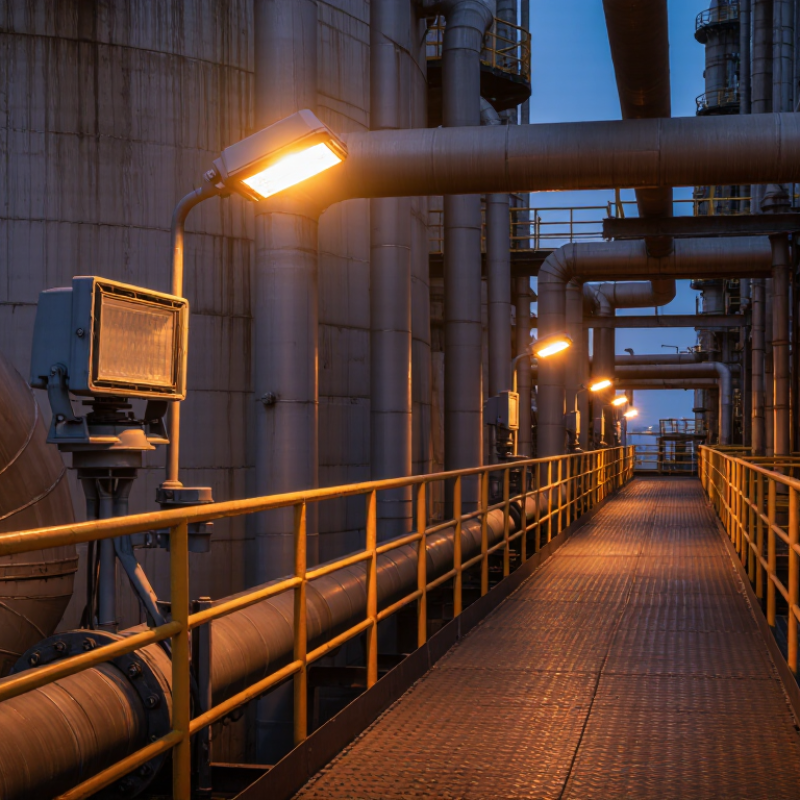
An explosion-proof LED floodlight is more than a sealed lamp. In flameproof designs, its enclosure contains an internal ignition and limits flame transmission through engineered joints. Other protection methods use different principles, so “explosion-proof” should not be treated as one universal design. The details matter. Before selecting a fixture, match its protection marking to the site’s gas or dust classification, temperature class, and hazardous-area zone. Then check ambient temperature, corrosion exposure, vibration, and required light levels. A bright beam is not useful if pipes or equipment cast deep shadows across a work area.
Industrial uses include illuminating tank farms, processing rooms, loading bays, and dusty production spaces. The International Energy Agency’s Tracking Industry report states that industry accounted for about 37% of global final energy consumption in 2022. Efficient lighting can support energy management, but savings depend on operating hours, optics, controls, and maintenance—not LED technology alone. Specify test evidence and installation limits, and have qualified personnel verify compatibility with the site classification. One point deserves extra scrutiny: a high ingress-protection rating does not, by itself, prove suitability for an explosive atmosphere. I would still review the marking against actual site conditions; drawings can be incomplete, and assumptions age poorly.
Explosion-proof LED floodlights are luminaires designed and certified for specified hazardous locations. The figures below are typical product-selection ranges, not specifications for any particular manufacturer or model. Always confirm the product certificate, marking, and suitability for the installation site.
| Floodlight Type | Typical Power Range | Typical Applications | Hazardous-Area Considerations | Key Checks When Comparing Products |
|---|---|---|---|---|
| Compact floodlight | Approximately 20–60 W | Small process areas, access routes, inspection points, and equipment platforms | Use only where the exact gas or dust classification and zone are covered by the product certification. | Certified area classification, mounting options, beam angle, ambient-temperature range, and certificate validity |
| General-purpose industrial floodlight | Approximately 60–150 W | Refinery and chemical-plant work areas, loading zones, and outdoor process spaces | For explosive gas atmospheres, verify the equipment group, protection concept, gas group, and temperature class stated on the marking. | Lumen output, photometric distribution, ingress protection, corrosion resistance, and required installation accessories |
| High-output floodlight | Approximately 150–300 W | Large tank farms, industrial yards, marine facilities, and high-bay process areas | For dust hazards, check the applicable dust group, equipment protection level, and maximum surface-temperature marking. | Thermal management, glare control, mounting height, wind exposure, and lighting calculations for the target area |
| High-temperature or severe-environment model | Varies by design; often available across several wattages | Hot process areas, offshore installations, and locations exposed to moisture or corrosive conditions | The permitted ambient-temperature range is model-specific; a hazardous-area certificate does not by itself establish suitability for every harsh environment. | Certified ambient range, enclosure materials, seals, corrosion protection, and maintenance requirements |
| Adjustable-bracket floodlight | Commonly offered in multiple wattages, depending on the certified model | Pipe racks, conveyor systems, elevated structures, and directional task lighting | The bracket and cable-entry arrangement must be suitable for the certified installation and site conditions. | Adjustment range, mounting strength, cable-entry type, aiming access, and compatibility with site wiring |
| Check | What to Verify |
|---|---|
| Area classification | Confirm whether the location presents a gas, vapor, or combustible-dust hazard and identify its zone or division under the applicable local system. |
| Certification and marking | Check the exact model’s certification documentation and Ex marking. ATEX, IECEx, and North American approvals are distinct schemes and are not automatically interchangeable. |
| Protection and temperature | Match the gas or dust group, equipment protection level, temperature class or maximum surface temperature, and ambient range to the hazard assessment. |
| Enclosure and lighting performance | Review the IP rating, materials, optical distribution, lumen output, efficacy, glare, and environmental suitability using the product datasheet and photometric files. |
| Installation and maintenance | Follow the manufacturer’s certified installation instructions and applicable electrical codes. Use qualified personnel for installation and maintenance in hazardous locations. |
Typical wattage ranges are indicative only and do not establish brightness, certification, or suitability. Select equipment from its complete documentation and the hazardous-area assessment for the specific installation.

In China, explosion-proof lighting should be assessed against the applicable parts of the GB/T 3836 series. These standards address equipment used in explosive gas and dust atmospheres. The right selection depends on the site’s hazardous-area classification, not simply on a product label. Check the required protection type, equipment protection level, gas or dust group, and temperature class against actual operating conditions. A mismatch can matter. Explosion protection is not just a rugged enclosure.
For a floodlight near a tank or dusty processing line, review its nameplate and supporting documents before installation. Confirm the Ex marking and verify whether the exact product falls under current compulsory certification requirements. A test report alone does not necessarily establish all required approvals. Also check the ingress protection rating, but do not treat it as proof of explosion protection; water and dust resistance address different risks. Installation details count, too. Cable entries, glands, earthing, and maintenance must match the manufacturer’s instructions and site conditions. Documents can look complete while a small installation detail is overlooked. That deserves a second look.
Designing an explosion-proof LED floodlight starts with its operating environment. Engineers consider dust, moisture, vibration, ambient temperature, and the gases or vapors specified for the application. The housing, joints, and cable entries must work as a system, not as separate parts. Small gaps matter. A robust enclosure may use carefully machined contact surfaces, durable seals, and corrosion-resistant metal. Designers also manage heat around the LED board and driver, since excessive temperature can shorten component life. Optics need attention too: a wide beam can illuminate a loading bay, while a narrower beam may suit a tall tank area.
Testing checks whether the design performs as intended. Manufacturers typically inspect dimensions and materials, then evaluate sealing, electrical performance, temperature rise, and mechanical strength under controlled conditions. Accredited third-party testing may be required for particular certifications; buyers should verify the certificate’s scope and product model. Production checks matter as much as a successful prototype. Not always easy. A loose fastener, uneven seal, or inconsistent coating can affect reliability, so traceable inspection records are useful. In practice, no test captures every site condition. Engineers still need to review installation details, maintenance access, and the actual environment before selecting a floodlight.
Leading explosion-proof LED floodlight manufacturers in China should be compared by engineering evidence, not catalogue claims alone. Check how each model manages heat, vibration, and dust around its enclosure. Ask for test reports that identify the exact product model and explain the testing scope. Details matter. A certificate for one fixture does not automatically cover every version in a product family.
Good suppliers can explain beam angles, mounting options, cable entries, and maintenance needs in plain language. Request drawings and photometric data, then compare them with the site layout. For example, a wide beam may suit an open loading area, while a narrower distribution can reduce glare near walkways. Verify that protection markings and supporting documents match the intended market and installation conditions. Ask who handles spare parts and technical questions after delivery. A polished brochure is not enough.
Factory capability also matters. Look for consistent assembly records, incoming-material checks, and documented final inspections. Where possible, review sample units and inspect seals, fasteners, and finish quality. No shortlist is perfect; real site conditions can expose gaps that paperwork misses. That is worth admitting. A careful comparison balances verified documentation, practical lighting performance, and clear communication.
IP codes describe protection against dust and water ingress: the first digit “6” indicates dust-tight protection, while the second digit identifies the tested water-protection category. These code digits are labels, not a linear performance scale. An IP rating does not certify explosion protection; verify the applicable hazardous-area certification separately. IPX8 test conditions are specified by the manufacturer.
For China’s explosion-proof LED floodlight manufacturers, certification is a starting point, not a complete comparison. Check whether each certificate covers the exact model, enclosure, and hazardous-area classification—not merely a product family. IECEx documentation can support international evaluation, while ATEX documents may be relevant for European projects. Verify certificate numbers with the issuing body and request test reports. A certificate image alone is weak evidence.
Performance deserves equal scrutiny. The IEA’s “Energy Efficiency 2023” report notes that lighting uses about 15% of global electricity and produces roughly 5% of global greenhouse-gas emissions. In demanding sites, compare measured lumens per watt, beam distribution, color temperature, and thermal limits. Ask for test conditions, not just headline figures. A 150-watt fixture may look efficient on paper, yet poor optics can leave dark patches beneath tanks or pipe racks. Numbers need context.
Tips: Request a sample and inspect the gasket, cable entries, and heat-sink finish. Ask how the supplier handles spare drivers, warranty claims, and failure analysis. Response time matters when a fitting fails above a production line. A factory may offer strong paperwork but slow support; that trade-off deserves attention. Independent lab reports and clear service commitments make the comparison more dependable.


For those larger-sized parts, or smaller quantity runs, we have 2 independent powder coat booths and ovens. The quality, durability and affordability of today’s powder coating finishes make this the process of choice for world-class companies.
Powder coating advantages over other forms of coating are many. Materials used in the Powder coating process can be metals and non-metals that come in a multitude of thicknesses, textures, colors, etc. Another of Powder coating’s biggest advantages over conventional coatings is its ability to create finishes in many different textures. Powder Coating Booths allow us the ability to apply these advantages to large products.
Tri-State Fabricators runs a full-service conveyor line for painting. Wet painting can provide protection or decoration to many different part styles. From start to finish, every project is easier to undergo random and point-based inspection by our skilled painting team.
Advantages to our Wet Paint Line are these lines start with product prep and ends with a thorough inspection of a high quality finished product. Our ability to complete large and small projects with a superior finish and doing so in a timely and economical fashion. This passes along the savings in production to our customers. When powder coating ins not an option, our Wet Paint Line gets the job done right the first time.
When the parts get big and heavy we roll-out our custom paint racks and oversize booth. By utilizing our partnerships with all the major paint brands, we can match virtually any color with wet paint.
The advantages of having access to a Wet Paint Booth are many. Large projects of many different shapes can be loaded into the booth. The Wet Paint Booth offers an environment that is much more controlled than a typical parts painting operation.
Not only are they used because of their controlled environment, but they’re are also advantageous when it comes to applying paint to parts that are needed in industries that require specialty coatings such as medical, aerospace, etc.
Our military forces have some very high standards when it comes to the finish of their vehicles and equipment. From the first pre-treatment step to final coat, it takes a great deal of knowledge and experience to protect the men and women of our armed forces. They deserve only the best, and Tri-State Fabricators provides it.
All of our processes are closely monitored by our staff and management teams. Both of which are highly trained in the processes of metal fabrication and finishing. Tri-State Fabricators’ goal is to always fully satisfy each and every customer, including the military. We will always put a 110% into what we do.
Abrasive media blasting is an excellent way to remove old paint, rust, and increase the paint/powder adhesion. Glass beads produce a much smoother and brighter finish than angular abrasives; leaving the part clean yet without any dimensional change. Chemically inert and environmentally friendly, we can recycle our beads approximately 30 times; making them a more preferred method of metal cleaning or surface finishing.
Advantages to Glass Bead Blasting are many. Glass bead blast media is used when a project is needing rough surfaces need to become smooth for applications of coatings such as paint. It is typically used to clean paint and rust from a product surface without deforming the surface it is being used on. Overall, compared to many other blasting media, Glass Bead Blasting is a very economical choice and those savings are always passed on to our customers.
Tri-State Fabricators utilize a zinc phosphate wash to clean and etch the material to ensure the best paint adhesion possible. The unique design of our 3-stage wash system does the work like a 5-stage. From Cleaning and rinsing to conversion coating and post-treatment, Our Part Washing process is a complete service and works throughout the fabrication service and the finishing service.
Along with the previously mentioned benefits, Curing is a vital chemical reaction that leaves the product finish hard and relatively safe from mild abrasion and aggressive corrosion. This process can be done in more than one way; ambient air-dry or in curing ovens at temps that exceed 240°.
From fixing paint mistakes (someone else’s of course) to simply cleaning our paint line hooks, our burn-off oven is put to good use. After a quick burn-off, a little clean up, and a fresh coat of paint, your parts will look better than new.
Why does our Burn-Off Oven work so well? Because super heating the air around parts turns the materials into ashes. From paint and powder coatings to rubber and machining oils, high temps do the job without degrading the integrity of the part.
Masking is a vital part of producing high quality products. We have die-cut masking patterns to protect machined surfaces as well as a wide range of plugs and caps to protect threaded holes and bolts. We provide permanent and temporary masking.
Masking allows the selected sections of a product to be protected from a fabrication or finishing service. This can be with both chemicals when etching and tapes, paints when only finishing just a section of the product. Masking is great in aiding the customization process of a project.
Screen printing is a photographic process that transfers artwork onto a porous nylon screen which allows colored ink to flow through the screen and be deposited on an aluminum or plastic component. We can generally have just about any design created onto a screen for your parts.
Some of the advantages of Screen Printing are, brand recognition for your business displaying on your products, assembly instructions, product warnings/hazards, etc. Tri-State Fabricators produces Screen Printing of the highest quality so you know it’s durable.
Metal Finishing is the art of treating the exterior portion of product, often metal but can also be made of other materials, so that the surface is clean and free of any debris. Then the process of applying coats or either paint of powder coat takes place. This coating process improves the quality of the product in both appearance and resistance to wear and corrosion.
Tri-State Fabricators, Inc., understands that a project typically isn’t complete until a high-quality finish has been added to your product. This is why our painting and powder coating teams continuously inspect the products throughout the Metal Finishing process.

