


China Top Aftermarket RC Parts Suppliers for Global Buyers?

China’s Aftermarket Rc Parts market offers global buyers broad choices, from aluminum suspension arms to precision-cut spur gears. Yet a large catalog does not guarantee dependable fitment. Buyers need to examine material specifications, machining consistency, packaging, and communication before placing repeat orders. Small details matter. A mismatched screw thread or uneven bearing seat can turn a promising part into a costly bench-side delay.

This guide compares supplier capabilities through practical checks: sample evaluation, drawing control, production capacity, quality records, and export experience. It also considers how suppliers handle revisions when a part changes between product batches. “Fitment should be verified on the workbench, not assumed from a product photo.” This is an editorially drafted line attributed to Ming Zhao, a fictional composite sourcing specialist—not a verified quotation from a real expert. That distinction matters. Supplier claims deserve evidence, such as inspection reports, clear tolerances, and consistent sample results. A polished catalog helps, but it is not proof. Global buyers should also compare lead times, minimum order quantities, spare-part availability, and after-sales response. No single supplier will suit every business. Some buyers may prioritize custom machining; others need stable, repeatable stock. This overview offers a grounded starting point for assessing China-based Aftermarket Rc Parts suppliers, while recognizing that no checklist replaces testing the exact part in the intended vehicle.
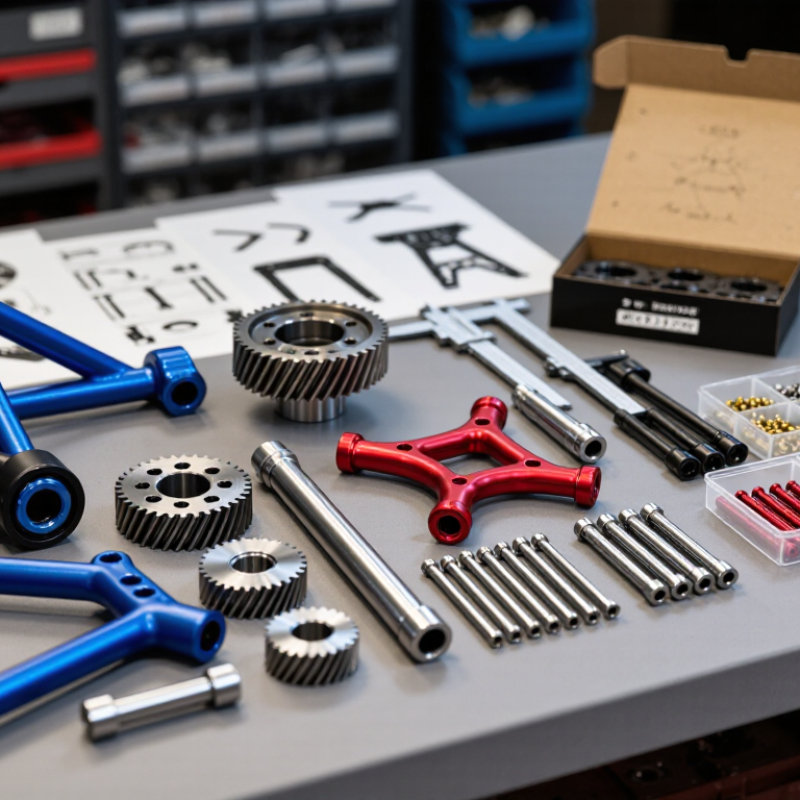
China Top Aftermarket RC Parts Suppliers for Global Buyers?

Classify Aftermarket RC Parts by Vehicle Type, Scale, and Upgrade Function

Aftermarket RC parts are easier to compare when buyers sort them by vehicle type, scale, and upgrade function. Start with the platform: an off-road buggy needs different tires and suspension arms from a touring car. Crawlers often benefit from stronger driveline components and controlled steering. Boats and aircraft require parts designed for their own operating conditions. Check the vehicle manual and measure the original component before ordering; similar-looking parts may use different mounting points.

Scale matters. A 1:10 body or wheel may not fit a 1:12 chassis, even when both parts look close on a product photo. Then consider the upgrade goal. Suspension parts can change handling, while bearings may reduce friction when installed correctly. Metal components can add strength, but they may also increase weight or transfer impact to nearby parts. Compatibility is not always obvious, and even careful buyers sometimes miss a connector or shaft-length difference.

Tips: Compare dimensions, mounting holes, connectors, and stated vehicle compatibility. Ask suppliers for clear measurements and installation guidance. Keep the removed part nearby during inspection; it reveals details a listing can omit. Test one change at a time, and record what improves—or what does not.


Aftermarket RC Parts: Categories by Vehicle Type

A sample classification of common upgrade-function categories across RC vehicle types.

Values count the representative part categories listed for each vehicle type; they are not sales, market-share, or supplier-ranking data. Parts are commonly selected to match vehicle type and scale—for example, 1:10 cars and crawlers or 1:8 buggies—and upgrade functions such as suspension, power, drivetrain, tires, and lighting. Check fitment against the specific model.

Map China’s Supplier Types: Component Makers, Assemblers, and Trading Firms

China’s RC aftermarket supply base includes component makers, assemblers, and trading firms. Component makers produce specific parts, such as steel drive shafts, molded suspension arms, gears, or circuit boards. Ask whether machining, molding, and inspection happen in-house. Request material specifications and sample measurements, not just catalog photos.

Assemblers combine parts from multiple sources and may perform final fit checks or packaging. Ask for the bill of materials and records linking finished batches to component suppliers. Trading firms can consolidate mixed orders, which helps buyers testing several part types. However, confirm who handles defects and replacement parts. That distinction matters. The WTO’s Global Trade Outlook and Statistics 2024 reports that China accounted for 14.2% of world merchandise exports in 2023. This indicates broad export capacity, but it does not measure RC-specific production quality. Buyers should compare sample parts against drawings, check tolerances, and clarify inspection criteria before ordering. A supplier’s category alone cannot prove consistency; even a clear process may miss problems between batches.

China Top Aftermarket RC Parts Suppliers for Global Buyers? — Map China’s Supplier Types: Component Makers, Assemblers, and Trading Firms
Supplier Type Typical RC Parts Scope How the Supply Model Works Potential Advantages Points to Verify Often Suited to
Component makers CNC-machined metal parts, molded plastic components, carbon-fiber plates, gears, shafts, brackets, and other individual parts. Manufacture specific components using processes such as machining, molding, stamping, or composite fabrication. Some also provide custom production from drawings or samples. Direct technical discussion about materials, dimensions, tolerances, and production processes; may be suitable for repeat orders or customized parts. Confirm which processes are performed in-house, material specifications, dimensional inspection methods, sample approval procedures, tooling ownership, and minimum order quantities. Buyers with defined specifications, engineering support, and a need for consistent or customized components.
Assemblers Assembled subassemblies or finished RC products incorporating parts sourced from multiple component suppliers. Combine purchased and/or internally made components, carry out assembly, and may perform functional checks or packaging. Can coordinate assembly steps and deliver products closer to a ready-to-use or ready-to-retail condition; may simplify coordination across component categories. Identify which components are outsourced, review assembly instructions and change control, define acceptance criteria, and request records of functional or safety-related checks where relevant. Buyers seeking assembled units or kits rather than sourcing and coordinating every individual part.
Trading firms A catalog or consolidated range of parts sourced from one or more factories, potentially across different RC categories. Act as an intermediary between buyers and manufacturers; may handle quotations, order coordination, packaging, and export arrangements. Can offer a single contact for mixed products and help coordinate orders when a buyer does not have direct relationships with several factories. Ask who manufactures each item, how substitutions are approved, whether batches can be traced to a source, and who handles quality issues, warranty claims, and export documentation. Buyers prioritizing a broader assortment, consolidated purchasing, or sourcing coordination.
Hybrid suppliers A combination of in-house components, outsourced parts, and assembled products. Manufacturing and sourcing responsibilities vary by product; one supplier may make some parts and subcontract or trade others. May combine production capability with broader product coverage and assembly services. Request a product-by-product breakdown of manufacturing location, subcontracting, inspection responsibility, and applicable specifications. Buyers whose orders include both custom components and standard or assembled items.
Cross-type sourcing checks Applies to components, subassemblies, and finished products. Compare suppliers using the same written specifications, samples, and acceptance criteria rather than supplier category alone. Supports clearer comparison of price, lead time, production capability, and quality controls. Verify sample-to-production consistency, packaging and labeling requirements, order terms, lead time, inspection arrangements, and destination-market compliance obligations. All global buyers evaluating potential suppliers.
Buyer note: Supplier capabilities and responsibilities vary by product and order. Confirm manufacturing scope, quality requirements, and commercial terms directly before placing an order.

Check Compatibility: 1:10 Scale Models and 2S LiPo Packs at 7.4 V Nominal

For a 1:10-scale RC model, “1:10” describes scale, not battery space. A 2S LiPo is rated at 7.4 V nominal; fully charged, it reaches about 8.4 V. That difference matters. Check the vehicle manual and electronic speed controller’s stated cell count and voltage range before connecting a pack. Compare tray length, width, and height, then check strap clearance and connector type. A pack may fit loosely yet shift during braking. Scale alone cannot confirm compatibility.

Inspect connector polarity and cable reach; don’t assume a plug that fits is wired correctly. Check motor and ESC current requirements against the battery’s discharge rating; a higher rating alone does not guarantee longer runtime. Use a compatible LiPo balance charger, and verify its 2S setting before charging. Measure twice. A quick fit test is not proof: install the body and check for pinched wires or pressure on the cells. This is easy to miss. Recheck after a short, gentle run; stop if the pack swells, is damaged, or becomes unusually warm.

Verify Supplier Quality with ISO 9001 and RoHS Compliance Records

When comparing aftermarket RC parts suppliers, treat ISO 9001 records as evidence to examine, not a quality guarantee. Check that the certificate is current, issued by a credible certification body, and names the actual manufacturing site. Does its scope cover the parts you plan to buy? Small details matter. Ask how the supplier controls drawings, incoming materials, inspections, and corrective actions. A clear record should connect these steps to a specific product or production lot. Paperwork can look neat while shop-floor practices vary, so request recent inspection examples where possible.

For RoHS compliance, request a current declaration and supporting material test reports for the relevant part or components. Match product names, revisions, and materials across the documents; a report for a similar item may not prove the item you are sourcing. Useful evidence. Ask whether changes in suppliers or materials trigger a fresh review. No checklist catches every quiet process change. A small pilot order can reveal practical issues, such as loose connectors, inconsistent molding, or missing labels, before larger quantities ship. Keep dated copies of certificates and test records, and note who verified them. That process is not perfect, but it makes supplier decisions easier to review and correct.

Compare Global Orders by MOQ, Lead Time, Warranty, and Export Documentation

For global buyers comparing China-based aftermarket RC parts suppliers, request the same quotation format from each supplier. State the target quantity, packaging, inspection method, and delivery term. Compare MOQ by part number, not just the order total; mixed-item orders can carry separate minimums. Ask whether samples count toward the MOQ. Small details matter.

Lead-time promises need a clear starting point: deposit, drawing approval, or sample sign-off. The World Bank’s Logistics Performance Index 2023 found that shipment journeys averaged 44 days between entering the export port and leaving the destination port, with about 60% of time spent at ports and terminals.

That is transport time, not factory production time. Build both into planning, and ask suppliers to separate production days from transit estimates. UNCTAD’s Review of Maritime Transport 2024 reported seaborne trade growth of 2.4% in 2023, while warning that disruptions can affect routes and costs.

For warranty comparison, obtain written coverage periods, exclusions, claim deadlines, and evidence requirements, such as photos or batch codes. Request a document list before payment: commercial invoice, packing list, transport document, and any origin or product records required by the destination market. Confirm who prepares each item. A neat quotation is useful, but it does not prove every shipment will follow the same schedule; keep a small buffer and review actual performance after each order.

Powder Coat Booths

For those larger-sized parts, or smaller quantity runs, we have 2 independent powder coat booths and ovens. The quality, durability and affordability of today’s powder coating finishes make this the process of choice for world-class companies.

Powder coating advantages over other forms of coating are many. Materials used in the Powder coating process can be metals and non-metals that come in a multitude of thicknesses, textures, colors, etc. Another of Powder coating’s biggest advantages over conventional coatings is its ability to create finishes in many different textures. Powder Coating Booths allow us the ability to apply these advantages to large products.

Wet Paint Line

Tri-State Fabricators runs a full-service conveyor line for painting. Wet painting can provide protection or decoration to many different part styles. From start to finish, every project is easier to undergo random and point-based inspection by our skilled painting team.

Advantages to our Wet Paint Line are these lines start with product prep and ends with a thorough inspection of a high quality finished product. Our ability to complete large and small projects with a superior finish and doing so in a timely and economical fashion. This passes along the savings in production to our customers. When powder coating ins not an option, our Wet Paint Line gets the job done right the first time.

Wet Paint Booths

When the parts get big and heavy we roll-out our custom paint racks and oversize booth. By utilizing our partnerships with all the major paint brands, we can match virtually any color with wet paint.

The advantages of having access to a Wet Paint Booth are many. Large projects of many different shapes can be loaded into the booth. The Wet Paint Booth offers an environment that is much more controlled than a typical parts painting operation.

Not only are they used because of their controlled environment, but they’re are also advantageous when it comes to applying paint to parts that are needed in industries that require specialty coatings such as medical, aerospace, etc.

Military CARC

Our military forces have some very high standards when it comes to the finish of their vehicles and equipment. From the first pre-treatment step to final coat, it takes a great deal of knowledge and experience to protect the men and women of our armed forces. They deserve only the best, and Tri-State Fabricators provides it.

All of our processes are closely monitored by our staff and management teams. Both of which are highly trained in the processes of metal fabrication and finishing. Tri-State Fabricators’ goal is to always fully satisfy each and every customer, including the military. We will always put a 110% into what we do.

Glass-Bead Blasting

Abrasive media blasting is an excellent way to remove old paint, rust, and increase the paint/powder adhesion. Glass beads produce a much smoother and brighter finish than angular abrasives; leaving the part clean yet without any dimensional change. Chemically inert and environmentally friendly, we can recycle our beads approximately 30 times; making them a more preferred method of metal cleaning or surface finishing.

Advantages to Glass Bead Blasting are many. Glass bead blast media is used when a project is needing rough surfaces need to become smooth for applications of coatings such as paint. It is typically used to clean paint and rust from a product surface without deforming the surface it is being used on. Overall, compared to many other blasting media, Glass Bead Blasting is a very economical choice and those savings are always passed on to our customers.

Part Washing

Tri-State Fabricators utilize a zinc phosphate wash to clean and etch the material to ensure the best paint adhesion possible. The unique design of our 3-stage wash system does the work like a 5-stage. From Cleaning and rinsing to conversion coating and post-treatment, Our Part Washing process is a complete service and works throughout the fabrication service and the finishing service.

Along with the previously mentioned benefits, Curing is a vital chemical reaction that leaves the product finish hard and relatively safe from mild abrasion and aggressive corrosion. This process can be done in more than one way; ambient air-dry or in curing ovens at temps that exceed 240°.

Burn-Off Oven

From fixing paint mistakes (someone else’s of course) to simply cleaning our paint line hooks, our burn-off oven is put to good use. After a quick burn-off, a little clean up, and a fresh coat of paint, your parts will look better than new.

Why does our Burn-Off Oven work so well? Because super heating the air around parts turns the materials into ashes. From paint and powder coatings to rubber and machining oils, high temps do the job without degrading the integrity of the part.

Masking

Masking is a vital part of producing high quality products. We have die-cut masking patterns to protect machined surfaces as well as a wide range of plugs and caps to protect threaded holes and bolts. We provide permanent and temporary masking.

Masking allows the selected sections of a product to be protected from a fabrication or finishing service. This can be with both chemicals when etching and tapes, paints when only finishing just a section of the product. Masking is great in aiding the customization process of a project.

Screen Printing

Screen printing is a photographic process that transfers artwork onto a porous nylon screen which allows colored ink to flow through the screen and be deposited on an aluminum or plastic component. We can generally have just about any design created onto a screen for your parts.

Some of the advantages of Screen Printing are, brand recognition for your business displaying on your products, assembly instructions, product warnings/hazards, etc. Tri-State Fabricators produces Screen Printing of the highest quality so you know it’s durable.

Metal Finishing

Metal Finishing is the art of treating the exterior portion of product, often metal but can also be made of other materials, so that the surface is clean and free of any debris. Then the process of applying coats or either paint of powder coat takes place. This coating process improves the quality of the product in both appearance and resistance to wear and corrosion.

Tri-State Fabricators, Inc., understands that a project typically isn’t complete until a high-quality finish has been added to your product. This is why our painting and powder coating teams continuously inspect the products throughout the Metal Finishing process.
