


Choosing an Industrial Cable Reel manufacturer involves more than comparing prices or browsing polished product photos. Reels may serve workshops, construction sites, ports, factories, or mobile equipment, and each setting places different demands on cable capacity, enclosure strength, braking, and handling. A reel that looks suitable on a screen may not fit the cable’s diameter or the space available beside a machine. Small details matter.
This guide introduces ten manufacturers in China and outlines practical points buyers can investigate before requesting a quotation. It considers product range, customization, material choices, stated load ratings, quality-control information, and communication during the sample and ordering process. These factors help readers ask more specific questions, such as whether a reel can accommodate a stated cable length or withstand frequent movement in a dusty workshop. Ask for drawings and test records where relevant. Verify the details.
A manufacturer’s website can offer useful clues, but it cannot prove how a product will perform in your exact application. No catalog tells the whole story. Confirm specifications directly, compare like-for-like configurations, and clarify lead times, packaging, replacement parts, and after-sales support. Rankings and suitability can also vary by project; the most recognizable supplier may not be the right fit for every buyer. The companies featured here provide a starting point for research, not a substitute for technical evaluation. Some comparisons may remain imperfect, because public information is not equally detailed for every manufacturer. That is worth remembering.
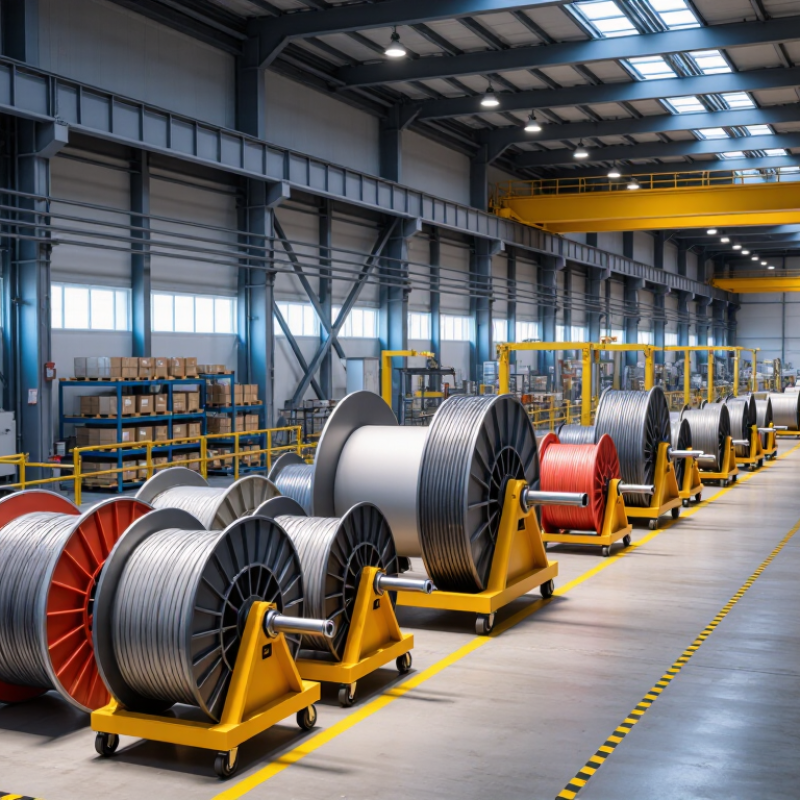
An industrial cable reel stores and pays out flexible cable while helping control tension, twist, and wear. Its drum turns as equipment moves or an operator pulls cable. Many reels include a frame, rotating hub, cable guide, and electrical connection. The design keeps cable off wet floors and away from wheels or sharp edges. Small details matter.
Common types include manual, spring-driven, and motor-driven reels. Manual reels suit shorter runs and occasional use. Spring reels retract cable automatically, which can reduce slack around workstations. Motor-driven models handle longer cable runs or frequent movement, but need suitable controls and power. Some reels use slip rings to maintain electrical contact while the drum rotates; others are designed for specific cable or signal needs.
Reels appear on cranes, material-handling equipment, service vehicles, and production lines. A reel for a slow-moving indoor machine may not suit a fast outdoor application. Check cable length, conductor size, voltage, load, travel speed, and duty cycle before choosing. Also consider dust, moisture, temperature, and mounting space. I have seen tidy installations become troublesome when the cable is too stiff or the reel is poorly aligned. Specifications help, but the actual movement path deserves a close look.

China’s industrial cable reel industry is organized around specialized manufacturers and a broad component supply chain. Some factories focus on reel frames, drums, and cable guides. Others assemble spring-driven, motorized, or manual systems. Steel, bearings, slip rings, motors, and electrical controls often come from separate suppliers. This structure allows manufacturers to offer varied configurations without making every component in-house. It is not uniform. Production capabilities and quality controls differ between factories.
Many producers serve equipment makers, workshops, ports, and material-handling operations. Their work may include drawing review, sample production, assembly, and inspection. Customization can involve cable length, reel capacity, mounting style, or operating conditions. A practical evaluation should look beyond catalog specifications. Ask how the supplier checks winding tension, electrical continuity, and mechanical operation. Requesting relevant test records can clarify what “tested” means. That detail is sometimes overlooked.
Tips: Share the cable type, length, and duty cycle before requesting a quotation. Confirm installation space and operating environment. Compare inspection details, not just price. A clear drawing helps, though early specifications may still need revision.
Selecting an industrial cable reel manufacturer begins with the operating conditions, not the catalog. Define cable type, length, weight, voltage, and required retraction speed. A reel handling a light signal cable may not suit a heavy power cable. Check drum dimensions, mounting space, duty cycle, and exposure to dust, moisture, or temperature changes. Ask how the design manages cable tension, braking, and electrical connections. Clear drawings and test records matter.
Tips: Share a real installation layout and cable data before requesting a quote. Ask for evidence of testing under comparable loads. Confirm spare-part availability and service response times in writing.
Review the manufacturer’s engineering experience with similar applications, but look beyond project lists. Ask who checks the design, what tolerances apply, and how maintenance access is planned. Compare quotations by materials, controls, commissioning support, and expected service life, not price alone. If possible, assess a sample or inspect a finished unit. A polished specification sheet can still miss an awkward cable path or tight mounting clearance. I have seen small details change the installation plan, so leave room for a practical design review.
| No. | Selection Criterion | What to Evaluate | Evidence to Request | Practical Verification |
|---|---|---|---|---|
| 1 | Product and application fit | Confirm that the reel design suits the intended equipment, installation environment, cable route, and operating conditions. | Product drawings, application data, installation instructions, and a written confirmation of the proposed configuration. | Compare the proposed reel and cable configuration against the project specification before requesting a quotation. |
| 2 | Electrical ratings | Check rated voltage, current, conductor configuration, protective-earth arrangements, and any applicable temperature limits. | Datasheets, wiring diagrams, nameplate details, and relevant electrical test reports. | Verify that the stated ratings meet the connected equipment’s requirements and the applicable local electrical rules. |
| 3 | Cable specification | Assess conductor material and cross-section, cable length, insulation and sheath type, flexibility, and suitability for repeated reeling. | Cable datasheet, conductor details, cable-manufacturer documentation, and test certificates where applicable. | Check the cable specification against the required load, route length, bend conditions, and operating environment. |
| 4 | Mechanical design and duty | Review reel capacity, drum dimensions, frame construction, drive or spring mechanism, operating speed, and intended duty cycle. | Dimensioned drawings, operating limits, maintenance instructions, and documented performance or endurance test results. | Confirm that the reel can handle the required cable length and operating frequency without exceeding its documented limits. |
| 5 | Environmental protection | Evaluate resistance to dust, water, corrosion, temperature variation, vibration, and other site-specific exposures. | Enclosure protection rating documentation, material specifications, and environmental test reports relevant to the application. | Where an IP rating is required, verify the declared rating and its supporting documentation against IEC 60529. |
| 6 | Safety and standards documentation | Determine which safety and product requirements apply to the reel, its electrical components, and the destination market. | Applicable conformity documents, risk or safety information, component certificates, and test reports. | Check the scope and validity of each document; IEC 60204-1 may be relevant to electrical equipment of machinery, depending on the application. |
| 7 | Quality management and production control | Review how incoming materials, assembly processes, inspections, nonconforming products, and traceability are controlled. | Quality-system certificate, inspection procedures, sample inspection records, and serial or batch traceability information. | Confirm that any ISO 9001 certificate is current and applies to the relevant manufacturing scope and site. |
| 8 | Testing and inspection | Check the inspection plan for electrical safety, mechanical operation, cable winding, and final product acceptance. | Test procedures, sample factory inspection reports, acceptance criteria, and calibration records for relevant equipment. | Agree on inspection points and acceptance criteria before production; arrange sample or pre-shipment inspection when appropriate. |
| 9 | Customization and engineering support | Assess the ability to adapt dimensions, cable type, mounting, controls, connectors, and documentation to project requirements. | Engineering drawings, revision history, response process, and a clearly defined approval workflow. | Submit a written specification and verify that the approved drawing matches the final quotation and order documents. |
| 10 | Commercial and after-sales support | Compare lead-time commitments, warranty terms, spare-parts availability, service arrangements, and export packaging. | Written quotation, delivery schedule, warranty conditions, spare-parts list, and packaging or shipping specifications. | Confirm responsibilities, exclusions, delivery terms, and the process for handling defects before placing an order. |
Note: This table is a supplier-evaluation checklist, not a ranking of individual manufacturers. Applicable standards and required evidence depend on the product design, installation, and destination market.
China’s industrial cable reel sector serves factories, ports, mines, and mobile equipment builders. These ten manufacturer profiles highlight capabilities buyers can compare; they are not an independently verified ranking. Details matter.
One profile centers on heavy-duty steel reels for harsh workshop floors. Another specializes in compact spring-driven units for hand tools. A third focuses on motorized reels with controlled winding speed. The fourth supplies weather-resistant housings for outdoor machinery. The fifth builds customized reels for long cable runs and unusual mounting layouts. Look closely at drum width, cable capacity, and braking design.
The sixth profile emphasizes mobile power systems for service vehicles. The seventh develops reels for automated production lines, where repeatable positioning matters. The eighth works on corrosion-resistant materials for damp or washdown areas. The ninth offers modular assemblies that simplify installation and maintenance. The tenth focuses on low-volume, application-specific engineering. Fit is everything.
A sound comparison checks rated voltage, current, cable type, duty cycle, and operating environment. Ask for drawings, test records, and clear guidance on service intervals. A smooth sample winding is useful, but it cannot prove long-term reliability. Some specifications may look impressive on paper; real installation conditions can expose limits. Verify the details before choosing.
Comparing China’s top 10 industrial cable reel manufacturers means looking beyond catalogue photos. Check rated voltage and current, cable length and conductor size, winding method, duty cycle, and enclosure protection. Motorized reels suit frequent movement; spring-driven units may work for simpler, lighter duties. The IEA’s Electricity 2024 report says global electricity demand grew 2.2% in 2023 and is forecast to average 3.4% annual growth in 2024–2026. That makes dependable power handling increasingly important. Small details matter. Ask for test records, material specifications, and evidence of quality controls—not just a standards logo. IEC 60204-1 addresses electrical equipment of machinery, while IEC 60529 defines enclosure IP ratings. Neither alone proves long-term reel performance.
Tips: Match the reel to the actual route. Measure travel distance, bend radius, cable weight, and operating cycles. Request a sample drawing and a documented load test. A neat datasheet cannot show every installation problem.
Compare manufacturers’ engineering support, customization options, spare-part availability, and inspection procedures. ISO 9001 certification can indicate a documented quality-management system, but it does not guarantee each product’s performance. I would still verify the test method and acceptance criteria. Even careful comparisons miss something: real cable routing can reveal snags that a factory specification does not.


For those larger-sized parts, or smaller quantity runs, we have 2 independent powder coat booths and ovens. The quality, durability and affordability of today’s powder coating finishes make this the process of choice for world-class companies.
Powder coating advantages over other forms of coating are many. Materials used in the Powder coating process can be metals and non-metals that come in a multitude of thicknesses, textures, colors, etc. Another of Powder coating’s biggest advantages over conventional coatings is its ability to create finishes in many different textures. Powder Coating Booths allow us the ability to apply these advantages to large products.
Tri-State Fabricators runs a full-service conveyor line for painting. Wet painting can provide protection or decoration to many different part styles. From start to finish, every project is easier to undergo random and point-based inspection by our skilled painting team.
Advantages to our Wet Paint Line are these lines start with product prep and ends with a thorough inspection of a high quality finished product. Our ability to complete large and small projects with a superior finish and doing so in a timely and economical fashion. This passes along the savings in production to our customers. When powder coating ins not an option, our Wet Paint Line gets the job done right the first time.
When the parts get big and heavy we roll-out our custom paint racks and oversize booth. By utilizing our partnerships with all the major paint brands, we can match virtually any color with wet paint.
The advantages of having access to a Wet Paint Booth are many. Large projects of many different shapes can be loaded into the booth. The Wet Paint Booth offers an environment that is much more controlled than a typical parts painting operation.
Not only are they used because of their controlled environment, but they’re are also advantageous when it comes to applying paint to parts that are needed in industries that require specialty coatings such as medical, aerospace, etc.
Our military forces have some very high standards when it comes to the finish of their vehicles and equipment. From the first pre-treatment step to final coat, it takes a great deal of knowledge and experience to protect the men and women of our armed forces. They deserve only the best, and Tri-State Fabricators provides it.
All of our processes are closely monitored by our staff and management teams. Both of which are highly trained in the processes of metal fabrication and finishing. Tri-State Fabricators’ goal is to always fully satisfy each and every customer, including the military. We will always put a 110% into what we do.
Abrasive media blasting is an excellent way to remove old paint, rust, and increase the paint/powder adhesion. Glass beads produce a much smoother and brighter finish than angular abrasives; leaving the part clean yet without any dimensional change. Chemically inert and environmentally friendly, we can recycle our beads approximately 30 times; making them a more preferred method of metal cleaning or surface finishing.
Advantages to Glass Bead Blasting are many. Glass bead blast media is used when a project is needing rough surfaces need to become smooth for applications of coatings such as paint. It is typically used to clean paint and rust from a product surface without deforming the surface it is being used on. Overall, compared to many other blasting media, Glass Bead Blasting is a very economical choice and those savings are always passed on to our customers.
Tri-State Fabricators utilize a zinc phosphate wash to clean and etch the material to ensure the best paint adhesion possible. The unique design of our 3-stage wash system does the work like a 5-stage. From Cleaning and rinsing to conversion coating and post-treatment, Our Part Washing process is a complete service and works throughout the fabrication service and the finishing service.
Along with the previously mentioned benefits, Curing is a vital chemical reaction that leaves the product finish hard and relatively safe from mild abrasion and aggressive corrosion. This process can be done in more than one way; ambient air-dry or in curing ovens at temps that exceed 240°.
From fixing paint mistakes (someone else’s of course) to simply cleaning our paint line hooks, our burn-off oven is put to good use. After a quick burn-off, a little clean up, and a fresh coat of paint, your parts will look better than new.
Why does our Burn-Off Oven work so well? Because super heating the air around parts turns the materials into ashes. From paint and powder coatings to rubber and machining oils, high temps do the job without degrading the integrity of the part.
Masking is a vital part of producing high quality products. We have die-cut masking patterns to protect machined surfaces as well as a wide range of plugs and caps to protect threaded holes and bolts. We provide permanent and temporary masking.
Masking allows the selected sections of a product to be protected from a fabrication or finishing service. This can be with both chemicals when etching and tapes, paints when only finishing just a section of the product. Masking is great in aiding the customization process of a project.
Screen printing is a photographic process that transfers artwork onto a porous nylon screen which allows colored ink to flow through the screen and be deposited on an aluminum or plastic component. We can generally have just about any design created onto a screen for your parts.
Some of the advantages of Screen Printing are, brand recognition for your business displaying on your products, assembly instructions, product warnings/hazards, etc. Tri-State Fabricators produces Screen Printing of the highest quality so you know it’s durable.
Metal Finishing is the art of treating the exterior portion of product, often metal but can also be made of other materials, so that the surface is clean and free of any debris. Then the process of applying coats or either paint of powder coat takes place. This coating process improves the quality of the product in both appearance and resistance to wear and corrosion.
Tri-State Fabricators, Inc., understands that a project typically isn’t complete until a high-quality finish has been added to your product. This is why our painting and powder coating teams continuously inspect the products throughout the Metal Finishing process.

