


Hose Clamps are small components, but they secure critical connections in vehicle, machinery, and fluid-handling systems. A loose clamp can cause leakage, vibration, or costly maintenance. Buyers therefore need more than an attractive catalogue and a competitive unit price.
China’s manufacturing scale makes supplier selection especially relevant. OICA’s 2023 production statistics recorded 30,160,966 motor vehicles produced in China, the highest national output that year. This figure signals a substantial industrial ecosystem, not proof that every supplier meets the same quality standard. Small parts matter. A manufacturer’s material choices, band-edge finish, tightening range, corrosion resistance, and production consistency all deserve close review.
This guide introduces ten notable Chinese hose clamp manufacturers and the factors buyers can use to compare them. These include product range, customization, testing practices, export experience, and the availability of technical documentation. In practice, a stainless-steel clamp for a marine environment may need different specifications from one used on a workshop air hose. Fit matters.
There is no universally accepted ranking of “top” manufacturers. Public company profiles and product catalogs rarely provide enough evidence to judge long-term field performance. Treat this list as a starting point, then confirm specifications, samples, and quality records directly with each supplier. That extra step can feel tedious. It is still wiser than choosing from a headline alone.
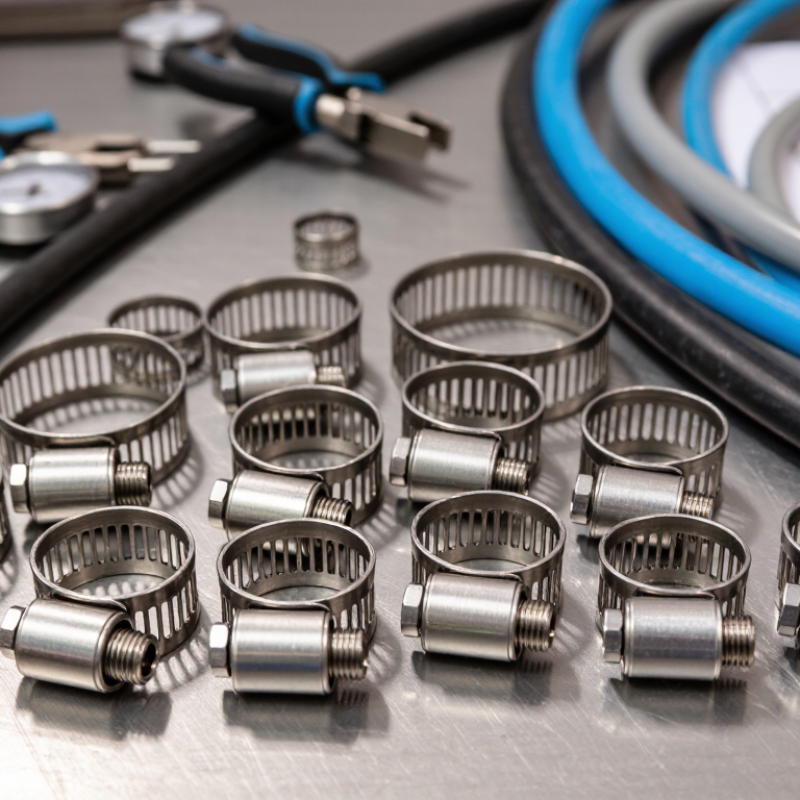
A hose clamp is a fastening device that presses a flexible hose against a fitting. In a common screw-type clamp, turning the screw draws a perforated metal band tighter around the hose. The band’s pressure helps limit leaks and keeps the hose from slipping off under normal operating conditions. Spring and bolt-style clamps use different mechanisms, so their installation needs can vary.
Tips: Match the clamp’s diameter to the hose and fitting. Position it behind the fitting’s raised bead, where it can grip securely. Tighten gradually. Stop if the hose begins to bulge, split, or deform; more force does not always mean a better seal. Check the connection again after the system has run and cooled.
A clamp should suit the hose material, operating temperature, and expected pressure. For example, a soft hose can be damaged by a narrow band tightened too far. A loose clamp may allow seepage, while an overtightened one may cut into the hose. It is easy to focus only on the screw, but correct sizing and placement matter just as much. Even a neat-looking installation deserves a careful leak check.

Hose clamps secure flexible hoses to fittings, but one design does not suit every connection. Worm-drive clamps use a screw band and are common on automotive, workshop, and household hoses. They are adjustable and easy to inspect. Spring clamps maintain pressure as temperatures change, making them useful on cooling systems. T-bolt clamps provide a stronger, more even grip on larger hoses, such as those used in industrial air or fluid lines. Ear clamps offer a compact, fixed fit for repeatable production assembly. Each type has limits.
Choose a clamp that matches the hose material, outside diameter, fitting shape, and working conditions. A worm-drive clamp may be convenient, but tightening it too much can cut soft rubber or distort a thin hose. Spring clamps can be awkward to remove in a cramped space. T-bolt models may be unnecessary for a small, low-pressure connection. There is no perfect choice for every job; vibration, heat, and frequent servicing can change what works best.
Tips: Measure the hose over the fitting, not by its loose diameter. Position the clamp behind the fitting’s raised bead, then tighten it evenly. Check for leaks after the system runs and cools. A dry connection is a good sign, but it is not proof that the clamp will stay secure over time.
Counts represent the typical application examples listed for each clamp type, not market share or a ranking. Selection depends on hose material, diameter, pressure, temperature, vibration, and service requirements.
Choosing a hose clamp manufacturer in China requires more than comparing prices. Start with the application: hose material, working pressure, temperature range, and exposure to moisture or chemicals. Ask what stainless steel grade or coating the clamp uses, and request material documents tied to the actual batch. Check how the band edges are finished; rough edges can damage soft hoses. Small details matter.
Review production controls, not just catalog photos. Ask how the manufacturer checks band width, screw fit, tightening torque, and corrosion resistance. Request recent test records and a sample from the same production process you would order. Confirm whether inspection reports identify batch numbers. A neat sample is useful, but it cannot prove consistent mass production. I would also ask what happens when a sample fails. Some suppliers may give vague answers; that deserves a follow-up.
Tips: Send a clear specification sheet and compare replies line by line. Ask about minimum order quantity, lead time, packaging, and inspection options before paying a deposit. Check whether the contact person can explain tolerances in plain language. Keep the first order modest if practical, then inspect several clamps from different cartons. This takes extra time, and it may not catch every issue, but it gives you better evidence than a low quote alone.
China’s top 10 hose clamp manufacturers are best compared by process control, material traceability, and application fit—not catalogue size alone. The China Association of Automobile Manufacturers reported 31.282 million vehicles produced in China in 2024, alongside 5.859 million vehicle exports. These figures indicate a large manufacturing base, but they do not directly measure hose-clamp demand. Buyers should still verify each factory’s actual production capacity and target industries.
For a shortlist, inspect band-edge finishing, screw engagement, and clamp consistency across sample batches. Ask for material certificates, dimensional inspection records, corrosion-test conditions, and documented tightening ranges. A clamp that looks polished may still cut into a soft hose or loosen under vibration. Small details matter. Check whether the supplier can explain how it controls those risks, rather than relying only on a general quality certificate. Compare prototypes using the same hose diameter and installation torque. One limitation in many supplier comparisons is that test methods differ, making results difficult to compare directly. That deserves more attention. A careful top-ten assessment should therefore weigh repeatability, technical support, and clear test evidence alongside price and delivery time.
Manufacturer evaluation benchmarks: use these technical standards and specifications to compare suppliers. No company or brand rankings are presented.
| No. | Comparison dimension | Factual technical reference | What to verify with the supplier |
|---|---|---|---|
| 1 | Worm-drive clamp design | DIN 3017-1 covers worm-drive hose clamps. | Request the applicable standard edition, dimensional range, and product drawings. |
| 2 | Clamp performance testing | SAE J1508 specifies requirements and test methods for hose clamps. | Check which tests apply to the offered clamp type and ask for test reports. |
| 3 | Stainless steel grade: 304 | EN 1.4301 is a commonly used designation for 304 stainless steel; ASTM A240 covers stainless steel plate, sheet, and strip. | Confirm the grade for each component and request material documentation. |
| 4 | Stainless steel grade: 316 | EN 1.4401 is a designation for 316 stainless steel; ASTM A240 includes relevant stainless steel product forms. | Verify whether the band, housing, and screw all use the specified grade. |
| 5 | Stainless fastener properties | ISO 3506 specifies mechanical properties for corrosion-resistant stainless steel fasteners. | Ask for the screw material grade and the relevant mechanical-property class. |
| 6 | Electroplated components | ISO 4042 addresses electroplated coating systems for fasteners. | Confirm coating type, thickness requirements, and applicable inspection records. |
| 7 | Corrosion testing | ISO 9227 defines neutral, acetic acid, and copper-accelerated acetic acid salt-spray test methods. | Specify the test method and acceptance criteria; the test method alone does not set a universal pass duration. |
| 8 | Material inspection documents | EN 10204 describes types of inspection documents for metallic products, including type 3.1 certificates. | State the required document type and confirm that it covers the actual production batch. |
| 9 | Size and dimensional control | Clamp fit depends on the specified diameter range and the hose-and-fitting assembly dimensions. | Compare the supplier’s size chart and drawing against the measured assembly, not hose nominal size alone. |
| 10 | Material-code clarity | Codes such as W1, W2, W4, and W5 are used in the clamp trade, but definitions should be confirmed against each supplier’s specification. | Request a component-by-component material breakdown rather than relying on a code alone. |
When comparing hose clamp suppliers, look beyond catalog size and price. Ask for current quality-system certificates, then check their scope, issuing body, and expiry date. ISO 9001 can indicate a managed quality process, but it does not certify every clamp. For automotive supply, IATF 16949 may be relevant; confirm whether the supplier’s production site is covered. Ask for evidence. Material certificates should identify the steel grade and, where applicable, the corrosion-resistant coating.
Product checks should match the clamp’s intended use. Request drawings with band width, thickness, diameter range, and tightening specifications. Inspect sample edges for burrs, then check whether the screw turns smoothly without binding. Ask how the supplier tests tightening performance and corrosion resistance, and whether results are traceable to a production lot. Details matter. A polished sample is useful, but it cannot show how consistently a factory produces thousands of units.
Compare suppliers using the same sample requirements and questions. Ask about inspection frequency, nonconforming-part handling, and changes to materials or tooling. Review actual test reports rather than relying on broad claims. Paperwork can look tidy while process details remain vague. That is a reason to ask follow-up questions, not an automatic rejection. A factory visit or independent inspection may help, though neither guarantees future consistency. Keep records of approved samples, specifications, and agreed tolerances before placing repeat orders.


For those larger-sized parts, or smaller quantity runs, we have 2 independent powder coat booths and ovens. The quality, durability and affordability of today’s powder coating finishes make this the process of choice for world-class companies.
Powder coating advantages over other forms of coating are many. Materials used in the Powder coating process can be metals and non-metals that come in a multitude of thicknesses, textures, colors, etc. Another of Powder coating’s biggest advantages over conventional coatings is its ability to create finishes in many different textures. Powder Coating Booths allow us the ability to apply these advantages to large products.
Tri-State Fabricators runs a full-service conveyor line for painting. Wet painting can provide protection or decoration to many different part styles. From start to finish, every project is easier to undergo random and point-based inspection by our skilled painting team.
Advantages to our Wet Paint Line are these lines start with product prep and ends with a thorough inspection of a high quality finished product. Our ability to complete large and small projects with a superior finish and doing so in a timely and economical fashion. This passes along the savings in production to our customers. When powder coating ins not an option, our Wet Paint Line gets the job done right the first time.
When the parts get big and heavy we roll-out our custom paint racks and oversize booth. By utilizing our partnerships with all the major paint brands, we can match virtually any color with wet paint.
The advantages of having access to a Wet Paint Booth are many. Large projects of many different shapes can be loaded into the booth. The Wet Paint Booth offers an environment that is much more controlled than a typical parts painting operation.
Not only are they used because of their controlled environment, but they’re are also advantageous when it comes to applying paint to parts that are needed in industries that require specialty coatings such as medical, aerospace, etc.
Our military forces have some very high standards when it comes to the finish of their vehicles and equipment. From the first pre-treatment step to final coat, it takes a great deal of knowledge and experience to protect the men and women of our armed forces. They deserve only the best, and Tri-State Fabricators provides it.
All of our processes are closely monitored by our staff and management teams. Both of which are highly trained in the processes of metal fabrication and finishing. Tri-State Fabricators’ goal is to always fully satisfy each and every customer, including the military. We will always put a 110% into what we do.
Abrasive media blasting is an excellent way to remove old paint, rust, and increase the paint/powder adhesion. Glass beads produce a much smoother and brighter finish than angular abrasives; leaving the part clean yet without any dimensional change. Chemically inert and environmentally friendly, we can recycle our beads approximately 30 times; making them a more preferred method of metal cleaning or surface finishing.
Advantages to Glass Bead Blasting are many. Glass bead blast media is used when a project is needing rough surfaces need to become smooth for applications of coatings such as paint. It is typically used to clean paint and rust from a product surface without deforming the surface it is being used on. Overall, compared to many other blasting media, Glass Bead Blasting is a very economical choice and those savings are always passed on to our customers.
Tri-State Fabricators utilize a zinc phosphate wash to clean and etch the material to ensure the best paint adhesion possible. The unique design of our 3-stage wash system does the work like a 5-stage. From Cleaning and rinsing to conversion coating and post-treatment, Our Part Washing process is a complete service and works throughout the fabrication service and the finishing service.
Along with the previously mentioned benefits, Curing is a vital chemical reaction that leaves the product finish hard and relatively safe from mild abrasion and aggressive corrosion. This process can be done in more than one way; ambient air-dry or in curing ovens at temps that exceed 240°.
From fixing paint mistakes (someone else’s of course) to simply cleaning our paint line hooks, our burn-off oven is put to good use. After a quick burn-off, a little clean up, and a fresh coat of paint, your parts will look better than new.
Why does our Burn-Off Oven work so well? Because super heating the air around parts turns the materials into ashes. From paint and powder coatings to rubber and machining oils, high temps do the job without degrading the integrity of the part.
Masking is a vital part of producing high quality products. We have die-cut masking patterns to protect machined surfaces as well as a wide range of plugs and caps to protect threaded holes and bolts. We provide permanent and temporary masking.
Masking allows the selected sections of a product to be protected from a fabrication or finishing service. This can be with both chemicals when etching and tapes, paints when only finishing just a section of the product. Masking is great in aiding the customization process of a project.
Screen printing is a photographic process that transfers artwork onto a porous nylon screen which allows colored ink to flow through the screen and be deposited on an aluminum or plastic component. We can generally have just about any design created onto a screen for your parts.
Some of the advantages of Screen Printing are, brand recognition for your business displaying on your products, assembly instructions, product warnings/hazards, etc. Tri-State Fabricators produces Screen Printing of the highest quality so you know it’s durable.
Metal Finishing is the art of treating the exterior portion of product, often metal but can also be made of other materials, so that the surface is clean and free of any debris. Then the process of applying coats or either paint of powder coat takes place. This coating process improves the quality of the product in both appearance and resistance to wear and corrosion.
Tri-State Fabricators, Inc., understands that a project typically isn’t complete until a high-quality finish has been added to your product. This is why our painting and powder coating teams continuously inspect the products throughout the Metal Finishing process.

