


China Top 10 Carbon Fiber Components Suppliers?

China’s carbon-fiber industry is moving from expansion toward qualification, application depth, and supply-chain discipline. The China Chemical Fibers Association reported continued growth in domestic carbon-fiber capacity during 2023, while the International Energy Agency identified lightweight materials as important for improving electric-vehicle efficiency. Capacity alone, however, does not prove dependable performance.

This introduction examines China’s Top 10 Carbon Fiber Components suppliers through practical criteria. These include fiber grade, component design, autoclave or compression-molding capability, quality certification, delivery stability, and experience with aerospace, automotive, wind-energy, and industrial programs. Public information from company disclosures, industry databases, and reports from CompositesWorld and Research and Markets provides useful direction. Yet market figures can differ widely. Some reports count nominal capacity, while others count qualified production.

As composites analyst Chris Red has observed, “Capacity is not the same as qualified supply.” That distinction matters. A glossy carbon-fiber panel may look flawless under showroom lighting, but hidden voids, uneven resin flow, or weak bonding can appear after vibration and heat cycling. Supplier selection therefore requires more than a factory tour or a low quotation. It requires traceable test data and customer references.

The ranking that follows is not absolute. It reflects publicly visible capabilities at the time of research. Smaller specialists may outperform larger producers in narrow applications. That possibility deserves attention. Readers should verify current certifications, production locations, material systems, and delivery records before making a purchasing decision.
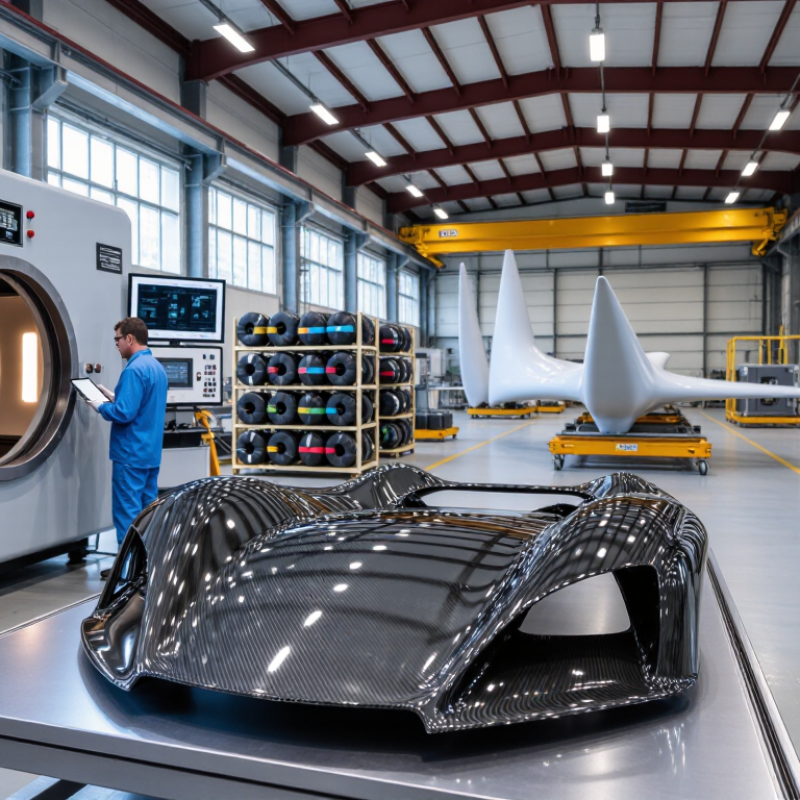
China Top 10 Carbon Fiber Components Suppliers?

What Are Carbon Fiber Components and Why Are They Important?

Carbon fiber components are engineered parts made from continuous carbon filaments and a polymer resin. Common examples include brackets, covers, frames, pressure shells, and structural panels. Not simply black plastic. Their value comes from high stiffness, strong tensile performance, and low weight. A lighter component can reduce energy use, improve handling, or increase payload capacity. Carbon fiber also resists rust, which helps in humid or chemically exposed environments.

The material behaves differently in every direction. Fiber alignment must follow the expected load path. A poorly designed layup may look flawless but fail near a drilled hole or sharp corner. Practical inspection should include fiber orientation, resin distribution, void content, surface defects, and dimensional accuracy. Reliable suppliers should provide process records, material certificates, inspection data, and batch traceability.

Controlled curing temperatures matter, especially for thick parts. Non-destructive testing can reveal internal delamination that visual checks miss. Engineers should also review fatigue performance, impact resistance, repair methods, and service temperature.

Carbon fiber is not automatically the best choice. It can cost more, require specialized tooling, and suffer hidden damage after impact. Some early designs focus too heavily on weight reduction. That tradeoff may weaken durability or complicate maintenance. A careful supplier evaluates the application, load conditions, production volume, and required tolerances before recommending a component. Small testing mistakes can become expensive field problems.


How Is China’s Carbon Fiber Components Supplier Market Organized?

China’s carbon fiber components supplier market is organized as a layered manufacturing network. Upstream producers supply carbon fiber and resin systems. Intermediate firms convert them into prepreg, woven fabric, pultruded profiles, or molded blanks. Downstream processors then build bicycle frames, pressure vessels, robotics arms, automotive panels, and industrial structures.

The China Carbon Fiber Industry Association estimated 2023 domestic demand at about 76,000 tonnes. Domestic output covered roughly 44,000 tonnes, while imports supplied the remaining volume. This gap explains the market’s mixed structure. Large material producers support standardized orders, while smaller processors compete through tooling speed, low-volume customization, and regional delivery.

The supply base is geographically clustered. Coastal manufacturing zones focus on sporting goods, automotive parts, and export production. Northern and central regions show stronger activity in wind-energy structures, industrial equipment, and pressure applications. A 2024 CompositesWorld market review also identified Asia as the largest carbon fiber consumption region, driven by renewable energy and transportation demand.

Quality control separates serious suppliers from simple mold shops. Buyers usually examine fiber volume fraction, void content, curing records, dimensional tolerance, and batch traceability. Some suppliers still publish limited technical data. That weakness deserves attention.

Market figures remain estimates. Different reports define “component supplier” differently, so direct comparisons can mislead. Procurement teams should verify factory capacity, testing methods, and actual delivery records before signing long-term contracts.

China’s carbon fiber components supplier market is organized primarily around wind-energy structures, pressure vessels, aerospace and defense, sporting goods, automotive parts, and industrial equipment. The shares shown are sector-level 2024 estimates based on commonly reported application patterns in China’s carbon-fiber market; they represent demand structure rather than individual company or brand revenue.

What Criteria Identify China’s Top 10 Carbon Fiber Components Suppliers?

China Top 10 Carbon Fiber Components Suppliers?

Identifying China’s top ten carbon fiber component suppliers requires more than comparing production volume. A credible assessment starts with verified manufacturing experience. Review completed projects, component sizes, and service life in demanding applications. Ask for inspection records, process qualifications, and measurable customer outcomes. Claims without evidence should carry little weight.

Technical capability is equally important. Strong suppliers control fiber placement, resin systems, curing, trimming, and surface finishing. They should explain tolerances in practical terms, such as ±0.2 millimeters on a critical mounting area. Independent testing should cover tensile strength, impact resistance, fatigue performance, and environmental aging. Traceability matters too. Each batch should connect materials, operators, equipment, and inspection results.

Reliability also includes communication and responsible operations. Evaluate prototype support, engineering drawings, delivery consistency, corrective-action records, and after-sales response. Check whether the supplier follows applicable quality and product-safety requirements in the target market. Factory visits can reveal more than polished brochures. Still, one visit is not enough. No supplier is perfect, and published data may hide weak points. A fair ranking should reduce scores for missing evidence, unclear tolerances, or inconsistent samples. It should also be reviewed regularly, because equipment, staff, and production controls change.

Which Companies Are China’s Leading Carbon Fiber Components Suppliers?

China’s leading carbon fiber components suppliers usually fit three groups. Integrated manufacturers produce carbon fiber, prepreg, and finished parts under one quality system. Specialized fabricators focus on bicycle frames, automotive panels, robotic arms, or aerospace-grade brackets. Precision workshops serve smaller batches and complex molds. The strongest suppliers show traceable material batches, controlled curing records, and repeatable dimensional results. They also provide test data for tensile strength, void content, impact resistance, and surface finish. In supplier audits, these records matter more than attractive factory photos.

Experience reveals a common weakness. Some companies quote excellent strength values, yet their sample parts show uneven edges or resin-rich corners. That gap should not be ignored. Ask for production samples, not only laboratory coupons. Review mold temperature logs, ultrasonic inspection reports, and corrective-action records. Confirm whether the quoted tolerance applies after trimming and drilling. A reliable engineering team should explain fiber orientation clearly and admit where design limits remain. That honesty is useful, even when the answer is imperfect.

Tips: Compare at least three suppliers using the same drawing and test standard. Check communication speed, prototype discipline, packaging protection, and after-sales response. Request a small pilot order before approving volume production. One overlooked detail can change assembly fit.

How Do These Suppliers Compare in Technology, Capacity, and Applications?

China’s top ten carbon fiber component suppliers differ sharply in technology, capacity, and application focus. Some operate high-temperature carbonization lines, while others specialize in molding finished components. Their technical strength depends on fiber grade, resin control, curing accuracy, and production consistency.

Aerospace-oriented suppliers usually emphasize autoclave molding, non-destructive testing, and strict batch traceability. Automotive suppliers often invest in rapid compression molding and automated cutting to reduce cycle times. Wind-energy producers require wide fabrics, stable resin systems, and large molds. Hydrogen storage applications demand careful filament winding, liner bonding, and pressure testing. Sporting-goods manufacturers may prioritize surface finish and lightweight designs over extreme certification requirements.

Capacity figures need careful interpretation. A factory may report fiber output, not finished component output. These are not equal. Large annual capacity can still hide bottlenecks in tooling, inspection, or skilled labor. Reliable buyers should review recent delivery records, process qualifications, test reports, and corrective-action history. Independent laboratory verification adds confidence, especially for safety-critical parts.

Technology is only one measure. Practical experience matters. A supplier with smaller equipment may provide tighter process control and faster engineering changes. However, limited redundancy can create delivery risks. The comparison is therefore imperfect, and published specifications should not replace an on-site audit. Performance data, application evidence, and transparent quality records reveal more than impressive production figures.

Powder Coat Booths

For those larger-sized parts, or smaller quantity runs, we have 2 independent powder coat booths and ovens. The quality, durability and affordability of today’s powder coating finishes make this the process of choice for world-class companies.

Powder coating advantages over other forms of coating are many. Materials used in the Powder coating process can be metals and non-metals that come in a multitude of thicknesses, textures, colors, etc. Another of Powder coating’s biggest advantages over conventional coatings is its ability to create finishes in many different textures. Powder Coating Booths allow us the ability to apply these advantages to large products.

Wet Paint Line

Tri-State Fabricators runs a full-service conveyor line for painting. Wet painting can provide protection or decoration to many different part styles. From start to finish, every project is easier to undergo random and point-based inspection by our skilled painting team.

Advantages to our Wet Paint Line are these lines start with product prep and ends with a thorough inspection of a high quality finished product. Our ability to complete large and small projects with a superior finish and doing so in a timely and economical fashion. This passes along the savings in production to our customers. When powder coating ins not an option, our Wet Paint Line gets the job done right the first time.

Wet Paint Booths

When the parts get big and heavy we roll-out our custom paint racks and oversize booth. By utilizing our partnerships with all the major paint brands, we can match virtually any color with wet paint.

The advantages of having access to a Wet Paint Booth are many. Large projects of many different shapes can be loaded into the booth. The Wet Paint Booth offers an environment that is much more controlled than a typical parts painting operation.

Not only are they used because of their controlled environment, but they’re are also advantageous when it comes to applying paint to parts that are needed in industries that require specialty coatings such as medical, aerospace, etc.

Military CARC

Our military forces have some very high standards when it comes to the finish of their vehicles and equipment. From the first pre-treatment step to final coat, it takes a great deal of knowledge and experience to protect the men and women of our armed forces. They deserve only the best, and Tri-State Fabricators provides it.

All of our processes are closely monitored by our staff and management teams. Both of which are highly trained in the processes of metal fabrication and finishing. Tri-State Fabricators’ goal is to always fully satisfy each and every customer, including the military. We will always put a 110% into what we do.

Glass-Bead Blasting

Abrasive media blasting is an excellent way to remove old paint, rust, and increase the paint/powder adhesion. Glass beads produce a much smoother and brighter finish than angular abrasives; leaving the part clean yet without any dimensional change. Chemically inert and environmentally friendly, we can recycle our beads approximately 30 times; making them a more preferred method of metal cleaning or surface finishing.

Advantages to Glass Bead Blasting are many. Glass bead blast media is used when a project is needing rough surfaces need to become smooth for applications of coatings such as paint. It is typically used to clean paint and rust from a product surface without deforming the surface it is being used on. Overall, compared to many other blasting media, Glass Bead Blasting is a very economical choice and those savings are always passed on to our customers.

Part Washing

Tri-State Fabricators utilize a zinc phosphate wash to clean and etch the material to ensure the best paint adhesion possible. The unique design of our 3-stage wash system does the work like a 5-stage. From Cleaning and rinsing to conversion coating and post-treatment, Our Part Washing process is a complete service and works throughout the fabrication service and the finishing service.

Along with the previously mentioned benefits, Curing is a vital chemical reaction that leaves the product finish hard and relatively safe from mild abrasion and aggressive corrosion. This process can be done in more than one way; ambient air-dry or in curing ovens at temps that exceed 240°.

Burn-Off Oven

From fixing paint mistakes (someone else’s of course) to simply cleaning our paint line hooks, our burn-off oven is put to good use. After a quick burn-off, a little clean up, and a fresh coat of paint, your parts will look better than new.

Why does our Burn-Off Oven work so well? Because super heating the air around parts turns the materials into ashes. From paint and powder coatings to rubber and machining oils, high temps do the job without degrading the integrity of the part.

Masking

Masking is a vital part of producing high quality products. We have die-cut masking patterns to protect machined surfaces as well as a wide range of plugs and caps to protect threaded holes and bolts. We provide permanent and temporary masking.

Masking allows the selected sections of a product to be protected from a fabrication or finishing service. This can be with both chemicals when etching and tapes, paints when only finishing just a section of the product. Masking is great in aiding the customization process of a project.

Screen Printing

Screen printing is a photographic process that transfers artwork onto a porous nylon screen which allows colored ink to flow through the screen and be deposited on an aluminum or plastic component. We can generally have just about any design created onto a screen for your parts.

Some of the advantages of Screen Printing are, brand recognition for your business displaying on your products, assembly instructions, product warnings/hazards, etc. Tri-State Fabricators produces Screen Printing of the highest quality so you know it’s durable.

Metal Finishing

Metal Finishing is the art of treating the exterior portion of product, often metal but can also be made of other materials, so that the surface is clean and free of any debris. Then the process of applying coats or either paint of powder coat takes place. This coating process improves the quality of the product in both appearance and resistance to wear and corrosion.

Tri-State Fabricators, Inc., understands that a project typically isn’t complete until a high-quality finish has been added to your product. This is why our painting and powder coating teams continuously inspect the products throughout the Metal Finishing process.
