


Tool rooms rarely lose everything at once. A wrench goes missing after maintenance, a drill returns without its battery, or a calibration tool sits on the wrong shelf. These small gaps can delay production and complicate inventory checks. Rfid Tool Tracking systems use tagged assets, readers, and software to make tool location and movement easier to verify.
Market momentum offers useful context, but not a guarantee of performance. Grand View Research estimated the global RFID market at USD 14.5 billion in 2023 and projected an 11.9% compound annual growth rate from 2024 to 2030. This figure covers many RFID applications, not tool tracking alone. Still, it signals growing investment in identification and visibility technologies. A large market does not automatically make a system suitable for a busy workshop.
This guide compares RFID tool tracking systems available in China, focusing on practical details: tag durability, read accuracy, handheld and fixed readers, software integration, and after-sales support. A metal cabinet can affect radio signals. So can crowded tool carts. Buyers should test tags on the actual tools and shelves they use, rather than rely only on a vendor demonstration. That advice may sound cautious. It is. The best choice depends on the worksite, budget, and asset-control process—not simply the longest feature list. The systems below are assessed against those real operating needs, with attention to what suppliers document and what buyers should verify before deployment.
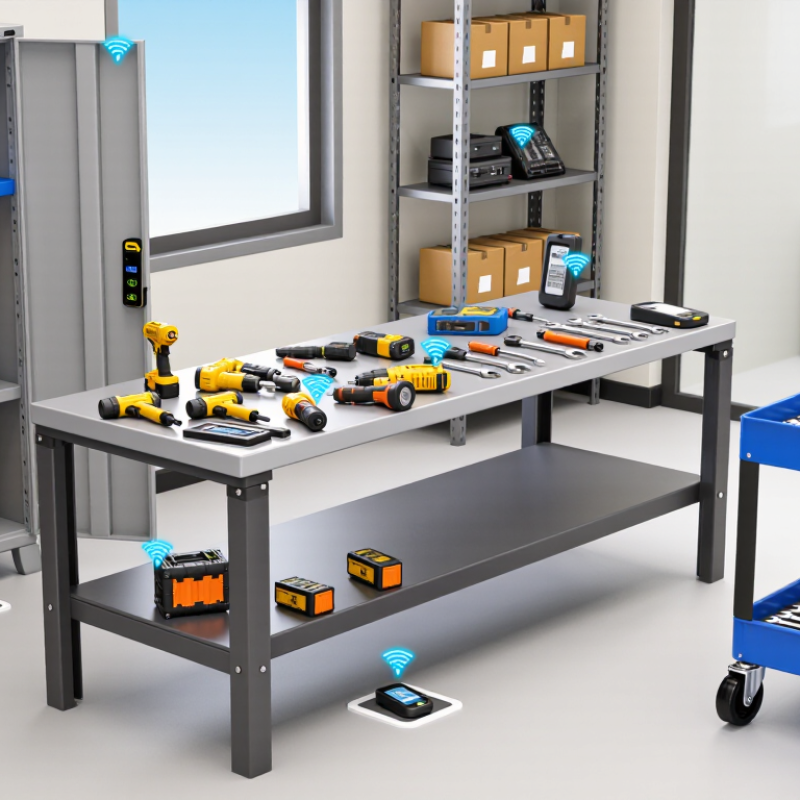
An RFID tool tracking system links tagged tools, readers, and inventory software. Each tool carries a small tag with a unique identifier. A reader sends radio waves; passive tags reply using reflected energy, so they need no battery. Software matches each read to a tool record, user, and time. Fixed readers can monitor cabinets or doorways, while handheld readers help staff locate equipment across a workshop. The GS1 EPC Gen2 standard defines UHF RFID operation across 860–960 MHz. RAIN Alliance reported 44.8 billion RAIN RFID tags shipped worldwide in 2022, showing the technology’s broad industrial scale—not a guarantee of tool-room accuracy.
In practice, a technician might scan a cabinet, see a missing torque wrench, and check its last recorded zone. Read performance depends on tag placement, reader setup, and the surrounding materials. Metal toolboxes and tightly packed tools can create missed reads or confusing results. A dashboard may look precise while the physical count is wrong. That deserves regular testing. Pilot the system with real tools and daily workflows before expanding it.
Tips: Test tags on metal tools, not just plastic samples. Set clear check-in rules, then compare system records with a manual count each week.

An RFID tool-tracking system has four practical parts: tags, readers, software, and clear operating rules. Each tool needs a tag that survives oil, dust, vibration, and repeated handling. Metal can weaken radio signals, so metal-compatible tags and careful placement matter. A tag hidden beneath a steel handle may be unreadable. Test tags on real tools before purchasing them in bulk.
Readers and antennas capture tag signals at storage cabinets, workshop exits, or service counters. Software turns those reads into records: tool identity, location, checkout time, and return status. It should connect with existing inventory or maintenance systems, while limiting access to authorized staff. The 2023 Warehousing Vision Study reported that 87% of surveyed decision-makers planned to increase technology investment by 2028. That broader trend supports careful modernization, not automatic RFID adoption. Fit comes first. In Chinese workshops, dense metal shelving and crowded work areas can create missed reads; a site survey helps expose these problems. No setup is perfect. Teams should also check tag failures, reader coverage, and whether workers actually follow checkout steps. A dashboard can look precise while recording the wrong tool.
Typical read ranges of passive RFID frequency bands used in tool tracking
Approximate practical ranges are shown for comparison; actual performance depends on the reader, antenna, tag, mounting surface, and environment. A tool tracking system also typically includes RFID tags, readers and antennas, tracking software, and a database.
Best RFID Tool Tracking Systems in China?
How to Evaluate RFID Tool Tracking Systems in China
Evaluate the worksite before comparing equipment. A tool crib, repair shop, and outdoor service yard create different reading conditions. Metal tools can detune ordinary tags, while crowded shelves may cause missed or duplicate reads. Ask vendors to test representative tools in your actual storage layout. A short demonstration with clean sample tags proves very little.
Check the full workflow, not just read distance. Can staff issue and return a drill with one scan? Does the system record the worker, time, and storage location clearly? Test handheld readers and fixed portals during busy periods. Watch for delays, confusing alerts, and manual corrections. Small friction matters. If workers bypass the process, accurate inventory quickly becomes a hopeful number.
Review integration, support, and ongoing costs. Confirm how records connect with existing maintenance or asset systems, and ask what happens during a network outage. For deployments across several sites in China, local-language training and responsive technical support can reduce downtime. Request clear details on tag replacement, software fees, and data access controls. Run a pilot with damaged tools and rushed handovers, not only ideal cases. No pilot is perfectly clean; that is useful. The awkward exceptions often reveal what a polished presentation misses.
Compare system types against the tools, workflow, and operating environment at your site. Read distances below are indicative planning ranges, not guaranteed performance; actual results depend on tag design, reader settings, tool material, orientation, and surrounding metal.
| System type | Radio and indicative read zone | Best suited to | Main advantages | Key limitations to evaluate | Useful pilot checks |
|---|---|---|---|---|---|
| UHF handheld readers | UHF; often about 1–10 m in favorable conditions. Metal tools generally need suitable on-metal tags. | Periodic tool-room counts, mobile searches, and checks across work areas. | Portable; can read multiple tags quickly; supports location-based inventory rounds. | Read distance varies considerably. Nearby tagged items may be read unintentionally; results depend on operator technique and tag placement. | Count known tool sets; test missed and unintended reads; check battery life, ergonomics, and offline operation. |
| UHF RFID smart cabinet | UHF antennas inside an enclosed cabinet; the intended read area is the cabinet interior, not a fixed outdoor distance. | Controlled issue and return of high-value, shared, or safety-critical tools. | Can record access and tool movement at a defined point; supports user authentication and transaction logs. | Cabinet layout, dense tool storage, and metal surfaces can affect reads. Requires a defined process for exceptions and untagged items. | Test the actual tool mix and storage arrangement; verify user permissions, audit logs, power/network recovery, and exception handling. |
| UHF portal or doorway readers | UHF antennas around a controlled passage; the effective zone is configured for the doorway or portal. | Monitoring tool movement through a designated entrance or tool-room exit. | Can capture movement without requiring each item to be scanned by hand; useful for alerts and event records. | Adjacent tagged items, people carrying several tools, and multiple lanes can make direction and item association difficult. | Run walk-through tests in both directions; check missed, duplicate, and cross-lane reads; test alert delays and event accuracy. |
| HF / NFC point-of-use readers | 13.56 MHz; typically a short-range tap or close presentation, often within a few centimeters depending on the reader and tag. | One-at-a-time issue, return, inspection, or maintenance confirmation. | Intentional close-range interaction helps limit reads of nearby items; suitable for explicit operator confirmation. | Usually requires presenting items individually; throughput may be lower for bulk inventory. Metal-compatible tag selection may be necessary. | Check tap workflow, cycle time, tag durability, metal-surface performance, and whether the reader works with the chosen devices. |
| Hybrid system | Combines technologies, commonly UHF for inventory or portals and HF/NFC for deliberate point-of-use transactions. | Sites needing both broad inventory checks and controlled confirmation at selected tool points. | Can match different workflows to different read methods; allows a phased rollout by area or tool category. | More interfaces and tag choices to manage; asset records, permissions, and event histories need consistent integration. | Test data synchronization, duplicate-event handling, user experience across devices, and total support requirements. |
| Evaluation dimension | What to verify | Evidence to request or collect |
|---|---|---|
| China radio compliance | Confirm that the proposed radio equipment and operating settings meet applicable Chinese requirements. UHF RFID deployments should specifically confirm permitted bands, power limits, and equipment approvals for the intended use. | Equipment documentation, applicable approval records, and written confirmation of deployment settings for the site. |
| Tag suitability | Check performance on each tool material and shape, including metal, curved surfaces, oils, vibration, cleaning, and handling. | Samples attached to representative tools and results from repeated reads in the actual storage and work environments. |
| Read quality and workflow | Measure missed reads, unintended reads, duplicate events, transaction time, and the effort required from staff. | A site pilot using representative tools, normal operating pace, and documented test scenarios. |
| Software and integration | Verify asset records, user permissions, audit trails, alerts, exports, and integration with existing maintenance or inventory workflows. | A working integration test, sample reports, data-field mapping, and documented interface requirements. |
| Deployment and support | Assess installation needs, network availability, training, maintenance, replacement tags, and local-language support arrangements. | A deployment plan, training materials, support response process, and lifecycle cost breakdown. |
RFID tool tracking in China generally falls into three practical types: handheld readers, fixed portals, and smart tool cabinets. Handheld readers suit maintenance teams that scan tools during shift changes or audits. Fixed portals record tagged tools passing through a workshop doorway. Cabinets add access control and show which worker removed each item. No setup fits every site.
Tag choice matters. Metal tools can interfere with radio signals, so metal-mount tags or tested label positions are often necessary. For mixed tool sizes, a pilot should check read rates near steel drawers, crowded racks, and workshop entrances. GS1 US and Auburn University RFID Lab studies have reported inventory accuracy improving from about 63% to 95% in RFID retail pilots. That figure is not a tool-room guarantee, but it shows why verified item-level reads matter.
A useful system links tag IDs to tool records, locations, and maintenance status. Handheld UHF readers offer flexibility; fixed readers reduce manual scans; cabinets provide tighter issue-and-return records. Chinese manufacturers and service teams may need local-language software, integration with existing asset systems, and support across multiple sites. Ask vendors to demonstrate missed reads and duplicate reads, not just a clean demo. Real sites are messier. Even a small pilot can reveal dead zones, awkward workflows, and tags that loosen after repeated handling.
RFID tool tracking in China depends less on the reader alone than on how well tags survive daily work. A tool moving between a metal cabinet, a repair bench, and a production line faces different read conditions. Test on the actual tools. Metal-tuned tags may help, but placement still matters. A tag hidden beneath a wrench handle can be hard to scan.
The MHI 2024 Annual Industry Report found that 55% of surveyed supply-chain leaders were increasing investment in technology and innovation. This is a global finding, not a China-specific forecast. It signals interest, not guaranteed savings. For a Chinese factory, map tool movements before buying equipment: check doorways, storage points, shift handovers, and areas with dense metal shelving. A small pilot can expose missed reads. It can also reveal that staff skip scans when production is busy.
Integration needs equal care. Match RFID events to existing ERP or MES records, and agree on tool IDs, user permissions, and exception rules before connecting systems. Confirm that handheld devices work across the site’s Wi-Fi coverage. Keep a manual fallback. It sounds basic. But a reader outage should not stop a technician from recording a tool checkout. Review false reads and unreturned-tool alerts with workers each week; the first workflow design is rarely quite right.


For those larger-sized parts, or smaller quantity runs, we have 2 independent powder coat booths and ovens. The quality, durability and affordability of today’s powder coating finishes make this the process of choice for world-class companies.
Powder coating advantages over other forms of coating are many. Materials used in the Powder coating process can be metals and non-metals that come in a multitude of thicknesses, textures, colors, etc. Another of Powder coating’s biggest advantages over conventional coatings is its ability to create finishes in many different textures. Powder Coating Booths allow us the ability to apply these advantages to large products.
Tri-State Fabricators runs a full-service conveyor line for painting. Wet painting can provide protection or decoration to many different part styles. From start to finish, every project is easier to undergo random and point-based inspection by our skilled painting team.
Advantages to our Wet Paint Line are these lines start with product prep and ends with a thorough inspection of a high quality finished product. Our ability to complete large and small projects with a superior finish and doing so in a timely and economical fashion. This passes along the savings in production to our customers. When powder coating ins not an option, our Wet Paint Line gets the job done right the first time.
When the parts get big and heavy we roll-out our custom paint racks and oversize booth. By utilizing our partnerships with all the major paint brands, we can match virtually any color with wet paint.
The advantages of having access to a Wet Paint Booth are many. Large projects of many different shapes can be loaded into the booth. The Wet Paint Booth offers an environment that is much more controlled than a typical parts painting operation.
Not only are they used because of their controlled environment, but they’re are also advantageous when it comes to applying paint to parts that are needed in industries that require specialty coatings such as medical, aerospace, etc.
Our military forces have some very high standards when it comes to the finish of their vehicles and equipment. From the first pre-treatment step to final coat, it takes a great deal of knowledge and experience to protect the men and women of our armed forces. They deserve only the best, and Tri-State Fabricators provides it.
All of our processes are closely monitored by our staff and management teams. Both of which are highly trained in the processes of metal fabrication and finishing. Tri-State Fabricators’ goal is to always fully satisfy each and every customer, including the military. We will always put a 110% into what we do.
Abrasive media blasting is an excellent way to remove old paint, rust, and increase the paint/powder adhesion. Glass beads produce a much smoother and brighter finish than angular abrasives; leaving the part clean yet without any dimensional change. Chemically inert and environmentally friendly, we can recycle our beads approximately 30 times; making them a more preferred method of metal cleaning or surface finishing.
Advantages to Glass Bead Blasting are many. Glass bead blast media is used when a project is needing rough surfaces need to become smooth for applications of coatings such as paint. It is typically used to clean paint and rust from a product surface without deforming the surface it is being used on. Overall, compared to many other blasting media, Glass Bead Blasting is a very economical choice and those savings are always passed on to our customers.
Tri-State Fabricators utilize a zinc phosphate wash to clean and etch the material to ensure the best paint adhesion possible. The unique design of our 3-stage wash system does the work like a 5-stage. From Cleaning and rinsing to conversion coating and post-treatment, Our Part Washing process is a complete service and works throughout the fabrication service and the finishing service.
Along with the previously mentioned benefits, Curing is a vital chemical reaction that leaves the product finish hard and relatively safe from mild abrasion and aggressive corrosion. This process can be done in more than one way; ambient air-dry or in curing ovens at temps that exceed 240°.
From fixing paint mistakes (someone else’s of course) to simply cleaning our paint line hooks, our burn-off oven is put to good use. After a quick burn-off, a little clean up, and a fresh coat of paint, your parts will look better than new.
Why does our Burn-Off Oven work so well? Because super heating the air around parts turns the materials into ashes. From paint and powder coatings to rubber and machining oils, high temps do the job without degrading the integrity of the part.
Masking is a vital part of producing high quality products. We have die-cut masking patterns to protect machined surfaces as well as a wide range of plugs and caps to protect threaded holes and bolts. We provide permanent and temporary masking.
Masking allows the selected sections of a product to be protected from a fabrication or finishing service. This can be with both chemicals when etching and tapes, paints when only finishing just a section of the product. Masking is great in aiding the customization process of a project.
Screen printing is a photographic process that transfers artwork onto a porous nylon screen which allows colored ink to flow through the screen and be deposited on an aluminum or plastic component. We can generally have just about any design created onto a screen for your parts.
Some of the advantages of Screen Printing are, brand recognition for your business displaying on your products, assembly instructions, product warnings/hazards, etc. Tri-State Fabricators produces Screen Printing of the highest quality so you know it’s durable.
Metal Finishing is the art of treating the exterior portion of product, often metal but can also be made of other materials, so that the surface is clean and free of any debris. Then the process of applying coats or either paint of powder coat takes place. This coating process improves the quality of the product in both appearance and resistance to wear and corrosion.
Tri-State Fabricators, Inc., understands that a project typically isn’t complete until a high-quality finish has been added to your product. This is why our painting and powder coating teams continuously inspect the products throughout the Metal Finishing process.

