China Best Pool Cleaning Accessories Supplier?
Choosing China’s best Pool Cleaning Accessories supplier is not simply a search for the lowest quotation. A reliable partner should provide clear product specifications, consistent quality checks, and responsive communication. Brushes, leaf nets, vacuum heads, and telescopic poles may look simple, but small design differences affect fit, handling, and service life.
For this guide, fictional sourcing specialist Lin Wei offers an original, illustrative line: “A good accessory earns trust through fit, finish, and repeatable quality.” This is not a verified quotation from a real industry expert. Buyers should confirm claims directly with suppliers and request current product details before making decisions.
Look closely at materials, connection sizes, bristle strength, packaging, sample availability, and production lead times. Ask how the supplier checks finished products and handles defects. A sample can reveal details a catalog photo misses: a loose collar, rough edge, or handle that flexes too easily. Small clues matter.
Price still matters. But it tells only part of the story. Compare quotations alongside product consistency, communication, and after-sales support. Supplier claims deserve verification. No shortcut here. Even a well-presented catalog cannot replace clear specifications and careful sample review. This introduction sets out practical criteria for assessing Chinese manufacturers and exporters, so buyers can compare options with greater confidence and fewer avoidable surprises.
What Pool Cleaning Accessories Include and How They Are Used
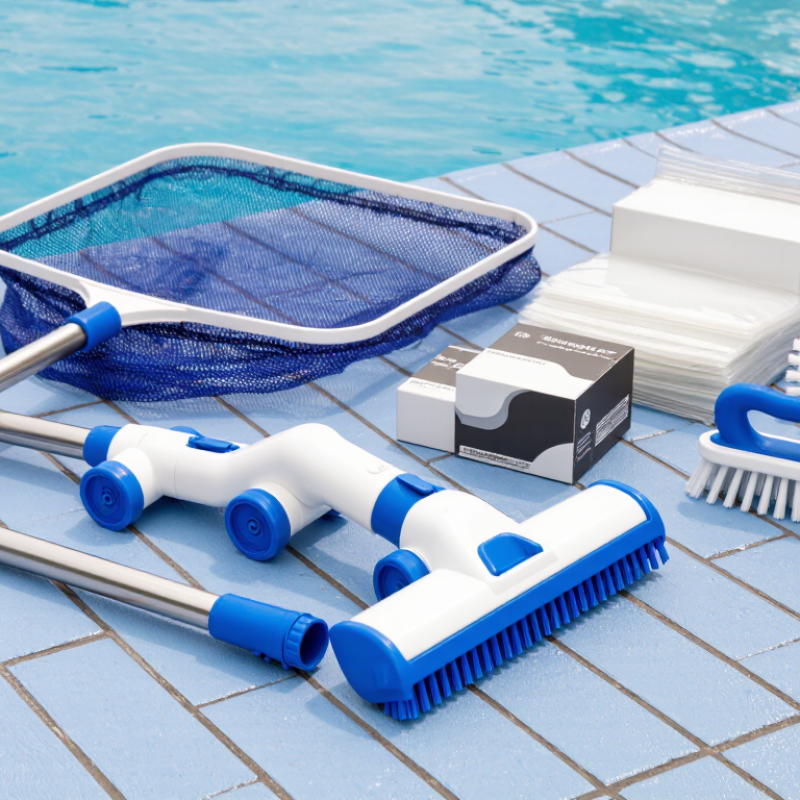
Pool cleaning accessories are simple tools with distinct jobs. A telescopic pole extends your reach across the water, while a fine-mesh skimmer net lifts leaves and insects from the surface. Use it after windy weather, before debris sinks. Small details matter.
A wall brush loosens algae and dirt from pool walls, steps, and corners. Choose bristles suited to the pool surface; overly stiff bristles may scratch some finishes.
For settled debris, a vacuum head connects to a hose and pole, then moves slowly along the floor. Rushing can stir up dirt and make it harder to collect. A leaf rake is useful for heavier debris, but it can feel awkward in a small pool.
Water-testing strips or a liquid test kit help check sanitizer and pH levels. Follow the kit’s instructions and record readings, since color matching can be imperfect. Rinse tools with fresh water after use and let them dry away from direct sun.
When sourcing accessories, check pole fittings, hose diameter, and replacement-part availability. A tool that almost fits is frustrating. It happens more often than you might expect.
Which Quality and Safety Standards Should Accessories Meet?
Pool accessories endure chlorine, sunlight, moisture, and repeated handling. Their materials should resist fading, corrosion, and cracking. Check for smooth edges, secure joints, and no exposed sharp fasteners. Small details matter. For items that support people or equipment, ask for documented load testing and clear use limits.
Electrical accessories need special scrutiny. Request test reports covering electrical safety and a suitable ingress-protection rating for the intended setting. An IP rating alone does not establish suitability for poolside use. Ask whether testing followed relevant standards for the product category and destination market. Reports from a competent, preferably accredited, laboratory are more useful when they identify the tested model and date. Keep records.
A supplier’s quality system, such as certification to ISO 9001, can show controlled processes, but it cannot replace product-level safety evidence. Ask how incoming materials, production batches, and finished goods are inspected. One limitation: paperwork can look convincing while a sample tells a different story. Compare delivered accessories with approved samples, labels, and instructions, and clarify how defects are handled. A careful supplier should answer these questions with specific documents, not broad assurances.
How to Evaluate Pool Cleaning Accessory Suppliers in China
China Best Pool Cleaning Accessories Supplier?
How to Evaluate Pool Cleaning Accessory Suppliers in China
A reliable supplier should prove performance, not just offer a polished catalogue. Ask for material specifications, inspection records, and test samples from the same production line used for bulk orders. Check brush bristles for secure fitting, hose joints for leaks, and plastic parts for brittleness after repeated exposure to pool chemicals and sunlight. Small details matter. Request batch traceability and written defect-handling procedures, then compare them with a trial order. One weakness in my own evaluation approach is relying too heavily on sample quality; production consistency needs separate verification.
Market context helps set realistic expectations. The Pool & Hot Tub Alliance’s 2023 industry materials estimate about 10.7 million residential pools in the United States, a large installed base with varied replacement needs. That figure is not a forecast for accessory sales, but it underlines why durable, compatible parts matter. Ask suppliers how they control dimensions across batches and whether they can provide measurable quality records, such as defect rates and inspection frequency. Check export experience, packaging strength, and response times with specific scenarios, not promises. A slow answer about a cracked connector is revealing. So is an incomplete test report. Compare quotations carefully: the lowest price may omit tooling, spare parts, or packaging protections that become obvious only after delivery.
What Manufacturing and Customization Capabilities Matter?
A capable pool-cleaning accessories supplier should prove more than a low unit price. Ask how brushes, skimmer nets, and vacuum parts handle chlorine, saltwater, sunlight, and repeated abrasion. Request material specifications, dimensional tolerances, and test records for each product. Small details matter: a loose handle joint or brittle net frame can turn routine cleaning into a replacement order. PHTA industry data estimates about 10.7 million swimming pools in the United States, indicating a large installed base with varied maintenance needs. That figure is not a forecast of accessory sales, but it supports the case for dependable, repeatable production.
Customization should include practical choices, not just a logo or color. Check whether the factory can adjust brush width, bristle stiffness, handle length, mesh size, packaging, and carton markings. Ask for a pre-production sample, then compare it with the approved drawing and final shipment. Clear inspection steps matter. So does traceability for materials and production batches. A supplier should explain minimum order quantities, tooling ownership, sample lead times, and what happens when a specification changes. I would still question overly polished claims: a perfect sample proves little if bulk quality drifts. The hard part is keeping every batch consistent.
Choosing Materials for Pool-Cleaning Accessories
Typical material density is one useful reference when comparing manufacturing options. Ask suppliers about exact material grades, UV and chemical resistance, corrosion testing, and custom tooling.
Approximate reference values: actual density varies by grade and formulation. Density alone does not determine suitability for pool use.
How to Compare Suppliers, Pricing, and Export Services?
When comparing pool-cleaning accessory suppliers, assess the complete order, not just the unit price. Request matching specifications for brushes, vacuum heads, hoses, and replacement parts. Check material quality, connector compatibility, packaging, warranty terms, and sample consistency. A low quote can still be the wrong choice. Ask for a dated quotation that separates product, packing, freight, and payment costs.
Export readiness matters. Request packing lists, commercial invoices, carton dimensions, and export references. Have a customs broker confirm product classifications. UNCTAD’s Review of Maritime Transport 2024 reports that global maritime trade grew 2.4% in 2023; shipping routes and freight costs can still be unpredictable. Compare delivery terms, port options, transit estimates, and destination charges before choosing a supplier.
Tips: Test a sample in a real pool. Check for loose brush bristles, stiff hoses, and connectors that do not fit. Compare at least three written offers by landed cost per usable unit. Ask how defects are handled, and request pre-shipment inspection records. A sample may not reflect mass production, so this step deserves extra attention.





