


Choosing a reliable supplier begins with understanding the job. A Centrifugal Flow Fan must move the required air against system resistance, not merely look impressive on a specification sheet. For buyers comparing manufacturers and suppliers in China, this distinction matters. Duct length, bends, filters, operating temperature, and installation space can all change the duty point. Small details count.
Frank P. Bleier, author of the Industrial Fan Handbook, offers useful engineering guidance that can be paraphrased simply: match fan performance to the system it will serve. This is a paraphrase, not a verified verbatim quotation. It points buyers toward practical questions: What airflow and static pressure are required? Which impeller and housing materials suit the environment? How are vibration, noise, efficiency, and balancing checked? Ask suppliers for performance curves, test methods, motor details, and clear explanations of operating limits. Good documentation is useful. So is a direct conversation with the engineering team.
A capable manufacturer should connect design choices with measurable requirements, rather than rely on broad claims. Request evidence for the stated duty point and clarify how customization affects delivery, maintenance, and spare parts. Factory inspection or sample testing may also help, depending on order size and risk. No supplier is perfect. Even a detailed specification can miss a real installation constraint. That deserves a second look. This guide introduces China’s Centrifugal Flow Fan manufacturers and suppliers, with attention to selection, verification, and the trade-offs that shape a sound purchase.
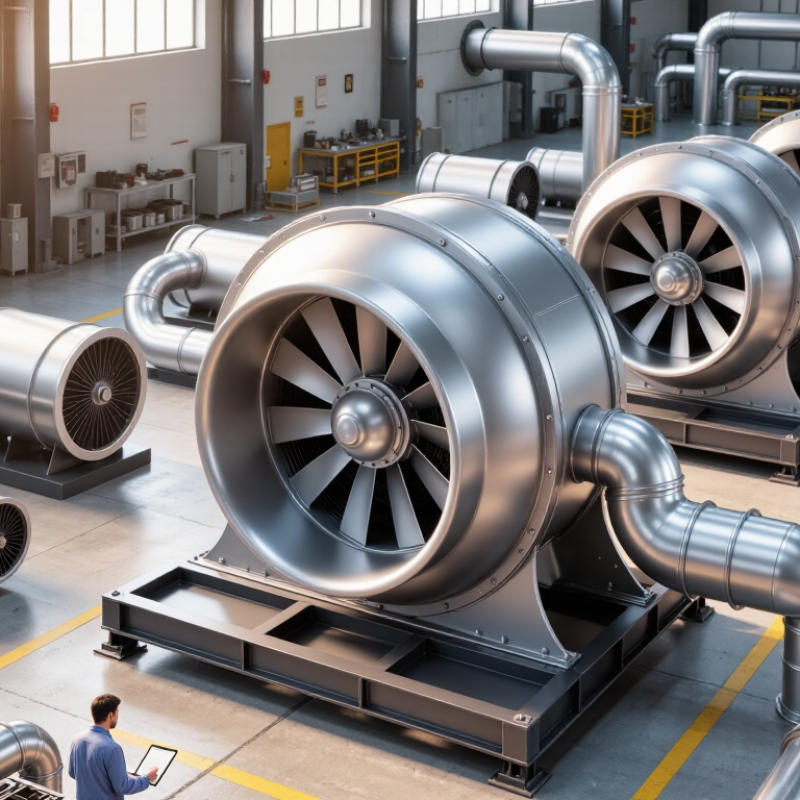
A centrifugal flow fan draws air through its central inlet, then an impeller accelerates it outward. The casing collects this moving air and guides it toward the outlet, often set at a right angle to the inlet. This is the basic operating principle. Blade shape, rotational speed, and duct resistance all affect the delivered airflow and pressure. A fan’s rated capacity alone cannot predict how it will perform after installation.
The actual operating point occurs where the fan curve meets the system-resistance curve. A clogged filter or narrow duct can shift that point and reduce airflow. The U.S. Department of Energy’s Improving Fan System Performance: A Sourcebook for Industry reports that system improvements can often save 20% to 50% of fan-system energy. That range is not a guarantee; results depend on the existing setup, controls, and operating hours. Small details matter.
Speed changes have a particularly strong effect. AMCA Publication 201, Fans and Systems, describes the fan laws: airflow varies with speed, pressure with speed squared, and power approximately with speed cubed. So a modest speed reduction may cut energy use substantially, but only if the process still receives enough air. Measure pressure and airflow at the installation. Calculations can miss real duct losses, and that deserves a second look.

Centrifugal fans draw air into an impeller and discharge it outward through a casing. The wheel design affects pressure, airflow, noise, and dust tolerance. Forward-curved wheels suit compact, lower-pressure HVAC duties, while backward-inclined designs often provide better efficiency at higher pressures. Radial-blade fans handle dustier air robustly, though they can be louder. That trade-off matters.
Common installations include air handlers, kitchen exhaust systems, drying lines, and dust collection. In a workshop, a clogged filter can reduce airflow even when the fan sounds normal. Check the operating point against the system curve, not just the maximum airflow on a data sheet. Static pressure, temperature, air density, and inlet conditions all affect selection. Small details count.
Compare efficiency at the required duty alongside sound level, motor power, and maintenance access. A backward-curved wheel may save energy at one operating point, but poor duct design can erase the gain. Ask suppliers for tested performance curves and clear construction details, including wheel material and bearing arrangement. Numbers need context. Even a careful choice can miss something: filters, dampers, and production loads change over time.
| Fan Type | Typical Impeller Design | Typical Performance Profile | Common Applications | Key Characteristics |
|---|---|---|---|---|
| Forward-Curved Fan | Many shallow blades curve in the direction of rotation. | High airflow at relatively low to medium static pressure; generally suited to compact, lower-pressure systems. | Air-handling units, furnaces, fan-coil units, and compact ventilation equipment. | Small size for a given airflow and relatively quiet operation. The motor must be selected carefully because power demand can rise as airflow increases. |
| Backward-Inclined Fan | Blades lean opposite to the direction of rotation; designs may use flat or curved blades. | Medium to high airflow at medium to high static pressure; commonly offers good operating efficiency. | Commercial HVAC systems, process ventilation, and general industrial air movement. | Non-overloading power characteristics are common in properly designed versions. Performance depends on the system resistance and operating point. |
| Backward-Curved Airfoil Fan | Smooth, airfoil-shaped blades curve backward. | High efficiency over an appropriate operating range, typically at medium to high airflow and pressure. | Large HVAC installations, clean-air handling, and energy-conscious ventilation systems. | Low aerodynamic losses can support efficient operation. The blade profile is generally best suited to relatively clean air. |
| Radial-Blade Fan | Straight blades extend radially from the hub. | Medium airflow at medium to high pressure; robust performance in demanding service. | Dust collection, material handling, industrial exhaust, and systems carrying particulate-laden air. | Simple, sturdy construction and good resistance to buildup compared with many airfoil designs. Abrasive or corrosive service may require suitable materials and wear protection. |
| High-Pressure Radial Fan | Radial or reinforced blades designed for higher pressure generation. | Lower to medium airflow at high static pressure, depending on the fan design and speed. | Pneumatic conveying, combustion-air supply, drying systems, and high-resistance process equipment. | Designed for systems with substantial pressure losses. Operating speed, temperature, and material-handling requirements affect selection. |
| Inline Centrifugal Fan | Centrifugal impeller housed in a casing designed for installation in a duct. | Medium airflow at low to medium static pressure; available performance varies by impeller and casing design. | Ducted ventilation, bathroom and kitchen exhaust, and small commercial or industrial air systems. | Can be installed directly in ductwork where space is limited. Noise, access for maintenance, and duct pressure losses should be considered. |
When comparing centrifugal fan manufacturers in China, begin with the duty point, not the brochure. Share the required airflow, static pressure, air temperature, dust load, and operating hours. Ask for a fan curve that marks your proposed operating point. Check whether it sits near the efficient range, with some allowance for system resistance. Small detail. A polished curve alone proves little.
Request test records and ask how performance was measured. Manufacturers should explain impeller balancing, vibration limits, and weld inspection procedures. For dusty or humid service, verify material grades and coatings against the actual conditions. If possible, compare the quoted motor rating with power readings at your duty point. These checks expose gaps. Still, one factory visit cannot confirm the quality of every production batch.
Review lead times, spare-part availability, technical documents, and warranty response times. Ask for references from projects with similar airflow and operating conditions. Clear answers matter more than broad claims. Record tolerances, test methods, packaging, and delivery scope in the agreement. A capable supplier may still be a poor fit if communication is slow. Leave room for doubt, and verify critical claims through witnessed testing or independent inspection.
China Best Centrifugal Flow Fan Manufacturers and Suppliers
Supplier Capabilities, Quality Standards, and Customization Options
A capable supplier should match the fan to measured airflow, static pressure, temperature, and operating hours. Ask for performance curves, impeller balancing records, motor data, and a clear test procedure. For comparable performance checks, ISO 5801 covers fan testing using standardized airways. ISO 14694 addresses industrial fan vibration limits. Paperwork matters, but it cannot replace a test under conditions close to your installation.
The IEA’s Energy-Efficiency Policy Opportunities for Electric Motor-Driven Systems estimates that motor-driven systems account for about 45% of global electricity use. This is not a fan-only figure, but it shows why efficient motors and correctly sized fans deserve attention. Suppliers may offer customized impeller diameters, casing materials, inlet configurations, coatings, and control options. Each change can affect pressure, noise, delivery time, or maintenance needs. A catalogue match may look convincing and still miss the real duty point.
Tips: Send a duty schedule, duct layout, gas temperature, and site constraints with your inquiry. Request the operating point on the fan curve, not just a maximum airflow figure. Check how the supplier validates custom designs; extra testing can add time, but skipping it may be a false saving.
Publication years of selected international standards relevant to fan performance, acoustics, balance, and vibration.
These standards address different aspects of fan testing and quality control. When evaluating a supplier, confirm which standards apply to the product and test method, and verify the current edition in the ISO catalogue.
When comparing centrifugal flow fan manufacturers and suppliers, begin with operating conditions, not catalogue claims. Provide the required airflow, static pressure, temperature, dust load, duty cycle, and installation space. Request a performance curve for the intended operating point, along with motor power and noise data. A fan that meets the airflow figure alone may still fall short on pressure. Small details matter.
Before ordering, clarify what the quotation includes: motor, controls, accessories, testing, packaging, and documentation. Confirm production lead time, shipping terms, crate dimensions, and who handles delivery coordination. For example, a narrow plant-room doorway can make an otherwise suitable unit difficult to install. Ask for inspection records and a clear process for reporting transit damage. Schedules can shift, so written updates are useful. Not perfect, but practical.
After-sales support should be specific. Check how to request troubleshooting, which replacement parts are available, and whether commissioning guidance is included. Keep the fan’s model details, performance data, and maintenance records together for faster diagnosis. Ask how quickly the supplier typically responds, rather than accepting a vague promise of support. Even a thorough checklist cannot prevent every delay or mismatch. That deserves honest discussion before purchase.


For those larger-sized parts, or smaller quantity runs, we have 2 independent powder coat booths and ovens. The quality, durability and affordability of today’s powder coating finishes make this the process of choice for world-class companies.
Powder coating advantages over other forms of coating are many. Materials used in the Powder coating process can be metals and non-metals that come in a multitude of thicknesses, textures, colors, etc. Another of Powder coating’s biggest advantages over conventional coatings is its ability to create finishes in many different textures. Powder Coating Booths allow us the ability to apply these advantages to large products.
Tri-State Fabricators runs a full-service conveyor line for painting. Wet painting can provide protection or decoration to many different part styles. From start to finish, every project is easier to undergo random and point-based inspection by our skilled painting team.
Advantages to our Wet Paint Line are these lines start with product prep and ends with a thorough inspection of a high quality finished product. Our ability to complete large and small projects with a superior finish and doing so in a timely and economical fashion. This passes along the savings in production to our customers. When powder coating ins not an option, our Wet Paint Line gets the job done right the first time.
When the parts get big and heavy we roll-out our custom paint racks and oversize booth. By utilizing our partnerships with all the major paint brands, we can match virtually any color with wet paint.
The advantages of having access to a Wet Paint Booth are many. Large projects of many different shapes can be loaded into the booth. The Wet Paint Booth offers an environment that is much more controlled than a typical parts painting operation.
Not only are they used because of their controlled environment, but they’re are also advantageous when it comes to applying paint to parts that are needed in industries that require specialty coatings such as medical, aerospace, etc.
Our military forces have some very high standards when it comes to the finish of their vehicles and equipment. From the first pre-treatment step to final coat, it takes a great deal of knowledge and experience to protect the men and women of our armed forces. They deserve only the best, and Tri-State Fabricators provides it.
All of our processes are closely monitored by our staff and management teams. Both of which are highly trained in the processes of metal fabrication and finishing. Tri-State Fabricators’ goal is to always fully satisfy each and every customer, including the military. We will always put a 110% into what we do.
Abrasive media blasting is an excellent way to remove old paint, rust, and increase the paint/powder adhesion. Glass beads produce a much smoother and brighter finish than angular abrasives; leaving the part clean yet without any dimensional change. Chemically inert and environmentally friendly, we can recycle our beads approximately 30 times; making them a more preferred method of metal cleaning or surface finishing.
Advantages to Glass Bead Blasting are many. Glass bead blast media is used when a project is needing rough surfaces need to become smooth for applications of coatings such as paint. It is typically used to clean paint and rust from a product surface without deforming the surface it is being used on. Overall, compared to many other blasting media, Glass Bead Blasting is a very economical choice and those savings are always passed on to our customers.
Tri-State Fabricators utilize a zinc phosphate wash to clean and etch the material to ensure the best paint adhesion possible. The unique design of our 3-stage wash system does the work like a 5-stage. From Cleaning and rinsing to conversion coating and post-treatment, Our Part Washing process is a complete service and works throughout the fabrication service and the finishing service.
Along with the previously mentioned benefits, Curing is a vital chemical reaction that leaves the product finish hard and relatively safe from mild abrasion and aggressive corrosion. This process can be done in more than one way; ambient air-dry or in curing ovens at temps that exceed 240°.
From fixing paint mistakes (someone else’s of course) to simply cleaning our paint line hooks, our burn-off oven is put to good use. After a quick burn-off, a little clean up, and a fresh coat of paint, your parts will look better than new.
Why does our Burn-Off Oven work so well? Because super heating the air around parts turns the materials into ashes. From paint and powder coatings to rubber and machining oils, high temps do the job without degrading the integrity of the part.
Masking is a vital part of producing high quality products. We have die-cut masking patterns to protect machined surfaces as well as a wide range of plugs and caps to protect threaded holes and bolts. We provide permanent and temporary masking.
Masking allows the selected sections of a product to be protected from a fabrication or finishing service. This can be with both chemicals when etching and tapes, paints when only finishing just a section of the product. Masking is great in aiding the customization process of a project.
Screen printing is a photographic process that transfers artwork onto a porous nylon screen which allows colored ink to flow through the screen and be deposited on an aluminum or plastic component. We can generally have just about any design created onto a screen for your parts.
Some of the advantages of Screen Printing are, brand recognition for your business displaying on your products, assembly instructions, product warnings/hazards, etc. Tri-State Fabricators produces Screen Printing of the highest quality so you know it’s durable.
Metal Finishing is the art of treating the exterior portion of product, often metal but can also be made of other materials, so that the surface is clean and free of any debris. Then the process of applying coats or either paint of powder coat takes place. This coating process improves the quality of the product in both appearance and resistance to wear and corrosion.
Tri-State Fabricators, Inc., understands that a project typically isn’t complete until a high-quality finish has been added to your product. This is why our painting and powder coating teams continuously inspect the products throughout the Metal Finishing process.

