


China Best Glass Fiber Felt Aerogel Pack Insulation Sheet?

Choosing the China Best Glass Fiber Felt Aerogel Pack Insulation Sheet is not a simple ranking exercise. “Best” depends on the operating temperature, available space, installation method, and exposure to moisture or vibration. A sheet may look uniform on a sample board, yet behave differently around pipe bends or tight equipment housings. Buyers should compare measured thermal conductivity, thickness, density, and service-temperature data under stated test conditions.

Aerogel pioneer and materials scientist Samuel S. Kistler wrote, “The term aerogel is applied to gels in which the liquid is replaced by gas.” His 1931 paper, “Coherent Expanded Aerogels and Jellies,” helps explain the material’s distinctive porous structure; it does not certify any modern composite. In a Glass Fiber Felt Aerogel Pack Insulation Sheet, the felt provides a flexible support for the aerogel layer. That construction can help with handling and fitting, but its actual performance depends on formulation, manufacturing quality, and installation.

Look closely at product documents. Do they report test methods, temperature ranges, and batch consistency? Ask for samples and inspect cut edges, fiber shedding, and compression recovery. Details matter. A low conductivity figure alone cannot prove suitability for a real project. One useful question is whether the supplier’s data reflects the same thickness and conditions you expect to use. This introduction sets out practical criteria for comparing Chinese suppliers without treating a single specification—or a polished product photo—as proof of quality.
China Best Glass Fiber Felt Aerogel Pack Insulation Sheet?

Definition and Structure of Glass-Fiber-Reinforced Aerogel Pack Sheets

China Best Glass Fiber Felt Aerogel Pack Insulation Sheet?

Definition and Structure of Glass-Fiber-Reinforced Aerogel Pack Sheets

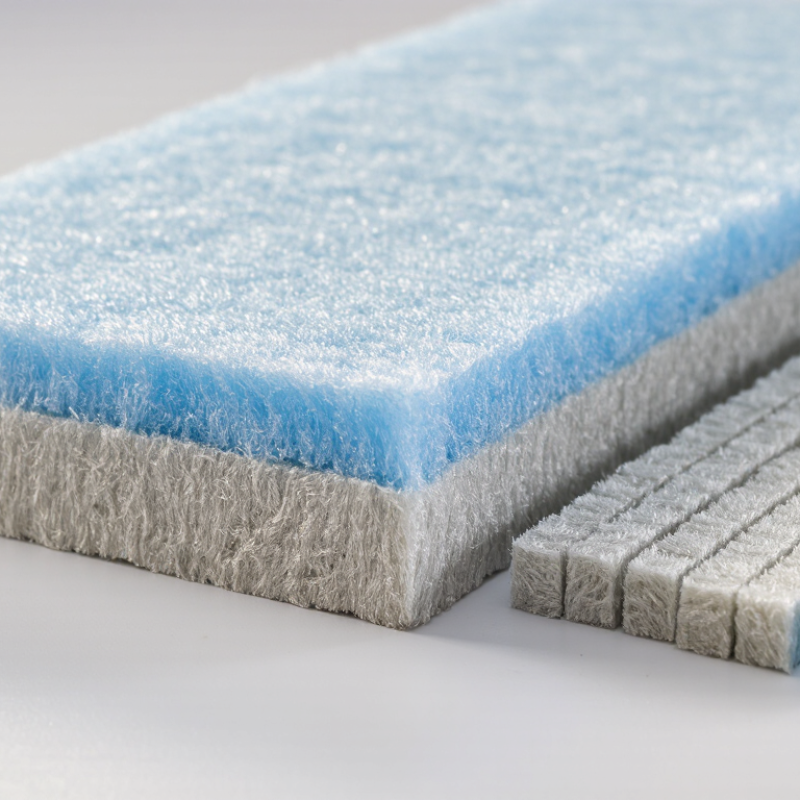
A glass-fiber-reinforced aerogel sheet is a flexible insulating composite, not a solid block of aerogel. Its silica-aerogel particles or network sit within a porous glass-fiber felt. The fibers form a supporting scaffold, helping the brittle aerogel resist cracking during cutting and installation. Look closely at an exposed edge: fine fibers hold the pale, lightweight core together. That is the basic structure.

The 2011 review “Aerogel Insulation for Building Applications: A State-of-the-Art Review,” published in Energy and Buildings, reports silica-aerogel thermal conductivity commonly around 0.013–0.020 W/m·K. Actual sheet performance varies with density, moisture, thickness, and test method. The number is useful, but it is not a guaranteed rating for every reinforced product. Check measured data for the finished sheet.

Some sheets include a facing layer or moisture barrier; others do not. These additions can affect handling, installation, and heat flow. Glass fibers improve integrity, yet they do not make every sheet equally durable. I would inspect cut edges and ask for test results after aging or humidity exposure. A small detail, but an important one: compression at joints can reduce insulation performance in real assemblies.


How Glass Fiber Felt Reinforcement Supports Aerogel Insulation

Aerogel insulation sheets are thin, but their structure can be delicate. Glass fiber felt provides flexible, continuous support. It helps hold the insulation together during cutting, wrapping, and installation. Loose particles are less likely to escape. The felt also makes a lightweight sheet easier to handle around pipes, ducts, and equipment panels. That matters on crowded job sites, where sharp bends and repeated repositioning can damage unsupported material.

Reinforcement does not make a sheet indestructible. The felt distributes handling stress and can help limit cracking or edge fraying, while aerogel remains the main insulating layer. Installers should check the specified thickness, temperature range, and facing before choosing a sheet. Small gaps at seams can reduce the benefit. A snug fit matters.

Glass fiber felt can improve dimensional stability, so sheets are less prone to shifting when secured. Still, performance depends on the full assembly, including compression, joints, moisture exposure, and the insulated surface. I would not treat reinforcement as a substitute for careful installation. That distinction is easy to miss. Compare tested thermal data with actual operating conditions, then verify that the sheet suits the equipment and installation method.

Thermal Conductivity: Typical Aerogel Blankets Reach 0.013–0.020 W/(m·K)

Aerogel insulation is valued for its low thermal conductivity, with typical blanket products measuring about 0.013–0.020 W/(m·K). The exact figure depends on test temperature, sample thickness, density, and measurement method. A lower number can look impressive, but it is meaningful only when the test conditions match the intended use. Check the technical report, not just a product summary.

Glass-fiber felt can reinforce an aerogel sheet and help it hold together during handling and installation. In a real pack, however, seams, fasteners, compression, and small air gaps can affect heat loss. Details matter. A sheet compressed around a sharp corner may not perform like an untouched laboratory sample. I would compare conductivity values at similar mean temperatures and thicknesses, then review how the material will be fitted. Moisture exposure and repeated handling also deserve attention, even when the published figure is strong. No single conductivity value tells the whole story.

China Best Glass Fiber Felt Aerogel Pack Insulation Sheet? - Thermal Conductivity: Typical Aerogel Blankets Reach 0.013–0.020 W/(m·K)

Typical specification guide for glass-fiber-reinforced silica aerogel insulation blankets. Values are indicative, not a product ranking or a guarantee; confirm the test conditions and current datasheet for any specific material.

Specification Typical Information What to Check
Material structure Silica aerogel held in a flexible fibrous reinforcement, commonly glass fiber felt or a similar glass-fiber web. Confirm the reinforcement type and whether the product contains additional facing or binder layers.
Thermal conductivity About 0.013–0.020 W/(m·K) is a commonly reported range for aerogel blanket products. Compare values measured at the same mean temperature and using a stated test method; conductivity generally changes with temperature.
Thickness Several thicknesses are available; 5 mm and 10 mm are common examples, with other options depending on the product. Check actual thickness tolerance and whether the stated thickness is measured under a specified pressure.
Density Varies by formulation, reinforcement, and manufacturing process; there is no single standard density for all aerogel blankets. Request the measured density and its test method when weight or fit is important.
Temperature capability The usable temperature range is product-specific and depends on the aerogel, reinforcement, facings, and operating conditions. Use the manufacturer’s continuous and short-term temperature ratings for the complete composite, not the aerogel alone.
Water behavior Some silica aerogel blankets are made to be hydrophobic; moisture resistance is not identical across all products. Check water-repellency data and whether seams, cuts, or exposed edges need protection.
Handling and installation Flexible blanket formats can be cut and fitted around many curved or irregular surfaces. Follow the product’s installation and dust-control guidance; use suitable personal protective equipment when cutting or handling.
Common applications Industrial pipes, tanks, equipment, and other locations where thin insulation or space efficiency is useful. Confirm suitability for the operating temperature, substrate, environment, and applicable safety requirements.
Thermal test methods Common methods for insulation materials include ASTM C177 and ASTM C518; the method used should be reported with the result. Compare results only when test method, temperature, specimen conditioning, and reporting basis are clear.

Note: “Best” depends on the required conductivity, temperature rating, thickness, moisture exposure, installation conditions, and verified test data.

How ASTM C177 Measures Insulation Performance in Pack Sheets

China Best Glass Fiber Felt Aerogel Pack Insulation Sheet?

How ASTM C177 Measures Insulation Performance in Pack Sheets

For a glass-fiber felt aerogel pack sheet, a low thermal conductivity value sounds impressive. But the test method behind that number matters. ASTM C177 measures steady-state heat flow through a specimen placed between controlled hot and cold plates. A guarded section limits edge losses, helping researchers calculate thermal transmission under defined laboratory conditions. The standard describes a measurement method, not a pass-or-fail rating for insulation products.

A review by Baetens and colleagues in Energy and Buildings (2011) reported thermal conductivity values of about 0.013–0.020 W/(m·K) for aerogel insulation materials. This range offers context, not a guaranteed result for every felt composite. In practice, ask for the tested sheet’s thickness, mean temperature, conditioning, and measured conductivity. Compression can change the thickness; gaps around a pack can also weaken real-world performance. Small details matter.

C177 results are most useful when comparing specimens tested under similar conditions. They do not automatically predict performance in a finished pack, where seams, moisture, and installation pressure can differ. That limitation is easy to overlook. I would also check whether the report identifies the exact sample construction, rather than just “aerogel felt.” A clear test record makes the number more useful, though it still cannot capture every field condition.

China Best Glass Fiber Felt Aerogel Pack Insulation Sheet? How ASTM C177 Measures Insulation Performance

Illustrative calculation, not ASTM test results: The bars show thermal resistance calculated as thickness divided by an assumed thermal conductivity of 0.020 W/(m·K). ASTM C177 measures steady-state heat flow through a specimen to determine thermal transmission properties; actual sheet performance must be measured under specified test conditions.

Battery-Pack Selection: Compare Thickness, Temperature Range, and Compression Strength

Choosing a glass-fiber-felt aerogel insulation sheet for a battery pack means matching thickness, temperature range, and compression strength to actual conditions. Thickness affects heat transfer, but it also uses valuable clearance near cells, wiring, and the enclosure. Measure the tightest gap in the assembled pack, allowing for manufacturing tolerances. Small gaps matter. A thicker sheet is not automatically the safer choice if it interferes with fit or service access.

Check the material’s stated continuous and peak temperature limits, including how long peak exposure is allowed. Compare those figures with expected pack temperatures and nearby heat sources, not just normal operating readings. Leave a margin for uneven heating and measurement uncertainty. Do not guess. Test the complete assembly where possible, since joints, edges, and compression can change how heat travels.

Compression strength needs careful interpretation: a value is meaningful only with its test method and deformation level. Too much pressure may reduce thickness or damage the felt; too little can leave gaps that weaken insulation. Ask for data on compression recovery and performance after thermal cycling. One assumption deserves a second look: drawings rarely capture every fit issue. A prototype can reveal what a specification sheet cannot.

Powder Coat Booths

For those larger-sized parts, or smaller quantity runs, we have 2 independent powder coat booths and ovens. The quality, durability and affordability of today’s powder coating finishes make this the process of choice for world-class companies.

Powder coating advantages over other forms of coating are many. Materials used in the Powder coating process can be metals and non-metals that come in a multitude of thicknesses, textures, colors, etc. Another of Powder coating’s biggest advantages over conventional coatings is its ability to create finishes in many different textures. Powder Coating Booths allow us the ability to apply these advantages to large products.

Wet Paint Line

Tri-State Fabricators runs a full-service conveyor line for painting. Wet painting can provide protection or decoration to many different part styles. From start to finish, every project is easier to undergo random and point-based inspection by our skilled painting team.

Advantages to our Wet Paint Line are these lines start with product prep and ends with a thorough inspection of a high quality finished product. Our ability to complete large and small projects with a superior finish and doing so in a timely and economical fashion. This passes along the savings in production to our customers. When powder coating ins not an option, our Wet Paint Line gets the job done right the first time.

Wet Paint Booths

When the parts get big and heavy we roll-out our custom paint racks and oversize booth. By utilizing our partnerships with all the major paint brands, we can match virtually any color with wet paint.

The advantages of having access to a Wet Paint Booth are many. Large projects of many different shapes can be loaded into the booth. The Wet Paint Booth offers an environment that is much more controlled than a typical parts painting operation.

Not only are they used because of their controlled environment, but they’re are also advantageous when it comes to applying paint to parts that are needed in industries that require specialty coatings such as medical, aerospace, etc.

Military CARC

Our military forces have some very high standards when it comes to the finish of their vehicles and equipment. From the first pre-treatment step to final coat, it takes a great deal of knowledge and experience to protect the men and women of our armed forces. They deserve only the best, and Tri-State Fabricators provides it.

All of our processes are closely monitored by our staff and management teams. Both of which are highly trained in the processes of metal fabrication and finishing. Tri-State Fabricators’ goal is to always fully satisfy each and every customer, including the military. We will always put a 110% into what we do.

Glass-Bead Blasting

Abrasive media blasting is an excellent way to remove old paint, rust, and increase the paint/powder adhesion. Glass beads produce a much smoother and brighter finish than angular abrasives; leaving the part clean yet without any dimensional change. Chemically inert and environmentally friendly, we can recycle our beads approximately 30 times; making them a more preferred method of metal cleaning or surface finishing.

Advantages to Glass Bead Blasting are many. Glass bead blast media is used when a project is needing rough surfaces need to become smooth for applications of coatings such as paint. It is typically used to clean paint and rust from a product surface without deforming the surface it is being used on. Overall, compared to many other blasting media, Glass Bead Blasting is a very economical choice and those savings are always passed on to our customers.

Part Washing

Tri-State Fabricators utilize a zinc phosphate wash to clean and etch the material to ensure the best paint adhesion possible. The unique design of our 3-stage wash system does the work like a 5-stage. From Cleaning and rinsing to conversion coating and post-treatment, Our Part Washing process is a complete service and works throughout the fabrication service and the finishing service.

Along with the previously mentioned benefits, Curing is a vital chemical reaction that leaves the product finish hard and relatively safe from mild abrasion and aggressive corrosion. This process can be done in more than one way; ambient air-dry or in curing ovens at temps that exceed 240°.

Burn-Off Oven

From fixing paint mistakes (someone else’s of course) to simply cleaning our paint line hooks, our burn-off oven is put to good use. After a quick burn-off, a little clean up, and a fresh coat of paint, your parts will look better than new.

Why does our Burn-Off Oven work so well? Because super heating the air around parts turns the materials into ashes. From paint and powder coatings to rubber and machining oils, high temps do the job without degrading the integrity of the part.

Masking

Masking is a vital part of producing high quality products. We have die-cut masking patterns to protect machined surfaces as well as a wide range of plugs and caps to protect threaded holes and bolts. We provide permanent and temporary masking.

Masking allows the selected sections of a product to be protected from a fabrication or finishing service. This can be with both chemicals when etching and tapes, paints when only finishing just a section of the product. Masking is great in aiding the customization process of a project.

Screen Printing

Screen printing is a photographic process that transfers artwork onto a porous nylon screen which allows colored ink to flow through the screen and be deposited on an aluminum or plastic component. We can generally have just about any design created onto a screen for your parts.

Some of the advantages of Screen Printing are, brand recognition for your business displaying on your products, assembly instructions, product warnings/hazards, etc. Tri-State Fabricators produces Screen Printing of the highest quality so you know it’s durable.

Metal Finishing

Metal Finishing is the art of treating the exterior portion of product, often metal but can also be made of other materials, so that the surface is clean and free of any debris. Then the process of applying coats or either paint of powder coat takes place. This coating process improves the quality of the product in both appearance and resistance to wear and corrosion.

Tri-State Fabricators, Inc., understands that a project typically isn’t complete until a high-quality finish has been added to your product. This is why our painting and powder coating teams continuously inspect the products throughout the Metal Finishing process.
