


China Best UV Blocking Transparent Umbrellas Wholesale?

Choosing China’s best wholesale source for UV Blocking Transparent Umbrellas takes more than comparing prices. Buyers should check canopy material, UV test documentation, frame strength, print quality, and sample consistency. A clear canopy can brighten a rainy street, but transparency alone does not prove effective UV protection. Ask suppliers for test results and details about coatings or films. Inspect samples in daylight, too.

For this draft, the following quotation is illustrative, not a verified statement from a real specialist: “A transparent canopy should earn trust through test data, not appearance.” — Lin Wei, fictional UV-materials specialist. Keep that principle close when reviewing factory claims. Compare minimum order quantities, production timelines, packaging, and defect policies before requesting a bulk quote. Ask how the supplier checks coating coverage and whether performance remains consistent across production batches. Small details matter. A faint haze, uneven edge seal, or loose rib can become obvious when umbrellas are opened side by side. This guide outlines practical questions for evaluating Chinese manufacturers and wholesalers, so buyers can make a better-informed shortlist without treating marketing language as proof.
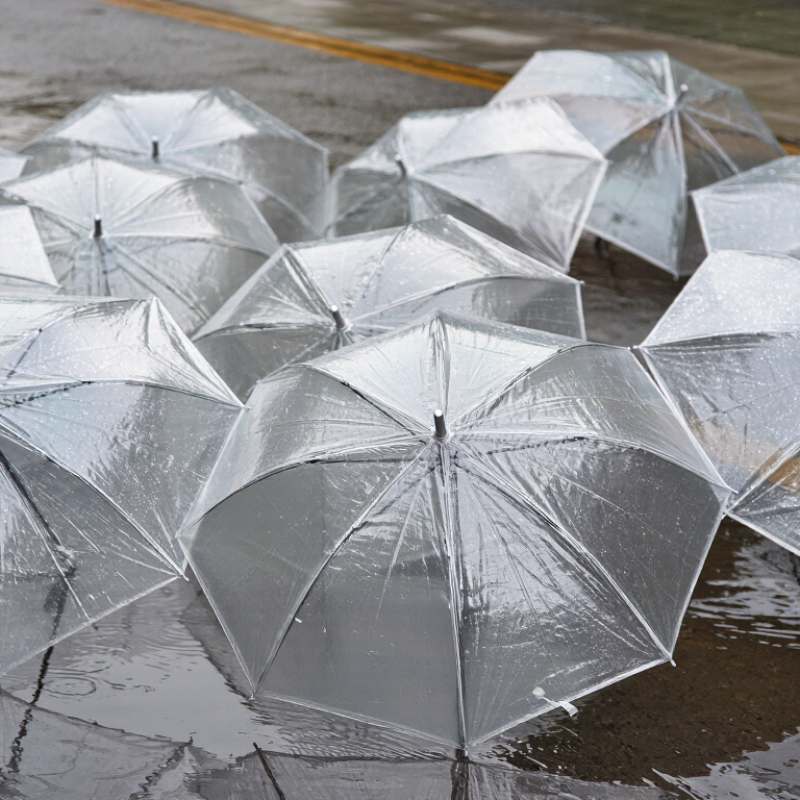
China Best UV Blocking Transparent Umbrellas Wholesale?

What Defines a UV-Blocking Transparent Umbrella?

A UV-blocking transparent umbrella lets visible light pass through while reducing ultraviolet radiation reaching the user. Its clear canopy alone does not provide reliable protection. The material, any UV-absorbing treatment, and the quality of that treatment all matter. Clear is not proof.

In product evaluation, ask for test data showing UVA and UVB transmission, or a clearly stated UV-protection rating with its test method. A dark-looking panel is not necessarily more protective, and a coating may perform differently after repeated folding, rain, or sun exposure. Check that the report matches the actual canopy material and finish, not just a similar sample. I’ll admit, appearance can fool us.

For wholesale inspection, hold the canopy against daylight and examine its clarity, seams, and surface for uneven haze or peeling. Then compare supplier documentation with a sample from the production batch. Small details matter. Ask whether protection is built into the film or applied as a surface treatment, and whether testing considers durability. No transparent canopy should be described as blocking all UV unless credible results support that claim. A slightly imperfect point: test results cannot predict every user’s exposure, especially when sunlight reflects from pavement or water.


How Transparent Canopies Reduce Ultraviolet Exposure

A transparent canopy keeps the sky visible, but visible light is not ultraviolet radiation. Its UV performance depends on the film, coating, seams, and sunlight entering from the sides. The WHO-WMO Global Solar UV Index: A Practical Guide recommends sun protection when the UV Index reaches 3 or higher. That threshold matters. ARPANSA notes that fresh snow can reflect up to 80% of UV radiation, illustrating why overhead shade alone is incomplete. A clear umbrella may reduce direct exposure, but it cannot block every reflected ray.

For wholesale buyers, request independent UVA and UVB transmission results, not just a “UV-blocking” claim. Ask whether testing covers the finished canopy, including seams and repeated folding. A 280–400 nm transmission scan helps compare performance more reliably than judging tint by eye. Looks matter. One weakness in many product descriptions is missing test conditions; material thickness and test methods can affect results. For China wholesale sourcing, request batch-level documentation and ask how performance holds up after everyday use. Laboratory figures are useful, but they may not tell the whole story.

Materials and Features That Affect UV Protection

China Best UV Blocking Transparent Umbrellas Wholesale?

Materials and Features That Affect UV Protection

A transparent canopy is not automatically UV protective. Clear PVC or TPU can look similar, yet additives, film thickness, and surface treatments affect how much ultraviolet radiation passes through. Ask suppliers for an independent test report covering the finished canopy, not just the raw material. Seams and panel joins matter too; sunlight can reach skin around the edges even when the central panel performs well. Looks are not proof.

Cancer Council Australia describes UPF 50+ fabric as blocking at least 98% of UV radiation. That is a useful benchmark, but buyers should confirm which test method and product configuration support the rating. A coating may wear or degrade with repeated folding, heat, and abrasion, so request durability information alongside initial test results. In practice, inspect the umbrella under bright daylight: check for uneven coating, pinholes, and exposed stitching. Clear panels also reduce shade compared with opaque fabric, a trade-off that is easy to overlook. Ask for results after relevant durability testing where available.

How to Assess Umbrella Quality and UV Performance

When assessing a transparent UV-blocking umbrella, ask for measured UV transmission, not just a “UV protection” claim. A laboratory can test canopy material with spectrophotometry; AATCC TM183 measures ultraviolet transmission through fabrics. Because this method is designed for fabric, ask whether the supplier tested the actual canopy material and clearly states any adaptation. Request separate UVA and UVB results, the test date, and a report identifying the sample. Numbers matter.

WHO estimated that ultraviolet radiation contributed to 1.5 million skin cancer cases and 120,000 premature deaths worldwide in 2020. That makes vague claims worth questioning. Check the canopy under bright light for pinholes, uneven coating, and gaps around seams. Inspect the stitching and frame too; a strong fabric is less useful if the canopy pulls loose in wind. A clear canopy can still transmit UV. Appearance alone is not evidence. Lab results also cannot capture every real-world angle: sunlight may reach skin from the sides or reflect off nearby surfaces. That part is easy to overlook. Repeated folding and abrasion may affect coatings, so ask whether durability testing was performed and whether results apply to the finished umbrella, not only a flat fabric swatch.

China Best UV Blocking Transparent Umbrellas Wholesale? - How to Assess Umbrella Quality and UV Performance

Use this checklist to compare transparent umbrella specifications and supplier evidence. UV results should be supported by a test report for the actual canopy material or finished umbrella; performance can vary with material, coating, condition, and test method.

Assessment Area What to Check How to Assess Buyer Guidance
UV Protection and Transparency
UPF rating The ultraviolet protection factor reported for the canopy material. Request a laboratory report identifying the tested material, specimen condition, test method, and UPF result. UPF 50 indicates that, under the test conditions, the material transmits about 1/50 of the erythemally weighted UV radiation. Check the report and applicable labeling rules before using a protection claim.
UV transmission Separate UVA and UVB transmission data, where available. Ask for spectrophotometric results across the relevant ultraviolet wavelength range, not only a marketing statement such as “UV resistant.” Compare reports produced using the same method and test conditions. A UPF value alone may not describe every aspect of UVA transmission.
Test method and sample identity Whether the report applies to the proposed transparent canopy, coating, and production specification. Match the report’s material description, construction, color, coating, and sample date to the order specification. A report for a different fabric or coating is not reliable evidence for the supplied umbrella. Confirm whether testing covers material swatches or the finished product.
Visible-light clarity Transparency, haze, color cast, and visual distortion. Inspect samples against printed text or a standard visual target under consistent lighting; request visible-light transmission or haze data if specified. Set an agreed appearance sample and acceptance criteria. Transparency does not, by itself, demonstrate UV protection.
Coating consistency Uneven coating, pinholes, cloudiness, peeling, or tacky areas. Inspect the full canopy in transmitted and reflected light, including seams and panel edges. Compare production samples with the approved sample. Define inspection conditions and defect limits in the purchase specification. Ask whether UV performance is tested after any relevant conditioning or ageing.
Care and use conditions Whether cleaning, abrasion, folding, wetting, or ageing affects the claimed performance. Review care instructions and ask for supporting test data if the protection claim is intended to apply after repeated use. Do not assume a UV rating remains unchanged after wear or damage unless the supplier provides evidence for that condition.
Construction, Durability, and Wholesale Quality Control
Canopy material and seams Material specification, panel alignment, stitching, seam finish, and attachment to ribs. Inspect production samples for skipped stitches, loose threads, uneven panels, sharp edges, and weak attachment points. Record the approved material and construction details in the order specification so substitutions can be identified.
Frame and ribs Rib alignment, joints, shaft, runner, tips, and resistance to bending or corrosion. Open and close samples repeatedly; check for sticking, loose joints, sharp parts, and visible damage after operation. Set a cycle-test requirement and pass/fail criteria suited to the intended use. Do not treat a cycle count as a universal industry guarantee.
Wind performance Frame stability and canopy behavior in the conditions relevant to the product’s intended use. Request the supplier’s test procedure and results, or conduct an agreed test on representative samples. Specify any wind-test conditions and acceptance criteria in advance. Avoid unsupported “storm-proof” claims.
Opening and closing Manual or automatic mechanism, button response, smooth movement, and pinch-point safety. Operate samples from each production lot and check that the mechanism locks, releases, and closes consistently. Confirm the mechanism type, operating instructions, and any safety requirements for the destination market.
Dimensions and tolerances Open diameter, closed length, canopy coverage, and handle dimensions. Measure samples using the same reference points and method agreed with the supplier. List target dimensions and permitted tolerances on the approved specification; tolerance limits should be agreed for the specific order.
Water shedding and drying Canopy drainage, water pooling, leakage at seams, and drying behavior. Wet a sample under an agreed test setup and inspect the canopy, seams, and handle area for leakage or pooling. Specify the test conditions and acceptance criteria. Waterproofing and UV protection are separate performance properties.
Production inspection Consistency between the approved sample and goods ready for shipment. Use pre-production approval, in-line checks, and a documented pre-shipment inspection plan. Agree inspection scope, sampling approach, defect categories, packaging checks, and corrective-action steps before production.
Documentation and traceability Test reports, material specification, care instructions, carton details, and lot identification. Check that documents refer to the correct product version and that production lots can be linked to inspection records. Keep the approved sample, final specification, test documentation, and inspection records with the purchase order.

Wholesale Sourcing Options for Transparent Umbrellas in China

China Best UV Blocking Transparent Umbrellas Wholesale?

For transparent umbrellas in China, buyers can approach manufacturers directly, work with trading companies, or hire a sourcing agent. Each option suits a different level of experience. Direct factory orders may offer more control over materials and customization, while an agent can help coordinate sampling and inspections. Ask whether the canopy uses a UV-protective treatment, and request a current test report. Clear plastic alone does not prove UV protection. Check a physical sample in daylight, too; coatings can affect visibility.

Compare quotations using the same specifications: canopy material, umbrella diameter, frame construction, handle, printing, and individual packaging. Ask about minimum order quantities and production lead times before approving a sample. Inspect the stitching, frame joints, and opening mechanism. A sample can look neat, yet the bulk order may vary, so agree on written quality requirements and consider a pre-shipment inspection. It is tempting to choose the lowest price. I would be cautious; unclear specifications can cost more later.

Tips: Request samples from two or three suppliers. Confirm UV test details, sample fees, payment terms, and shipping arrangements in writing. Keep one approved sample for comparison with the finished order.

China Transparent Umbrella Sourcing: Understanding UPF Ratings

Use verified UPF test results—not appearance alone—to assess UV protection when comparing transparent umbrellas.

The figures show the minimum UV blocked implied by each UPF rating: UPF is based on the ratio of UV exposure through unprotected material to exposure through tested material. UPF 50+ indicates at least 98% blocked. Ask suppliers for independent test reports for the specific umbrella material and construction; transparency alone does not establish UV performance.

Powder Coat Booths

For those larger-sized parts, or smaller quantity runs, we have 2 independent powder coat booths and ovens. The quality, durability and affordability of today’s powder coating finishes make this the process of choice for world-class companies.

Powder coating advantages over other forms of coating are many. Materials used in the Powder coating process can be metals and non-metals that come in a multitude of thicknesses, textures, colors, etc. Another of Powder coating’s biggest advantages over conventional coatings is its ability to create finishes in many different textures. Powder Coating Booths allow us the ability to apply these advantages to large products.

Wet Paint Line

Tri-State Fabricators runs a full-service conveyor line for painting. Wet painting can provide protection or decoration to many different part styles. From start to finish, every project is easier to undergo random and point-based inspection by our skilled painting team.

Advantages to our Wet Paint Line are these lines start with product prep and ends with a thorough inspection of a high quality finished product. Our ability to complete large and small projects with a superior finish and doing so in a timely and economical fashion. This passes along the savings in production to our customers. When powder coating ins not an option, our Wet Paint Line gets the job done right the first time.

Wet Paint Booths

When the parts get big and heavy we roll-out our custom paint racks and oversize booth. By utilizing our partnerships with all the major paint brands, we can match virtually any color with wet paint.

The advantages of having access to a Wet Paint Booth are many. Large projects of many different shapes can be loaded into the booth. The Wet Paint Booth offers an environment that is much more controlled than a typical parts painting operation.

Not only are they used because of their controlled environment, but they’re are also advantageous when it comes to applying paint to parts that are needed in industries that require specialty coatings such as medical, aerospace, etc.

Military CARC

Our military forces have some very high standards when it comes to the finish of their vehicles and equipment. From the first pre-treatment step to final coat, it takes a great deal of knowledge and experience to protect the men and women of our armed forces. They deserve only the best, and Tri-State Fabricators provides it.

All of our processes are closely monitored by our staff and management teams. Both of which are highly trained in the processes of metal fabrication and finishing. Tri-State Fabricators’ goal is to always fully satisfy each and every customer, including the military. We will always put a 110% into what we do.

Glass-Bead Blasting

Abrasive media blasting is an excellent way to remove old paint, rust, and increase the paint/powder adhesion. Glass beads produce a much smoother and brighter finish than angular abrasives; leaving the part clean yet without any dimensional change. Chemically inert and environmentally friendly, we can recycle our beads approximately 30 times; making them a more preferred method of metal cleaning or surface finishing.

Advantages to Glass Bead Blasting are many. Glass bead blast media is used when a project is needing rough surfaces need to become smooth for applications of coatings such as paint. It is typically used to clean paint and rust from a product surface without deforming the surface it is being used on. Overall, compared to many other blasting media, Glass Bead Blasting is a very economical choice and those savings are always passed on to our customers.

Part Washing

Tri-State Fabricators utilize a zinc phosphate wash to clean and etch the material to ensure the best paint adhesion possible. The unique design of our 3-stage wash system does the work like a 5-stage. From Cleaning and rinsing to conversion coating and post-treatment, Our Part Washing process is a complete service and works throughout the fabrication service and the finishing service.

Along with the previously mentioned benefits, Curing is a vital chemical reaction that leaves the product finish hard and relatively safe from mild abrasion and aggressive corrosion. This process can be done in more than one way; ambient air-dry or in curing ovens at temps that exceed 240°.

Burn-Off Oven

From fixing paint mistakes (someone else’s of course) to simply cleaning our paint line hooks, our burn-off oven is put to good use. After a quick burn-off, a little clean up, and a fresh coat of paint, your parts will look better than new.

Why does our Burn-Off Oven work so well? Because super heating the air around parts turns the materials into ashes. From paint and powder coatings to rubber and machining oils, high temps do the job without degrading the integrity of the part.

Masking

Masking is a vital part of producing high quality products. We have die-cut masking patterns to protect machined surfaces as well as a wide range of plugs and caps to protect threaded holes and bolts. We provide permanent and temporary masking.

Masking allows the selected sections of a product to be protected from a fabrication or finishing service. This can be with both chemicals when etching and tapes, paints when only finishing just a section of the product. Masking is great in aiding the customization process of a project.

Screen Printing

Screen printing is a photographic process that transfers artwork onto a porous nylon screen which allows colored ink to flow through the screen and be deposited on an aluminum or plastic component. We can generally have just about any design created onto a screen for your parts.

Some of the advantages of Screen Printing are, brand recognition for your business displaying on your products, assembly instructions, product warnings/hazards, etc. Tri-State Fabricators produces Screen Printing of the highest quality so you know it’s durable.

Metal Finishing

Metal Finishing is the art of treating the exterior portion of product, often metal but can also be made of other materials, so that the surface is clean and free of any debris. Then the process of applying coats or either paint of powder coat takes place. This coating process improves the quality of the product in both appearance and resistance to wear and corrosion.

Tri-State Fabricators, Inc., understands that a project typically isn’t complete until a high-quality finish has been added to your product. This is why our painting and powder coating teams continuously inspect the products throughout the Metal Finishing process.
