


China Best Beachflag Pole Supplier and Manufacturer

Outdoor visibility is becoming more measurable, but physical displays still matter. The World Out of Home Organization’s Global Expenditure Report 2024 recorded worldwide out-of-home advertising growth after market recovery. This trend supports practical, portable tools for events, retail entrances, sports venues, and exhibitions. A well-designed Beachflag Pole can create movement, height, and brand recognition within seconds.

China remains an important manufacturing base for display hardware, supported by established metalworking, fiberglass, textile, and export supply chains. Reports from Grand View Research on the outdoor advertising market emphasize durability, portability, and installation efficiency as valuable product considerations. These points are especially relevant when comparing Chinese suppliers and manufacturers. A reliable factory should explain tube materials, pole flexibility, base options, printing compatibility, and wind-use limitations clearly.

Small details matter. Smooth connectors prevent fabric snags. Reinforced joints reduce bending during repeated assembly. A stable cross base helps on pavement, while a water base suits outdoor campaigns. ISO 9001 certification can support process consistency, but it does not replace product inspection or field testing. That distinction is often overlooked.

Real experience exposes weaknesses.

Some suppliers publish impressive specifications without showing test conditions. Buyers should request sample units, dimensional drawings, packing photographs, and replacement-part policies. They should also confirm tolerances, coating quality, lead times, and shipment documentation. No manufacturer fits every project. The best choice depends on climate, display frequency, budget, and expected service life. A careful China Beachflag Pole supplier earns trust through evidence, not broad promises. Mistakes still happen, and transparent correction is part of professional manufacturing.
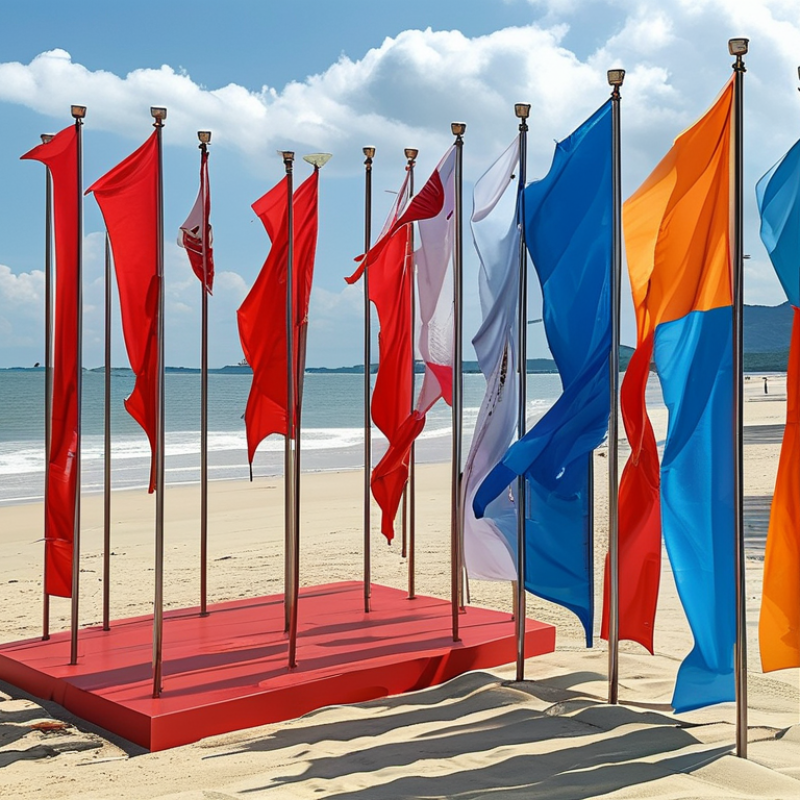
China Best Beachflag Pole Supplier and Manufacturer

Beachflag Pole Basics: Types, Uses, and Typical 2.8–5.5 m Heights

Beachflag poles usually fall into three practical types: feather, teardrop, and straight. Feather flags present a tall, curved profile, while teardrop flags keep their message visible during light wind. Straight flags offer a cleaner shape for entrances and retail displays. Common uses include trade shows, sports grounds, roadside promotions, and temporary event guidance.

Typical pole heights range from 2.8 to 5.5 metres. A 2.8-metre pole suits indoor halls and compact storefronts. Poles near 4 metres provide stronger visibility across busy event spaces. The 5.5-metre option works better outdoors, where surrounding vehicles and crowds can block shorter graphics. Lightweight aluminium is easy to transport, while fiberglass usually provides more flexibility under repeated movement. The base matters too. Cross bases suit hard floors, but ground spikes need stable soil and careful installation.

The World Out of Home Organization reported global out-of-home advertising expenditure of about 41.9 billion dollars in 2023. Grand View Research also estimated the outdoor advertising market at approximately 38.7 billion dollars in 2022. These figures show continuing demand for visible, portable displays, but they do not replace site testing. The tallest pole is not always better. Wind exposure, flag size, fabric weight, and local surface conditions can change performance quickly. A common field mistake is choosing height before checking stability. That decision deserves reconsideration. Suppliers should provide load guidance, material specifications, replacement-part information, and clear assembly instructions.Winvalid


Material Selection: Fiberglass Flexibility Versus Aluminum’s 2.7 g/cm³ Density

Selecting a beachflag pole starts with wind behavior, not appearance. Fiberglass flexes under gusts and returns toward its original shape. This reduces sudden loads on the base and fabric. Field installers often notice smoother movement on open beaches. The pole feels less rigid, but that is intentional.

Aluminum has a density of about 2.7 g/cm³, according to the Aluminum Association’s technical data. It offers predictable dimensions, good surface finish, and easier machining. Its elastic modulus is approximately 69 GPa, as listed in ASM Handbook material references. Fiberglass composites vary widely. E-glass fiber is much stiffer than the resin matrix, while the final pole depends on fiber direction and resin content. Reports from the European Composites Industry Association also identify fiber orientation as a major performance factor.

Weight alone can mislead. A lighter fiberglass section may flex safely, while a rigid aluminum section can transfer stronger forces to the base. That matters outdoors. For frequent assembly, aluminum can feel more precise and durable against handling damage. For gusty coastal displays, controlled fiberglass flexibility may protect the system better. Salt exposure still deserves attention, because aluminum needs suitable alloy selection and protective finishing. Fiberglass is not perfect; ultraviolet exposure and repeated bending can gradually weaken resin-rich areas. I would request flex-cycle results, wall-thickness data, and test conditions before approving a supplier. A single material ranking is misleading.

Fiberglass Flexibility Versus Aluminum Density

Fiberglass composite poles typically have a lower density than aluminum poles, making them lighter for portable beachflag applications. Fiberglass also provides controlled flexibility, while aluminum offers a rigid structure with a standard density of approximately 2.70 g/cm³. Actual fiberglass density varies according to the resin and reinforcement ratio.

Wind-Load Design Based on EN 1991-1-4 and Site-Speed Data

China Best Beachflag Pole Supplier and Manufacturer

Wind-Load Design Based on EN 1991-1-4 and Site-Speed Data

A reliable beachflag pole starts with wind engineering, not appearance. EN 1991-1-4 provides a framework for assessing wind actions on outdoor structures. The design should use local basic wind speed, terrain category, altitude, and exposure conditions. Generic wind values can mislead.

A qualified manufacturer converts site data into practical pole dimensions and base requirements. Engineers consider flag height, fabric area, porosity, pole flexibility, and connection strength. They calculate wind pressure and resulting overturning forces. The base must resist sliding, rotation, and uplift on the actual surface. Grass, paving, and sand behave differently.

Small details matter. Field experience shows that weak joints often fail before the pole itself. Prototype checks, material inspection, and installation records improve reliability. Testing should reflect realistic gusts, not only steady wind. A perfect model is not always possible. Site data may be incomplete, and assumptions need review. That uncertainty should be stated clearly. The final design should also follow the relevant National Annex and local project requirements. A lower pole may be safer at exposed coastal sites. Better airflow can reduce fabric loading, but it does not remove the need for structural verification.

China Best Beachflag Pole Supplier and Manufacturer - Wind-Load Design Based on EN 1991-1-4 and Site-Speed Data

Design Case Pole Height
(m)
Flag Size
(m)
Reference Wind Speed
vb (m/s)
Basic Velocity Pressure
qb (Pa)
Indicative Peak Pressure
qp (Pa)
Projected Area
A (m²)
Force Coefficient
cf
Horizontal Force
F (N)
Indicative Base Moment
M (N·m)
Typical Application
A 3.0 0.8 × 2.0 18 203 304 0.80 1.20 292 438 Sheltered gardens and low-exposure pedestrian areas
B 4.0 1.0 × 2.5 24 360 540 1.00 1.20 648 1,296 Urban plazas, event entrances and commercial forecourts
C 5.0 1.2 × 3.0 28 490 735 1.20 1.20 1,058 2,646 Open parks, beach promenades and exposed outdoor venues
D 6.0 1.5 × 3.5 32 640 960 1.50 1.20 1,728 5,184 Highly exposed coastal sites and temporary event structures
Calculation basis: Indicative values use air density ρ = 1.25 kg/m³, qb = 0.5ρvb², qp ≈ 1.50qb, F = qpcfA, and a resultant-force height of approximately 50% of the pole height. The approach is aligned with the wind-action principles of EN 1991-1-4; terrain category, orography, season factor, altitude, turbulence, national annex parameters, anchorage and foundation resistance must be verified for the actual site.

Manufacturing Quality: ISO 9001 Processes and ASTM G154 UV Testing

A reliable China beachflag pole supplier needs more than polished samples. It needs controlled manufacturing evidence. ISO 9001 processes help connect each production step, from material purchasing to final packing. We record supplier details, inspect incoming fiberglass or aluminum sections, and check dimensions before assembly. Small deviations matter. A loose connector can make a flag twist in ordinary wind.

Our quality team uses documented work instructions and inspection records. Operators check pole length, joint fit, base compatibility, and surface defects. Samples are reviewed during production, not only at the end. When an issue appears, we trace the batch, identify the cause, and verify the corrective action. This process is practical, but not perfect. Human inspection can miss subtle damage, so repeat checks remain necessary.

ASTM G154 UV testing ASTM G154 UV testing adds measurable evidence for outdoor performance. Controlled fluorescent UV exposure can reveal fading, brittleness, cracking, or weakening in fabrics and plastic components. We compare exposed samples with unexposed references and record visible changes. Test settings must match the intended material and application. A laboratory cycle cannot reproduce every combination of sunlight, moisture, salt, and temperature. It is evidence, not a guarantee. We therefore use the findings to refine material selection, coating choices, and production controls. Clear records help buyers understand what was tested, how it was tested, and where further field evaluation may still be useful.

Supplier Evaluation: MOQ, Lead Times, Custom Printing, and Warranty Terms

China Best Beachflag Pole Supplier and Manufacturer
A reliable supplier should disclose MOQ by size, fabric, base, and pole material. One combined MOQ can hide expensive substitutions. In practical sourcing, request a sample order before committing to a container. Check pole joints, stitching, base stability, and printed color under daylight. The 2023 Deloitte Global Chief Procurement Officer Survey identified cost reduction as a priority for 74% of procurement leaders. However, the cheapest quote may create higher replacement costs.
Lead times should separate sampling, artwork approval, production, and shipping. Ask for a written schedule with delay responsibilities.
For custom printing, confirm file formats, color references, bleed areas, and acceptable shade variation. A supplier should provide a digital proof and a physical pre-production sample.
The 2020 McKinsey Global Survey reported that 93% of supply chain leaders were pursuing resilience improvements. That supports using backup materials or a second production plan. I would still question vague promises. They sound efficient, but they are difficult to audit.
Tips:
Ask for a three-stage warranty. It should cover pole breakage, stitching defects, and printing failure separately. Request photos, inspection records, and replacement timelines. A 12-month warranty is useful only when exclusions are clearly listed. Wind exposure, incorrect assembly, and outdoor storage need precise definitions. A small trial order may feel slow. It often reveals more than a polished catalogue.

Powder Coat Booths

For those larger-sized parts, or smaller quantity runs, we have 2 independent powder coat booths and ovens. The quality, durability and affordability of today’s powder coating finishes make this the process of choice for world-class companies.

Powder coating advantages over other forms of coating are many. Materials used in the Powder coating process can be metals and non-metals that come in a multitude of thicknesses, textures, colors, etc. Another of Powder coating’s biggest advantages over conventional coatings is its ability to create finishes in many different textures. Powder Coating Booths allow us the ability to apply these advantages to large products.

Wet Paint Line

Tri-State Fabricators runs a full-service conveyor line for painting. Wet painting can provide protection or decoration to many different part styles. From start to finish, every project is easier to undergo random and point-based inspection by our skilled painting team.

Advantages to our Wet Paint Line are these lines start with product prep and ends with a thorough inspection of a high quality finished product. Our ability to complete large and small projects with a superior finish and doing so in a timely and economical fashion. This passes along the savings in production to our customers. When powder coating ins not an option, our Wet Paint Line gets the job done right the first time.

Wet Paint Booths

When the parts get big and heavy we roll-out our custom paint racks and oversize booth. By utilizing our partnerships with all the major paint brands, we can match virtually any color with wet paint.

The advantages of having access to a Wet Paint Booth are many. Large projects of many different shapes can be loaded into the booth. The Wet Paint Booth offers an environment that is much more controlled than a typical parts painting operation.

Not only are they used because of their controlled environment, but they’re are also advantageous when it comes to applying paint to parts that are needed in industries that require specialty coatings such as medical, aerospace, etc.

Military CARC

Our military forces have some very high standards when it comes to the finish of their vehicles and equipment. From the first pre-treatment step to final coat, it takes a great deal of knowledge and experience to protect the men and women of our armed forces. They deserve only the best, and Tri-State Fabricators provides it.

All of our processes are closely monitored by our staff and management teams. Both of which are highly trained in the processes of metal fabrication and finishing. Tri-State Fabricators’ goal is to always fully satisfy each and every customer, including the military. We will always put a 110% into what we do.

Glass-Bead Blasting

Abrasive media blasting is an excellent way to remove old paint, rust, and increase the paint/powder adhesion. Glass beads produce a much smoother and brighter finish than angular abrasives; leaving the part clean yet without any dimensional change. Chemically inert and environmentally friendly, we can recycle our beads approximately 30 times; making them a more preferred method of metal cleaning or surface finishing.

Advantages to Glass Bead Blasting are many. Glass bead blast media is used when a project is needing rough surfaces need to become smooth for applications of coatings such as paint. It is typically used to clean paint and rust from a product surface without deforming the surface it is being used on. Overall, compared to many other blasting media, Glass Bead Blasting is a very economical choice and those savings are always passed on to our customers.

Part Washing

Tri-State Fabricators utilize a zinc phosphate wash to clean and etch the material to ensure the best paint adhesion possible. The unique design of our 3-stage wash system does the work like a 5-stage. From Cleaning and rinsing to conversion coating and post-treatment, Our Part Washing process is a complete service and works throughout the fabrication service and the finishing service.

Along with the previously mentioned benefits, Curing is a vital chemical reaction that leaves the product finish hard and relatively safe from mild abrasion and aggressive corrosion. This process can be done in more than one way; ambient air-dry or in curing ovens at temps that exceed 240°.

Burn-Off Oven

From fixing paint mistakes (someone else’s of course) to simply cleaning our paint line hooks, our burn-off oven is put to good use. After a quick burn-off, a little clean up, and a fresh coat of paint, your parts will look better than new.

Why does our Burn-Off Oven work so well? Because super heating the air around parts turns the materials into ashes. From paint and powder coatings to rubber and machining oils, high temps do the job without degrading the integrity of the part.

Masking

Masking is a vital part of producing high quality products. We have die-cut masking patterns to protect machined surfaces as well as a wide range of plugs and caps to protect threaded holes and bolts. We provide permanent and temporary masking.

Masking allows the selected sections of a product to be protected from a fabrication or finishing service. This can be with both chemicals when etching and tapes, paints when only finishing just a section of the product. Masking is great in aiding the customization process of a project.

Screen Printing

Screen printing is a photographic process that transfers artwork onto a porous nylon screen which allows colored ink to flow through the screen and be deposited on an aluminum or plastic component. We can generally have just about any design created onto a screen for your parts.

Some of the advantages of Screen Printing are, brand recognition for your business displaying on your products, assembly instructions, product warnings/hazards, etc. Tri-State Fabricators produces Screen Printing of the highest quality so you know it’s durable.

Metal Finishing

Metal Finishing is the art of treating the exterior portion of product, often metal but can also be made of other materials, so that the surface is clean and free of any debris. Then the process of applying coats or either paint of powder coat takes place. This coating process improves the quality of the product in both appearance and resistance to wear and corrosion.

Tri-State Fabricators, Inc., understands that a project typically isn’t complete until a high-quality finish has been added to your product. This is why our painting and powder coating teams continuously inspect the products throughout the Metal Finishing process.
