


Top Cantilever Rack Types for Warehouse Storage

Long, awkward materials can turn a warehouse aisle into a daily obstacle course. Steel bars, lumber, pipes, and sheet goods need accessible support without obstructive front posts. A Cantilever Rack addresses this challenge with a central column and projecting arms. Workers can load items from the open side using suitable handling equipment. The result can be easier access, but only when the rack matches the inventory and workflow.

This guide introduces common cantilever rack types, including single-sided and double-sided systems, as well as light-, medium-, and heavy-duty configurations. It also considers adjustable arms, base length, upright spacing, and indoor or outdoor placement. Small details matter. A long pipe may need more support points than a short bundle, while uneven loads can affect how weight should be distributed. Capacity labels are not interchangeable; check the manufacturer’s specifications for the exact configuration and intended load. That step is easy to overlook.

Choosing a system involves more than selecting the strongest-looking frame. A larger rack may consume valuable floor space, while a compact layout can restrict handling access. The best fit depends on product dimensions, load weight, available equipment, and future storage needs. Even a careful plan can miss a real-world pinch point, so review aisle clearance before installation. The following sections compare the main options and explain what to assess before choosing.
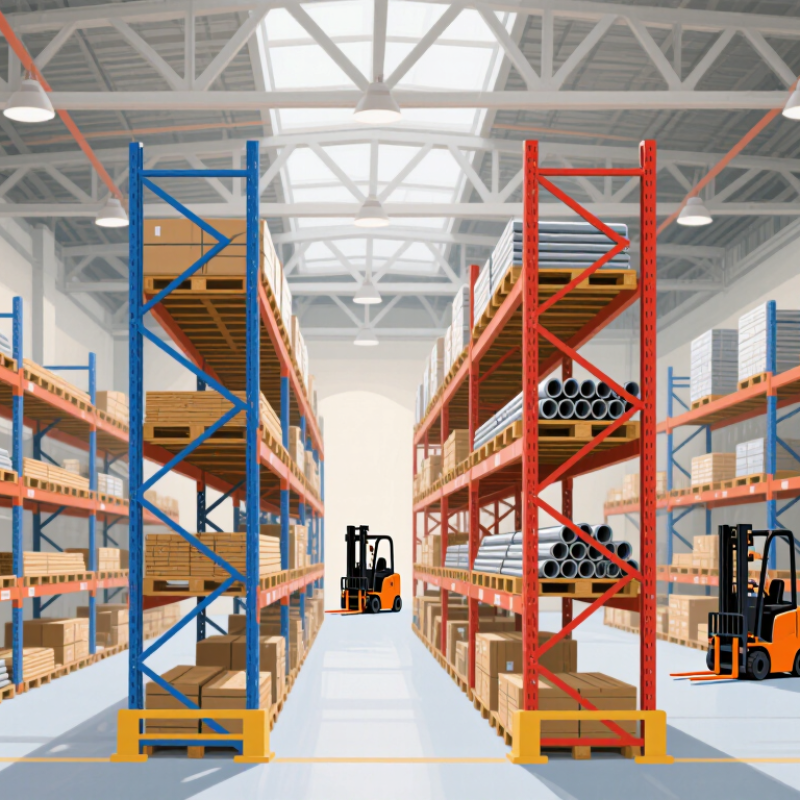
Top Cantilever Rack Types for Warehouse Storage

Assess Load Dimensions and Stability Under OSHA 29 CFR 1910.176(b)

Cantilever racks suit long, awkward materials such as pipe, timber, and sheet stock. Single-sided units fit against walls; double-sided racks serve central aisles. Choose arm length and upright spacing to support the actual load, not just its total weight. A bundle of pipe may weigh less than a compact steel plate, yet extend much farther beyond the arms. That overhang can shift the load center and reduce stability.

OSHA 29 CFR 1910.176(b) requires stored materials to be secured against sliding or collapse. It does not set one universal cantilever-rack layout or capacity. Check each load’s length, width, weight, and shape against the rack’s rated capacity and placement instructions. Keep heavy items low, distribute them evenly, and avoid unsupported ends. Leave aisles clear for handling equipment. In practice, dimension checks are easy to rush; a quick tape measure is not a full stability review. Uneven floors, damaged arms, or mixed bundle sizes may also change how safely loads sit.

Tips: Measure the longest load and its overhang before selecting arm length. Confirm the upright and arm capacities together, and inspect locking pins and anchors. If a load rocks, bends an arm, or sits unevenly, stop and reassess the setup. Don’t guess.


Top Cantilever Rack Types for Warehouse Storage

Example layout dimensions: load width and arm projection (meters). These are illustrative planning values, not standard rack dimensions or load ratings.

Choose a rack configuration and arm length to suit the actual load dimensions, and verify capacity and stability with the rack supplier or a qualified engineer. OSHA 29 CFR 1910.176(b) requires clear, appropriately marked aisles and passageways; it does not specify universal cantilever rack dimensions or capacities.

Compare Single-Sided and Double-Sided Cantilever Rack Types

Single-sided and double-sided cantilever racks solve different warehouse layout problems. A single-sided rack places arms on one side of the upright column. It works well against a wall or along a perimeter, where access from the rear is unnecessary. This arrangement can keep long items, such as timber or metal sections, off the floor without using a central aisle for both faces.

A double-sided rack has arms on both sides of its columns. Positioned in a row, it serves two picking faces and can increase storage density in the same floor area. But those gains depend on aisle width and equipment access. A forklift needs room to approach, lift, and turn with a long load. More storage is not always better. A narrow aisle may slow handling or create awkward load movements.

Compare the available floor space, item lengths, and picking frequency before choosing. Measure the longest load, including any overhang, and check that arms and uprights suit the expected load distribution. Review floor capacity and anchoring requirements with a qualified rack professional. A single-sided layout may leave a little space unused; that is not automatically a flaw. Conversely, double-sided access can be wasted if one face is blocked by stored goods or equipment. Walk the proposed layout with an actual load in mind. The drawing may look neat. The turn may not work.

Choose Structural-Steel or Roll-Formed Rack Construction

Top Cantilever Rack Types for Warehouse Storage

Choose Structural-Steel or Roll-Formed Rack Construction

Structural-steel cantilever racks suit heavy, long loads such as steel bars, lumber, or large pipe bundles. Their welded or bolted components can provide substantial capacity, depending on the design. Uprights and arms often feel stout under demanding handling. That strength may come with greater weight, cost, and installation effort. Check the rated capacity for each arm and column, not just the rack’s overall rating. A forklift bump can also damage an arm, so aisle clearance matters.

Roll-formed racks use shaped steel sections, often making them lighter and easier to adjust. They can work well for lighter or changing inventory, such as trim, tubing, or packaged panels. But thinner sections may be more vulnerable to impact, and capacity varies by profile and configuration. Neither construction is automatically better. Compare load weight, bundle dimensions, handling equipment, floor conditions, and expected changes in inventory. A rack that fits today’s stock may become awkward after one product shift.

Tips: Measure the longest loads, including overhang. Review the rack’s load tables and anchoring requirements before installation. Leave room for safe forklift turns. If impacts or changing loads are common, factor repairs and adjustments into the decision; that part is easy to underestimate.

Match Arm Loads and Bracing to ANSI/RMI MH16.3-2021

Cantilever racks may be single-sided against a wall or double-sided in open warehouse aisles. The choice changes the layout, but not the need to check each arm and upright for the actual stored load. ANSI/RMI MH16.3-2021 provides a structural basis for evaluating cantilevered rack systems. Treat it as a design reference, not a substitute for site-specific engineering.

Start with the load on each arm, including how far it projects and where the material rests. A bundle of pipe placed near the arm tip creates a different demand than the same bundle supported close to the column. Check the full load path: arms, connections, uprights, bases, anchors, and supporting floor. Bracing helps control frame movement and stability, but it cannot make an overloaded arm safe. It must suit the rack height, configuration, and expected forces. Small details matter.

In practice, record the product dimensions and weight, then compare them with the rack’s approved configuration and posted capacity information. Keep loads centered and distributed as intended; long stock can shift during handling. If arms, braces, or anchors differ from the original design, have a qualified rack engineer review the change against MH16.3-2021. A field adjustment may look harmless. It may not be. Recheck the arrangement after installation, especially where aisle impacts or uneven floors are concerns.

Plan Layout, Seismic Design, and Inspections Using RMI Guidance

Cantilever racks suit long, awkward goods such as timber, pipe, and sheet stock. Single-sided racks work along walls; double-sided units serve aisles from both faces. Select light-, medium-, or heavy-duty arms according to verified product loads, not appearance. Measure the longest bundles, forklift turning path, and aisle clearance before fixing the layout. Leave room for guards and clear access to exits. A tidy drawing can still miss a real-world obstruction.

For seismic design, give a qualified structural professional the rack layout, stored-load assumptions, building details, and local seismic criteria. Use current RMI guidance and applicable specifications to inform the design, installation, and anchorage review. Do not assume a rack is safe because it stood through an earlier tremor. Uneven loading, altered arms, or an unverified slab can change the outcome. Small details matter.

Inspect uprights, bases, arms, braces, anchors, and connections on a documented schedule. Look for bent steel, cracked welds, loose fasteners, impact marks, and missing load notices. Record the rack location and defect, then restrict access when damage may affect stability until a competent person assesses it. Check again after relocation or a layout change. The checklist may feel repetitive, but missed damage is harder to explain.

Powder Coat Booths

For those larger-sized parts, or smaller quantity runs, we have 2 independent powder coat booths and ovens. The quality, durability and affordability of today’s powder coating finishes make this the process of choice for world-class companies.

Powder coating advantages over other forms of coating are many. Materials used in the Powder coating process can be metals and non-metals that come in a multitude of thicknesses, textures, colors, etc. Another of Powder coating’s biggest advantages over conventional coatings is its ability to create finishes in many different textures. Powder Coating Booths allow us the ability to apply these advantages to large products.

Wet Paint Line

Tri-State Fabricators runs a full-service conveyor line for painting. Wet painting can provide protection or decoration to many different part styles. From start to finish, every project is easier to undergo random and point-based inspection by our skilled painting team.

Advantages to our Wet Paint Line are these lines start with product prep and ends with a thorough inspection of a high quality finished product. Our ability to complete large and small projects with a superior finish and doing so in a timely and economical fashion. This passes along the savings in production to our customers. When powder coating ins not an option, our Wet Paint Line gets the job done right the first time.

Wet Paint Booths

When the parts get big and heavy we roll-out our custom paint racks and oversize booth. By utilizing our partnerships with all the major paint brands, we can match virtually any color with wet paint.

The advantages of having access to a Wet Paint Booth are many. Large projects of many different shapes can be loaded into the booth. The Wet Paint Booth offers an environment that is much more controlled than a typical parts painting operation.

Not only are they used because of their controlled environment, but they’re are also advantageous when it comes to applying paint to parts that are needed in industries that require specialty coatings such as medical, aerospace, etc.

Military CARC

Our military forces have some very high standards when it comes to the finish of their vehicles and equipment. From the first pre-treatment step to final coat, it takes a great deal of knowledge and experience to protect the men and women of our armed forces. They deserve only the best, and Tri-State Fabricators provides it.

All of our processes are closely monitored by our staff and management teams. Both of which are highly trained in the processes of metal fabrication and finishing. Tri-State Fabricators’ goal is to always fully satisfy each and every customer, including the military. We will always put a 110% into what we do.

Glass-Bead Blasting

Abrasive media blasting is an excellent way to remove old paint, rust, and increase the paint/powder adhesion. Glass beads produce a much smoother and brighter finish than angular abrasives; leaving the part clean yet without any dimensional change. Chemically inert and environmentally friendly, we can recycle our beads approximately 30 times; making them a more preferred method of metal cleaning or surface finishing.

Advantages to Glass Bead Blasting are many. Glass bead blast media is used when a project is needing rough surfaces need to become smooth for applications of coatings such as paint. It is typically used to clean paint and rust from a product surface without deforming the surface it is being used on. Overall, compared to many other blasting media, Glass Bead Blasting is a very economical choice and those savings are always passed on to our customers.

Part Washing

Tri-State Fabricators utilize a zinc phosphate wash to clean and etch the material to ensure the best paint adhesion possible. The unique design of our 3-stage wash system does the work like a 5-stage. From Cleaning and rinsing to conversion coating and post-treatment, Our Part Washing process is a complete service and works throughout the fabrication service and the finishing service.

Along with the previously mentioned benefits, Curing is a vital chemical reaction that leaves the product finish hard and relatively safe from mild abrasion and aggressive corrosion. This process can be done in more than one way; ambient air-dry or in curing ovens at temps that exceed 240°.

Burn-Off Oven

From fixing paint mistakes (someone else’s of course) to simply cleaning our paint line hooks, our burn-off oven is put to good use. After a quick burn-off, a little clean up, and a fresh coat of paint, your parts will look better than new.

Why does our Burn-Off Oven work so well? Because super heating the air around parts turns the materials into ashes. From paint and powder coatings to rubber and machining oils, high temps do the job without degrading the integrity of the part.

Masking

Masking is a vital part of producing high quality products. We have die-cut masking patterns to protect machined surfaces as well as a wide range of plugs and caps to protect threaded holes and bolts. We provide permanent and temporary masking.

Masking allows the selected sections of a product to be protected from a fabrication or finishing service. This can be with both chemicals when etching and tapes, paints when only finishing just a section of the product. Masking is great in aiding the customization process of a project.

Screen Printing

Screen printing is a photographic process that transfers artwork onto a porous nylon screen which allows colored ink to flow through the screen and be deposited on an aluminum or plastic component. We can generally have just about any design created onto a screen for your parts.

Some of the advantages of Screen Printing are, brand recognition for your business displaying on your products, assembly instructions, product warnings/hazards, etc. Tri-State Fabricators produces Screen Printing of the highest quality so you know it’s durable.

Metal Finishing

Metal Finishing is the art of treating the exterior portion of product, often metal but can also be made of other materials, so that the surface is clean and free of any debris. Then the process of applying coats or either paint of powder coat takes place. This coating process improves the quality of the product in both appearance and resistance to wear and corrosion.

Tri-State Fabricators, Inc., understands that a project typically isn’t complete until a high-quality finish has been added to your product. This is why our painting and powder coating teams continuously inspect the products throughout the Metal Finishing process.
