Choosing an Audi Rs Q3 Body Kit is not just a styling decision. The right parts should suit the vehicle’s model year, existing trim, and intended use. A bumper that looks perfect in a product photo may sit differently on your car. Fitment details matter. So does the material. ABS plastic, fiberglass, and polyurethane can differ in flexibility, finish, and repair needs, so check the manufacturer’s specifications rather than relying on appearance alone.
This guide presents seven practical tips for comparing options, from verifying compatibility to reviewing the seller’s return policy. Look closely at close-up product images, included hardware, and whether the kit arrives primed or ready for paint. Ask who handles installation, too. Some parts need professional fitting, and extra labor can change the total cost. Measure twice. Pause before ordering. A low price can be tempting, but unclear fitment information is a warning worth investigating.
There is no single best kit for every RS Q3. Your budget, preferred look, local requirements, and willingness to maintain the finish all shape a sensible choice. Even careful research cannot guarantee a flawless fit, especially when listings omit useful details. That deserves a second look. Use these tips to ask better questions, compare complete costs, and make a decision based on verifiable product information—not just a dramatic image.
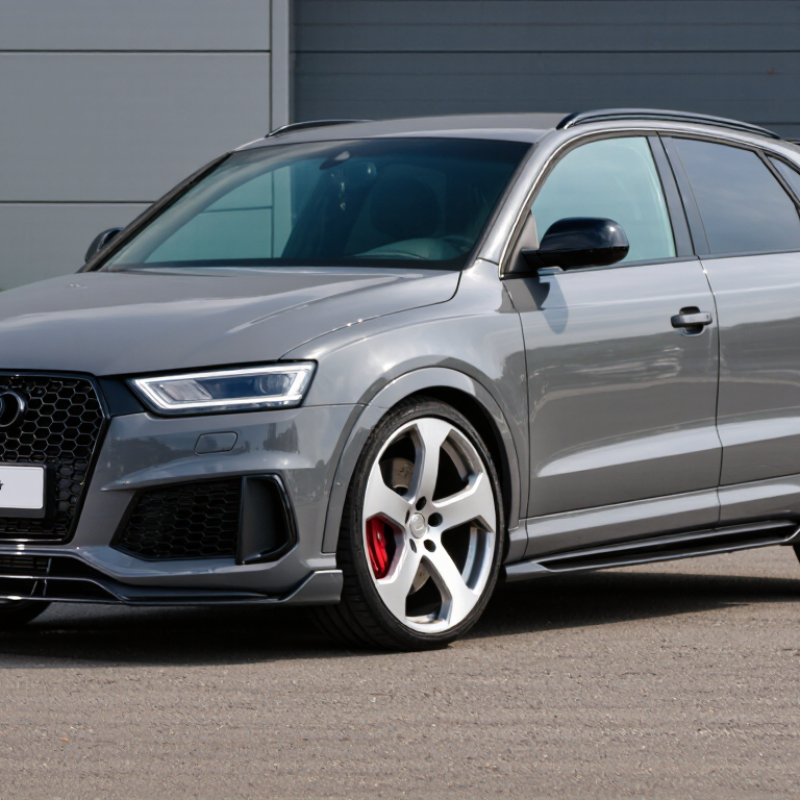
Before choosing a body kit, confirm your vehicle’s model year and generation using its registration documents and vehicle identification details. The RS Q3 has changed across production years, and facelift updates can alter bumper shapes, grille openings, and mounting points. A kit described as “RS Q3 compatible” may still fit only a specific year range. Check the seller’s fitment chart carefully.
Compare the kit with your actual front and rear bumpers, not just online photos. Look at the wheel-arch edges, parking sensor positions, exhaust cutouts, and any factory trim that the kit must clear. Measure twice. If your vehicle has optional equipment or a previous repair, mention it before ordering. Small differences can mean extra trimming, uneven gaps, or sensors that no longer sit correctly. That part is easy to overlook.
Ask for clear underside and mounting-point photos, plus installation notes for your exact generation. Confirm whether the pieces attach to factory holes or require additional preparation, and whether clips or fasteners are included. A careful installer can spot conflicts before paint is applied. Still, documentation is not always complete; treat vague fitment claims as a reason to request written confirmation, not as proof of a perfect fit.
Choose the look before choosing the parts. A restrained setup might use a front lip, side skirts, and a roof spoiler in matching finishes. A more assertive design may add wider arches, but those can make the vehicle appear heavier. Fitment comes first. Compare component photos with your vehicle’s year and trim, then check mounting points and included hardware.
SEMA’s 2023 Market Report estimated U.S. specialty-equipment sales at $52.3 billion in 2022. That figure shows a large customization market, not proof that any specific kit fits well. Ask for measured fitment details, installation instructions, and material information. Look closely at panel gaps and the edges around parking sensors. Small gaps matter. A seller’s attractive photos cannot confirm clearance or installation quality.
Match materials to your use and expectations. Flexible components may tolerate minor knocks better, while rigid parts can hold crisp shapes but may crack under impact. Neither choice is perfect. Check how a front splitter affects approach clearance on steep driveways, and whether wider arches suit your wheel setup. I’d recheck measurements before ordering; published fitment notes can still leave details unclear. A subtle color mismatch can also change the entire look.
For a compact performance SUV body kit, compare the material before judging the finish. ABS is commonly used for molded parts and can produce consistent shapes. Polyurethane offers more flex, which may help with minor knocks. Fiberglass is rigid and often needs careful fitting; poorly supported edges can crack. Material alone does not guarantee quality.
Inspect construction closely. Look for even panel thickness, clean edges, reinforced mounting points, and hardware that aligns with factory locations. Ask whether the parts have been test-fitted before painting. A glossy finish can hide ripples, filler, or uneven gaps. Small details matter. SEMA’s 2024 market report valued the U.S. specialty-equipment market at about $52 billion in 2023, but market size is no substitute for checking a specific kit.
Finish options usually include raw, primed, painted, or carbon-look surfaces. Raw parts may need sanding and preparation; primer is not always ready for paint. Painted finishes can match the vehicle, but color and gloss may vary under daylight. Carbon-look finishes can conceal a printed pattern rather than real composite material, so ask for close-up photos and a clear materials description. I would not rely on showroom images alone. A slightly imperfect fitment note is more useful than vague claims of “premium quality.”
Before buying a body kit, check the rules where the vehicle is registered and driven. Requirements can differ by location, especially for bumper shape, lighting, reflectors, and number-plate visibility. A part that looks acceptable online may still need inspection or supporting documentation. Ask the relevant transport authority or a qualified inspection centre what applies to your vehicle. Keep written guidance and any compliance documents with the purchase records. Small details matter. Even a slightly altered lamp opening can affect visibility or inspection results.
Compatibility deserves the same care. Confirm the vehicle’s model year, trim, factory options, and existing modifications before ordering. Compare mounting points and check whether the kit clears parking sensors, cameras, wheel arches, and standard fasteners. Ask for a fitment list and installation instructions, not just attractive photos. Measure twice. A small mismatch can leave uneven panel gaps or require extra work. Have an experienced installer test-fit the parts before paint, then check panel alignment, sensor operation, and wheel clearance. Fitment guides are useful, but they can miss earlier repairs or unusual factory options. That uncertainty is worth discussing before spending money.
Before buying a body kit for a compact performance SUV, check who is selling it, not just how polished the photos look. Ask for clear images of the actual parts, including mounting points, inner edges, and any surface defects. A reliable seller should answer fitment questions specifically and explain what is included. Vague claims like “easy installation” are not enough. Get the material, finish, and delivery timing in writing, and keep the messages. Small details matter.
Read the warranty terms before checkout. Check how long coverage lasts, which parts it includes, and whether damage during shipping or installation is excluded. Ask who handles a claim and what proof is required. Keep your invoice and photograph the package before opening it. That takes a minute. It can save an argument later.
Price the whole job, not only the kit: shipping, paint matching, brackets, professional fitting, and possible adjustments can add up. I would also leave room for an unexpected expense; fitment can be imperfect, even when the listing sounds confident. A low advertised price may not stay low once the parts reach the workshop. Compare written quotes and warranty details side by side before deciding.



For those larger-sized parts, or smaller quantity runs, we have 2 independent powder coat booths and ovens. The quality, durability and affordability of today’s powder coating finishes make this the process of choice for world-class companies.
Powder coating advantages over other forms of coating are many. Materials used in the Powder coating process can be metals and non-metals that come in a multitude of thicknesses, textures, colors, etc. Another of Powder coating’s biggest advantages over conventional coatings is its ability to create finishes in many different textures. Powder Coating Booths allow us the ability to apply these advantages to large products.
Tri-State Fabricators runs a full-service conveyor line for painting. Wet painting can provide protection or decoration to many different part styles. From start to finish, every project is easier to undergo random and point-based inspection by our skilled painting team.
Advantages to our Wet Paint Line are these lines start with product prep and ends with a thorough inspection of a high quality finished product. Our ability to complete large and small projects with a superior finish and doing so in a timely and economical fashion. This passes along the savings in production to our customers. When powder coating ins not an option, our Wet Paint Line gets the job done right the first time.
When the parts get big and heavy we roll-out our custom paint racks and oversize booth. By utilizing our partnerships with all the major paint brands, we can match virtually any color with wet paint.
The advantages of having access to a Wet Paint Booth are many. Large projects of many different shapes can be loaded into the booth. The Wet Paint Booth offers an environment that is much more controlled than a typical parts painting operation.
Not only are they used because of their controlled environment, but they’re are also advantageous when it comes to applying paint to parts that are needed in industries that require specialty coatings such as medical, aerospace, etc.
Our military forces have some very high standards when it comes to the finish of their vehicles and equipment. From the first pre-treatment step to final coat, it takes a great deal of knowledge and experience to protect the men and women of our armed forces. They deserve only the best, and Tri-State Fabricators provides it.
All of our processes are closely monitored by our staff and management teams. Both of which are highly trained in the processes of metal fabrication and finishing. Tri-State Fabricators’ goal is to always fully satisfy each and every customer, including the military. We will always put a 110% into what we do.
Abrasive media blasting is an excellent way to remove old paint, rust, and increase the paint/powder adhesion. Glass beads produce a much smoother and brighter finish than angular abrasives; leaving the part clean yet without any dimensional change. Chemically inert and environmentally friendly, we can recycle our beads approximately 30 times; making them a more preferred method of metal cleaning or surface finishing.
Advantages to Glass Bead Blasting are many. Glass bead blast media is used when a project is needing rough surfaces need to become smooth for applications of coatings such as paint. It is typically used to clean paint and rust from a product surface without deforming the surface it is being used on. Overall, compared to many other blasting media, Glass Bead Blasting is a very economical choice and those savings are always passed on to our customers.
Tri-State Fabricators utilize a zinc phosphate wash to clean and etch the material to ensure the best paint adhesion possible. The unique design of our 3-stage wash system does the work like a 5-stage. From Cleaning and rinsing to conversion coating and post-treatment, Our Part Washing process is a complete service and works throughout the fabrication service and the finishing service.
Along with the previously mentioned benefits, Curing is a vital chemical reaction that leaves the product finish hard and relatively safe from mild abrasion and aggressive corrosion. This process can be done in more than one way; ambient air-dry or in curing ovens at temps that exceed 240°.
From fixing paint mistakes (someone else’s of course) to simply cleaning our paint line hooks, our burn-off oven is put to good use. After a quick burn-off, a little clean up, and a fresh coat of paint, your parts will look better than new.
Why does our Burn-Off Oven work so well? Because super heating the air around parts turns the materials into ashes. From paint and powder coatings to rubber and machining oils, high temps do the job without degrading the integrity of the part.
Masking is a vital part of producing high quality products. We have die-cut masking patterns to protect machined surfaces as well as a wide range of plugs and caps to protect threaded holes and bolts. We provide permanent and temporary masking.
Masking allows the selected sections of a product to be protected from a fabrication or finishing service. This can be with both chemicals when etching and tapes, paints when only finishing just a section of the product. Masking is great in aiding the customization process of a project.
Screen printing is a photographic process that transfers artwork onto a porous nylon screen which allows colored ink to flow through the screen and be deposited on an aluminum or plastic component. We can generally have just about any design created onto a screen for your parts.
Some of the advantages of Screen Printing are, brand recognition for your business displaying on your products, assembly instructions, product warnings/hazards, etc. Tri-State Fabricators produces Screen Printing of the highest quality so you know it’s durable.
Metal Finishing is the art of treating the exterior portion of product, often metal but can also be made of other materials, so that the surface is clean and free of any debris. Then the process of applying coats or either paint of powder coat takes place. This coating process improves the quality of the product in both appearance and resistance to wear and corrosion.
Tri-State Fabricators, Inc., understands that a project typically isn’t complete until a high-quality finish has been added to your product. This is why our painting and powder coating teams continuously inspect the products throughout the Metal Finishing process.


