


Top 10 Boat Ratchet Straps for Secure Transport

Moving a boat safely begins before the trailer leaves the driveway. Boat Ratchet Straps help hold the hull steady, but the right choice depends on the boat’s weight, trailer design, attachment points, and journey conditions. A strap that looks sturdy may still be poorly suited to a sharp edge or a narrow tie-down point. Small details matter.

As [verified marine transport expert’s name] notes, “A secure tie-down starts with the right anchor point, not the tightest pull.” Please verify this expert attribution and quotation before publication; no source material was provided to confirm a real person’s statement. That caution belongs here. A confident-sounding quote should never replace a checkable source.

This Top 10 guide compares Boat Ratchet Straps by practical features, including working load limits, webbing width, buckle design, hook style, and resistance to wear. It also considers how straps sit against a hull, where abrasion can begin, and whether tension is easy to inspect during a stop. Look for clear product specifications. Check the manufacturer’s instructions, too. A strap can loosen, shift, or rub when fitted carelessly, and even a good product cannot fix poor placement. The rankings aim to make comparison easier, not promise a perfect setup for every boat. Your trailer and load still deserve a careful, hands-on inspection before each trip.
Top 10 Boat Ratchet Straps for Secure Transport

How Boat Ratchet Straps Secure Watercraft During Transport

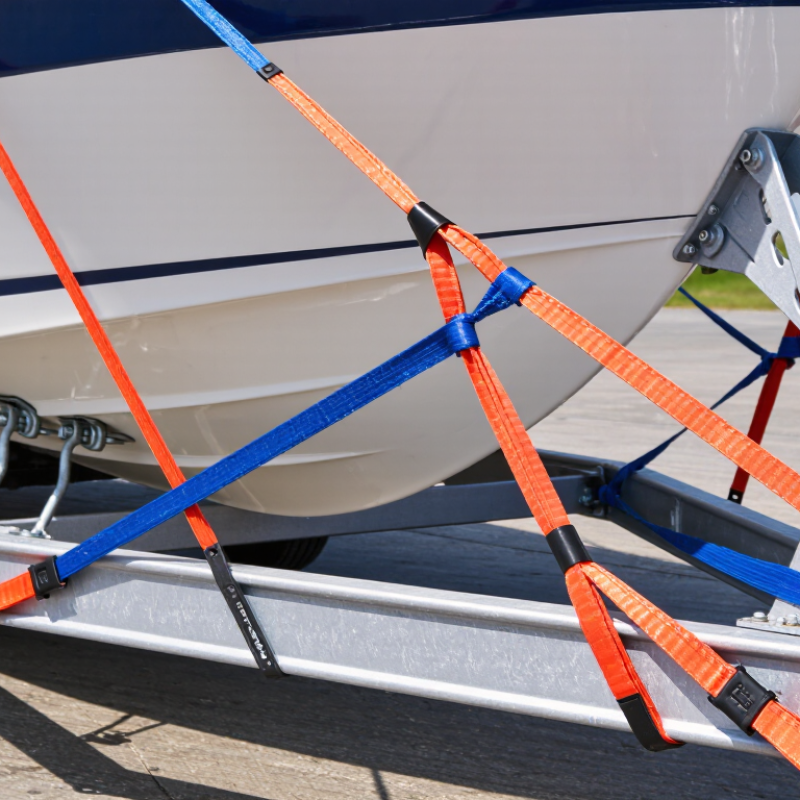
Boat ratchet straps secure watercraft by limiting movement in several directions, not merely pressing the hull onto the trailer. A snug strap across the hull helps resist bounce and side-to-side shift; bow and stern restraints help control fore-and-aft movement. Attach them to the boat’s designated tie-down points and solid trailer anchors. Keep webbing flat, away from sharp edges, and clear of delicate fittings. No twist. A glossy hull can hide a loose strap, so check tension again after a short, safe stop.

For a useful load-capacity reference, the U.S. Federal Motor Carrier Safety Administration’s cargo-securement rule sets the combined working load limit of tiedowns at no less than 50 percent of the cargo’s weight for covered commercial motor vehicles. That figure is not a universal recreational-trailer rule, but it shows why strap ratings matter. Follow the boat and trailer makers’ instructions, and never assume a strap’s breaking strength equals its working load limit. Inspect stitching, hooks, and ratchets for fraying, corrosion, or bent parts before travel. I may be cautious here: tighter is not always safer. Excessive pressure can damage a hull or fittings, while a strap routed at the wrong angle may still let the boat shift. Check the load after the first few miles.


Key Features and Ratings to Compare Before Choosing

When comparing boat ratchet straps, read the working load limit (WLL), not only the breaking strength.

FMCSA’s cargo-securement rule, 49 CFR 393.106(d), sets the combined WLL of tie-downs at no less than half the secured cargo’s weight in applicable commercial transport. Treat that as a regulatory baseline, not a complete boat-loading plan.

A strap marked with a high break strength may still have a much lower WLL. Compare strap width, length, stitching, hooks, and ratchet feel. Wider webbing can spread pressure, but it must fit the boat’s contact points without bunching.

Check that hooks seat fully on trailer anchors and that metal parts show no rust or distortion. Small details matter. A strap that binds or slips during a test pull deserves a closer look. UV exposure, salt spray, and sharp hull edges can weaken webbing; edge protectors help, but do not repair damaged straps.

Inspect stitching for pulled threads and webbing for cuts, glazing, or stiffness. I would not choose by rating alone: anchor placement and hull shape change how loads behave, and that judgment is easy to get wrong. FMCSA’s figures describe cargo securement, not a guarantee against boat movement on every road.

Ten Boat Ratchet Straps for Different Transport Needs

Boat transport needs vary with hull shape, trailer design, and trip length. A compact aluminum boat may need shorter straps that avoid loose tails near the wheels. A wider fiberglass hull may call for longer straps and soft sleeves where webbing touches the finish. Check the strap’s working load limit on its label, then compare it with the trailer and boat maker’s guidance. Do not judge capacity by webbing width alone. The ratchet should close smoothly, and the hooks should sit securely on suitable trailer points. Not every anchor point is suitable.

Tighten each strap until the boat feels stable, not until the hull flexes or the suspension compresses heavily.

It sounds obvious. It isn’t always.

Cross-check that straps cannot rub against sharp edges, propellers, or painted surfaces. For a short local drive, a quick check after the first few miles can reveal settling or loosened webbing. Longer journeys and rough roads deserve more frequent checks.

Wet straps may tighten or shift as they dry, so inspect them again at the end of the trip. Keep spare straps dry and away from fuel, grit, and direct sunlight. A slightly awkward strap angle may look secure, but it can pull sideways under braking; adjust it before departure.

How to Attach and Tighten Straps for a Stable Load

A secure boat load starts at the trailer’s rated tie-down points, not convenient rails or fittings. Attach straps to the bow and stern eyes, following the boat and trailer manufacturers’ instructions. Keep each strap clear of propellers, wiring, and sharp edges. If an edge cannot be avoided, use suitable edge protection. Keep it snug.

Turn the ratchet handle smoothly until the strap is firm, then close and lock the handle. Do not keep cranking just to remove every trace of movement; excessive force can stress the hull or fittings. FMCSA cargo-securement rules specify an aggregate working load limit of at least half the cargo weight for covered commercial loads (49 CFR 393.106). That benchmark is useful context, not a substitute for your trailer maker’s requirements.

Check that the boat sits squarely on its supports and that the winch strap is not the only restraint. Add dedicated bow and stern tie-downs where specified. After a short drive, stop somewhere safe and check strap tension, hooks, and anchor points. Straps can settle as the hull and trailer move. I still find this easy to overlook: a tight ratchet handle does not prove the load is stable. Recheck after bumps, rain, or a change in strap position.

Top 10 Boat Ratchet Straps for Secure Transport

Example working load limit (WLL) ratings for comparing tie-down capacity—not a product ranking. Always use the WLL printed on the strap label.

Choose straps based on their labeled WLL and the load’s securement requirements. Attach them to suitable tie-down points, tighten evenly, and avoid excessive pressure on the boat hull. Recheck tension after starting the journey.

Inspection, Care, and Safe Replacement of Ratchet Straps

Before loading, inspect each strap in good light. Run the webbing slowly through your fingers and check for cuts, fraying, melted fibers, stiff patches, chemical stains, and damaged stitching. Look closely at the ratchet teeth, handle, hooks, and attachment points for cracks, bending, or heavy corrosion. Salt and grit hide wear. Rinse hardware with fresh water, then let the strap dry fully away from direct heat. Keep webbing clean and dry; never cover damage with tape or sew a repair yourself. A barely readable capacity label is a reason to retire the strap, not guess its rating.

The Web Sling and Tie Down Association’s WSTDA-T-1 standard uses a 3:1 design factor for web tie-down assemblies: breaking strength is not the same as working load limit. Check the label and use the marked working load limit when planning securement. Replace a strap after a severe shock load, visible structural damage, or any doubt about its history. Boat transport adds spray, sharp trailer edges, and repeated vibration; protect contact points with suitable edge guards, and recheck tension after the first short drive. Don’t overtighten. I still find that easy to misjudge: a strap can feel reassuringly firm while pressing a hull against a hard edge. Retired straps should be clearly marked and kept out of service.

Powder Coat Booths

For those larger-sized parts, or smaller quantity runs, we have 2 independent powder coat booths and ovens. The quality, durability and affordability of today’s powder coating finishes make this the process of choice for world-class companies.

Powder coating advantages over other forms of coating are many. Materials used in the Powder coating process can be metals and non-metals that come in a multitude of thicknesses, textures, colors, etc. Another of Powder coating’s biggest advantages over conventional coatings is its ability to create finishes in many different textures. Powder Coating Booths allow us the ability to apply these advantages to large products.

Wet Paint Line

Tri-State Fabricators runs a full-service conveyor line for painting. Wet painting can provide protection or decoration to many different part styles. From start to finish, every project is easier to undergo random and point-based inspection by our skilled painting team.

Advantages to our Wet Paint Line are these lines start with product prep and ends with a thorough inspection of a high quality finished product. Our ability to complete large and small projects with a superior finish and doing so in a timely and economical fashion. This passes along the savings in production to our customers. When powder coating ins not an option, our Wet Paint Line gets the job done right the first time.

Wet Paint Booths

When the parts get big and heavy we roll-out our custom paint racks and oversize booth. By utilizing our partnerships with all the major paint brands, we can match virtually any color with wet paint.

The advantages of having access to a Wet Paint Booth are many. Large projects of many different shapes can be loaded into the booth. The Wet Paint Booth offers an environment that is much more controlled than a typical parts painting operation.

Not only are they used because of their controlled environment, but they’re are also advantageous when it comes to applying paint to parts that are needed in industries that require specialty coatings such as medical, aerospace, etc.

Military CARC

Our military forces have some very high standards when it comes to the finish of their vehicles and equipment. From the first pre-treatment step to final coat, it takes a great deal of knowledge and experience to protect the men and women of our armed forces. They deserve only the best, and Tri-State Fabricators provides it.

All of our processes are closely monitored by our staff and management teams. Both of which are highly trained in the processes of metal fabrication and finishing. Tri-State Fabricators’ goal is to always fully satisfy each and every customer, including the military. We will always put a 110% into what we do.

Glass-Bead Blasting

Abrasive media blasting is an excellent way to remove old paint, rust, and increase the paint/powder adhesion. Glass beads produce a much smoother and brighter finish than angular abrasives; leaving the part clean yet without any dimensional change. Chemically inert and environmentally friendly, we can recycle our beads approximately 30 times; making them a more preferred method of metal cleaning or surface finishing.

Advantages to Glass Bead Blasting are many. Glass bead blast media is used when a project is needing rough surfaces need to become smooth for applications of coatings such as paint. It is typically used to clean paint and rust from a product surface without deforming the surface it is being used on. Overall, compared to many other blasting media, Glass Bead Blasting is a very economical choice and those savings are always passed on to our customers.

Part Washing

Tri-State Fabricators utilize a zinc phosphate wash to clean and etch the material to ensure the best paint adhesion possible. The unique design of our 3-stage wash system does the work like a 5-stage. From Cleaning and rinsing to conversion coating and post-treatment, Our Part Washing process is a complete service and works throughout the fabrication service and the finishing service.

Along with the previously mentioned benefits, Curing is a vital chemical reaction that leaves the product finish hard and relatively safe from mild abrasion and aggressive corrosion. This process can be done in more than one way; ambient air-dry or in curing ovens at temps that exceed 240°.

Burn-Off Oven

From fixing paint mistakes (someone else’s of course) to simply cleaning our paint line hooks, our burn-off oven is put to good use. After a quick burn-off, a little clean up, and a fresh coat of paint, your parts will look better than new.

Why does our Burn-Off Oven work so well? Because super heating the air around parts turns the materials into ashes. From paint and powder coatings to rubber and machining oils, high temps do the job without degrading the integrity of the part.

Masking

Masking is a vital part of producing high quality products. We have die-cut masking patterns to protect machined surfaces as well as a wide range of plugs and caps to protect threaded holes and bolts. We provide permanent and temporary masking.

Masking allows the selected sections of a product to be protected from a fabrication or finishing service. This can be with both chemicals when etching and tapes, paints when only finishing just a section of the product. Masking is great in aiding the customization process of a project.

Screen Printing

Screen printing is a photographic process that transfers artwork onto a porous nylon screen which allows colored ink to flow through the screen and be deposited on an aluminum or plastic component. We can generally have just about any design created onto a screen for your parts.

Some of the advantages of Screen Printing are, brand recognition for your business displaying on your products, assembly instructions, product warnings/hazards, etc. Tri-State Fabricators produces Screen Printing of the highest quality so you know it’s durable.

Metal Finishing

Metal Finishing is the art of treating the exterior portion of product, often metal but can also be made of other materials, so that the surface is clean and free of any debris. Then the process of applying coats or either paint of powder coat takes place. This coating process improves the quality of the product in both appearance and resistance to wear and corrosion.

Tri-State Fabricators, Inc., understands that a project typically isn’t complete until a high-quality finish has been added to your product. This is why our painting and powder coating teams continuously inspect the products throughout the Metal Finishing process.
