


Black Nylon Cable Ties: How to Improve Demolding and Surface Appearance

Black Nylon Cable Ties: Addressing White Bloom and Demolding Challenges with SILIMER Silicone Additive

Application Case | Silicone Additives for Nylon Injection Molding

For black nylon injection-molded parts, achieving efficient demolding while maintaining long-term surface appearance can be challenging. Mold-release additives used at high loading levels may affect surface quality, while reducing additive dosage may lead to sticking, difficult ejection, and unstable production.

A manufacturer of industrial black nylon cable ties encountered this challenge during production. After storage, visible white bloom appeared on the surface of finished parts, affecting the appearance of the black molded products. Meanwhile, reducing the existing release additive level resulted in insufficient demolding performance.

To address the balance between processing efficiency and surface appearance, SILIKE offered SILIMER 5133 Easy Mold Release Silicone Wax, a modified copolymerized silicone additive, as an alternative solution.
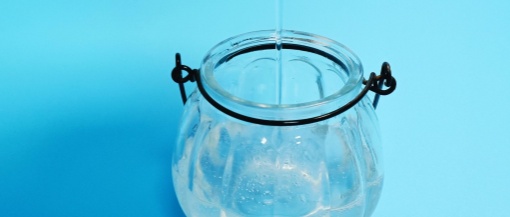
https://www.siliketech.com/silicone-wax-silimer-5133-product/

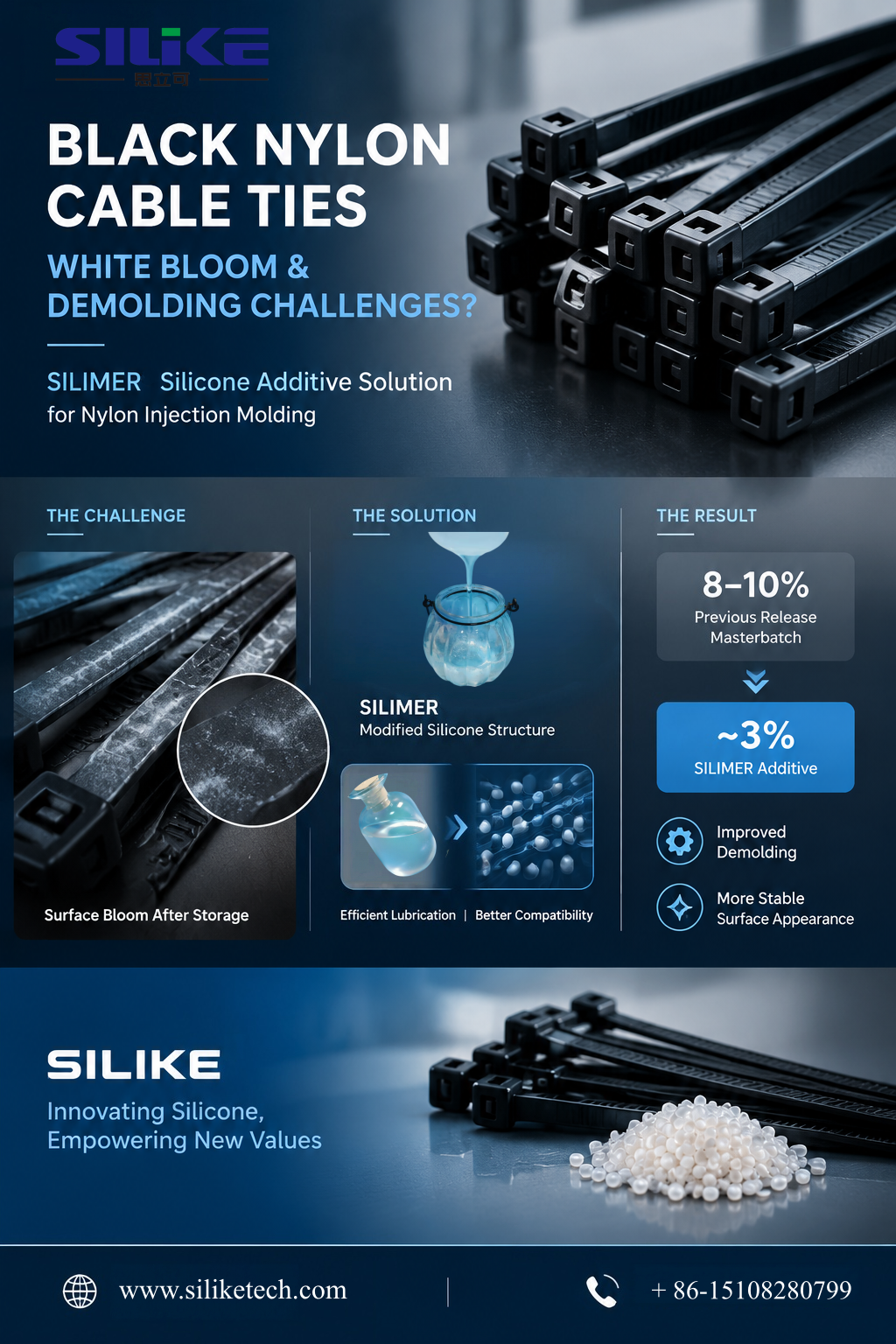
Compared with the customer’s previous release system requiring approximately 8–10% conventional mold-release masterbatch, SILIMER 5133 achieved the required performance at approximately 3 wt% addition level under the customer’s evaluation conditions.

The results described in this case are based on a specific customer formulation and processing setup. Actual performance may vary depending on nylon grade, formulation design, additive dosage, molding conditions, and storage or conditioning conditions.

Processing Challenge: White Bloom on Black Nylon Cable Ties

The customer specializes in manufacturing black nylon cable ties for industrial applications.

During storage, a visible white deposit gradually appeared on the molded parts. Due to the high contrast between the black surface and the residue, even a small amount of surface accumulation became noticeable and affected product appearance.

To maintain smooth injection molding and reliable part release, the customer previously relied on a conventional mold-release masterbatch system.

However, the formulation created a common challenge:

• Increasing release additive loading improved mold release performance but increased the risk of surface residue.

• Reducing additive loading helped improve appearance but caused sticking, difficult ejection, and unstable production.

The customer required an additive solution that could provide efficient release performance while maintaining stable surface quality.

Understanding White Bloom in Nylon Injection Molding

White bloom on black nylon parts can result from multiple formulation and processing factors, including:

• Additive compatibility with the nylon matrix

• Excessive additive concentration

• Polymer–additive interaction

• Pigment and filler systems

• Processing history

• Storage and conditioning conditions

When a release additive is not sufficiently compatible with the polymer system, higher loading levels may increase the possibility of additive migration or surface accumulation over time.

Therefore, improving surface appearance requires more than simply reducing additive dosage. The key is selecting an additive technology that provides efficient lubrication while maintaining good interaction with the polymer matrix.
Solution: SILIMER 5133 Silicone Additive for Nylon Demolding & Surface Appearance

https://www.siliketech.com/silicone-wax-silimer-5133-product/

Based on the customer’s requirements, SILIKE proposed SILIMER 5133 Easy Mold Release Silicone Wax as an alternative to the existing release system.

SILIMER 5133 is a modified copolymerized silicone additive designed for thermoplastic processing applications requiring improved release performance and surface properties.

The evaluation focused on balancing:

• Mold release performance

• Additive efficiency

• Surface appearance stability

Unlike conventional release systems that may depend on higher loading levels, SILIMER 5133 provides efficient lubrication and release performance at a lower addition level.

In this customer application, SILIMER 5133 was evaluated at approximately 3 wt% addition level.

Application Results: Improved Demolding and Surface Appearance

Improved Mold Release Performance

During the customer’s nylon cable tie production evaluation, SILIMER® 5133 helped improve injection molding performance.

The customer reported:

• Reduced screw torque

• Smoother molding operation

• Easier mold opening and part ejection

• Reduced sticking-related issues

The results showed that SILIMER 5133 provided effective lubrication and release performance without relying on the previous high-loading release masterbatch system.

More Stable Surface Appearance

After storage and water-conditioning evaluation, the black nylon cable ties maintained a more uniform surface appearance.

Under the customer’s evaluation conditions, no visible white bloom was observed.

This result highlights the importance of balancing:

Lubrication efficiency + Polymer compatibility + Surface appearance

rather than optimizing only mold release performance.

Why SILIMER 5133 Helps Improve Release Performance

The performance of silicone additives depends on molecular structure, dispersion behavior, and interaction with the polymer system.

SILIMER 5133 uses a modified copolymerized silicone structure designed to provide efficient lubrication in thermoplastic processing.

During injection molding, the additive can help reduce friction between:

• Polymer melt and processing equipment

• Polymer melt and mold surfaces

This can support:

• Improved processing behavior

• Easier mold release

• Smoother part ejection

• Enhanced surface lubricity

For appearance-sensitive applications such as black nylon cable ties, selecting the appropriate additive technology helps processors balance:

• Release performance

• Surface consistency

• Long-term appearance stability

Application Considerations for Nylon Injection Molding

The performance of silicone additives can be influenced by:

Nylon resin type
Different PA grades may show different processing behavior and additive compatibility.

Formulation design
Carbon black, fillers, stabilizers, and other additives may affect surface performance.

Processing conditions
Injection parameters, mold design, and temperature settings can influence demolding behavior.

A production trial under actual processing conditions is recommended to determine the suitable additive selection and dosage.

Beyond Black Nylon Cable Ties

Although this case focuses on black nylon cable ties, SILIMER® silicone additives can also be evaluated in other thermoplastic applications requiring improved processing and surface performance.

Potential applications include:

• PA / Nylon injection molding

• PE and PP processing

• PC and PC/ABS components

• TPE and TPU applications

Depending on the selected grade and formulation, SILIMER silicone additives can support requirements including:

• Mold release

• Processing lubrication

• Surface lubricity

• Scratch resistance

• Wear resistance

• Surface appearance improvement

Conclusion

For black nylon cable ties, achieving stable production performance requires balancing processing efficiency and product appearance.

In this customer application, SILIMER 5133 Easy Mold Release Silicone Wax provided an alternative to the previous high-loading release masterbatch system, achieving the targeted demolding performance at approximately 3 wt% addition level under the customer’s evaluation conditions.

The case demonstrates that an efficient silicone additive technology can help processors optimize:

Demolding performance
Additive efficiency
Surface appearance stability

For nylon injection molding applications involving white bloom, difficult demolding, sticking, or surface quality concerns, SILIKE provides silicone additive solutions and technical support.

SILIKE — Innovating Silicone, Empowering New Values

Contact us:
Tel: +86-28-83625089
Email: sale@levvymetal.com
Website: www.siliketech.com

Powder Coat Booths

For those larger-sized parts, or smaller quantity runs, we have 2 independent powder coat booths and ovens. The quality, durability and affordability of today’s powder coating finishes make this the process of choice for world-class companies.

Powder coating advantages over other forms of coating are many. Materials used in the Powder coating process can be metals and non-metals that come in a multitude of thicknesses, textures, colors, etc. Another of Powder coating’s biggest advantages over conventional coatings is its ability to create finishes in many different textures. Powder Coating Booths allow us the ability to apply these advantages to large products.

Wet Paint Line

Tri-State Fabricators runs a full-service conveyor line for painting. Wet painting can provide protection or decoration to many different part styles. From start to finish, every project is easier to undergo random and point-based inspection by our skilled painting team.

Advantages to our Wet Paint Line are these lines start with product prep and ends with a thorough inspection of a high quality finished product. Our ability to complete large and small projects with a superior finish and doing so in a timely and economical fashion. This passes along the savings in production to our customers. When powder coating ins not an option, our Wet Paint Line gets the job done right the first time.

Wet Paint Booths

When the parts get big and heavy we roll-out our custom paint racks and oversize booth. By utilizing our partnerships with all the major paint brands, we can match virtually any color with wet paint.

The advantages of having access to a Wet Paint Booth are many. Large projects of many different shapes can be loaded into the booth. The Wet Paint Booth offers an environment that is much more controlled than a typical parts painting operation.

Not only are they used because of their controlled environment, but they’re are also advantageous when it comes to applying paint to parts that are needed in industries that require specialty coatings such as medical, aerospace, etc.

Military CARC

Our military forces have some very high standards when it comes to the finish of their vehicles and equipment. From the first pre-treatment step to final coat, it takes a great deal of knowledge and experience to protect the men and women of our armed forces. They deserve only the best, and Tri-State Fabricators provides it.

All of our processes are closely monitored by our staff and management teams. Both of which are highly trained in the processes of metal fabrication and finishing. Tri-State Fabricators’ goal is to always fully satisfy each and every customer, including the military. We will always put a 110% into what we do.

Glass-Bead Blasting

Abrasive media blasting is an excellent way to remove old paint, rust, and increase the paint/powder adhesion. Glass beads produce a much smoother and brighter finish than angular abrasives; leaving the part clean yet without any dimensional change. Chemically inert and environmentally friendly, we can recycle our beads approximately 30 times; making them a more preferred method of metal cleaning or surface finishing.

Advantages to Glass Bead Blasting are many. Glass bead blast media is used when a project is needing rough surfaces need to become smooth for applications of coatings such as paint. It is typically used to clean paint and rust from a product surface without deforming the surface it is being used on. Overall, compared to many other blasting media, Glass Bead Blasting is a very economical choice and those savings are always passed on to our customers.

Part Washing

Tri-State Fabricators utilize a zinc phosphate wash to clean and etch the material to ensure the best paint adhesion possible. The unique design of our 3-stage wash system does the work like a 5-stage. From Cleaning and rinsing to conversion coating and post-treatment, Our Part Washing process is a complete service and works throughout the fabrication service and the finishing service.

Along with the previously mentioned benefits, Curing is a vital chemical reaction that leaves the product finish hard and relatively safe from mild abrasion and aggressive corrosion. This process can be done in more than one way; ambient air-dry or in curing ovens at temps that exceed 240°.

Burn-Off Oven

From fixing paint mistakes (someone else’s of course) to simply cleaning our paint line hooks, our burn-off oven is put to good use. After a quick burn-off, a little clean up, and a fresh coat of paint, your parts will look better than new.

Why does our Burn-Off Oven work so well? Because super heating the air around parts turns the materials into ashes. From paint and powder coatings to rubber and machining oils, high temps do the job without degrading the integrity of the part.

Masking

Masking is a vital part of producing high quality products. We have die-cut masking patterns to protect machined surfaces as well as a wide range of plugs and caps to protect threaded holes and bolts. We provide permanent and temporary masking.

Masking allows the selected sections of a product to be protected from a fabrication or finishing service. This can be with both chemicals when etching and tapes, paints when only finishing just a section of the product. Masking is great in aiding the customization process of a project.

Screen Printing

Screen printing is a photographic process that transfers artwork onto a porous nylon screen which allows colored ink to flow through the screen and be deposited on an aluminum or plastic component. We can generally have just about any design created onto a screen for your parts.

Some of the advantages of Screen Printing are, brand recognition for your business displaying on your products, assembly instructions, product warnings/hazards, etc. Tri-State Fabricators produces Screen Printing of the highest quality so you know it’s durable.

Metal Finishing

Metal Finishing is the art of treating the exterior portion of product, often metal but can also be made of other materials, so that the surface is clean and free of any debris. Then the process of applying coats or either paint of powder coat takes place. This coating process improves the quality of the product in both appearance and resistance to wear and corrosion.

Tri-State Fabricators, Inc., understands that a project typically isn’t complete until a high-quality finish has been added to your product. This is why our painting and powder coating teams continuously inspect the products throughout the Metal Finishing process.

