


Choosing the right Wooden Doors starts with understanding where each door will be used. A quiet bedroom, a busy hallway, and an exposed entrance place different demands on materials and construction. Solid wood offers a substantial feel and can often be repaired or refinished, but it may respond to changes in humidity. Engineered wood can provide greater dimensional stability, while hollow-core doors are lighter and often suit closets or low-traffic interior spaces. Each option has trade-offs.
Details matter. A front door needs suitable weather protection, secure hardware, and a finish intended for exterior exposure. Interior doors should match the room’s privacy, sound-control, and durability needs. For example, a solid-core door may help reduce noise between a home office and a living area, while a lighter door may be practical for a closet. Check the manufacturer’s specifications, including the door’s construction, finish, and care requirements. Also measure the opening carefully; an attractive door that does not fit is still the wrong choice.
There is no single best type for every project. Budget, climate, maintenance, style, and installation conditions all shape the decision. Even experienced renovators can overlook how much daily use affects a door’s long-term performance. I would compare samples in the actual room, where daylight and nearby finishes can change their appearance. A little uncertainty is normal. The goal is a door that fits the space, performs reliably, and remains practical to maintain.
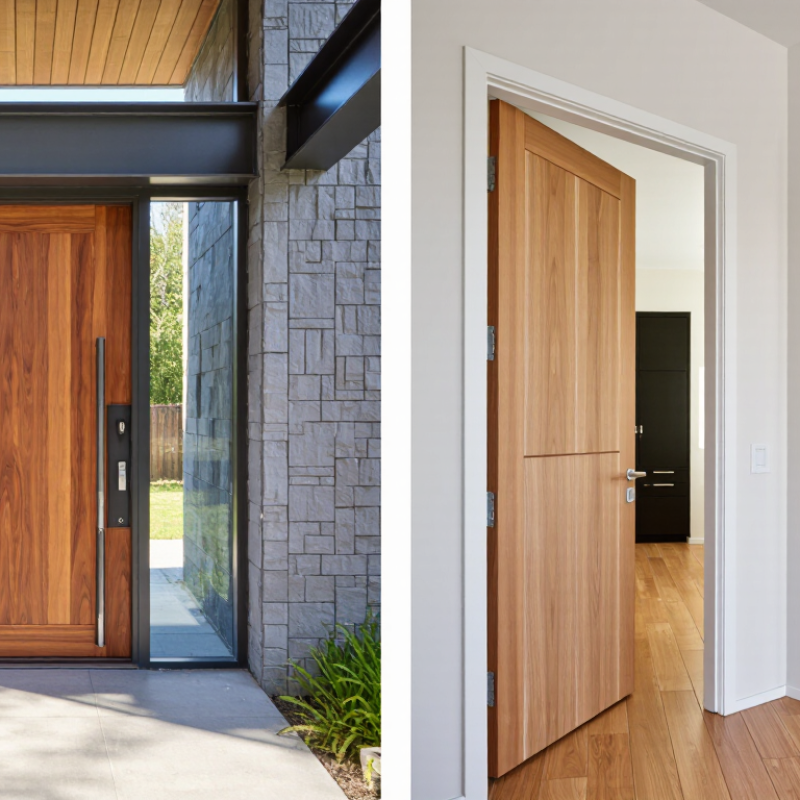
A door should match the way a room is used, not just its style. For a busy hallway, a solid-core wooden door can help soften everyday noise and feel more substantial under repeated use. A lightweight hollow-core option may suit a quiet closet, where sound control matters less. Exterior doors face a tougher mix: rain, sun, temperature swings, and frequent opening. Species, construction, protective finish, and the quality of the frame all affect performance. There is no single best choice.
Location can change the decision. The USDA Forest Products Laboratory’s Wood Handbook (FPL-GTR-282, 2021) reports that, at 70°F, wood’s equilibrium moisture content is about 6% at 30% relative humidity and about 20% at 90%. That difference matters: changing moisture can make wood move, so a door in a humid entry may need careful detailing and regular finish checks. This is easy to overlook. A specification alone cannot prevent problems caused by poor installation or neglected maintenance.
Tips: Check the room’s traffic, privacy, and moisture exposure before choosing. Ask how the door is built, and confirm that its finish suits the location. Leave room in the budget for installation; that part is easy to underestimate.

Wooden doors are built in several ways, and the construction affects weight, stability, sound control, and repair options. Solid-wood panel doors use joined boards or panels and show natural grain, but seasonal movement can loosen joints or create sticking. The USDA Forest Products Laboratory’s Wood Handbook places fiber saturation near 30% moisture content for many species. Below that point, wood dimensions change as moisture levels shift. That matters near damp bathrooms, exterior walls, and unconditioned entryways.
Stile-and-rail doors have vertical stiles, horizontal rails, and inset panels. Their frame-and-panel design allows movement while keeping the door visually detailed. Flush doors instead use flat faces over a core: hollow-core versions are lighter, while solid-core versions feel heavier and generally offer better sound reduction. Engineered cores can also improve dimensional stability, though quality varies by materials and assembly. Look closely at the edges. That is where weak bonding may show. For a high-traffic room, a solid core may be worth its weight; for a closet, hollow core can be practical. I still find the choice less obvious in humid homes. Installation gaps, finish quality, and indoor moisture can matter as much as the door’s label.
Wood species shape a door’s grain, color, weight, and response to humidity. Oak offers pronounced grain and a strong visual pattern; maple has a finer, quieter surface, while walnut brings a naturally darker tone. These differences show most clearly under clear finishes. Stains can deepen color, but may look uneven across boards, so test a sample first. Small details count.
The USDA Forest Products Laboratory’s Wood Handbook (2010) reports white oak shrinkage of about 5.6% radially and 10.5% tangentially, from green to oven-dry condition. These figures describe major moisture loss, not normal indoor door movement, but they illustrate why stable moisture and careful construction matter.
A well-sealed finish slows moisture exchange; it does not stop it. For a painted door, maple or a paint-grade wood can provide a smoother base, while a clear finish suits expressive grain. Flush designs feel spare; stile-and-rail panels add depth and shadow. Glass inserts can brighten a hallway, though they reduce privacy.
I would still compare full-size samples in the project’s actual light. A sample can surprise you.
A door’s location matters more than its style. For bedrooms, studies, and hallways, solid-core wooden doors offer better sound control and a substantial feel. Hollow-core doors are lighter and often suit closets or low-traffic rooms, though they provide less privacy. For bathrooms and laundry rooms, look for a suitable protective finish and keep the door edges sealed. Repeated moisture can still cause swelling.
Exterior doors face rain, sun, and changing temperatures. A well-built solid-wood door can work well under a covered entry, but it needs regular finish checks. Engineered wood constructions may offer greater dimensional stability, depending on their materials and build. Add a proper threshold, weatherstripping, and careful installation; even a good door can let drafts through if the frame is poorly fitted. I’d also consider how much direct afternoon sun the doorway gets. That detail is easy to overlook.
Tips: Match the door to its exposure, not just its room. Check the manufacturer’s care guidance, inspect edges and joints, and maintain exterior finishes before bare wood appears. When in doubt, ask an experienced installer to assess the opening and local conditions.
Typical fit for interior and exterior applications
Solid-core doors are commonly suited to interior rooms where added mass is useful, while hollow-core doors are a lightweight interior option. Solid wood and some engineered wood doors can be used outside when designed and finished for weather exposure. Scores are a qualitative selection guide, not product test results; exterior suitability depends on construction, finish, and installation.
Wooden doors differ in purchase price, upkeep, and how well they handle moisture. Hollow-core doors usually cost less and suit dry interior rooms, but they offer less impact resistance. Solid-wood doors feel substantial and can be repaired, though exposed finishes need periodic inspection and renewal. Engineered-wood doors often provide a steadier middle ground: layered construction can reduce movement, but edge damage still needs prompt sealing. One trade-off is easy to miss.
The USDA Forest Products Laboratory’s 2021 Wood Handbook reports total shrinkage of roughly 6% to 17% across wood species, from green to oven-dry condition. That is lumber data, not a service-life prediction for finished doors, but it explains why humidity and exposed end grain matter. For an exterior opening, check the sill, bottom edge, and finish after wet seasons; small coating failures can invite swelling and sticking. In a sheltered interior, maintenance demands are usually lighter. Still, local climate and installation quality can outweigh species choice.
Compare the full cost, not just the invoice: include finishing, hardware, weatherstripping, and future touch-ups. A painted engineered door may be practical where rain hits hard; a well-protected solid-wood door may suit a sheltered entry. Neither choice is maintenance-free. Ask suppliers for construction details and finish-care guidance, then check whether repairs are feasible before choosing.
| Door Type | Typical Material Cost | Maintenance | Long-Term Durability | Moisture Considerations | Best Suited For |
|---|---|---|---|---|---|
| Solid Hardwood Made from hardwood boards or panels. | About $200–$1,000+ per interior door slab. | Inspect the finish periodically; sand and refinish when worn. Keep the door sealed and promptly repair scratches or finish damage. | High when well-made and maintained. Can be repaired and refinished, but may dent, warp, or move with changes in humidity. | More vulnerable to swelling and movement in damp or changing conditions. Use an appropriate finish and avoid prolonged exposure to water. | Projects prioritizing natural wood appearance, repairability, and a premium feel. |
| Solid Softwood Typically made from species such as pine or fir. | About $100–$500 per interior door slab. | Paint or seal exposed surfaces; touch up dents and scratches as needed. Softwood often benefits from a durable protective finish. | Moderate to high, depending on construction and care. It is generally easier to dent than many hardwoods but can be repaired and refinished. | Can swell, shrink, or warp as humidity changes. Sealing all faces and edges helps reduce moisture-related movement. | Painted interiors, traditional designs, and projects seeking a natural-wood door at a lower cost than many hardwood options. |
| Engineered Wood with Wood Veneer An engineered core covered with a real-wood veneer. | About $150–$600 per interior door slab. | Clean gently and protect the veneer from deep scratches and excess moisture. Refinishing options depend on veneer thickness. | Often more dimensionally stable than solid wood, but surface damage can be harder to repair if the veneer is thin. | The engineered core can be stable, but water may damage the veneer or edges. Keep surfaces and joints protected. | Projects seeking the appearance of real wood with more consistent construction and less movement than many solid-wood doors. |
| Solid-Core Composite with Wood Veneer or Finish A dense composite core with a decorative wood surface. | About $100–$500 per interior door slab. | Usually requires routine cleaning and occasional touch-ups. Avoid abrasive cleaners and protect the surface from chips. | Generally sturdy and offers better sound reduction than hollow-core doors. Damaged skins may be difficult to restore seamlessly. | Core and surface performance vary by product. It is not automatically suitable for wet areas; check the door’s moisture rating. | Bedrooms, bathrooms, and other interior spaces where a substantial feel and improved sound control are priorities. |
| Hollow-Core Molded Wood-Fiber Molded wood-fiber skins over a lightweight internal frame. | About $50–$200 per interior door slab. | Clean gently and repair small surface marks with care. The thin skin can be damaged by impacts and may not tolerate extensive sanding. | Low to moderate. Lightweight construction is suitable for everyday interior use but is less resistant to impacts than solid-core options. | Keep away from standing water and persistent dampness; the skin and edges can be damaged by moisture. | Budget-conscious interior projects, closets, and low-traffic areas where sound insulation is not a major requirement. |
Cost note: Prices are broad, indicative U.S. material-only estimates for standard interior door slabs. They exclude installation, hardware, finishing, and any frame or trim; actual prices vary by size, construction, wood species, finish, and location. For exterior doors or damp locations, verify that the specific door is rated for the intended use.


For those larger-sized parts, or smaller quantity runs, we have 2 independent powder coat booths and ovens. The quality, durability and affordability of today’s powder coating finishes make this the process of choice for world-class companies.
Powder coating advantages over other forms of coating are many. Materials used in the Powder coating process can be metals and non-metals that come in a multitude of thicknesses, textures, colors, etc. Another of Powder coating’s biggest advantages over conventional coatings is its ability to create finishes in many different textures. Powder Coating Booths allow us the ability to apply these advantages to large products.
Tri-State Fabricators runs a full-service conveyor line for painting. Wet painting can provide protection or decoration to many different part styles. From start to finish, every project is easier to undergo random and point-based inspection by our skilled painting team.
Advantages to our Wet Paint Line are these lines start with product prep and ends with a thorough inspection of a high quality finished product. Our ability to complete large and small projects with a superior finish and doing so in a timely and economical fashion. This passes along the savings in production to our customers. When powder coating ins not an option, our Wet Paint Line gets the job done right the first time.
When the parts get big and heavy we roll-out our custom paint racks and oversize booth. By utilizing our partnerships with all the major paint brands, we can match virtually any color with wet paint.
The advantages of having access to a Wet Paint Booth are many. Large projects of many different shapes can be loaded into the booth. The Wet Paint Booth offers an environment that is much more controlled than a typical parts painting operation.
Not only are they used because of their controlled environment, but they’re are also advantageous when it comes to applying paint to parts that are needed in industries that require specialty coatings such as medical, aerospace, etc.
Our military forces have some very high standards when it comes to the finish of their vehicles and equipment. From the first pre-treatment step to final coat, it takes a great deal of knowledge and experience to protect the men and women of our armed forces. They deserve only the best, and Tri-State Fabricators provides it.
All of our processes are closely monitored by our staff and management teams. Both of which are highly trained in the processes of metal fabrication and finishing. Tri-State Fabricators’ goal is to always fully satisfy each and every customer, including the military. We will always put a 110% into what we do.
Abrasive media blasting is an excellent way to remove old paint, rust, and increase the paint/powder adhesion. Glass beads produce a much smoother and brighter finish than angular abrasives; leaving the part clean yet without any dimensional change. Chemically inert and environmentally friendly, we can recycle our beads approximately 30 times; making them a more preferred method of metal cleaning or surface finishing.
Advantages to Glass Bead Blasting are many. Glass bead blast media is used when a project is needing rough surfaces need to become smooth for applications of coatings such as paint. It is typically used to clean paint and rust from a product surface without deforming the surface it is being used on. Overall, compared to many other blasting media, Glass Bead Blasting is a very economical choice and those savings are always passed on to our customers.
Tri-State Fabricators utilize a zinc phosphate wash to clean and etch the material to ensure the best paint adhesion possible. The unique design of our 3-stage wash system does the work like a 5-stage. From Cleaning and rinsing to conversion coating and post-treatment, Our Part Washing process is a complete service and works throughout the fabrication service and the finishing service.
Along with the previously mentioned benefits, Curing is a vital chemical reaction that leaves the product finish hard and relatively safe from mild abrasion and aggressive corrosion. This process can be done in more than one way; ambient air-dry or in curing ovens at temps that exceed 240°.
From fixing paint mistakes (someone else’s of course) to simply cleaning our paint line hooks, our burn-off oven is put to good use. After a quick burn-off, a little clean up, and a fresh coat of paint, your parts will look better than new.
Why does our Burn-Off Oven work so well? Because super heating the air around parts turns the materials into ashes. From paint and powder coatings to rubber and machining oils, high temps do the job without degrading the integrity of the part.
Masking is a vital part of producing high quality products. We have die-cut masking patterns to protect machined surfaces as well as a wide range of plugs and caps to protect threaded holes and bolts. We provide permanent and temporary masking.
Masking allows the selected sections of a product to be protected from a fabrication or finishing service. This can be with both chemicals when etching and tapes, paints when only finishing just a section of the product. Masking is great in aiding the customization process of a project.
Screen printing is a photographic process that transfers artwork onto a porous nylon screen which allows colored ink to flow through the screen and be deposited on an aluminum or plastic component. We can generally have just about any design created onto a screen for your parts.
Some of the advantages of Screen Printing are, brand recognition for your business displaying on your products, assembly instructions, product warnings/hazards, etc. Tri-State Fabricators produces Screen Printing of the highest quality so you know it’s durable.
Metal Finishing is the art of treating the exterior portion of product, often metal but can also be made of other materials, so that the surface is clean and free of any debris. Then the process of applying coats or either paint of powder coat takes place. This coating process improves the quality of the product in both appearance and resistance to wear and corrosion.
Tri-State Fabricators, Inc., understands that a project typically isn’t complete until a high-quality finish has been added to your product. This is why our painting and powder coating teams continuously inspect the products throughout the Metal Finishing process.

