What Is the Best Wheel Diamond Cutting Machine in 2026?

What makes the best Wheel Diamond Cutting Machine in 2026? The answer depends on the wheels, workload, and finish you need—not a bold claim on a product page. A shop repairing alloy rims may value repeatable cuts and easy setup. A production line may prioritize cycle time, rigid clamping, and service access. Small details matter. A clean coolant path, readable controls, and stable workholding can affect daily results as much as headline power.

This guide compares machines through practical criteria: cutting accuracy, compatible wheel sizes, spindle performance, adjustment range, workflow, safety features, and maintenance demands. It also considers whether manufacturers provide clear specifications, training, spare parts, and responsive technical support. Look for evidence you can verify, such as stated tolerances, sample finishes, and a demonstration on a wheel similar to yours. Specs can still leave questions. Published accuracy may depend on setup, operator skill, or material condition, and those limits deserve attention. We will separate useful claims from vague marketing language and explain which trade-offs matter for different shops. There is no single winner for every buyer. The right choice is the machine that meets your workload, fits your budget, and produces consistent results without making routine service a struggle. A careful comparison beats a flashy brochure.

What Is the Best Wheel Diamond Cutting Machine in 2026?

What Is a Wheel Diamond Cutting Machine?

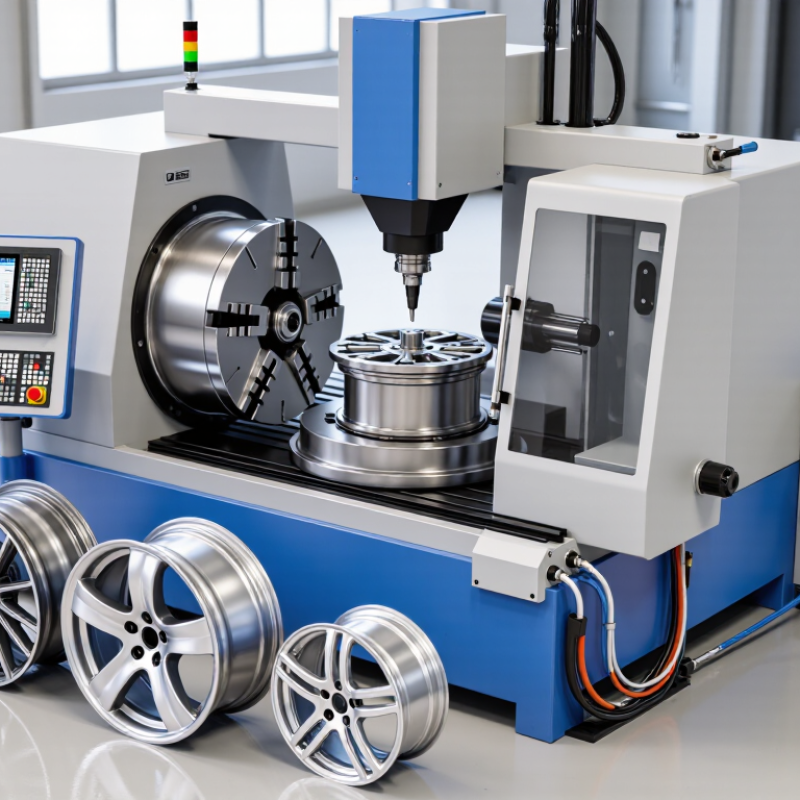
A wheel diamond-cutting machine is a CNC lathe that refines the visible face of an alloy wheel with a diamond-tipped cutting tool. The wheel is clamped and rotated while the tool removes a very thin layer of metal, creating precise grooves and a bright, machined finish. The machine is not cutting diamonds; diamond describes the tool’s hard cutting edge. That distinction matters.

A touch probe can map the wheel’s contours before cutting, helping the machine follow curved spokes and avoid uneven depths. Coolant and chip removal also matter: fine aluminum swarf can mark a finished surface if it is not cleared. The U.S. Geological Survey’s Mineral Commodity Summaries 2024 estimated global synthetic industrial-diamond production at about 16 billion carats in 2023. That figure describes the tool-material supply, not machine accuracy or finish quality. A bright cut is not automatically better. It removes metal, and the remaining coating and wheel condition affect durability. Even skilled setup has limits. A deep scratch or damaged spoke may not disappear safely with another pass.

How Does a Wheel Diamond Cutting Machine Work?

What Is the Best Wheel Diamond Cutting Machine in 2026?
How Does a Wheel Diamond Cutting Machine Work?

A wheel diamond cutting machine restores the bright, finely lined face of a compatible alloy wheel. The wheel is centered and clamped on a rotating spindle. A diamond-tipped cutting tool then moves across the face, removing a very thin layer of metal. The machine follows the wheel’s shape, often using a programmed path to guide the cutter. Tiny, even grooves catch the light and create the familiar machined finish. It is careful work, not a quick polish.

Tips: Check the wheel for cracks or bends before cutting. Confirm it is suitable for machining, and use the correct wheel profile and secure clamping. Keep the work area clear of chips. A small setup error can leave uneven lines.

Cut depth, spindle stability, and accurate measurement all affect the result. Operators may use a probe to map the face before cutting, then inspect the finish and wheel runout afterward. Follow the machine maker’s operating instructions and use suitable guards and eye protection. Coolant or other chip-control methods depend on the machine and cutting process. Not every wheel can safely be cut again; repeated machining removes material, so limits matter. Even experienced operators can miss a subtle flaw, which is why inspection should never be skipped.

How a Wheel Diamond Cutting Machine Works

A diamond cutting tool removes a thin layer from the face of a rotating alloy wheel. This chart shows the theoretical rim surface speed for common wheel diameters at a constant 100 rpm, calculated as circumference × rotations per minute. In practice, the machine’s speed and feed settings must follow the wheel, tool, and equipment specifications.

Which Machine Types and Features Matter Most?

What Is the Best Wheel Diamond Cutting Machine in 2026?

The right machine depends on wheel size, finish requirements, and daily production volume. A dedicated CNC wheel-cutting machine suits repeat work across common wheel designs. A flexible CNC lathe may fit shops handling varied parts, but setup can take longer. Neither type is automatically better.

Look for a rigid spindle, stable fixturing, and enough axis travel for the largest wheel you expect to process. Check how the machine handles tool paths, depth control, and repeatable positioning. A clear measurement routine helps operators compare the cut with the wheel’s original surface. Small errors show quickly on bright, machined faces. That matters.

Ask for a cutting demonstration on a representative wheel, not just a polished sample. Inspect the finish under angled light, and listen for vibration during the cut. Confirm that guards, chip management, and maintenance access suit your workshop. Software and operator training deserve attention too. They are easy to overlook. A machine that runs well in a short trial may still need careful tuning across different wheel shapes. I would leave room in the budget for tooling, setup time, and support; the quoted machine price rarely tells the whole story.

What Is the Best Wheel Diamond Cutting Machine in 2026? — Which Machine Types and Features Matter Most?

Machine Type How It Works Measurement and Programming Best Suited For Main Trade-Off Features to Check
Manual or semi-automatic wheel lathe The operator sets up the wheel and controls some or all cutting movements. The wheel rotates while a diamond tool removes a thin layer from the face. Typically relies more on operator measurement, setup, and judgment; automation varies by machine. Low-volume workshops and operators who need a simpler entry point into wheel refinishing. Results and setup time can depend heavily on operator skill and consistent procedures. Rigid wheel clamping, repeatable tool adjustment, clear controls, guarding, and compatible wheel adapters.
CNC wheel lathe with contact probing CNC-controlled cutting follows a programmed path. A contact probe can measure wheel-face geometry to help establish the cutting profile. Probe measurements support setup and path generation; the operator may still need to verify the scan and select appropriate cutting parameters. Shops seeking repeatable CNC machining across a range of wheel designs. Contact measurement depends on probe access, correct setup, and suitable software; it does not assess hidden structural damage. Probe repeatability, usable software, editable cutting paths, emergency stop, interlocked guarding, and service access.
CNC wheel lathe with optical or laser scanning A non-contact sensor records accessible surface geometry. Software uses the captured profile to help generate a machining path. Can capture complex visible profiles without the probe physically touching the measured surface; results depend on calibration and surface visibility. Workshops handling varied designs or seeking more automated profile capture. Reflective, dirty, or obstructed surfaces can affect measurement. Scanning is not a crack-detection or structural-inspection method. Scan coverage, calibration process, profile preview, path-editing options, data storage, and compatibility with the wheel range being processed.
Automated CNC production cell Combines CNC cutting with added workflow automation, such as programmed setup routines or integrated handling equipment, depending on configuration. Automation may reduce repeated manual steps, but the operator still needs to confirm wheel condition, fixturing, and the selected program. Higher-throughput operations with stable processes and trained staff. Higher equipment and integration requirements; automation does not remove the need for inspection or correct setup. Cycle-time documentation, safe loading access, changeover process, fault recovery, maintenance support, and integration requirements.
General-purpose CNC lathe adapted for wheel work A standard CNC lathe is configured with suitable wheel-holding fixtures and tooling rather than being designed specifically for wheel refinishing. Measurement and programming depend on the lathe, fixtures, and added systems; a dedicated wheel-scanning workflow may not be included. Facilities with existing CNC expertise that can validate a wheel-specific setup. Fixture design, wheel clearance, guarding, and software workflow require careful engineering and validation. Spindle and work-envelope suitability, secure purpose-designed fixtures, guarding, tool access, and a validated machining procedure.

Selection note: There is no single best machine for every shop. Confirm that the machine and fixtures cover the wheel sizes and profiles you handle, and compare the complete workflow—not just the cutting unit. Diamond cutting removes material, so repeated refinishing can reduce the remaining face material. Inspect wheels for suitability before machining; scanning alone does not establish structural integrity.

How to Compare Performance, Precision, and Cost in 2026

What Is the Best Wheel Diamond Cutting Machine in 2026?

How to Compare Performance, Precision, and Cost in 2026

In 2026, the best wheel diamond cutting machine is not simply the fastest model. Compare its performance on the wheel types your shop actually receives. Ask for a demonstration using a sample alloy wheel, then inspect the finish under direct light. Look for even machining, clean transitions, and minimal chatter marks. Small flaws show up quickly.

Precision depends on more than a sharp diamond tool. Check spindle runout, clamping stability, probe repeatability, and whether the control system can reproduce a saved profile. Request repeat cuts on the same wheel, then compare measurements at several points across its face. A glossy result can hide uneven material removal. Ask how the machine handles curved spokes and narrow pockets, where access and consistency become harder. No brochure proves that.

Cost should include installation, operator training, tooling, maintenance, and expected downtime—not only the purchase price. Compare cycle times using the same wheel design and finish standard, rather than accepting headline figures. Review service response times and replacement-part availability. If possible, run a trial with your own workload. I would still leave room for judgment: unusual wheel damage can make any estimate imperfect.

How to Choose a Machine for Your Wheel Refinishing Needs

Choosing a wheel diamond cutting machine starts with the work you actually receive. Check the wheel diameter range, face width, and damage types you handle most often. A machine that fits common passenger wheels may not suit larger or unusually shaped rims. Measure a few frequent jobs before comparing specifications.

Precision matters, but repeatability matters just as much. Look for stable clamping, clear tool-depth controls, and a spindle that runs smoothly. Ask for a demonstration using a wheel similar to yours. Watch how the operator aligns it, sets the cut, and checks the finish under direct light. Small setup differences can leave visible rings or remove more material than intended. That matters.

Consider daily workflow, too. A readable interface and quick changeover can save time across several wheels. Check what training, maintenance guidance, and service support are available, along with the cost of tooling and routine upkeep. If possible, test the machine on a typical refinishing job before committing. One detail is easy to overlook: shop lighting and operator habits affect inspection, even with accurate equipment. No specification sheet captures every real-world limitation, so leave room to reassess after a few weeks of use.

Powder Coat Booths

For those larger-sized parts, or smaller quantity runs, we have 2 independent powder coat booths and ovens. The quality, durability and affordability of today’s powder coating finishes make this the process of choice for world-class companies.

Powder coating advantages over other forms of coating are many. Materials used in the Powder coating process can be metals and non-metals that come in a multitude of thicknesses, textures, colors, etc. Another of Powder coating’s biggest advantages over conventional coatings is its ability to create finishes in many different textures. Powder Coating Booths allow us the ability to apply these advantages to large products.

Wet Paint Line

Tri-State Fabricators runs a full-service conveyor line for painting. Wet painting can provide protection or decoration to many different part styles. From start to finish, every project is easier to undergo random and point-based inspection by our skilled painting team.

Advantages to our Wet Paint Line are these lines start with product prep and ends with a thorough inspection of a high quality finished product. Our ability to complete large and small projects with a superior finish and doing so in a timely and economical fashion. This passes along the savings in production to our customers. When powder coating ins not an option, our Wet Paint Line gets the job done right the first time.

Wet Paint Booths

When the parts get big and heavy we roll-out our custom paint racks and oversize booth. By utilizing our partnerships with all the major paint brands, we can match virtually any color with wet paint.

The advantages of having access to a Wet Paint Booth are many. Large projects of many different shapes can be loaded into the booth. The Wet Paint Booth offers an environment that is much more controlled than a typical parts painting operation.

Not only are they used because of their controlled environment, but they’re are also advantageous when it comes to applying paint to parts that are needed in industries that require specialty coatings such as medical, aerospace, etc.

Military CARC

Our military forces have some very high standards when it comes to the finish of their vehicles and equipment. From the first pre-treatment step to final coat, it takes a great deal of knowledge and experience to protect the men and women of our armed forces. They deserve only the best, and Tri-State Fabricators provides it.

All of our processes are closely monitored by our staff and management teams. Both of which are highly trained in the processes of metal fabrication and finishing. Tri-State Fabricators’ goal is to always fully satisfy each and every customer, including the military. We will always put a 110% into what we do.

Glass-Bead Blasting

Abrasive media blasting is an excellent way to remove old paint, rust, and increase the paint/powder adhesion. Glass beads produce a much smoother and brighter finish than angular abrasives; leaving the part clean yet without any dimensional change. Chemically inert and environmentally friendly, we can recycle our beads approximately 30 times; making them a more preferred method of metal cleaning or surface finishing.

Advantages to Glass Bead Blasting are many. Glass bead blast media is used when a project is needing rough surfaces need to become smooth for applications of coatings such as paint. It is typically used to clean paint and rust from a product surface without deforming the surface it is being used on. Overall, compared to many other blasting media, Glass Bead Blasting is a very economical choice and those savings are always passed on to our customers.

Part Washing

Tri-State Fabricators utilize a zinc phosphate wash to clean and etch the material to ensure the best paint adhesion possible. The unique design of our 3-stage wash system does the work like a 5-stage. From Cleaning and rinsing to conversion coating and post-treatment, Our Part Washing process is a complete service and works throughout the fabrication service and the finishing service.

Along with the previously mentioned benefits, Curing is a vital chemical reaction that leaves the product finish hard and relatively safe from mild abrasion and aggressive corrosion. This process can be done in more than one way; ambient air-dry or in curing ovens at temps that exceed 240°.

Burn-Off Oven

From fixing paint mistakes (someone else’s of course) to simply cleaning our paint line hooks, our burn-off oven is put to good use. After a quick burn-off, a little clean up, and a fresh coat of paint, your parts will look better than new.

Why does our Burn-Off Oven work so well? Because super heating the air around parts turns the materials into ashes. From paint and powder coatings to rubber and machining oils, high temps do the job without degrading the integrity of the part.

Masking

Masking is a vital part of producing high quality products. We have die-cut masking patterns to protect machined surfaces as well as a wide range of plugs and caps to protect threaded holes and bolts. We provide permanent and temporary masking.

Masking allows the selected sections of a product to be protected from a fabrication or finishing service. This can be with both chemicals when etching and tapes, paints when only finishing just a section of the product. Masking is great in aiding the customization process of a project.

Screen Printing

Screen printing is a photographic process that transfers artwork onto a porous nylon screen which allows colored ink to flow through the screen and be deposited on an aluminum or plastic component. We can generally have just about any design created onto a screen for your parts.

Some of the advantages of Screen Printing are, brand recognition for your business displaying on your products, assembly instructions, product warnings/hazards, etc. Tri-State Fabricators produces Screen Printing of the highest quality so you know it’s durable.

Metal Finishing

Metal Finishing is the art of treating the exterior portion of product, often metal but can also be made of other materials, so that the surface is clean and free of any debris. Then the process of applying coats or either paint of powder coat takes place. This coating process improves the quality of the product in both appearance and resistance to wear and corrosion.

Tri-State Fabricators, Inc., understands that a project typically isn’t complete until a high-quality finish has been added to your product. This is why our painting and powder coating teams continuously inspect the products throughout the Metal Finishing process.