


7 Best Weather Station Humidity Sensors for Buyers

A Weather Station Humidity Sensor can turn a backyard setup into a useful record of changing air conditions. But the number on the display is only a starting point. A sensor mounted beside a warm wall may report differently from one placed in a shaded, ventilated enclosure. Small details matter.

Meteorological observing-systems specialist David Berry’s guidance can be paraphrased this way: sensor exposure and maintenance are essential to trustworthy readings. This guide compares seven options with practical buyer questions in mind. We consider stated accuracy, response time, operating range, compatibility, and replacement availability. A tight accuracy specification looks appealing, but it does not guarantee consistent results in poor placement or after years of exposure. Look for clear calibration guidance, too.

The right choice depends on your station and your habits. Do you need a simple replacement probe, or a sensor that connects to a specific console? Will it face strong sun, frost, or driving rain? Check the manufacturer’s installation limits before buying. Also consider how easy the sensor is to inspect and replace. No model removes every uncertainty. Even a well-made instrument can drift, and that is easy to overlook. The selections ahead help buyers compare useful features without treating a product rating as a substitute for careful setup.
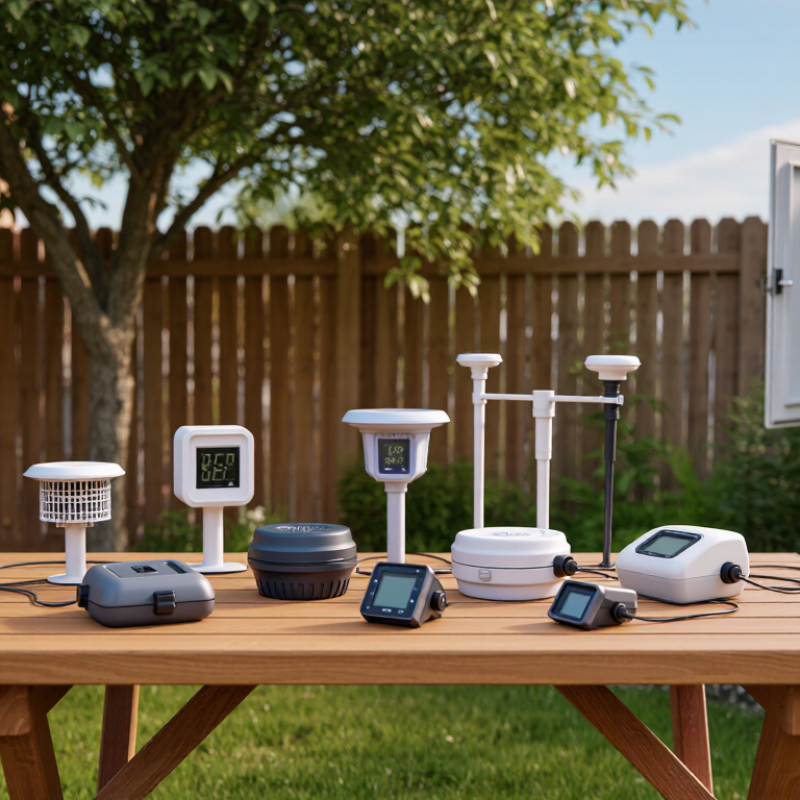
7 Best Weather Station Humidity Sensors for Buyers

How Weather Station Humidity Sensors Measure Moisture

Most weather-station humidity sensors measure relative humidity, not the total amount of water vapor in the air. A common sensor uses a thin, moisture-sensitive polymer. Water molecules enter the material and change its electrical capacitance. The station’s circuit converts that change into a humidity percentage. Simple idea. The percentage describes how close the air is to saturation at its current temperature.

Temperature matters. Many stations read temperature beside humidity and use it to improve the displayed result. A sensor in direct sun, near a warm wall, or exposed to rain may give misleading readings. Protective screens reduce sunlight and splashes while allowing air to pass through. Some models use resistive elements instead of capacitive ones, but both need stable airflow and sensible placement. Even careful readings are not perfect; dust, aging, and rapid weather changes can create small errors.

Tips: Mount the sensor in a shaded, ventilated spot, away from vents and paving that heats up. Check it against a trusted reference occasionally, and note unusual readings before adjusting anything. Don’t clean the sensing element with solvents or poke it. A few minutes of patience helps.

7 Best Weather Station Humidity Sensors for Buyers – How Weather Station Humidity Sensors Measure Moisture

Sensor option How it measures moisture Typical measurement range Typical accuracy Typical response time Best suited to Buyer considerations
Outdoor capacitive probe Water vapor changes the electrical capacitance of a moisture-sensitive polymer film; electronics convert that change to relative humidity (RH). Typically 0–100% RH About ±2–3% RH near room temperature About 8–30 seconds General-purpose outdoor weather stations A common balance of accuracy, power use, and cost. Check temperature compensation and the recommended calibration interval.
Shielded capacitive sensor Uses the same capacitive polymer principle, with a radiation shield that helps limit direct sun and rain exposure around the sensing element. Typically 0–100% RH About ±2–5% RH, depending on the sensor and conditions About 10–60 seconds, depending on airflow Standard outdoor installations exposed to sun and changing weather The shield and its ventilation affect readings; install it in a well-exposed location away from walls and heat sources.
Aspirated capacitive sensor A small fan draws ambient air across a capacitive RH element, helping the sensor track air conditions rather than the temperature of its housing. Typically 0–100% RH About ±2–3% RH for many configurations Often about 5–20 seconds Sites where fast response and reduced solar-heating error matter Fan power, maintenance, and protection from dust or insects should be considered.
Heated capacitive probe A polymer-capacitance element is warmed to reduce condensation or frost; the instrument uses the element temperature and sensor output to derive ambient moisture conditions. Usually 0–100% RH within the specified operating conditions Often about ±2–5% RH; performance depends on the measurement method Typically tens of seconds to several minutes Cold, wet, or icing-prone environments Heating uses extra power. Confirm that the instrument reports ambient RH rather than RH at the warmed sensor surface.
Resistive polymer sensor Absorbed water changes the electrical resistance of a hygroscopic material; the electronics use that resistance change to estimate RH. Commonly 10–95% RH, depending on design About ±3–5% RH for typical low-cost devices About 10–60 seconds Budget stations and applications where moderate accuracy is sufficient Check long-term drift, temperature dependence, and recovery after exposure to condensation.
Chilled-mirror dew-point sensor A mirror is cooled until condensation first forms on its surface. That temperature is the dew point, which can be used with air temperature to calculate RH. Dew-point range depends on the instrument; RH can be calculated from dew point and air temperature Often around ±0.1–0.2°C dew point for precision instruments Typically tens of seconds to several minutes Reference measurements and calibration work Usually more expensive and maintenance-intensive than polymer sensors; mirror cleanliness is important.
Aspirated wet-and-dry-bulb psychrometer Measures the temperature difference between a dry bulb and a water-wetted bulb in moving air; a psychrometric calculation estimates RH. Broadly usable across ordinary atmospheric conditions when properly operated About ±2–5% RH with suitable thermometers, airflow, and technique About 30–120 seconds, depending on airflow and conditions Manual observations and comparison checks Requires clean water, a maintained wick, adequate airflow, and correct calculations; less convenient for unattended stations.

Typical figures are indicative ranges, not guarantees for a specific instrument. Accuracy and response time vary with temperature, airflow, calibration, sensor condition, and the manufacturer’s stated test conditions.


Sensor Types and Features That Shape Accuracy

Humidity-sensor type affects more than the number shown on a weather-station display. Capacitive sensors detect moisture-related changes in a polymer film and suit continuous outdoor monitoring. Resistive sensors measure changes in electrical resistance, but contamination and aging can shift readings. Chilled-mirror instruments measure dew point directly and are useful references, though they are usually too complex for a compact home station. Small differences matter. A sensor mounted beside a warm wall may report different humidity from one in a shaded, ventilated shelter.

The World Meteorological Organization’s Guide to Instruments and Methods of Observation sets 1% RH resolution and 3% RH uncertainty as surface-observation targets. These are useful benchmarks, not guarantees for every consumer device. Look for a stated accuracy range, operating-temperature limits, and calibration guidance. Temperature compensation matters because a sensor’s response can change as the day heats up. So does placement. Keep the sensor away from direct sun, roof runoff, and exhaust vents; allow air to circulate around its shield. Compare readings with a trusted reference during stable conditions, and record any consistent offset. That check is easy to skip. It is also where a tidy specification sheet can meet messy outdoor reality.

7 Best Weather Station Humidity Sensors: Accuracy by Sensor Type

Representative humidity-accuracy specifications found across sensor datasheets. Lower values indicate smaller stated error; actual performance depends on the specific model, temperature, calibration, and operating conditions.

For outdoor stations, compare accuracy across the humidity and temperature ranges you expect, and check for calibration guidance, weather protection, and long-term stability—not accuracy alone.

Seven Weather Station Humidity Sensors Compared

Comparing seven weather station humidity sensors means looking beyond the numbers printed on a package. Check the stated accuracy, operating range, update interval, and compatibility with your station. A sensor rated within ±2% relative humidity may suit household tracking, but placement still matters. Near a damp wall, readings can drift. In direct sun, the enclosure may warm and distort results. Small details count.

Look for a protective screen, clear calibration instructions, and a replacement path if the sensor fails. Some units respond quickly to changing air; others update more slowly, which can hide a brief humidity spike after rain. For outdoor use, inspect how the housing handles wind-driven moisture and freezing conditions. For indoor use, a compact sensor may fit near a plant shelf, though leaves can trap damp air around it. Compare all seven candidates under the same criteria, and check independent test methods when available. Specs alone are not proof. I’d also admit a limitation: without side-by-side testing in the same room, rankings can overstate small differences. A simple log beside a reference instrument can reveal whether readings stay consistent over several days.

How to Match a Sensor to Your Weather Station

A humidity sensor is useful only when your weather station can read it. Check the station manual for compatible sensor types, wireless frequency, connector style, and supported data formats. Similar-looking sensors may use different signals. They may not pair at all.

Then compare the sensor’s range and accuracy with your needs. For garden monitoring, readings across 20–90% relative humidity may be enough. A greenhouse or storage area may need dependable readings closer to saturation. Check whether the station allows calibration offsets; even a small adjustment can help align readings with a trusted reference. Look for clear specifications, not just a broad “high accuracy” claim. Details matter.

Placement matters, too. A sensor mounted in direct sun or beside a damp wall can report misleading humidity. Use a ventilated radiation shield outdoors, and keep the sensor away from sprinklers and roof runoff. Indoors, avoid vents and cooking areas. Check battery life and replacement availability before buying. Small details.

I would still verify the exact station model before ordering, even when a listing says “universal.” That label can be vague, and returning a sensor wastes time. One imperfect point: sensor accuracy may drift with age, so compare it periodically rather than trusting one good reading forever.

Installation, Calibration, and Ongoing Care

Mount the humidity sensor in a shaded, ventilated spot, away from walls, roof edges, sprinklers, and dryer vents. Direct sun can heat the housing and distort readings. Keep the sensor at the height recommended for your station, with its openings unobstructed. A reading can look precise while still reflecting a poor location. Small placement changes matter.

Calibrate the sensor according to its instructions, and let it settle after moving or adjusting it. For a useful check, compare its reading with a reliable reference instrument kept nearby under similar conditions. Allow both devices time to stabilize. If the difference persists, follow the manufacturer’s adjustment procedure rather than applying a guessed correction. Humidity changes naturally across a yard, so perfect agreement is not always realistic.

Tips: Inspect the shield and vents monthly for dust, cobwebs, or water. Clean gently with a soft, dry cloth; avoid soaking the sensor. Keep notes on calibration dates and unusual readings. A simple log can reveal a gradual drift that one quick check misses. I would still recheck after severe weather, even when the sensor appears fine.

Powder Coat Booths

For those larger-sized parts, or smaller quantity runs, we have 2 independent powder coat booths and ovens. The quality, durability and affordability of today’s powder coating finishes make this the process of choice for world-class companies.

Powder coating advantages over other forms of coating are many. Materials used in the Powder coating process can be metals and non-metals that come in a multitude of thicknesses, textures, colors, etc. Another of Powder coating’s biggest advantages over conventional coatings is its ability to create finishes in many different textures. Powder Coating Booths allow us the ability to apply these advantages to large products.

Wet Paint Line

Tri-State Fabricators runs a full-service conveyor line for painting. Wet painting can provide protection or decoration to many different part styles. From start to finish, every project is easier to undergo random and point-based inspection by our skilled painting team.

Advantages to our Wet Paint Line are these lines start with product prep and ends with a thorough inspection of a high quality finished product. Our ability to complete large and small projects with a superior finish and doing so in a timely and economical fashion. This passes along the savings in production to our customers. When powder coating ins not an option, our Wet Paint Line gets the job done right the first time.

Wet Paint Booths

When the parts get big and heavy we roll-out our custom paint racks and oversize booth. By utilizing our partnerships with all the major paint brands, we can match virtually any color with wet paint.

The advantages of having access to a Wet Paint Booth are many. Large projects of many different shapes can be loaded into the booth. The Wet Paint Booth offers an environment that is much more controlled than a typical parts painting operation.

Not only are they used because of their controlled environment, but they’re are also advantageous when it comes to applying paint to parts that are needed in industries that require specialty coatings such as medical, aerospace, etc.

Military CARC

Our military forces have some very high standards when it comes to the finish of their vehicles and equipment. From the first pre-treatment step to final coat, it takes a great deal of knowledge and experience to protect the men and women of our armed forces. They deserve only the best, and Tri-State Fabricators provides it.

All of our processes are closely monitored by our staff and management teams. Both of which are highly trained in the processes of metal fabrication and finishing. Tri-State Fabricators’ goal is to always fully satisfy each and every customer, including the military. We will always put a 110% into what we do.

Glass-Bead Blasting

Abrasive media blasting is an excellent way to remove old paint, rust, and increase the paint/powder adhesion. Glass beads produce a much smoother and brighter finish than angular abrasives; leaving the part clean yet without any dimensional change. Chemically inert and environmentally friendly, we can recycle our beads approximately 30 times; making them a more preferred method of metal cleaning or surface finishing.

Advantages to Glass Bead Blasting are many. Glass bead blast media is used when a project is needing rough surfaces need to become smooth for applications of coatings such as paint. It is typically used to clean paint and rust from a product surface without deforming the surface it is being used on. Overall, compared to many other blasting media, Glass Bead Blasting is a very economical choice and those savings are always passed on to our customers.

Part Washing

Tri-State Fabricators utilize a zinc phosphate wash to clean and etch the material to ensure the best paint adhesion possible. The unique design of our 3-stage wash system does the work like a 5-stage. From Cleaning and rinsing to conversion coating and post-treatment, Our Part Washing process is a complete service and works throughout the fabrication service and the finishing service.

Along with the previously mentioned benefits, Curing is a vital chemical reaction that leaves the product finish hard and relatively safe from mild abrasion and aggressive corrosion. This process can be done in more than one way; ambient air-dry or in curing ovens at temps that exceed 240°.

Burn-Off Oven

From fixing paint mistakes (someone else’s of course) to simply cleaning our paint line hooks, our burn-off oven is put to good use. After a quick burn-off, a little clean up, and a fresh coat of paint, your parts will look better than new.

Why does our Burn-Off Oven work so well? Because super heating the air around parts turns the materials into ashes. From paint and powder coatings to rubber and machining oils, high temps do the job without degrading the integrity of the part.

Masking

Masking is a vital part of producing high quality products. We have die-cut masking patterns to protect machined surfaces as well as a wide range of plugs and caps to protect threaded holes and bolts. We provide permanent and temporary masking.

Masking allows the selected sections of a product to be protected from a fabrication or finishing service. This can be with both chemicals when etching and tapes, paints when only finishing just a section of the product. Masking is great in aiding the customization process of a project.

Screen Printing

Screen printing is a photographic process that transfers artwork onto a porous nylon screen which allows colored ink to flow through the screen and be deposited on an aluminum or plastic component. We can generally have just about any design created onto a screen for your parts.

Some of the advantages of Screen Printing are, brand recognition for your business displaying on your products, assembly instructions, product warnings/hazards, etc. Tri-State Fabricators produces Screen Printing of the highest quality so you know it’s durable.

Metal Finishing

Metal Finishing is the art of treating the exterior portion of product, often metal but can also be made of other materials, so that the surface is clean and free of any debris. Then the process of applying coats or either paint of powder coat takes place. This coating process improves the quality of the product in both appearance and resistance to wear and corrosion.

Tri-State Fabricators, Inc., understands that a project typically isn’t complete until a high-quality finish has been added to your product. This is why our painting and powder coating teams continuously inspect the products throughout the Metal Finishing process.
