A vibration alarm can arrive while a motor is still turning smoothly. The real question is whether the instrument captured a meaningful change—or merely noise from a loose sensor, poor mounting, or an unsuitable measurement range. Choosing the best Vibration Measuring Device in 2026 therefore starts with the machine, the fault you need to detect, and the person who must interpret the results. A handheld meter may suit quick route checks. A permanently installed sensor may be better for assets that are difficult to reach or costly to stop.
The U.S. Department of Energy’s Operations & Maintenance Best Practices guide reports potential predictive-maintenance benefits, including 25–30% lower maintenance costs and 35–45% less downtime. These are program-level estimates, not guaranteed results from buying one device. That distinction matters. The best instrument is not always the one with the largest screen or the most features; it is the one that produces repeatable readings and supports sound decisions. Mobius Institute founder Jason Tranter is a recognized vibration-analysis educator, but I cannot verify a verbatim quotation from him on this specific question. A useful, clearly editorial principle is: “A reading matters only when it helps explain what the machine is doing.” Even that needs scrutiny: trends can mislead when setup, operating speed, or sensor placement changes.
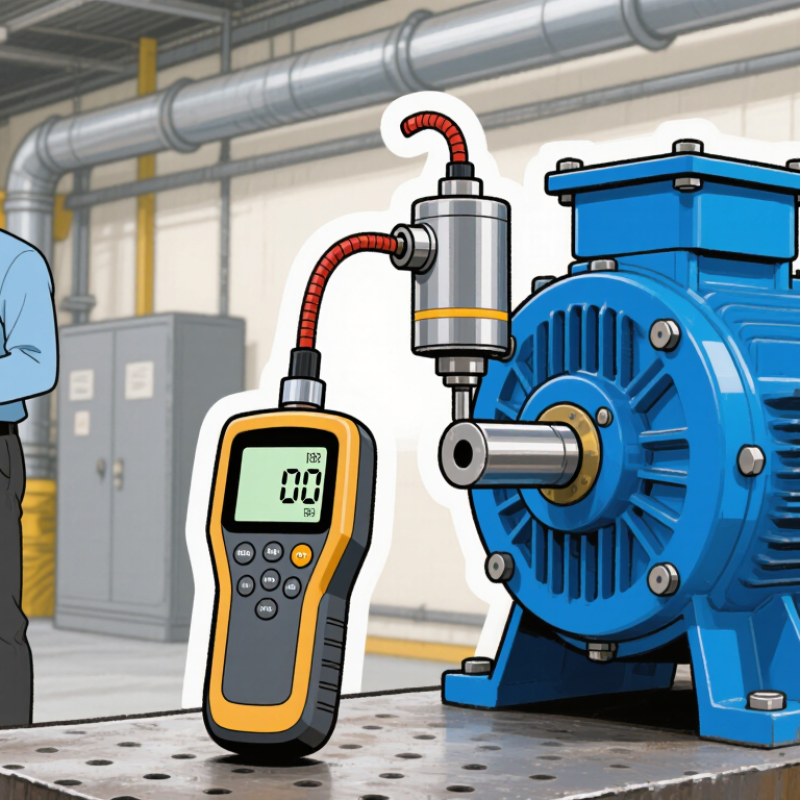
A vibration measuring device captures how a machine moves while it runs. A sensor, often an accelerometer, is placed near a bearing or motor housing. It measures vibration as acceleration, velocity, or displacement. A basic meter gives an overall reading; an analyzer can also show which frequencies are strongest. A peak near a machine’s running speed may point to imbalance, while other patterns can suggest looseness or bearing wear. It is a clue, not a diagnosis.
The U.S. Department of Energy’s Operations & Maintenance Best Practices report estimates predictive maintenance can cost 8–12% less than preventive maintenance and 30–40% less than reactive maintenance. Those figures describe maintenance programs, not guaranteed savings from buying a measuring device. The distinction matters. A meter helps teams spot change earlier, but people still need to interpret readings against equipment history and operating conditions.
For useful comparisons, record readings at the same point, under similar load and speed. Track trends over time, rather than reacting to one high number. A hot bearing, a loose sensor, or a changed production rate can distort results. Even careful measurements have limits. That part is easy to overlook. A vibration device supports maintenance decisions; it does not make them for you.
Vibration measurement turns tiny movements into data. A sensor attached to a machine detects motion as it moves back and forth. Many handheld meters use an accelerometer, which measures acceleration in units such as meters per second squared. The instrument may also calculate velocity or displacement from that signal. Each value describes a different part of the motion.
Frequency matters, too. It shows how often the machine completes a vibration cycle, usually in hertz. A low-frequency sway can point to looseness, while a sharp, high-frequency signal may come from a bearing or gear. These clues are not diagnoses by themselves. They need context.
The meter samples the sensor’s signal many times per second, then displays readings or a frequency spectrum. For a useful comparison, place the sensor firmly on the same spot each time. A loose grip can change the result. So can heat, nearby impacts, or an uneven surface. I have seen a reading look alarming simply because the probe shifted between checks. It is an easy mistake. A well-chosen device should match the machine, expected frequency range, and measurement task. Calibration and clear units matter as much as a bright display.
Vibration measuring devices serve different jobs, so the right type depends on what you need to observe. A handheld vibration meter gives quick readings from a machine casing. Press its sensor firmly against a bearing housing, and it can show overall vibration levels or frequency clues. These meters suit routine checks, but a single reading may miss an intermittent fault.
Small, portable, useful.
An accelerometer captures vibration as a changing electrical signal. Connected to a data collector or analyzer, it can reveal frequencies linked to imbalance, looseness, or bearing wear. A fixed sensor with a data logger tracks changes over hours or days, which helps when equipment runs under varying loads. For people exposed to vibration, specialized meters assess hand-arm or whole-body exposure rather than machine condition. Context matters. Sensor placement, mounting, measurement direction, and operating speed can all affect results. One awkward truth: a precise-looking number can still be misleading if the setup is poor. Even experienced technicians may need to repeat a measurement. Choose a device whose range, frequency response, and reporting functions match the task, then record how and where each reading was taken.
Choosing a vibration measuring device in 2026 starts with the job, not the feature list. A handheld meter may suit spot checks on a pump bearing, while continuous monitoring calls for reliable logging and alarms. Different tasks. Compare measurement range, frequency response, and stated accuracy with the vibration levels you expect. A sensor that clips at high amplitudes can miss the fault you are trying to detect.
Resolution is not the same as accuracy. Check calibration traceability, measurement uncertainty, and whether the device captures acceleration, velocity, or displacement across the required frequencies. For field work, inspect mounting options, battery life, enclosure rating, and screen readability under bright workshop lights. Small details count. A loose magnetic mount on a curved housing can distort readings, so repeatable placement matters. Also check whether exported files and timestamps fit your maintenance records.
Compare setup time and operator training alongside sensor specifications. If two technicians get noticeably different readings, the procedure may need attention, even with a capable instrument. That is easy to overlook. Ask how the device handles noise, averaging, and data gaps, then test it on a familiar machine. Datasheets rarely show every awkward field condition. Record the mounting point and operating state with each reading, and check how often recalibration is recommended.
How to compare vibration measuring devices in 2026
This chart compares common device types by typical feature availability: 1 means the feature is typically available, and 0 means it is not a typical capability. For general condition checks, a basic meter may be sufficient; frequency analysis and waveform capture are useful for diagnosing faults, while route-based trending supports repeated measurements. Capabilities vary by model, so confirm specifications for the intended measurement task.
The best vibration measuring device depends on what you need to detect. A handheld meter can suit routine checks on motors, pumps, and fans. For troubleshooting, an analyzer with waveform and frequency-spectrum views can reveal more detail. Neither is automatically better. Match the device to the machine, measurement task, and user’s experience.
Check which values the instrument measures: acceleration, velocity, or displacement. Confirm its frequency range covers the machine’s operating speeds and any suspected faults. A clear display helps during noisy inspections, while data export matters when you track changes over weeks. Sensor mounting also affects readings. A loose magnet or inconsistent position can make comparisons misleading. Calibration records and a stated measurement uncertainty are useful signs of dependable specifications. Still, even a capable device cannot compensate for poor measurement technique.
Tips: Use the same measurement point and machine conditions each time. Record load, speed, and sensor placement. Take a baseline reading before problems appear. Compare trends, not just one number. If results seem odd, repeat the measurement; small setup differences can matter.



For those larger-sized parts, or smaller quantity runs, we have 2 independent powder coat booths and ovens. The quality, durability and affordability of today’s powder coating finishes make this the process of choice for world-class companies.
Powder coating advantages over other forms of coating are many. Materials used in the Powder coating process can be metals and non-metals that come in a multitude of thicknesses, textures, colors, etc. Another of Powder coating’s biggest advantages over conventional coatings is its ability to create finishes in many different textures. Powder Coating Booths allow us the ability to apply these advantages to large products.
Tri-State Fabricators runs a full-service conveyor line for painting. Wet painting can provide protection or decoration to many different part styles. From start to finish, every project is easier to undergo random and point-based inspection by our skilled painting team.
Advantages to our Wet Paint Line are these lines start with product prep and ends with a thorough inspection of a high quality finished product. Our ability to complete large and small projects with a superior finish and doing so in a timely and economical fashion. This passes along the savings in production to our customers. When powder coating ins not an option, our Wet Paint Line gets the job done right the first time.
When the parts get big and heavy we roll-out our custom paint racks and oversize booth. By utilizing our partnerships with all the major paint brands, we can match virtually any color with wet paint.
The advantages of having access to a Wet Paint Booth are many. Large projects of many different shapes can be loaded into the booth. The Wet Paint Booth offers an environment that is much more controlled than a typical parts painting operation.
Not only are they used because of their controlled environment, but they’re are also advantageous when it comes to applying paint to parts that are needed in industries that require specialty coatings such as medical, aerospace, etc.
Our military forces have some very high standards when it comes to the finish of their vehicles and equipment. From the first pre-treatment step to final coat, it takes a great deal of knowledge and experience to protect the men and women of our armed forces. They deserve only the best, and Tri-State Fabricators provides it.
All of our processes are closely monitored by our staff and management teams. Both of which are highly trained in the processes of metal fabrication and finishing. Tri-State Fabricators’ goal is to always fully satisfy each and every customer, including the military. We will always put a 110% into what we do.
Abrasive media blasting is an excellent way to remove old paint, rust, and increase the paint/powder adhesion. Glass beads produce a much smoother and brighter finish than angular abrasives; leaving the part clean yet without any dimensional change. Chemically inert and environmentally friendly, we can recycle our beads approximately 30 times; making them a more preferred method of metal cleaning or surface finishing.
Advantages to Glass Bead Blasting are many. Glass bead blast media is used when a project is needing rough surfaces need to become smooth for applications of coatings such as paint. It is typically used to clean paint and rust from a product surface without deforming the surface it is being used on. Overall, compared to many other blasting media, Glass Bead Blasting is a very economical choice and those savings are always passed on to our customers.
Tri-State Fabricators utilize a zinc phosphate wash to clean and etch the material to ensure the best paint adhesion possible. The unique design of our 3-stage wash system does the work like a 5-stage. From Cleaning and rinsing to conversion coating and post-treatment, Our Part Washing process is a complete service and works throughout the fabrication service and the finishing service.
Along with the previously mentioned benefits, Curing is a vital chemical reaction that leaves the product finish hard and relatively safe from mild abrasion and aggressive corrosion. This process can be done in more than one way; ambient air-dry or in curing ovens at temps that exceed 240°.
From fixing paint mistakes (someone else’s of course) to simply cleaning our paint line hooks, our burn-off oven is put to good use. After a quick burn-off, a little clean up, and a fresh coat of paint, your parts will look better than new.
Why does our Burn-Off Oven work so well? Because super heating the air around parts turns the materials into ashes. From paint and powder coatings to rubber and machining oils, high temps do the job without degrading the integrity of the part.
Masking is a vital part of producing high quality products. We have die-cut masking patterns to protect machined surfaces as well as a wide range of plugs and caps to protect threaded holes and bolts. We provide permanent and temporary masking.
Masking allows the selected sections of a product to be protected from a fabrication or finishing service. This can be with both chemicals when etching and tapes, paints when only finishing just a section of the product. Masking is great in aiding the customization process of a project.
Screen printing is a photographic process that transfers artwork onto a porous nylon screen which allows colored ink to flow through the screen and be deposited on an aluminum or plastic component. We can generally have just about any design created onto a screen for your parts.
Some of the advantages of Screen Printing are, brand recognition for your business displaying on your products, assembly instructions, product warnings/hazards, etc. Tri-State Fabricators produces Screen Printing of the highest quality so you know it’s durable.
Metal Finishing is the art of treating the exterior portion of product, often metal but can also be made of other materials, so that the surface is clean and free of any debris. Then the process of applying coats or either paint of powder coat takes place. This coating process improves the quality of the product in both appearance and resistance to wear and corrosion.
Tri-State Fabricators, Inc., understands that a project typically isn’t complete until a high-quality finish has been added to your product. This is why our painting and powder coating teams continuously inspect the products throughout the Metal Finishing process.


