Who Are the Best Tunnel Kiln Manufacturers in China?
Choosing among China’s Tunnel Kiln manufacturers is not just a price comparison. It is a decision about fuel use, product consistency, maintenance, and years of production uptime. The International Energy Agency’s Energy Efficiency 2023 report puts industry at roughly 37% of global final energy consumption, underscoring why kiln efficiency deserves close scrutiny. That figure covers industry broadly, not tunnel kilns alone. Still, it gives buyers a useful reason to ask for measured fuel-consumption data rather than rely on sales claims.
A credible comparison should examine engineering depth and evidence from operating plants. Ask manufacturers for kiln temperature-uniformity records, firing-cycle details, refractory specifications, automation scope, and references for similar products. A kiln for facing bricks may require different airflow and firing control from one designed for ceramic tiles or refractories. Details decide. The United Nations Industrial Development Organization’s work on industrial energy efficiency also supports evaluating equipment through operating performance, not nominal design figures alone. Request the test conditions behind every claimed efficiency result.
This article considers manufacturers by technical capability, customization, commissioning support, spare-parts availability, and documented project experience. It also recognizes a limitation: public data rarely allows perfectly like-for-like comparisons across suppliers. No ranking is perfect. Buyers should verify references directly and compare quotations against the same product, output, fuel, and emissions requirements. The best choice is not automatically the largest factory or the lowest bid; it is the supplier able to show that its design fits the buyer’s actual production conditions.
What Is a Tunnel Kiln and How Is It Used?
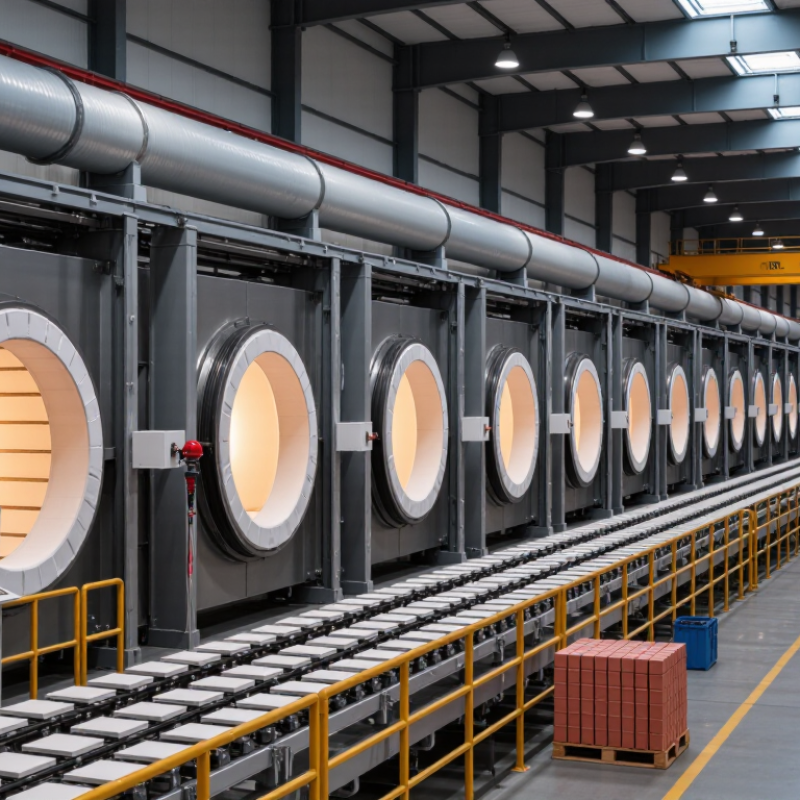
A tunnel kiln is a long, insulated firing chamber where products move continuously through controlled heat zones. Bricks, roof tiles, and ceramic wares travel on kiln cars, entering a preheating zone, passing through the hottest section, then cooling before unloading. The movement is steady; the temperatures are not. Burners, airflow, and travel speed must work together, or pieces may warp, crack, or fire unevenly. Tunnel kilns suit high-volume production because they avoid repeated heating and cooling of an entire batch kiln.
The European Commission Joint Research Centre’s Ceramic Manufacturing Industry BREF reports thermal energy use for brick production in a broad range of roughly 1–3 GJ per tonne, depending on product and process. That variation matters. Product thickness, moisture, kiln loading, and insulation all affect fuel use. Operators may also recover heat from the cooling zone to dry incoming products, reducing wasted energy. In practice, a kiln’s control system is only part of the picture; worn seals or uneven car loading can undermine performance. A useful reminder: there is no single setting for every plant. The best operating profile comes from measuring product quality, fuel use, and temperature uniformity over time.
How a Tunnel Kiln Fires Ceramic Products
A tunnel kiln continuously moves products through preheating, firing, and cooling zones. This illustrative temperature profile shows a typical high-temperature ceramic firing cycle; actual schedules vary by product, kiln design, and clay body.
Temperatures are representative examples, not specifications for a particular kiln or product.
What Criteria Define a Leading Tunnel Kiln Manufacturer?
A leading tunnel kiln manufacturer should prove more than its ability to build a long furnace shell. Buyers should assess process knowledge, engineering control, and commissioning experience. Ask how the team handles changes in clay moisture, feed size, and temperature across kiln zones. These details affect firing consistency and fuel use. Request reference data from comparable production lines, not only polished photographs. A plant visit can reveal whether technicians inspect burners, seals, and thermocouples carefully. Some gaps may remain; even experienced suppliers cannot remove every commissioning risk.
Technical capability should be matched by transparent documentation. A dependable manufacturer explains kiln dimensions, rated output, temperature uniformity, and expected maintenance intervals in writing. Ask for evidence. Request a clear scope for installation, operator training, spare parts, and response times. Find out who will troubleshoot a cold spot near the kiln exit and what measurements will guide adjustments. Vague promises are hard to verify. Compare energy figures only when product type, moisture, and firing schedule are similar. Numbers need context.
Tips: Bring sample products and a draft firing schedule to technical discussions. Record unanswered questions; they can expose gaps in the proposal.
Which Chinese Manufacturers Are Notable in the Tunnel Kiln Industry?
Which Chinese Manufacturers Are Notable in the Tunnel Kiln Industry?
Notable Chinese tunnel-kiln manufacturers are best judged by their engineering depth, not by promotional claims. Look for companies that design kiln cars, burners, insulation, and temperature controls as a coordinated system. Some focus on ceramic production; others serve brick, refractories, or other heat-treatment needs. A suitable manufacturer should explain how kiln length, firing curve, and product loading affect fuel use and output. Ask about commissioning support, operator training, and access to replacement parts. These details matter after installation.
A polished brochure is not proof of reliable performance. Request references for projects with similar products and capacity, then ask what operating data can be shared. Check whether temperature uniformity and fuel consumption were measured under real production conditions. Visit a working site if possible. This comparison is imperfect: factory results can differ with local fuel, maintenance, and loading habits. Still, specific evidence is more useful than a broad efficiency promise.
Tips: Share your product dimensions, target output, and available fuel before requesting a quotation. Ask for a process layout and a clear list of included equipment. That matters. Confirm who handles installation and troubleshooting, and how quickly common parts can be supplied. Small omissions can become costly delays.
How Do Their Kiln Designs and Services Compare?
Comparing Chinese tunnel kiln suppliers means looking beyond advertised capacity. The European Commission’s Ceramic Manufacturing BREF (2007) gives firing-energy figures for heavy-clay products of roughly 1.4–2.4 GJ per tonne, depending on product and operating conditions. Treat that range as a benchmark, not a guarantee. Ask each supplier for measured fuel use, product loading assumptions, and kiln temperature records. A well-insulated kiln with staged burners and waste-heat recovery may reduce energy demand, but only when matched to the clay body and production schedule.
Design differences show up on the factory floor. Check how evenly air moves through the kiln, whether burners can be adjusted by zone, and how quickly crews can replace seals or service fans. Details matter. A compact control system is useful only if operators can read alarms and access local support. Compare commissioning plans, operator training, spare-parts availability, and response times—not just warranty length. Request references from plants making similar bricks or tiles, then ask about actual output during seasonal changes.
Service claims need evidence. Request acceptance-test criteria for throughput, temperature uniformity, and fuel consumption, plus a written method for resolving missed targets. The BREF’s figures are not directly comparable across every product or factory, so suppliers should explain their test conditions. A polished proposal can still leave gaps; I would scrutinize who handles process tuning after handover.
What Should Buyers Consider When Choosing a Manufacturer?
Choosing a tunnel kiln manufacturer means checking more than rated capacity. Ask for temperature-uniformity records, fuel consumption per tonne, and performance data from lines firing similar products. Request a reference visit, if possible. Watch how operators load setters, monitor burners, and clear alarms. A polished test report is useful, but production conditions can be less tidy.
Energy deserves close attention. The International Energy Agency’s Energy Efficiency 2023 report estimates that industry accounts for about 37% of global energy use. Compare projected energy costs alongside purchase price, maintenance needs, and expected output. Check whether the supplier explains insulation choices, control accuracy, spare-part lead times, and commissioning support. No specification sheet predicts every production surprise; that uncertainty should be discussed, not hidden.
Tips: Ask for a written acceptance test using your product and firing curve. Confirm what happens if results miss agreed targets. Measure the whole line. Include loading, cooling, and downtime in the comparison. A low initial quote can still become expensive.





