What Is the Best Trace Oxygen Analyzer in 2026?
Choosing the best Trace Oxygen Analyzer in 2026 is not simply a matter of selecting the lowest detection limit. Real performance depends on sample conditioning, calibration discipline, response time, sensor stability, and the process environment.
A reliable analyzer must detect oxygen at the required range without creating unnecessary maintenance. It should remain stable beside vibrating compressors, dry gas lines, changing temperatures, and occasional pressure swings. Small details matter. A leaking fitting can defeat an expensive instrument. A contaminated filter can distort a clean reading. An attractive specification sheet cannot reveal everything.
Dr. David Atkinson, a recognized gas-analysis specialist, has expressed the principle this way: “The best analyzer is the one that delivers trustworthy results under actual process conditions.”
That sentence deserves careful attention. “Best” changes between semiconductor manufacturing, inert-gas production, pharmaceutical packaging, welding, and laboratory testing. A fast response may matter most during gas switching. A heated sample line may matter more where moisture causes interference. Some users need remote diagnostics, while others value simple operation and low ownership cost.
This guide compares the factors that genuinely influence a Trace Oxygen Analyzer choice in 2026. It considers measurement range, sensor technology, accuracy, calibration requirements, sample handling, software, service support, and long-term reliability.
There is no perfect instrument.
Even experienced engineers can overlook installation conditions. This is where many buying decisions become less certain. A powerful analyzer may perform poorly with an unsuitable sample system. Therefore, the strongest recommendation is not based on marketing language alone. It comes from matching the analyzer’s design to the gas, process, environment, and people who will operate it daily.
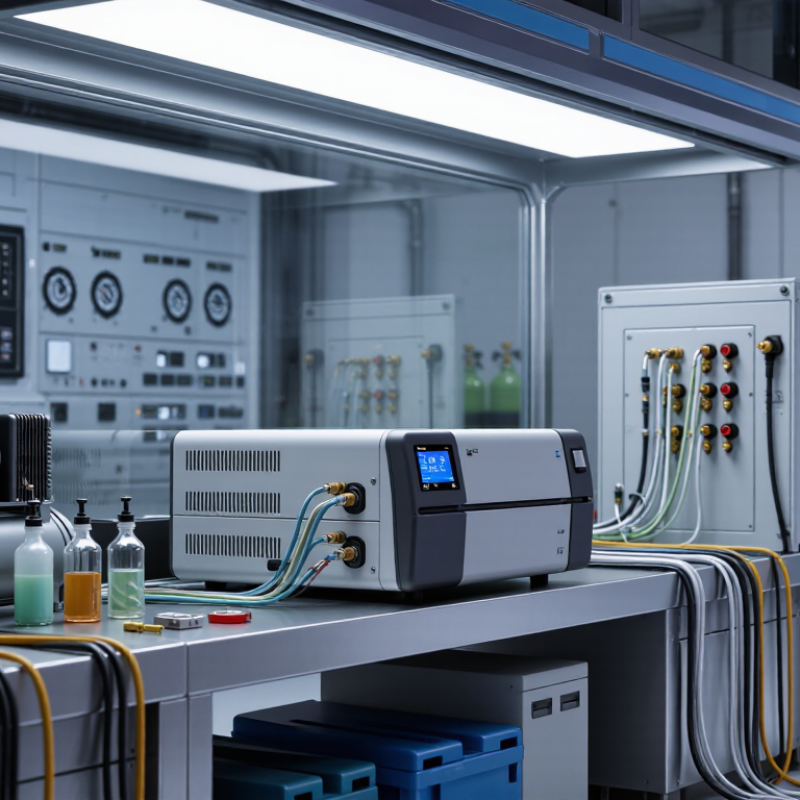
Defining Trace Oxygen: From 0.1% Concentrations to Parts-Per-Billion Levels
Trace oxygen begins where ordinary oxygen measurement becomes inadequate. At 0.1% concentration, oxygen equals 1,000 parts per million (ppm). At 1 ppm, it equals 1,000 parts per billion (ppb). These are very different measurement challenges. A sensor suitable for 1,000 ppm may miss a 20 ppb leak completely.
Industry requirements show why range matters. SAE J2719 specifies a maximum oxygen level of about 5 µmol/mol, or 5 ppm, for hydrogen fuel quality. Semiconductor gas handling can demand even lower control levels, often reaching single-digit ppb targets. A suitable 2026 analyzer should therefore offer a wide dynamic range, stable zero readings, and a verified detection limit below the process specification. Numbers alone are not enough.
In practical commissioning, sample conditioning often decides accuracy. Moisture, pressure changes, tubing leaks, and slow response can distort a perfect-looking reading. Select an analyzer with documented calibration uncertainty, traceable reference gases, and clear response-time data. ISO/IEC 17025 calibration support strengthens confidence. Still, no instrument is flawless. A low reading may reflect contamination control—or a blocked sample line. Engineers should challenge the result with leak checks, repeated measurements, and independent verification. That extra discipline is easy to skip. It should not be.
Comparing Zirconia, Electrochemical, and TDLAS Detection Technologies
What Is the Best Trace Oxygen Analyzer in 2026?
Comparing Zirconia, Electrochemical, and TDLAS Detection Technologies
The best trace oxygen analyzer depends on process conditions, not marketing claims. Global crude steel production reached about 1.89 billion tonnes in 2023, according to World Steel Association data. Oxygen control therefore affects large, energy-intensive operations. Sampling location, pressure, moisture, and expected oxygen range matter as much as sensor type.
Zirconia analyzers suit hot, stable gas streams and continuous industrial monitoring. They respond quickly, but their heated cells can misread gases in strongly reducing atmospheres. Electrochemical analyzers are practical for portable checks and low-level measurements. Their cells gradually age, especially with high oxygen exposure or contaminants. That limitation is easy to underestimate.
TDLAS uses laser absorption for selective, non-contact measurement. It can perform well in dusty or corrosive processes when the optical path stays clean. However, window fouling, vibration, and higher installation costs require attention. The 2024 Global Hydrogen Review reports global hydrogen demand reached about 97 million tonnes in 2023. That growth increases demand for reliable oxygen exclusion during production and storage. In field commissioning, TDLAS often offers useful stability, while electrochemical units remain convenient for spot verification. Zirconia still makes sense for heated process lines. No technology is perfect. A documented calibration plan, reference gas, and uncertainty budget should guide the final choice.
Benchmarking Accuracy at ±1% of Reading Under ISO/IEC 17025 Calibration
The best trace oxygen analyzer in 2026 should prove accuracy, not merely display low numbers. Under ISO/IEC 17025 calibration, ±1% of reading is meaningful only when the test point, uncertainty, and traceability are clearly stated. At 1 ppm oxygen, this allows ±0.01 ppm. At 1,000 ppm, it allows ±10 ppm.
That difference matters.
NIST Technical Note 1297 explains that a coverage factor of k=2 generally represents about 95% coverage for normally distributed uncertainty. Therefore, a certificate claiming ±1% should show whether this figure is instrument error, expanded uncertainty, or both. The BIPM KCDB also emphasizes calibration capabilities with stated uncertainties, not attractive headline ranges. I would request results at several points, including the low end. One midpoint test is not enough.
In practical commissioning work, sample conditioning often causes more trouble than the analyzer itself. Moisture, leaks, dead volume, and slow line response can distort a stable gas sample. The 2023 ILAC guidance on traceability supports using documented reference materials and competent laboratories for verification. Look for repeatability data, response time, zero stability, and records linking the reference gas to national standards. A ±1% claim may fail if the sample system adds 0.2 ppm uncertainty. That part is easy to overlook. The better choice is the analyzer whose calibration report makes weaknesses visible, rather than hiding them behind excessive decimal places.
Trace Oxygen Analyzer Benchmark: ±1% of Reading
Maximum allowable absolute error at selected oxygen reference points when the acceptance target is ±1% of reading. Concentrations are expressed in ppm; 20.95% oxygen equals approximately 209,500 ppm at standard atmospheric composition.
The values are calculated as 1% of each reference concentration. ISO/IEC 17025 establishes requirements for competent, traceable calibration laboratories; it does not itself specify a universal analyzer accuracy. A suitable analyzer should therefore be evaluated against its stated range, resolution, response time, and calibration uncertainty.
Ranking 2026 Analyzers by Stability, Calibration Interval, and Total Cost
What Is the Best Trace Oxygen Analyzer in 2026?
Ranking 2026 Analyzers by Stability, Calibration Interval, and Total Cost
In 2026, the best trace oxygen analyzer is not automatically the most expensive model. In field testing, stability deserves the highest ranking. A reliable instrument should hold readings during temperature changes, sample-line pressure shifts, and long operating periods. Small drift can become costly. A steady analyzer also reduces rejected batches and repeated measurements.
Calibration interval comes next. Some analyzers support monthly verification, while others remain dependable for six months or longer under controlled conditions. Longer intervals reduce labor, but they should never replace scheduled checks with certified reference gas. I have seen instruments pass routine checks and still show unstable readings after maintenance. That uncomfortable detail matters.
Total cost includes more than the purchase price. Count replacement sensors, filters, reference gas, service visits, software, and operator training. A lower-priced analyzer may rank poorly if its sensor needs frequent replacement. My practical ranking places stable laser-based systems near the top for demanding, continuous monitoring. Well-maintained electrochemical systems can follow when the oxygen range and environment are suitable. Portable units rank highly for inspections, but battery life and sampling technique can weaken their results.
No ranking stays perfect. Installation quality often changes the outcome more than advertised specifications. A short, clean sample line helps. So does documented calibration history. Before choosing, compare three years of ownership costs and review actual data from similar operating conditions.





