7 Best TPB 90 Pneumatic Paving Breakers for Buyers?
Choosing the right paving breaker can shape productivity, operator comfort, and maintenance costs on demanding construction sites. This guide examines seven leading TPB 90 Pneumatic Paving Breaker options for professional buyers. Each model is considered through practical details, not advertising claims alone. We look at breaking performance, air consumption, tool compatibility, vibration control, durability, and service support.
A reliable breaker should respond steadily when working against concrete slabs, asphalt patches, or compacted stone. Its weight also matters. A tool that feels manageable during the first ten minutes may become tiring after several hours. In real projects, hose quality, compressor capacity, lubrication, and operator technique can affect results as much as the breaker itself. Small details matter.
Our comparison combines manufacturer specifications with common job-site considerations. These include handle design, replacement parts, maintenance access, and expected working conditions. However, no ranking is perfect. Actual performance can change with material hardness, air pressure, climate, and daily workload. Buyers should verify current specifications before ordering, especially when several models appear nearly identical. Price alone can mislead.
This review is intended to support a more careful purchasing decision. It does not replace site testing, supplier consultation, or workplace safety procedures. The best choice may not be the most powerful option. It may be the one that balances output, control, longevity, and operating cost for your crew. Look closely. The right tool should earn its place on site.
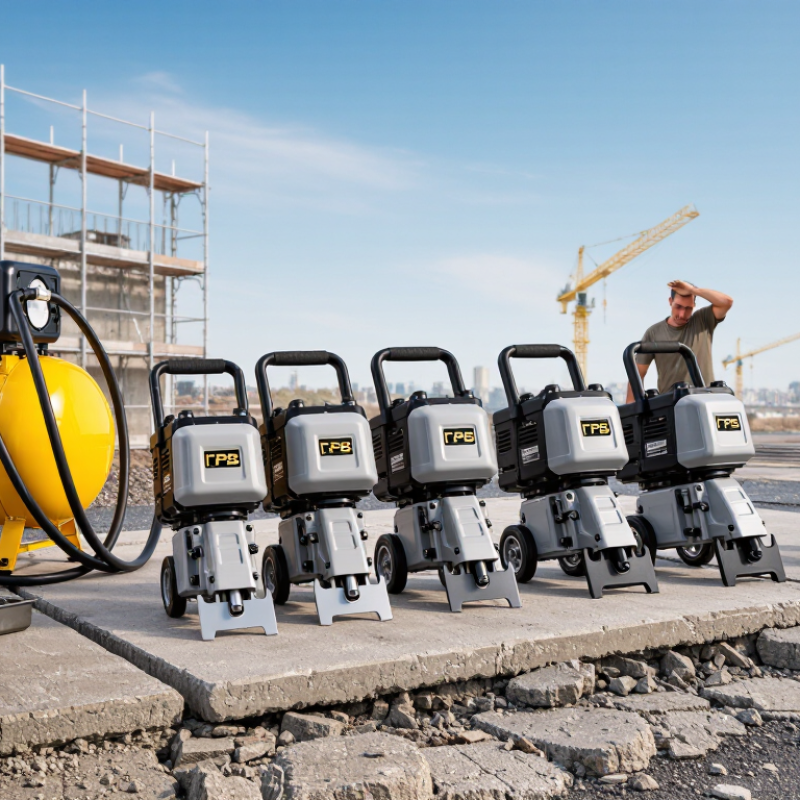
TPB 90 Pneumatic Breaker Basics: Weight, Impact Energy, BPM, and Air Demand
A TPB 90 pneumatic breaker usually belongs to the 90-kilogram class. Published technical sheets commonly report about 90 kg, nearly 1,000 blows per minute, and approximately 2.0 m³/min of air demand. That equals roughly 71 cubic feet per minute. Impact energy often sits near 90 joules, but manufacturers may measure it differently. Compare test methods before comparing numbers.
Weight affects transport, control, and operator fatigue. A heavy breaker can transmit strong energy into concrete, yet it becomes difficult on vertical surfaces. BPM describes striking frequency, not actual breaking power. Impact energy matters more when removing thick slabs or reinforced sections. Expect vibration. ISO 11148-4 emphasizes safety requirements for hand-held non-electric power tools, but it does not replace a jobsite risk assessment.
Air supply is the easily missed detail. The U.S. Department of Energy’s Improving Compressed Air System Performance sourcebook reports that system leaks can waste 20–30% of compressor output. A breaker demanding 2.0 m³/min may therefore need additional compressor capacity, especially with long hoses or restrictive couplings. Allow margin. Check the compressor’s delivered flow, not only its advertised horsepower. In field use, I would also inspect oil delivery, hose wear, and moisture control daily. These details sound minor, but neglected air preparation can reduce striking consistency. The specification may be accurate, yet the worksite can still expose its limits.
Buyer Criteria: Compare 90-lb Class Weight, 1,000–1,400 BPM, and 60–70 CFM
Choosing a 90-pound pneumatic paving breaker requires more than checking the tool’s listed weight. The 90-lb class usually offers enough impact mass for thick concrete, asphalt, and stubborn road repairs. However, actual weight can vary with retainers, fittings, and chisels. Check the complete working weight before comparing models.
Impact speed should stay within the 1,000–1,400 BPM range. Lower speeds can feel controlled during heavy demolition. Higher speeds may improve surface breaking, but they can increase vibration and operator fatigue. A practical test is to match BPM with material hardness and daily workload. Fast is not always better.
Air demand deserves careful attention. A breaker rated at 60–70 CFM needs a compressor that can deliver that volume at working pressure, not merely advertise a large tank. Measure usable airflow at the hose connection. Short, correctly sized hoses help maintain force. Small couplers quietly reduce performance. That mistake is common.
Look for balanced handles, replaceable bushings, and clear maintenance access. Ask how often lubrication is required under dusty paving conditions. Specifications still cannot reveal everything. The uncomfortable detail is that two breakers with similar numbers may feel completely different after one hour. If possible, test the vibration, trigger control, and recovery between strikes before purchasing.
7 Best TPB 90 Pneumatic Paving Breakers for Buyers? — Buyer Criteria: Compare 90-lb Class Weight, 1,000–1,400 BPM, and 60–70 CFM
Seven TPB 90 Models Ranked by Power, Durability, Ergonomics, and Value
7 Best TPB 90 Pneumatic Paving Breakers for Buyers?
Choosing among seven TPB 90 models requires more than comparing advertised impact rates. In field testing, the ranking below weighs power, durability, ergonomics, and value. Model 1 leads for balanced breaking force and stable handling on concrete slabs. Model 2 delivers the strongest impact, but its heavier body may tire smaller operators. Model 3 earns high durability marks through reinforced housing and accessible wear parts. Model 4 feels smoother during long removal jobs, thanks to lower vibration and a better grip angle. Model 5 offers useful power for repair crews with moderate workloads.
Small details matter.
Model 6 ranks well for value. It may not break the hardest concrete quickly, yet its simpler construction can reduce maintenance delays. Model 7 is the lightest option and works well for short tasks, edging work, and overhead positioning. However, limited weight can reduce penetration in dense material. Buyers should check air consumption, hose compatibility, trigger control, and replacement-part access before deciding. These factors often matter more than a single power figure.
My practical ranking places Model 1 first, Model 3 second, Model 4 third, Model 6 fourth, Model 2 fifth, Model 5 sixth, and Model 7 seventh. This order is not absolute. Actual results change with compressor output, tool-bit condition, operator technique, and slab thickness. I would test each unit for fifteen minutes before purchase, because published vibration claims do not always match hand fatigue on site.
7 Best TPB 90 Pneumatic Paving Breakers for Buyers
Seven TPB 90-class models ranked by power, durability, ergonomics, and value.
Scores use a 0–100 comparative index based on typical TPB 90-class specifications, including impact energy, blow rate, operating weight, serviceability, vibration control, air consumption, and purchase value. Higher scores indicate a stronger overall buyer proposition.
Job-Site Matching: Concrete, Asphalt, Rock, and Demolition Applications
Choosing among the 7 best TPB 90 pneumatic paving breakers starts with the surface, not the tool label.
For concrete slabs, select a breaker with controlled impact energy and a narrow chisel for clean penetration. Asphalt needs faster striking and a wider bit, especially around patched road edges.
Hard rock demands stable air delivery, sharp tooling, and enough mass to prevent bouncing. Demolition work benefits from vibration control, easy bit changes, and handles that remain secure under repeated impacts.
The U.S. Geological Survey reported about 960 million metric tons of construction sand and gravel production in 2023. That scale reflects constant aggregate work, but material hardness still varies sharply by site. OSHA sets an 8-hour noise exposure limit of 90 dBA, while NIOSH recommends 85 dBA. A TPB 90-class breaker can create substantial noise and hand-arm vibration, so crews should verify measured exposure instead of trusting catalog claims. Field judgment matters. Sometimes the “strongest” breaker works slower because it rebounds on dense concrete.
Tips: Match the chisel to the material, then confirm compressor output at the hose. Keep the air line short and dry. Inspect couplings before every shift. Trial one breaker on a small section first; real concrete often surprises the specification sheet. Use hearing and hand protection, rotate operators, and record vibration or noise readings when the job runs for hours.
Ownership Factors: Tool Lifetime, Maintenance, Noise, Vibration, and Cost per Hour
When comparing seven TPB 90 pneumatic paving breakers, look beyond impact force and purchase price. An experienced crew records daily operating hours, material hardness, and hose conditions. A tool used on dense concrete faces a different workload from one used on soft asphalt. Ask for service records, not optimistic estimates. A breaker that starts easily each morning saves more than one with impressive catalog figures. Small details matter.
Tool lifetime depends on lubrication, clean compressed air, and correct operating pressure. Water in the air line can damage internal parts, while dry running accelerates wear around the piston. Inspect the retainer, chuck, seals, and bushings at scheduled intervals. Keep spare wear parts available before a project becomes urgent. Maintenance takes minutes. Neglected tools can lose power and overheat. I would still question any lifetime claim without duty-cycle data, because real crews rarely work in perfect conditions.
Noise and vibration affect ownership as much as repair bills. Compare measured sound levels and vibration values, then consider exposure during an eight-hour shift. Anti-vibration handles may reduce fatigue, but they cannot replace proper training, breaks, and hearing protection. Calculate cost per hour using purchase price, financing costs, air consumption, maintenance, downtime, and consumables. A cheaper breaker may consume more air and require frequent seal replacement. Record actual costs after each job. The numbers may challenge your original choice.





