


7 Best Stone Frying Pans for Every Kitchen

Choosing a Stone Frying Pan can feel simple until you compare coatings, handles, and care instructions. The name may suggest natural rock, but many stone-style pans use a metal base with a mineral-look nonstick coating. That distinction matters. Construction, heat limits, and cleaning guidance vary by model, so the label alone is not a quality guarantee. Small details matter. A flat, stable base can help distribute heat, while a comfortable handle makes lifting and turning food easier. Still, even a well-designed pan has limits. High heat or metal utensils may shorten the life of some coatings, so check the manufacturer’s instructions before cooking.

This guide looks at seven options for different kitchens, budgets, and cooking habits. It considers practical features such as pan size, weight, stovetop compatibility, ease of cleaning, and the foods each pan may suit. A compact pan can work well for a quick breakfast; a wider one gives vegetables more room to brown. Not every pan fits. The right choice depends on your stove, storage space, and how often you cook. I would not call any single model perfect for everyone, and product details can change over time. Use the comparisons as a starting point, then verify current specifications and care advice before buying.
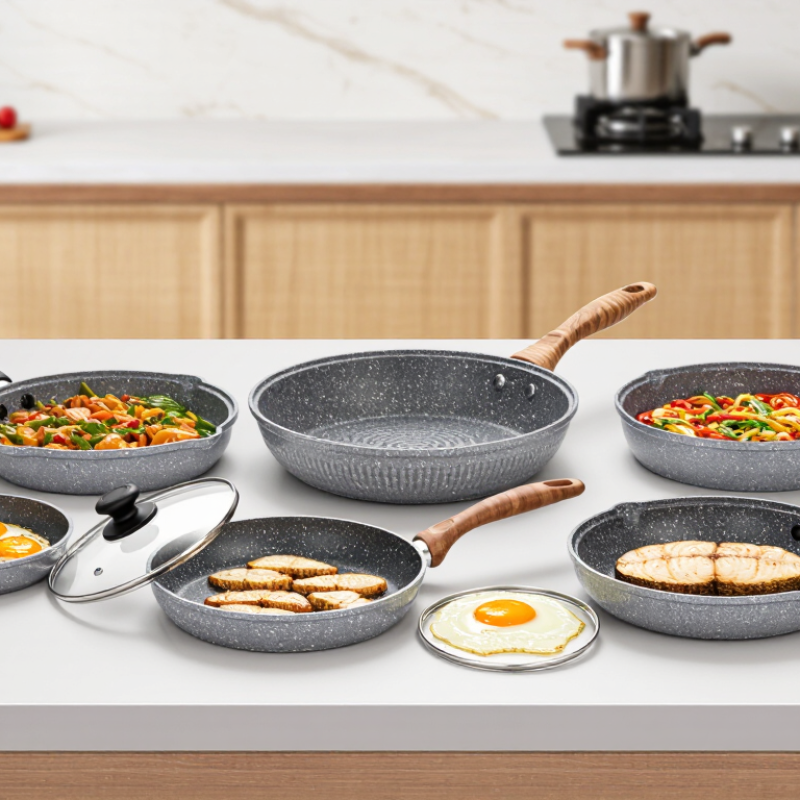
7 Best Stone Frying Pans for Every Kitchen

Understanding Stone Frying Pans and Their Coatings

Stone frying pans are usually named for their speckled finish, not carved from rock. Most have an aluminum body and a nonstick coating blended with mineral particles. The coating may be PTFE-based or ceramic-style; “stone” alone does not identify its chemistry. Check the care label and product specifications. A textured gray surface can look rugged, but it is still a thin layer that can wear.

The pan’s core affects how evenly it heats, while the coating affects food release and care. For eggs or delicate fish, an intact surface usually needs only a little oil and moderate heat. Keep flames within the pan’s base, and avoid heating an empty coated pan for long. Use silicone or wooden utensils, and let the pan cool before washing; sudden temperature changes can stress some materials. No coating is indestructible. Even careful cooks sometimes overheat a pan or scrape it with a fork. If the surface starts flaking, or food sticks despite normal care, replace it rather than guessing what has changed. Check whether the handle and oven-use limits suit your routine. That part is easy to overlook.


Key Features to Compare Before Choosing a Stone Frying Pan

A “stone” frying pan is usually metal with a textured or mineral-infused coating, not a solid slab of stone. Check the manufacturer’s material and care details before comparing appearance. A thick, flat base can sit steadily on the hob and help spread heat, while a very heavy pan may feel awkward when tossing vegetables. Lift it if you can. Handle balance matters.

Match the base to your cooktop, especially if you use induction; the pan must contain a magnetic layer. The U.S. Department of Energy’s Energy Saver guide estimates induction transfers about 85% of its energy to food, compared with roughly 32% for gas cooking. That figure describes the cooking method, not a guarantee of better results from any particular pan. Check the listed hob compatibility. Also compare usable diameter, oven-safe temperature, handle material, and cleaning instructions. Small details matter.

Coating care deserves close attention. Germany’s Federal Institute for Risk Assessment warns that empty PTFE-coated pans can release hazardous gases if heated to around 360°C. Not every stone-style coating contains PTFE, so verify the coating type and follow its stated heat limits. I would not choose a pan by its scratch-resistant claim alone; coating wear depends on use, utensils, and cleaning. Honestly, that part is hard to judge from a product photo.

Seven Stone Frying Pans for Different Kitchen Needs

“Stone” often describes a textured or mineral-reinforced coating, not a pan carved from rock. Check the care instructions before buying; coatings vary. A compact 20-centimeter pan suits one egg or a quick portion of vegetables. A 24-centimeter model handles everyday lunches, while a 28-centimeter pan gives family portions more room. Crowding food can still cause steaming.

A deep-sided stone pan is useful for saucy dishes and gently simmered vegetables. A low-sided crepe pan makes flipping easier, though its shallow shape limits what else it can cook. Ridged grill pans create browned lines on zucchini or chicken, but grooves take extra cleaning. An induction-ready pan needs a compatible magnetic base. Small details matter.

Choose by cooking habits, not appearance alone. A heavier pan may feel steady on the hob, yet tire your wrist during frequent tossing. Nonstick performance also depends on gentle heat and suitable utensils; a stone-style surface is not indestructible. I would avoid assuming every “stone” pan behaves alike. Even a useful pan can disappoint when its size, weight, or care needs do not fit your kitchen.

7 Best Stone Frying Pans for Every Kitchen - Seven Stone Frying Pans for Different Kitchen Needs

Use this guide to compare common stone-look and stone-coated frying pan styles. Sizes and features are typical examples; specifications vary by model.
Pan Style Typical Diameter Best Suited For What to Look For Cooktop and Care Notes
Compact frying pan About 8 inches (20 cm) One egg, a small omelet, or a single portion A lightweight body and gently sloped sides make small servings easy to turn. Check the pan’s base diameter against small burners. Use low to medium heat and non-metal utensils if the coating instructions recommend them.
Everyday frying pan About 10 inches (25 cm) Cooking for one or two people; everyday eggs and vegetables A flat cooking surface and comfortable handle offer a useful balance of capacity and storage space. Cooktop compatibility depends on the base. For induction, the pan must have a magnetic base and be listed as induction-compatible.
Large family pan About 12 inches (30 cm) Larger portions, several servings, or cooking multiple ingredients together A broad base provides more room, while a helper handle can make lifting a full pan easier. Confirm that the pan fits your burner and storage space. A larger pan may heat unevenly on a burner that is much smaller than its base.
Deep-sided frying pan About 10–11 inches (25–28 cm) Sautéing vegetables, shallow frying, and dishes with sauces Taller sides help contain splashes and hold more food than a standard shallow skillet. Check the usable depth and whether a lid is included. Follow the manufacturer’s instructions for heat limits and cleaning.
Induction-ready stone-look pan Commonly 10–12 inches (25–30 cm) Kitchens with an induction cooktop Look for an induction-compatible label and a flat magnetic base; the “stone” appearance alone does not indicate induction compatibility. Verify compatibility for your specific cooktop. Keep the pan base clean and lift it rather than sliding it across a glass surface.
Ceramic-coated stone-look pan Commonly 8–12 inches (20–30 cm) Those who prefer a ceramic-based nonstick coating Check the product description to confirm the coating type. “Stone” or “granite” styling is not a standardized coating specification. Use moderate heat and follow the care instructions. Avoid overheating an empty pan and check whether dishwasher use is permitted.
Lightweight aluminum-body pan Commonly 10–12 inches (25–30 cm) Easy handling and frequent everyday use An aluminum body is generally lighter than a comparable cast-iron pan; a bonded base may be needed for induction use. Check the listed cooktop compatibility and any oven-safe temperature limit. Hand-washing can help preserve many nonstick coatings.

Buying note: “Stone,” “granite,” and “stone-effect” are often marketing descriptions for a pan’s finish or nonstick coating, not proof that the cooking surface is made from solid stone. Check the listed coating, cooktop compatibility, and care instructions before buying.

Matching Pan Size and Compatibility to Your Cooktop

Choosing a stone frying pan starts with the cooktop, not just the advertised diameter. Pan sizes usually describe the top rim, while the flat base may be noticeably smaller. Measure the cooking zone and compare it with the base. A close match helps distribute heat evenly and avoids wasting energy.

For induction, the pan needs a magnetic base; a small magnet can help check, but follow the maker’s compatibility label. Stone-style coatings alone do not indicate whether a pan will work on induction.

On gas, choose a base that sits securely over the grate, and keep flames beneath the pan rather than licking up its sides. For electric coils or glass-ceramic surfaces, a flat base matters. A warped pan may wobble or heat unevenly. That detail is easy to miss.

Think about the meals you actually cook. A 20-centimeter pan suits eggs or a quick lunch, while a 28-centimeter pan gives vegetables more room to brown. But bigger is not always better: an oversized pan can heat slowly on a small burner. Handle clearance matters, too, especially when neighboring burners are in use.

Check the care instructions before choosing; some coatings need gentler utensils or lower heat. I would not assume every “stone” pan behaves the same. The coating and base construction vary.

Using and Caring for a Stone Frying Pan Safely

A stone-finish frying pan is not necessarily made from solid stone. Its surface may use different coating materials, so check the care label instead of judging safety by its speckled appearance. The German Federal Institute for Risk Assessment warns that PTFE-coated cookware can release hazardous gases when heated to around 360°C or higher. That warning applies to PTFE coatings, not automatically to every pan sold as “stone.” The distinction matters.

Use low or medium heat for everyday cooking, and avoid leaving an empty pan on a hot burner. Add a little oil when the pan is cool, then heat it gently; shimmering oil is a cue to lower the flame. Small habits matter. Don’t use metal utensils if the care instructions advise against them, and let the pan cool before washing. A sudden splash of cold water can stress a hot surface. If the coating is visibly peeling, stop using the pan for cooking and check the manufacturer’s guidance.

Tips: Use a soft sponge and mild dish soap. Dry the pan before storing it, and place a cloth between stacked pans to reduce scratches. Ventilate the kitchen when cooking. It is easy to assume “stone” means tougher, but the coating and its condition are what count.

Choosing Cooking Oils for a Stone Frying Pan

Smoke points are approximate and vary with processing and refinement. Avoid overheating oil or heating an empty pan, and follow the pan manufacturer’s care and temperature guidance.

Powder Coat Booths

For those larger-sized parts, or smaller quantity runs, we have 2 independent powder coat booths and ovens. The quality, durability and affordability of today’s powder coating finishes make this the process of choice for world-class companies.

Powder coating advantages over other forms of coating are many. Materials used in the Powder coating process can be metals and non-metals that come in a multitude of thicknesses, textures, colors, etc. Another of Powder coating’s biggest advantages over conventional coatings is its ability to create finishes in many different textures. Powder Coating Booths allow us the ability to apply these advantages to large products.

Wet Paint Line

Tri-State Fabricators runs a full-service conveyor line for painting. Wet painting can provide protection or decoration to many different part styles. From start to finish, every project is easier to undergo random and point-based inspection by our skilled painting team.

Advantages to our Wet Paint Line are these lines start with product prep and ends with a thorough inspection of a high quality finished product. Our ability to complete large and small projects with a superior finish and doing so in a timely and economical fashion. This passes along the savings in production to our customers. When powder coating ins not an option, our Wet Paint Line gets the job done right the first time.

Wet Paint Booths

When the parts get big and heavy we roll-out our custom paint racks and oversize booth. By utilizing our partnerships with all the major paint brands, we can match virtually any color with wet paint.

The advantages of having access to a Wet Paint Booth are many. Large projects of many different shapes can be loaded into the booth. The Wet Paint Booth offers an environment that is much more controlled than a typical parts painting operation.

Not only are they used because of their controlled environment, but they’re are also advantageous when it comes to applying paint to parts that are needed in industries that require specialty coatings such as medical, aerospace, etc.

Military CARC

Our military forces have some very high standards when it comes to the finish of their vehicles and equipment. From the first pre-treatment step to final coat, it takes a great deal of knowledge and experience to protect the men and women of our armed forces. They deserve only the best, and Tri-State Fabricators provides it.

All of our processes are closely monitored by our staff and management teams. Both of which are highly trained in the processes of metal fabrication and finishing. Tri-State Fabricators’ goal is to always fully satisfy each and every customer, including the military. We will always put a 110% into what we do.

Glass-Bead Blasting

Abrasive media blasting is an excellent way to remove old paint, rust, and increase the paint/powder adhesion. Glass beads produce a much smoother and brighter finish than angular abrasives; leaving the part clean yet without any dimensional change. Chemically inert and environmentally friendly, we can recycle our beads approximately 30 times; making them a more preferred method of metal cleaning or surface finishing.

Advantages to Glass Bead Blasting are many. Glass bead blast media is used when a project is needing rough surfaces need to become smooth for applications of coatings such as paint. It is typically used to clean paint and rust from a product surface without deforming the surface it is being used on. Overall, compared to many other blasting media, Glass Bead Blasting is a very economical choice and those savings are always passed on to our customers.

Part Washing

Tri-State Fabricators utilize a zinc phosphate wash to clean and etch the material to ensure the best paint adhesion possible. The unique design of our 3-stage wash system does the work like a 5-stage. From Cleaning and rinsing to conversion coating and post-treatment, Our Part Washing process is a complete service and works throughout the fabrication service and the finishing service.

Along with the previously mentioned benefits, Curing is a vital chemical reaction that leaves the product finish hard and relatively safe from mild abrasion and aggressive corrosion. This process can be done in more than one way; ambient air-dry or in curing ovens at temps that exceed 240°.

Burn-Off Oven

From fixing paint mistakes (someone else’s of course) to simply cleaning our paint line hooks, our burn-off oven is put to good use. After a quick burn-off, a little clean up, and a fresh coat of paint, your parts will look better than new.

Why does our Burn-Off Oven work so well? Because super heating the air around parts turns the materials into ashes. From paint and powder coatings to rubber and machining oils, high temps do the job without degrading the integrity of the part.

Masking

Masking is a vital part of producing high quality products. We have die-cut masking patterns to protect machined surfaces as well as a wide range of plugs and caps to protect threaded holes and bolts. We provide permanent and temporary masking.

Masking allows the selected sections of a product to be protected from a fabrication or finishing service. This can be with both chemicals when etching and tapes, paints when only finishing just a section of the product. Masking is great in aiding the customization process of a project.

Screen Printing

Screen printing is a photographic process that transfers artwork onto a porous nylon screen which allows colored ink to flow through the screen and be deposited on an aluminum or plastic component. We can generally have just about any design created onto a screen for your parts.

Some of the advantages of Screen Printing are, brand recognition for your business displaying on your products, assembly instructions, product warnings/hazards, etc. Tri-State Fabricators produces Screen Printing of the highest quality so you know it’s durable.

Metal Finishing

Metal Finishing is the art of treating the exterior portion of product, often metal but can also be made of other materials, so that the surface is clean and free of any debris. Then the process of applying coats or either paint of powder coat takes place. This coating process improves the quality of the product in both appearance and resistance to wear and corrosion.

Tri-State Fabricators, Inc., understands that a project typically isn’t complete until a high-quality finish has been added to your product. This is why our painting and powder coating teams continuously inspect the products throughout the Metal Finishing process.
