


China Best Steel Parking Bollards Manufacturer for Sale

As cities grow denser, parking areas must protect people, storefronts, and building entrances without making access feel hostile. UN DESA’s World Urbanization Prospects 2018 projects that 68% of the world’s population will live in urban areas by 2050. That shift puts practical pressure on site planning. Steel Parking Bollards can help define vehicle boundaries and guard vulnerable edges, but the right choice depends on placement, anchoring, visibility, and expected impact.

The material matters, too. World Steel Association’s World Steel in Figures 2024 reports global crude steel production of 1,892.2 million tonnes in 2023. This figure shows steel’s enormous industrial scale; it does not prove that any bollard is safe or suitable. Buyers should ask manufacturers for clear specifications, finish options, installation guidance, and relevant test documentation. A sturdy-looking post is not enough.

Urban designer Jan Gehl offers a useful planning principle: “First life, then spaces, then buildings—the other way around never works.” It is not a bollard specification, but it reminds buyers to start with people’s movement and needs. For projects sourcing from China, compare suppliers on fabrication quality, consistency, communication, and evidence—not price alone. Check the base plate, welds, coating, and fixing method against the site conditions. Small details matter. Still, even careful selection cannot replace competent installation or regular inspection. This guide introduces what to assess when choosing a China-based Steel Parking Bollards manufacturer for sale, while recognizing that product claims deserve verification.
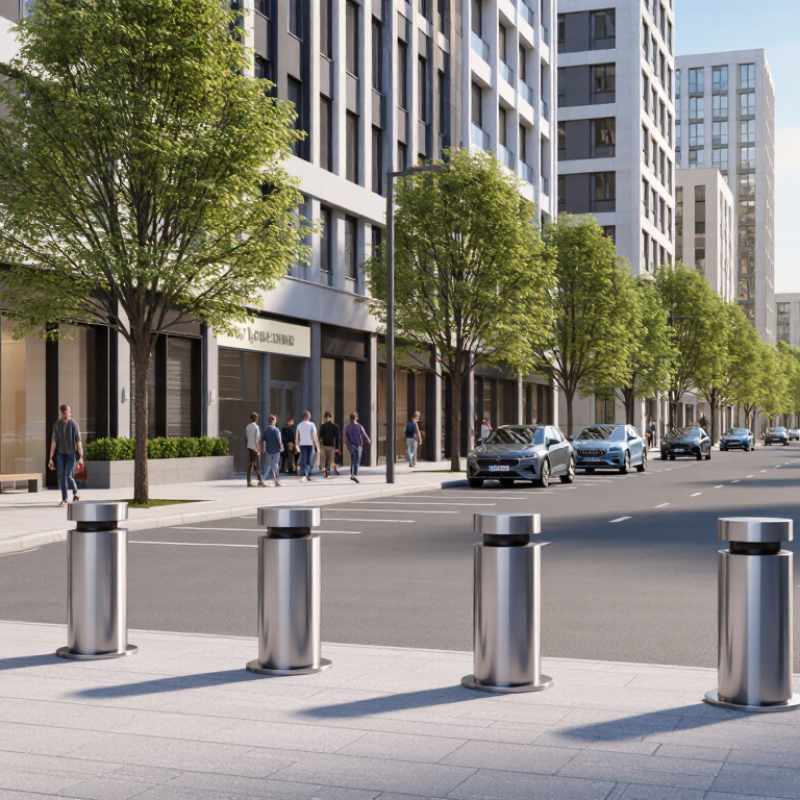
China Best Steel Parking Bollards Manufacturer for Sale

What Are Steel Parking Bollards and How Do They Work?

Steel parking bollards are sturdy vertical posts that help define parking spaces, protect walkways, and discourage vehicles from entering restricted areas. They are commonly made from steel pipe and may be surface-mounted with a base plate or embedded in concrete. Their visible height, spacing, and finish help drivers notice boundaries, especially near storefronts, loading zones, and pedestrian paths.

Some bollards provide visual guidance; others are designed to resist vehicle impact. The difference is critical. A plain steel post is not automatically crash-rated. Its performance depends on the steel, wall thickness, foundation, installation depth, and tested impact rating. NHTSA’s Traffic Safety Facts 2022 reported 7,522 pedestrian deaths in U.S. traffic crashes. That figure is not specific to parking lots, but it highlights why separating people from moving vehicles matters.

For a real site, check the vehicle risks and ground conditions before choosing a bollard. A shallow base plate on weak paving may not perform like a deeply embedded post in reinforced concrete. Not always obvious. Reflective bands can improve visibility at night, while spacing should still allow accessible routes and practical vehicle movement. The overlooked detail is often the foundation, not the steel finish. A qualified installer can verify dimensions and anchoring against the site plan and the intended level of protection.

China Best Steel Parking Bollards Manufacturer for Sale - What Are Steel Parking Bollards and How Do They Work?

Data Dimension Typical Information How It Works or Why It Matters
Definition A steel parking bollard is a short, sturdy post installed to define vehicle boundaries or help protect people, buildings, and equipment. It creates a visible physical barrier that can discourage or restrict vehicle access, depending on its design and installation.
Common Materials Carbon steel and stainless steel are commonly used. Outdoor carbon-steel units are often galvanized, painted, or powder-coated for corrosion protection. Material and finish affect strength, appearance, maintenance needs, and resistance to weather or corrosive environments.
Typical Above-Ground Height Approximately 600–1,200 mm (24–48 in), depending on the intended use and site layout. Height influences visibility and how effectively the post defines a boundary. Local accessibility, traffic, and building requirements should also be considered.
Typical Outside Diameter Approximately 100–200 mm (4–8 in) for many general-purpose steel bollards. A larger diameter may provide a more substantial barrier, but diameter alone does not determine impact performance.
Fixed, In-Ground Bollard Secured in a foundation or embedded below ground; the visible post remains in place. Suitable for permanent separation or access control where the post does not need to be moved. Foundation design and ground conditions are important.
Removable Bollard Fits into a ground sleeve or socket and can be lifted out when access is required. Allows occasional vehicle access through a protected area. A locking or securing method helps keep the bollard in position when installed.
Retractable Bollard Moves up and down within a below-ground housing; operation may be manual or powered. Provides a clear route when lowered and a visible barrier when raised. Drainage, maintenance access, and power requirements may apply.
Surface-Mounted Bollard Attached to a concrete surface with suitable anchors and a base plate. Can be used where excavation is impractical. Its performance depends on the slab, anchor type, edge distance, and installation quality.
How Bollards Work Posts establish a physical boundary, channel vehicles, protect specific areas, or control entry. Spacing and placement should prevent unwanted vehicle passage while maintaining safe pedestrian routes and required emergency access.
Common Applications Parking areas, building entrances, pedestrian zones, loading areas, storefronts, and equipment protection. The bollard type and layout should match the expected vehicle movement, site conditions, and level of protection needed.
Impact-Rating Consideration Not every steel bollard is crash-rated or designed to stop a moving vehicle. Where vehicle-impact resistance is required, check independent test documentation for the complete system, including the bollard, foundation, and installation method.
Installation Considerations Review underground utilities, soil and slab conditions, drainage, post spacing, visibility, and local codes before installation. Correct installation helps the bollard perform as intended and reduces the risk of water accumulation, loosening, or interference with access routes.
Maintenance Inspect the post, coating, base, anchors, locks, and moving parts periodically. Repair damaged finishes and address corrosion or loose fixings promptly. Retractable and removable units may require additional cleaning and functional checks.

Note: Dimensions shown are general examples, not universal specifications. Confirm product drawings, installation requirements, and applicable local standards for each project.


Types and Design Features of Steel Parking Bollards

Steel parking bollards for sale in China are available in fixed, removable, and fold-down styles. Fixed bollards suit entrances and walkway edges where access must stay restricted. Removable models use sleeves set into the ground, letting staff clear a route when needed. Fold-down designs lie flat when unlocked, which can help in private parking spaces. Each type serves a different purpose.

Design details affect daily performance. A thick steel wall can resist routine knocks, but the required thickness depends on traffic and installation conditions. Powder-coated finishes add color and help protect the surface; galvanized steel can offer added corrosion resistance outdoors. Reflective bands improve visibility at night, especially near dark pavement. Looks matter, too. A bright finish may fade or scratch over time, so inspect the coating and welds before purchase. Foundation depth and base dimensions should match the site and the bollard’s specifications.

Tips: Measure the opening and check underground utilities before choosing a model. Ask how the unit is anchored and maintained. Measure twice. A site visit can reveal awkward turning angles that drawings miss. That detail is easy to overlook.

Materials and Manufacturing Processes for Steel Bollards

Steel bollards start with a material choice shaped by their location. Carbon steel is widely used for parking areas because it can be fabricated into sturdy tubes and plates. For outdoor exposure, hot-dip galvanizing helps protect the steel from moisture and rust. A powder-coated finish can add color and another protective layer. In coastal or chemically exposed settings, stainless steel may be worth considering, though its cost can be higher.

Small details matter. Tube diameter and wall thickness should match the intended use, not just the product photograph. During manufacturing, steel is cut to length, formed where needed, and welded to a base plate or cap. Welds need consistent preparation and inspection; a neat exterior bead alone does not prove a sound joint. Drainage and sealing also deserve attention, since trapped water can encourage corrosion inside a tube. After fabrication, galvanizing or coating requires clean, properly prepared surfaces. A thick coating can look reassuring, but it cannot correct poor weld preparation. Buyers can ask for material specifications, dimensional checks, coating records, and clear installation details. These checks take effort, and no single finish suits every site.

Steel Bollard Materials: Minimum Specified Yield Strength

A comparison of common steel grades that may be considered for bollard manufacturing.

ASTM A572 Grade 50 has a higher minimum specified yield strength than ASTM A36 and annealed Type 304 stainless steel. Actual bollard performance also depends on design, wall thickness, installation, and the applicable product specification.

Common Applications and Key Selection Factors

China Best Steel Parking Bollards Manufacturer for Sale
Common Applications and Key Selection Factors

Steel parking bollards guide vehicles away from sidewalks, entrances, loading bays, and outdoor dining areas. They also protect payment machines and building corners from accidental bumps. NACTO’s Urban Street Design Guide treats bollards as tools for managing vehicle access while preserving pedestrian routes. The right layout matters: a row that blocks cars should still leave a clear, comfortable path for people using wheelchairs or pushing carts.

Choose bollards by risk, not appearance alone. Check impact rating, steel grade, wall thickness, foundation depth, corrosion protection, and replacement access. ASTM F3016/F3016M evaluates low-speed vehicle barriers using a 5,000-pound test vehicle at impact speeds including 10, 20, and 30 mph. Match tested performance to the site’s actual vehicle speeds and exposure. A decorative post is not automatically a security barrier. This distinction is easy to miss.

Tips: Measure the clear opening before ordering. Confirm underground utilities and concrete conditions before installation. For coastal or frequently washed sites, specify a suitable corrosion-resistant finish and inspect the base regularly. Even a well-rated bollard can disappoint if its footing is poorly designed.

How to Evaluate a Steel Bollard Manufacturer in China

A reliable steel bollard manufacturer should explain how its products are made, not just display polished photos. Ask about steel grade, wall thickness, welding methods, and protective finish. Request drawings with dimensions and tolerances. Small details matter: a base plate that sits flat can simplify installation, while uneven coating may expose edges to corrosion.

Ask for recent inspection records and sample test reports that match the bollard model you plan to buy. Check whether tests cover impact performance, coating thickness, or other requirements for your project. A report without clear product details is hard to assess. Request a sample when practical, and inspect its weld seams, finish, and packaging. Look closely.

Communication is part of quality control. Send a clear specification and see whether the supplier identifies missing details, such as anchoring method or required height. Confirm production lead time, inspection stages, packing method, and how defects are handled. A factory visit or live video walkthrough can help verify equipment and working processes, though it cannot replace independent checks. No single document proves everything. Compare evidence, not promises, and record any unresolved points before placing an order. A rushed decision can leave awkward gaps; even experienced buyers sometimes overlook them.

Powder Coat Booths

For those larger-sized parts, or smaller quantity runs, we have 2 independent powder coat booths and ovens. The quality, durability and affordability of today’s powder coating finishes make this the process of choice for world-class companies.

Powder coating advantages over other forms of coating are many. Materials used in the Powder coating process can be metals and non-metals that come in a multitude of thicknesses, textures, colors, etc. Another of Powder coating’s biggest advantages over conventional coatings is its ability to create finishes in many different textures. Powder Coating Booths allow us the ability to apply these advantages to large products.

Wet Paint Line

Tri-State Fabricators runs a full-service conveyor line for painting. Wet painting can provide protection or decoration to many different part styles. From start to finish, every project is easier to undergo random and point-based inspection by our skilled painting team.

Advantages to our Wet Paint Line are these lines start with product prep and ends with a thorough inspection of a high quality finished product. Our ability to complete large and small projects with a superior finish and doing so in a timely and economical fashion. This passes along the savings in production to our customers. When powder coating ins not an option, our Wet Paint Line gets the job done right the first time.

Wet Paint Booths

When the parts get big and heavy we roll-out our custom paint racks and oversize booth. By utilizing our partnerships with all the major paint brands, we can match virtually any color with wet paint.

The advantages of having access to a Wet Paint Booth are many. Large projects of many different shapes can be loaded into the booth. The Wet Paint Booth offers an environment that is much more controlled than a typical parts painting operation.

Not only are they used because of their controlled environment, but they’re are also advantageous when it comes to applying paint to parts that are needed in industries that require specialty coatings such as medical, aerospace, etc.

Military CARC

Our military forces have some very high standards when it comes to the finish of their vehicles and equipment. From the first pre-treatment step to final coat, it takes a great deal of knowledge and experience to protect the men and women of our armed forces. They deserve only the best, and Tri-State Fabricators provides it.

All of our processes are closely monitored by our staff and management teams. Both of which are highly trained in the processes of metal fabrication and finishing. Tri-State Fabricators’ goal is to always fully satisfy each and every customer, including the military. We will always put a 110% into what we do.

Glass-Bead Blasting

Abrasive media blasting is an excellent way to remove old paint, rust, and increase the paint/powder adhesion. Glass beads produce a much smoother and brighter finish than angular abrasives; leaving the part clean yet without any dimensional change. Chemically inert and environmentally friendly, we can recycle our beads approximately 30 times; making them a more preferred method of metal cleaning or surface finishing.

Advantages to Glass Bead Blasting are many. Glass bead blast media is used when a project is needing rough surfaces need to become smooth for applications of coatings such as paint. It is typically used to clean paint and rust from a product surface without deforming the surface it is being used on. Overall, compared to many other blasting media, Glass Bead Blasting is a very economical choice and those savings are always passed on to our customers.

Part Washing

Tri-State Fabricators utilize a zinc phosphate wash to clean and etch the material to ensure the best paint adhesion possible. The unique design of our 3-stage wash system does the work like a 5-stage. From Cleaning and rinsing to conversion coating and post-treatment, Our Part Washing process is a complete service and works throughout the fabrication service and the finishing service.

Along with the previously mentioned benefits, Curing is a vital chemical reaction that leaves the product finish hard and relatively safe from mild abrasion and aggressive corrosion. This process can be done in more than one way; ambient air-dry or in curing ovens at temps that exceed 240°.

Burn-Off Oven

From fixing paint mistakes (someone else’s of course) to simply cleaning our paint line hooks, our burn-off oven is put to good use. After a quick burn-off, a little clean up, and a fresh coat of paint, your parts will look better than new.

Why does our Burn-Off Oven work so well? Because super heating the air around parts turns the materials into ashes. From paint and powder coatings to rubber and machining oils, high temps do the job without degrading the integrity of the part.

Masking

Masking is a vital part of producing high quality products. We have die-cut masking patterns to protect machined surfaces as well as a wide range of plugs and caps to protect threaded holes and bolts. We provide permanent and temporary masking.

Masking allows the selected sections of a product to be protected from a fabrication or finishing service. This can be with both chemicals when etching and tapes, paints when only finishing just a section of the product. Masking is great in aiding the customization process of a project.

Screen Printing

Screen printing is a photographic process that transfers artwork onto a porous nylon screen which allows colored ink to flow through the screen and be deposited on an aluminum or plastic component. We can generally have just about any design created onto a screen for your parts.

Some of the advantages of Screen Printing are, brand recognition for your business displaying on your products, assembly instructions, product warnings/hazards, etc. Tri-State Fabricators produces Screen Printing of the highest quality so you know it’s durable.

Metal Finishing

Metal Finishing is the art of treating the exterior portion of product, often metal but can also be made of other materials, so that the surface is clean and free of any debris. Then the process of applying coats or either paint of powder coat takes place. This coating process improves the quality of the product in both appearance and resistance to wear and corrosion.

Tri-State Fabricators, Inc., understands that a project typically isn’t complete until a high-quality finish has been added to your product. This is why our painting and powder coating teams continuously inspect the products throughout the Metal Finishing process.
