Best Stainless Steel Casting Options for Global Buyers?
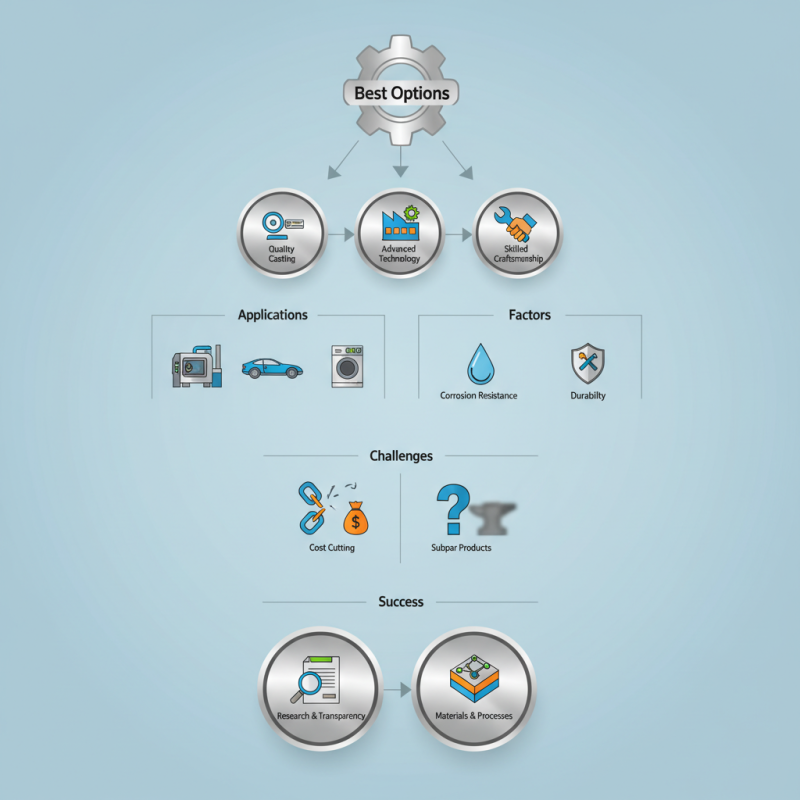
In the competitive world of stainless steel casting, global buyers seek the best options. Industry expert Dr. Emily Green emphasizes, "Quality casting is crucial for performance." With advanced technology and skilled craftsmanship, the market offers a range of choices, but not all meet the required standards.
Steel casting has endless applications, from industrial machinery to consumer products. Buyers must consider factors like corrosion resistance and durability. Inadequate research may lead to poor purchasing decisions. Understanding the nuances of this industry is essential for success.
Many suppliers promise high quality, yet the reality can be different. Companies may cut costs at the expense of quality, resulting in subpar products. Buyers should remain vigilant and demand transparency. Knowing materials and manufacturing processes can prevent costly mistakes in stainless steel casting purchases.
Overview of Stainless Steel Casting Processes
Stainless steel casting involves several key processes, primarily including investment casting, sand casting, and centrifugal casting. Investment casting, known for its precision, starts with a wax model coated in ceramic. This method provides high dimensional accuracy and a smooth surface finish. Reports indicate that investment casting holds around 25% of the market share in the stainless steel segment.
Sand casting is another prevalent process. It utilizes sand molds, making it suitable for large components. The setup costs are lower, but the finish may be less refined. This method accounts for approximately 30% of stainless steel castings globally. Notably, maintenance and the environmental impact of silica sand should be considered.
Centrifugal casting, while less common, is vital for producing cylindrical parts. This technique offers reduced internal defects but comes with a higher initial investment. Industry experts suggest that as markets expand, understanding these methods' pros and cons becomes essential. Global buyers should evaluate these factors to choose the best casting option for their specific needs.
Key Factors in Selecting Stainless Steel Casting Suppliers
Choosing the right stainless steel casting supplier is critical for global buyers. Quality, reliability, and expertise are the main factors to consider. A recent industry report indicated that the stainless steel casting market is projected to grow at a CAGR of 6.2% from 2021 to 2026. This growth emphasizes the need for companies to focus on sourcing from reputable suppliers.
While selecting a supplier, evaluate their technical expertise. Look for those with a proven track record in producing high-quality castings. Review their certifications and quality management systems. The Global Castings Market Research Study highlights that 40% of casting defects are due to poor supplier quality. Conducting due diligence can mitigate these risks.
Tips: Get samples before making bulk purchases. This gives a good indication of quality. Maintain communication to understand production capabilities. Assess how they react under pressure. A supplier's reliability during peak times is a crucial indicator of their long-term partnership potential. Engaging with local suppliers can also reduce logistical issues, as highlighted in multiple case studies.
Comparison of Global Stainless Steel Casting Markets
The global stainless steel casting market varies significantly across regions. Factors like material quality, production technology, and labor costs influence market dynamics. Countries in Asia, particularly China, are known for their volume and affordability. However, concerns about quality and environmental practices often surface.
In contrast, European countries emphasize precision and sustainability in casting processes. Their products often come at a higher price. Buyers may appreciate the craftsmanship but must weigh this against budget constraints. North America presents a mixed landscape, with a focus on innovation and custom solutions. Still, challenges in supply chain logistics can affect availability.
Emerging economies also play a role in shaping the market. Some manufacturers face difficulties in meeting international quality standards. Experience shows that global buyers should take a critical approach when selecting suppliers. Look for transparency and reviews from previous clients. The balance between cost, quality, and ethical practices is complex and requires careful consideration.
Innovative Applications of Stainless Steel Castings
In recent years, stainless steel castings have found innovative applications across various industries. These versatile materials are known for their durability and resistance to corrosion. Many sectors, such as aerospace, automotive, and medical equipment, benefit from stainless steel castings. They can withstand harsh environments, making them ideal for components exposed to moisture and chemicals.
When choosing stainless steel casting options, consider the specific demands of your application. The alloy composition can greatly influence performance. For instance, high nickel content enhances resistance to corrosion. Be mindful of the manufacturing process; this affects not only quality but also cost.
Tips: Always request samples before making large purchases. Ensure that the supplier provides detailed specifications. Understand the casting process and its impacts on the final product. Regular communication with suppliers can help clarify any doubts about material properties. Embrace feedback from end-users; it can guide improvements in design and material selection.
Best Stainless Steel Casting Options for Global Buyers | Casting Method | Common Applications | Advantages | Material Grades |
| Investment Casting | Aerospace, Automotive | High precision, intricate shapes | 316L, 304 |
| Sand Casting | Construction, Marine | Cost-effective, large parts | 304, 316 |
| Die Casting | Electronics, Household Goods | High volume, smooth finish | 430, 440C |
| Centrifugal Casting | Pipes, Cylinders | Uniform density, tight tolerances | 316, 310 |
| Shell Molding | Oil & Gas, Industrial | Good surface finish, high dimensional accuracy | 316L, 321 |
Sustainability Practices in Stainless Steel Casting Industry
The stainless steel casting industry is evolving, focusing more on sustainability. Many manufacturers are beginning to adopt eco-friendly practices. Reusing materials is an effective strategy. It reduces waste and lowers production costs.
Water consumption is another critical aspect. Traditional casting processes can waste significant amounts of water. New technologies aim to minimize this usage. Closed-loop systems recycle water, ensuring minimal environmental impact. However, not all companies implement these practices consistently.
Transparency in sourcing is necessary. Buyers often want to know where the raw materials come from. Ethical sourcing ensures that materials are mined responsibly. Yet, not every supply chain is transparent. This raises questions about accountability within the industry. Manufacturers must address these gaps to build trust with global buyers.