


Demand for shelf-stable meals is raising expectations for dependable thermal processing. Grand View Research estimated the global retort packaging market at USD 4.12 billion in 2023 and projected a 5.2% compound annual growth rate from 2024 to 2030. The report points to a wider market shift, not a guarantee that every retort investment will pay off. For global buyers, equipment choice still depends on product, package, plant utilities, and service access.
A Sides Spray Retort uses heated water sprayed across product loads to support controlled processing. In practice, details matter: rack layout, nozzle coverage, temperature uniformity, cycle records, and unloading workflow can all affect daily output. A specification sheet may look convincing. The factory floor is less forgiving. Buyers should ask manufacturers for validated process data, installation references, operator training, spare-parts plans, and clear acceptance criteria. These checks help compare more than headline capacity or purchase price.
This guide reviews seven manufacturers for buyers assessing side-spray retort systems across different markets. It focuses on engineering capability, customization, controls, documentation, and after-sales support. No single supplier suits every plant. A compact facility handling pouches may need different priorities from a high-volume line processing cans. Even a strong shortlist needs careful verification, because published claims and local service realities do not always match.
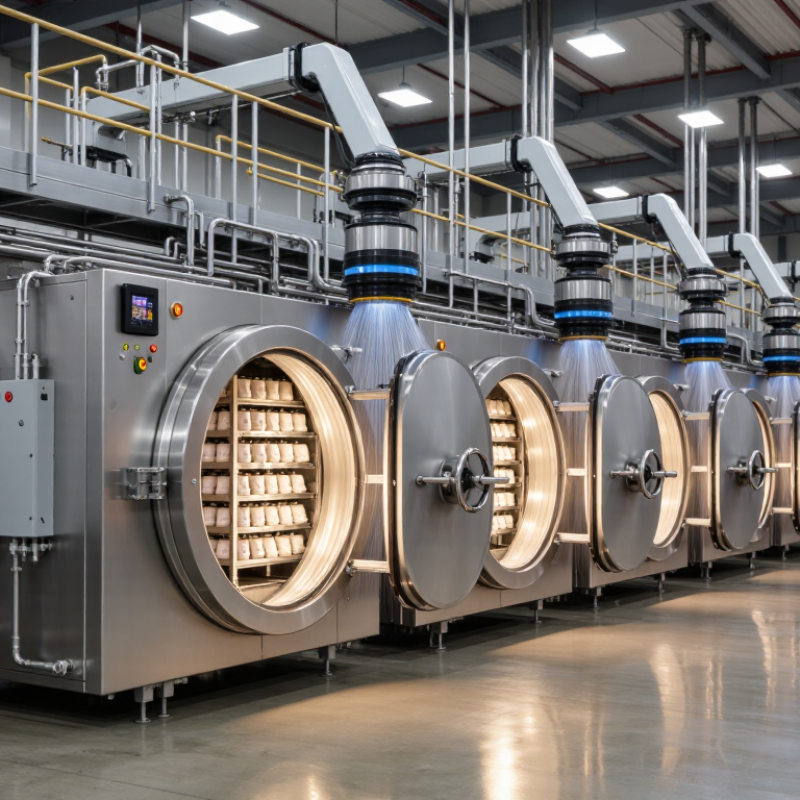
A side-spray retort heats sealed food containers with recirculated hot water sprayed through nozzles along the vessel’s sides. Pumps move water across the load, helping reduce cold spots between jars, cans, or pouches. The cycle typically includes venting or come-up, holding, and controlled cooling. Some systems rotate containers; others keep them still. The right setup depends on the package and product.
Heat penetration is tracked over time, not by chamber temperature alone. Thermal lethality is commonly expressed as F₀, using 121.1°C as its reference temperature. The U.S. FDA’s 21 CFR Part 113 requires scheduled processes for low-acid canned foods to account for factors such as container size, fill, and initial product temperature. There is no one safe cycle for every load. It is easy to trust a tidy temperature chart too much; the coldest point inside the food matters.
Tips: Confirm spray coverage with a loaded retort, not an empty one. Check drain screens and nozzles for residue. Keep records of product temperature, pressure, and cycle time, then review deviations with a qualified process authority. A small pouch can heat differently from a deep can. That detail is easy to miss.

Side-spray retorts stand out through how heated water reaches each package, not simply through vessel size. Lateral nozzles circulate water across loaded baskets, helping limit shadowed areas behind cans or pouches. Ask for nozzle-layout details, water-flow specifications, and temperature-uniformity tests using your actual load. Small changes matter. A half-empty basket can alter spray paths. The FAO’s 2023 State of Food and Agriculture estimated that 13.2% of food was lost globally in 2021 between harvest and retail. That figure is not a retort-performance measure, but it highlights the value of reliable preservation.
Strong systems pair circulation with precise control and useful records. For low-acid canned foods in the United States, FDA regulation 21 CFR Part 113 requires processing and production records. Buyers should check whether controls log retort temperature, pressure, and cycle time, and whether alarms flag deviations. Request heat-distribution and heat-penetration studies with representative containers, not just empty-vessel demonstrations. Maintenance access matters too: scale or blocked nozzles can weaken spray coverage. Not glamorous. Still, it counts. Even advanced automation cannot replace careful loading and operator judgment.
For global procurement, evaluate a side-spray retort manufacturer against your actual product and packaging, not a generic equipment brochure. Ask which pouch, tray, or container sizes the system can handle, and request documented temperature-distribution and heat-penetration data for comparable loads. Check how the spray system controls water flow, pressure, and temperature during heating and cooling. Request calibration records, operating manuals, and clear explanations of recipe controls. A polished brochure can still leave gaps. Details matter.
Inspect the proposed retort’s chamber finish, seals, piping, and access points. These details affect cleaning, maintenance, and downtime. Ask about factory testing, installation support, operator training, spare-parts availability, and response times across your time zones. For each purchase, clarify what commissioning includes and how performance will be verified with your containers and process. Do not rely on capacity figures alone; ask for the assumptions behind them. A neat specification sheet may not reflect a real production shift.
Tips: Share your container dimensions, fill weight, and target throughput before comparing quotations. Request a sample test or witnessed acceptance test, and record agreed performance criteria in writing. Compare total operating and service costs, not just the purchase price. One detail is easy to miss: local technical support may matter more than a small difference in cycle time.
Side-spray retort manufacturers differ in engineering depth, not just vessel size. A strong candidate can explain spray coverage, circulation design, and temperature uniformity with test data. Ask how sensors are calibrated. Request a sample heat-distribution report, not only a brochure. Details matter.
A practical comparison can cover seven capability profiles: custom-vessel engineering; pump and spray-nozzle design; automated recipe control; data logging and traceability; installation and commissioning; operator training; and responsive parts support. Some manufacturers excel at controls but rely on partners for service. Others build robust hardware yet offer less flexible software. These differences show up during production changes. A control screen is only useful when operators can verify its readings.
During factory discussions, ask vendors to describe how they handle a blocked nozzle, a drifting sensor, or uneven loading. Look for clear procedures and named responsibilities. Check whether trial runs use containers similar to yours, with realistic load patterns. Then compare service response times and spare-parts availability. Specifications can look excellent on paper. Still, a polished demonstration does not prove stable performance over a full shift. Buyers should verify claims carefully, and admit where their own process requirements remain unclear.
Choosing a sides spray retort supplier means looking beyond the advertised vessel size. Ask how many baskets fit per cycle, how long heating and cooling take, and what output the line can sustain during a typical shift. Request a layout showing loading space, utilities, and operator access. A large chamber may still create a bottleneck if loading takes too long. Details matter.
Compliance deserves careful review. Buyers should ask for equipment documentation, process records, material specifications, and support for validation under their own product and destination-market requirements. Ask for evidence. A supplier’s paperwork is useful, but it does not replace an independent review by qualified process specialists. Service also affects real capacity: check response hours, spare-part availability, remote troubleshooting, and technician travel arrangements. A delayed sensor can stop production just as surely as a major mechanical fault.
Compare costs across the equipment’s working life, not only the purchase quote. Include installation, training, energy and water use, maintenance, and expected downtime. Request references from facilities with similar container sizes and production patterns, then ask what proved difficult after commissioning. No supplier will fit every plant perfectly; even a technically strong proposal may overlook operator workload or future product changes. That is worth challenging before signing.
A practical comparison framework for evaluating suppliers by capacity, compliance, service, and cost.
The percentages are suggested buyer evaluation weights, not ratings or verified data for specific manufacturers. Adjust them to your project requirements, and confirm production capacity, applicable certifications, service coverage, and total cost directly with each supplier.


For those larger-sized parts, or smaller quantity runs, we have 2 independent powder coat booths and ovens. The quality, durability and affordability of today’s powder coating finishes make this the process of choice for world-class companies.
Powder coating advantages over other forms of coating are many. Materials used in the Powder coating process can be metals and non-metals that come in a multitude of thicknesses, textures, colors, etc. Another of Powder coating’s biggest advantages over conventional coatings is its ability to create finishes in many different textures. Powder Coating Booths allow us the ability to apply these advantages to large products.
Tri-State Fabricators runs a full-service conveyor line for painting. Wet painting can provide protection or decoration to many different part styles. From start to finish, every project is easier to undergo random and point-based inspection by our skilled painting team.
Advantages to our Wet Paint Line are these lines start with product prep and ends with a thorough inspection of a high quality finished product. Our ability to complete large and small projects with a superior finish and doing so in a timely and economical fashion. This passes along the savings in production to our customers. When powder coating ins not an option, our Wet Paint Line gets the job done right the first time.
When the parts get big and heavy we roll-out our custom paint racks and oversize booth. By utilizing our partnerships with all the major paint brands, we can match virtually any color with wet paint.
The advantages of having access to a Wet Paint Booth are many. Large projects of many different shapes can be loaded into the booth. The Wet Paint Booth offers an environment that is much more controlled than a typical parts painting operation.
Not only are they used because of their controlled environment, but they’re are also advantageous when it comes to applying paint to parts that are needed in industries that require specialty coatings such as medical, aerospace, etc.
Our military forces have some very high standards when it comes to the finish of their vehicles and equipment. From the first pre-treatment step to final coat, it takes a great deal of knowledge and experience to protect the men and women of our armed forces. They deserve only the best, and Tri-State Fabricators provides it.
All of our processes are closely monitored by our staff and management teams. Both of which are highly trained in the processes of metal fabrication and finishing. Tri-State Fabricators’ goal is to always fully satisfy each and every customer, including the military. We will always put a 110% into what we do.
Abrasive media blasting is an excellent way to remove old paint, rust, and increase the paint/powder adhesion. Glass beads produce a much smoother and brighter finish than angular abrasives; leaving the part clean yet without any dimensional change. Chemically inert and environmentally friendly, we can recycle our beads approximately 30 times; making them a more preferred method of metal cleaning or surface finishing.
Advantages to Glass Bead Blasting are many. Glass bead blast media is used when a project is needing rough surfaces need to become smooth for applications of coatings such as paint. It is typically used to clean paint and rust from a product surface without deforming the surface it is being used on. Overall, compared to many other blasting media, Glass Bead Blasting is a very economical choice and those savings are always passed on to our customers.
Tri-State Fabricators utilize a zinc phosphate wash to clean and etch the material to ensure the best paint adhesion possible. The unique design of our 3-stage wash system does the work like a 5-stage. From Cleaning and rinsing to conversion coating and post-treatment, Our Part Washing process is a complete service and works throughout the fabrication service and the finishing service.
Along with the previously mentioned benefits, Curing is a vital chemical reaction that leaves the product finish hard and relatively safe from mild abrasion and aggressive corrosion. This process can be done in more than one way; ambient air-dry or in curing ovens at temps that exceed 240°.
From fixing paint mistakes (someone else’s of course) to simply cleaning our paint line hooks, our burn-off oven is put to good use. After a quick burn-off, a little clean up, and a fresh coat of paint, your parts will look better than new.
Why does our Burn-Off Oven work so well? Because super heating the air around parts turns the materials into ashes. From paint and powder coatings to rubber and machining oils, high temps do the job without degrading the integrity of the part.
Masking is a vital part of producing high quality products. We have die-cut masking patterns to protect machined surfaces as well as a wide range of plugs and caps to protect threaded holes and bolts. We provide permanent and temporary masking.
Masking allows the selected sections of a product to be protected from a fabrication or finishing service. This can be with both chemicals when etching and tapes, paints when only finishing just a section of the product. Masking is great in aiding the customization process of a project.
Screen printing is a photographic process that transfers artwork onto a porous nylon screen which allows colored ink to flow through the screen and be deposited on an aluminum or plastic component. We can generally have just about any design created onto a screen for your parts.
Some of the advantages of Screen Printing are, brand recognition for your business displaying on your products, assembly instructions, product warnings/hazards, etc. Tri-State Fabricators produces Screen Printing of the highest quality so you know it’s durable.
Metal Finishing is the art of treating the exterior portion of product, often metal but can also be made of other materials, so that the surface is clean and free of any debris. Then the process of applying coats or either paint of powder coat takes place. This coating process improves the quality of the product in both appearance and resistance to wear and corrosion.
Tri-State Fabricators, Inc., understands that a project typically isn’t complete until a high-quality finish has been added to your product. This is why our painting and powder coating teams continuously inspect the products throughout the Metal Finishing process.

